Engineering Mechanics
Vector Addition Explained Simply for Engineering Mechanics
Two people push a stalled car. One pushes straight from behind, the other pushes a little from the side. The car does not move in either person's exact direction. It moves along a single combined path.
That single combined effect is what vector addition finds. It takes two or more vectors and works out the one vector that does the same job as all of them together.
In our last lesson we learned the unit vector and how to point a force. Now we learn how to add forces up. This matters because a real machine or structure never has just one force on it. It has many, and you must combine them to know the true result.
By the end of this lesson you will be able to add vectors using the triangle law, the parallelogram law, and the component method, and you will know when to use each one.
What Is Vector Addition?
Vector addition is the process of combining two or more vectors into a single vector that has the same overall effect.
The result of adding vectors is called the resultant. It is the one vector that could replace all the others without changing anything.
Here is the catch that makes vectors different from ordinary numbers. You cannot just add the sizes. A 3 N force and a 4 N force do not always give 7 N. If they point in different directions, the answer could be 5 N, or 1 N, or anything in between, depending on the angle.
Why? Because vectors carry direction, and direction changes how they combine. So we need proper methods that respect both size and direction. That is what the rest of this lesson gives you.
The Head-to-Tail Idea
Before the formal laws, get this one picture in your head, because every method is built on it.
To add two vectors, place the tail of the second vector at the head of the first. The resultant is the arrow drawn from the very first tail to the very last head.
Think of it as a journey. Walk along the first arrow, then continue along the second arrow. The resultant is the straight shortcut from where you started to where you ended up. Direction and distance both come out naturally.
The Triangle Law of Vector Addition
The triangle law says: if two vectors are shown as two sides of a triangle taken in order, then the third side, taken in the opposite order, gives the resultant.
That is simply the head-to-tail idea drawn as a triangle. Put the second arrow at the head of the first, and close the triangle. The closing side is your answer.
When the two vectors are at 90 degrees (a right angle), finding the resultant is easy, because it becomes a right-angled triangle and you can use the Pythagoras theorem from earlier lessons.
Solved Mini-Example
A force of 3 N acts east and a force of 4 N acts north. Find the resultant.
The two forces are at right angles, so draw them head to tail as a right triangle.
Use Pythagoras for the size: R = √(3² + 4²) = √(9 + 16) = √25 = 5 N
Find the direction: θ = tan⁻¹(4 / 3), which is about 53 degrees north of east.
So the resultant is 5 N, pointing about 53 degrees from the east direction. Two forces have become one.
The Parallelogram Law of Vector Addition
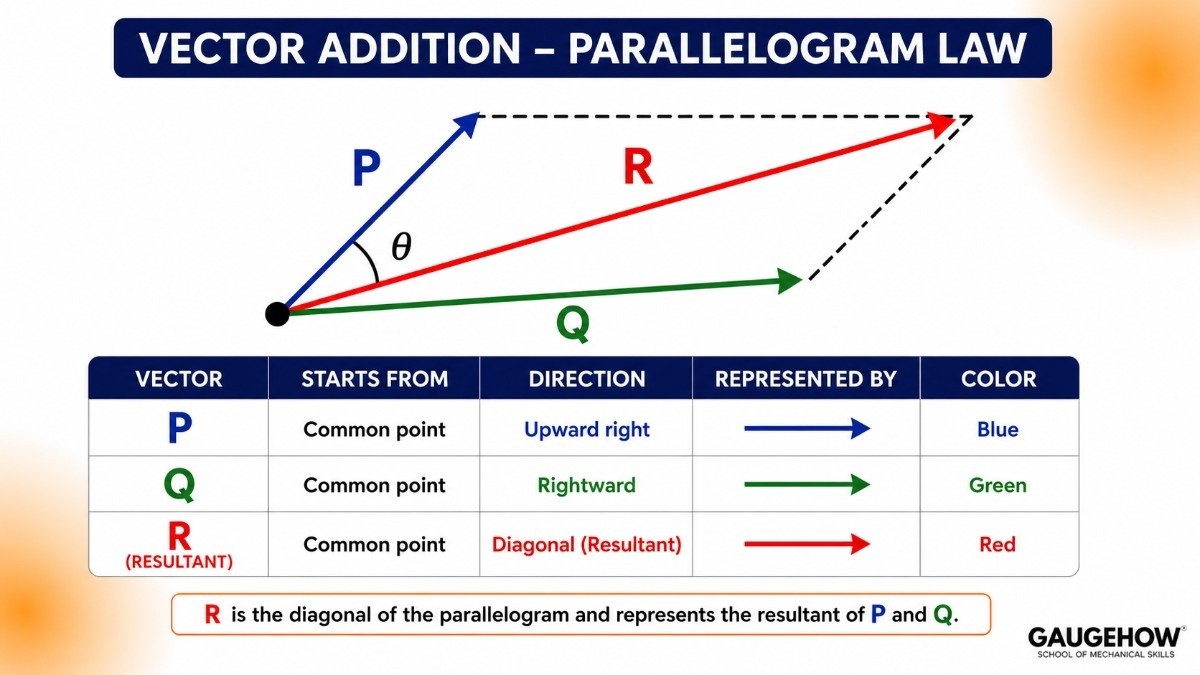
The parallelogram law says: if two vectors acting from the same point are drawn as two sides of a parallelogram, then the diagonal from that point gives the resultant.
Use this when both vectors start from the same corner, which is common for two forces pulling on the same bolt or hook. Instead of moving one arrow head-to-tail, you complete the parallelogram and draw the diagonal.
For two vectors P and Q with an angle θ between them, the size of the resultant is:
R = √(P² + Q² + 2PQ cos θ)
R is the magnitude of the resultant, in newtons (N) for forces.
P and Q are the sizes of the two vectors.
θ (theta) is the angle between them.
[IMAGE: two vectors P and Q starting from the same point, a parallelogram completed with dashed sides, and the diagonal R drawn from the common point as the resultant, with the angle theta marked between P and Q]
Adding Vectors by Components: The Best Method for Engineers
The triangle and parallelogram laws are great for two vectors. But real problems often have three, four, or more forces at odd angles. Drawing triangles then gets messy.
The component method solves this cleanly, and it is what engineers actually use. The idea is simple: break every vector into its x and y parts, add all the x parts together, add all the y parts together, then rebuild the resultant.
The steps are:
Resolve each vector into its x-component and y-component.
Add all the x-components to get the total Rx.
Add all the y-components to get the total Ry.
Find the resultant size: R = √(Rx² + Ry²)
Find its direction: θ = tan⁻¹(Ry / Rx)
The reason this works is that x and y directions do not interfere with each other. Sideways motion never adds to up-down motion, so you can safely handle each direction on its own, then combine at the end.
Solved Mini-Example
Add two forces: A = 3i + 4j (N) and B = 5i + 2j (N).
Add the x-parts: Rx = 3 + 5 = 8 N
Add the y-parts: Ry = 4 + 2 = 6 N
Find the size: R = √(8² + 6²) = √(64 + 36) = √100 = 10 N
Find the direction: θ = tan⁻¹(6 / 8), which is about 37 degrees from the x-axis.
So the resultant is 10 N at about 37 degrees. Notice how clean this is. No triangles to draw, just add the parts. This method scales to any number of vectors, which is why it wins for real work.
Rules That Make Vector Addition Easier
A few simple facts save time and prevent errors:
Order does not matter. A + B gives the same resultant as B + A. You can add forces in any order.
Grouping does not matter. When adding three or more, you can group them any way and still get the same answer.
Same direction, just add. If two vectors point the exact same way, add their sizes directly.
Opposite directions, subtract. If they point exactly opposite, subtract the smaller from the larger, and the resultant points the way of the larger one.
These are the same common-sense rules you use with numbers, with the one difference that direction is always along for the ride.
Where Engineers Use Vector Addition
Adding vectors is one of the most-used skills in mechanics:
Finding the net force: Every statics problem adds up all the forces on a body to find the resultant. This is the first move in almost every force analysis.
Structural loads: To size a beam or joint, engineers combine wind, weight, and applied loads into one resultant, work that tools like FEA with ANSYS automate across a whole model.
CAD and motion: Combined directions of movement and force in design software such as Fusion 360 rely on vector addition.
Robotics: A robot's overall motion from several drives is found by adding velocity vectors, often in Python.
Common Mistakes to Avoid
Adding sizes directly. You cannot add 3 N and 4 N to get 7 N unless they point the same way. Respect the angle.
Forgetting the direction of the resultant. A resultant needs both a size and a direction to be complete.
Mixing components. Add x-parts only with x-parts, and y-parts only with y-parts. Never cross them.
Wrong angle in the parallelogram law. θ is the angle between the two vectors, not the angle either one makes with the ground.
Frequently Asked Questions
What is vector addition in simple words? It is combining two or more vectors into a single vector, called the resultant, that has the same total effect as all of them together.
Why can't you just add the magnitudes? Because vectors have direction. Two forces at an angle combine differently than two pointing the same way, so the angle changes the result.
What is the difference between the triangle law and the parallelogram law? The triangle law places vectors head to tail and the closing side is the resultant. The parallelogram law draws both from the same point and uses the diagonal. Both give the same answer.
What is the best method to add many vectors? The component method. Break each vector into x and y parts, add the parts separately, then combine. It works for any number of vectors.
What is a resultant vector? It is the single vector that could replace all the added vectors without changing the overall effect.
Key Takeaways
Vector addition combines vectors into one resultant that has the same total effect.
You cannot add magnitudes directly unless the vectors point the same way.
The triangle law uses the head-to-tail rule; the parallelogram law uses the diagonal.
The component method (add x-parts, add y-parts, then combine) is best for many vectors.
The resultant size is √(Rx² + Ry²) and its direction is tan⁻¹(Ry / Rx).
Order and grouping of addition do not change the resultant.
Quick Revision Box
Parallelogram law: R = √(P² + Q² + 2PQ cos θ)
Component totals: Rx = sum of all x-parts, Ry = sum of all y-parts
Resultant size: R = √(Rx² + Ry²)
Resultant direction: θ = tan⁻¹(Ry / Rx)
Same direction: add sizes. Opposite direction: subtract sizes.
Practice Corner
Two forces of 6 N east and 8 N north act on a point. Find the resultant size.
Add the vectors A = 2i + 3j and B = 4i + 1j.
Two forces of 10 N each point in the exact same direction. What is the resultant?
In the parallelogram law, what does θ represent?
Why is the component method preferred for many vectors?
<details> <summary>Answers</summary>
R = √(6² + 8²) = √(36 + 64) = √100 = 10 N.
R = (2 + 4)i + (3 + 1)j = 6i + 4j.
20 N in the same direction (same direction, so add the sizes).
The angle between the two vectors.
Because you add x-parts and y-parts separately, so it handles any number of vectors without drawing triangles.
</details>
Conclusion
Vector addition is how engineers turn many forces into one clear resultant. Master the head-to-tail idea, the triangle and parallelogram laws, and the component method, and you can find the net effect of any set of forces, which is the very first step in solving a real mechanics problem.
Ready to practise? Head to the Mechanical Engineer learning hub at GaugeHow and try the practice questions before the next lesson.
What's Next
Next up: Vector Subtraction, where we find the difference between two vectors, a skill you need for relative velocity and for comparing forces.
Internal links:
FEA with ANSYS → https://gaugehow.com/course/fea-finite-element-analysis-with-ansys
3D modelling in Fusion 360 → https://gaugehow.com/course/fusion-360
Python for Mechanical Engineers → https://gaugehow.com/course/python-for-mechanical-engineers-robotics
Mechanical Engineer Hub → https://gaugehow.com/mech
Practice tests →https://gaugehow.com/practice