Mechanical Bearings: Definition, Types, and Selection
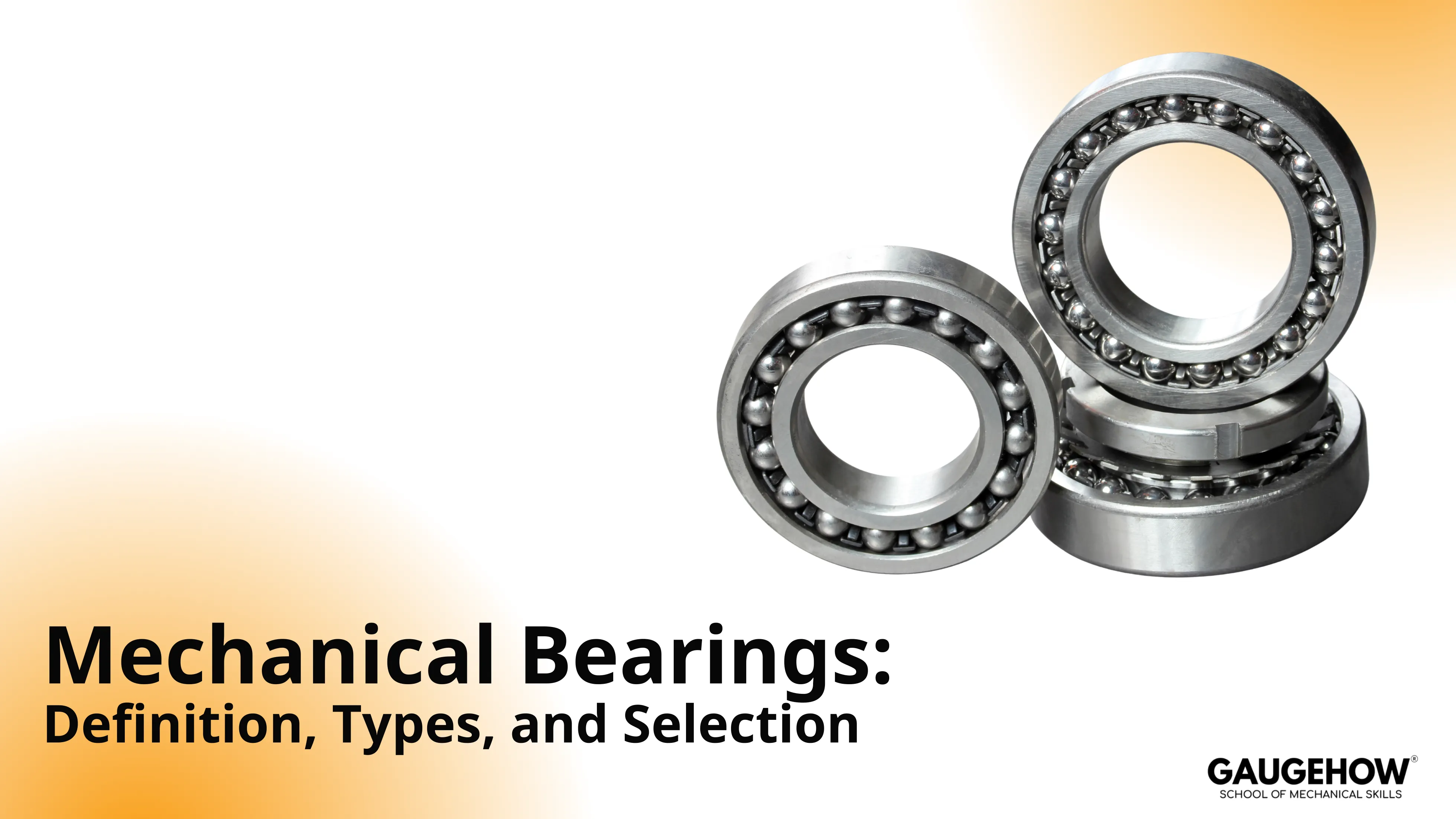
Mechanical bearings support a rotating or sliding part while keeping friction and wear under control. They carry radial and axial loads into the housing and maintain alignment. Rolling elements or a lubricant film separate surfaces, which reduces heat, noise, and surface damage.
Bearings rarely die quietly. They heat up, howl, shed metal into grease, then seize and take a shaft or housing with them.
That chain starts with the wrong load assumption, the wrong subtype, or a fit and lubrication choice that looked fine on paper. By the end, you can pick a family and subtype, set the arrangement, and know the first checks that prevent repeat failures.
Bearing Definition in Mechanical Engineering
A practical bearing definition in mechanical engineering is this: a bearing supports a moving member while controlling allowed motion and transferring load into the structure. The bearing is not just “a support,” because it also sets stiffness, alignment, and heat generation under real duty.
Load direction is the first truth you cannot negotiate, which means you should sketch the force path before you think about catalogs.
Radial loads come from belt pull, weight, and gear mesh, while axial loads come from thrust sources like helical gears and impellers. One clean note on radial vs axial load bearing selection saves hours of rework later.
A motor with a belt drive is a common trap. The motor looks “light duty,” but the belt tension creates a steady radial load that pushes the shaft off center. The decision takeaway is simple: if you cannot point to your dominant load direction, you are not selecting a bearing yet.
What Bearings Do in Machines
Bearings reduce friction, but the expensive value is control. They control the shaft position under load, so gears mesh correctly, seals stay alive, and couplings stop fighting misalignment. They also control heat because contact stress and sliding losses turn directly into temperature rise.
A gearbox shows this in practice. Gear forces push shafts apart and twist the housing, so a bearing arrangement that is “fine” at no-load can deflect under torque.
The decision takeaway: treat bearing choice as a stiffness and alignment component, not just a rotating part.
Bearings also shape noise and vibration. Surface finish, internal geometry, lubrication film, and mounting condition all change the running smoothness. A quiet machine usually has a bearing system that matches duty, fit, and lubrication together.
Types of Bearing in Mechanical Engineering
Most types of bearings in mechanical engineering sit in three families: rolling element bearings, plain bearings, and fluid bearings.
Rolling element designs run efficiently at speed, but they are sensitive to contamination and installation damage.
Plain bearings tolerate shock and dirt better, but they depend on correct materials and a stable lubrication regime.
Fluid bearings are a special case where a full film carries the load, so the system needs controlled lubrication and stable operating conditions.
Rolling element bearings are split into ball and roller families, then into subtypes that exist for specific load and packaging realities.
Ball bearing subtypes
Deep-groove ball: general-purpose radial duty with moderate axial capacity.
Angular contact ball: combined load control and stiffness, often used in pairs.
Thrust ball: primarily axial load at moderate speed, with limited radial tolerance.
Roller bearing subtypes
Cylindrical roller: high radial capacity and stiffness, with limited axial capability unless designed for it.
Tapered roller: combined radial and axial loads, common where thrust is real and stiffness matters.
Spherical roller: misalignment tolerance with heavy load capacity, used when the structure moves.
Needle roller: tight space with meaningful radial load, which makes packaging the main reason it exists.
Plain bearings are often called journal, sleeve, or bushing types, and the name change does not change the physics. They can be metal, polymer, or composite, which means the material pair and lubricant become part of the design choice.
The decision takeaway is to choose the family from the duty reality, then choose the subtype from load direction, space, and misalignment tolerance.
🔧 Trusted by 23,000+ Happy Learners
Industry-Ready Skills for Mechanical Engineers
Upskill with 40+ courses in Design/CAD, Simulation, FEA/CFD, Manufacturing, Robotics & Industry 4.0.
Ball Bearings vs Roller Bearings
Ball bearings usually win on speed and low running torque. Contact is smaller, so heat can be lower at high speed when lubrication is correct. That same contact concentrates stress, so shock, misalignment, and heavy radial loads can dent races and start noise early.
Roller bearings usually win on load and stiffness. The contact patch spreads force, so radial capacity rises and deflection drops.
That larger contact can raise friction and heat at higher speeds, so lubrication, preload, and cooling become more sensitive.
Option | Role in the machine | Best at | Typical industries | Example component |
Ball bearings (deep-groove, angular contact, thrust ball) | General support and guidance | High speed, low torque, compact packaging | Motors, fans, light gearboxes, spindles (angular contact) | Electric motor drive-end bearing |
Roller bearings (cylindrical, tapered, spherical, needle) | Load carriage and stiffness | High radial load, combined loads (tapered), misalignment tolerance (spherical) | Gearboxes, hubs, heavy conveyors, wind drivetrains | Tapered roller in a wheel hub |
A fast decision rule works in practice. If speed and low drag dominate, start with ball subtypes. If load, stiffness, or combined loading dominates, start with the right roller subtype.
How to Choose a Bearing
You learn how to choose a bearing faster when you stop chasing a part number first. Selection is a chain of checks that filters options until only a few families and subtypes make sense. The goal is a stable system that survives real loads, real dirt, and real assembly variation.
Step 1: Lock the load direction
Check the force sources and mark which direction the shaft is pushed during actual running. That matters because axial load changes both bearing subtype and arrangement. “Good” looks like a simple load sketch you can explain in one minute, so radial vs axial load bearing selection becomes a decision instead of a guess. A pump that “sometimes” thrusts still thrusts.
Step 2: Size the duty, not just the peak
Check typical load, peak load, shock events, and run time at temperature. That matters because fatigue and lubrication breakdown follow the duty cycle. “Good” looks like a realistic duty statement, not a single peak number. A conveyor with frequent starts can punish bearings more than a steady load.
Step 3: Set speed and lubrication together
Check surface speed, expected temperature rise, and how you will keep the lubricant clean. That matters because speed sets heat generation and film thickness requirements. “Good” looks like a lubrication method you can maintain, so bearing lubrication oil vs grease is chosen based on access, heat, and cleanliness. A high-speed spindle often needs oil control.
Step 4: Decide how much misalignment you will tolerate
Check shaft deflection, housing stiffness, mounting flatness, and how the machine is assembled in the field. That matters because misalignment drives edge loading and heat. “Good” looks like a measured alignment capability, not hope. A long conveyor frame will move under load.
Step 5: Set fits, clearance, and preload on purpose
Check shaft and housing fits, operating temperature, and how the internal setting will shift in service. That matters because internal geometry decides heat, stiffness, and noise. “Good” looks like an intentional setting, so bearing clearance and preload are treated as design variables. A gearbox bearing that runs hot often starts too tight.
Step 6: Plan sealing and contamination control
Check airborne dust, washdown, process fluid exposure, and what enters during maintenance. That matters because contamination turns rolling contact into abrasion. “Good” looks like sealing matched to reality plus a relube plan. A hub bearing lives or dies by sealing discipline.
Step 7: Confirm noise, vibration, and maintenance access
Check noise limits, vibration targets, and whether the bearing can be serviced safely. That matters because the best bearing on paper still fails if it cannot be maintained. “Good” looks like a system that can be installed and serviced without damage. A motor in a tight enclosure needs a plan for relube or replacement.
Where Bearings Are Used
Machine | Duty | Dominant load | Dominant risk |
Electric motors | steady, frequent starts | radial | heat, noise |
Pumps | continuous, seal-critical | combined, axial present | thrust shifts, contamination |
Gearboxes | torque transfer, shocks | combined | deflection, oil debris |
Conveyors | slow, dirty, shock starts | radial, shock | Ingress, misalignment |
Machine tool spindles | high speed, precision | radial, axial events | thermal drift, vibration |
Automotive hubs | variable, impact, weather | combined | water ingress, impact damage |
Compressors | continuous, pulsation | combined | heat, lubricant breakdown |
Wind turbines | variable, long-life | heavy combined | micro-movement, contamination |
Conclusion
A bearing system that lasts is rarely the fanciest one. It is the one that matches load direction, duty, alignment reality, and lubrication control, while staying installable and maintainable.
Mechanical bearings succeed when the system is designed as a system, not as a part swap. If bearing failure symptoms, such as overheating noise appear, revisit load, fit, sealing, and lubricant condition before you blame the bearing.
FAQs
1) What bearing type should I use for my application?
Start with load direction and speed. Ball suits higher speed and lighter loads, roller suits higher load and stiffness, plain suits dirty or shock duty. Then pick a subtype that matches thrust and misalignment.
2) How do I know if I have a thrust load in my machine?
Look for helical gears, impellers, angled belts, or coupling forces. If shaft movement changes with operating conditions, thrust exists. Confirm by tracing the force path from the driven element into the shaft.
3) Why does a bearing run hot even when the load seems normal?
Heat usually comes from tight fits, wrong internal settings, poor lubrication film, or misalignment. Check mounting, then lubricant condition, then alignment. A quick infrared trend after startup often exposes the cause.
4) What causes repeat bearing failures after replacement?
Repeat failures usually mean the root cause has never changed. Contamination, misalignment, installation damage, wrong arrangement for thrust, or the wrong lubricant are typical. Fix the system first, then replace the bearing.
5) Should I use grease or oil for lubrication?
Grease works when speeds and temperatures are moderate and relube access is practical. Oil fits higher speed or higher heat because it carries heat away. Match the choice to cleanliness and maintenance capability.