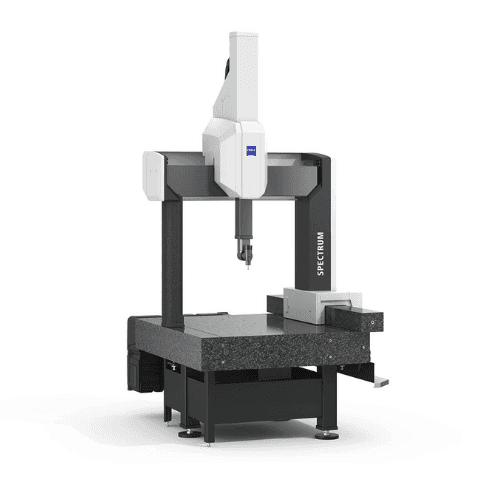
What Is a Surface Plate? Uses, Calibration & Price
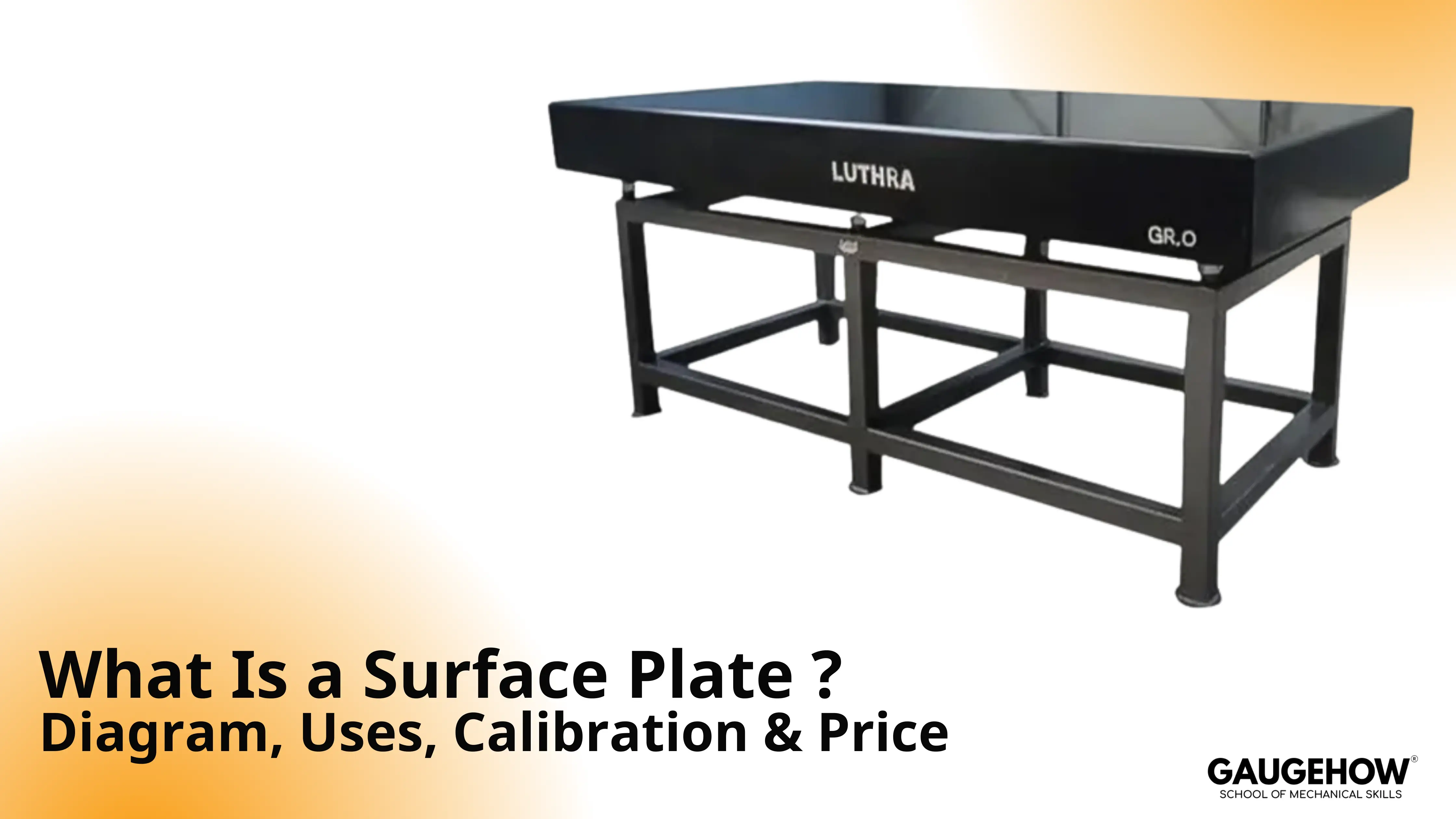
A surface plate is a precision reference plane used in metrology to support inspection, layout, and setup work on a stable, flat datum. It is also known as a datum plate or inspection plate in some shops.
When your block should sit flat, but the indicator sweep shows a peak, the question is not the part.
It is the reference. A surface plate gives you a controlled plane so you can separate machining error from setup drift.
Learn what makes a plate trustworthy, and what ruins readings.
Start With Selection
Bench Situation | Best Choice | Why It Holds | Proof Check |
Inspection room, tight tolerance decisions | Granite or ceramic, proper stand | Stable reference behavior when handled cleanly | Repeat-touch one point 3 times |
General workshop inspection and layout | Granite, moderate spec | Practical stability without overpaying | Clean + rotate working zone |
Heavy parts, frequent sliding contact | Cast iron, rigid stand | Tougher under handling when burr control is real | Rocking check in 3 locations |
Teaching, small parts, portable checks | Small plate on correct support | Short span reduces sag sensitivity | Confirm support points first |
Two-Minute Verification Gate
Clean plane: wipe the working zone and your instrument base.
Rocking check: place the part in three different spots, confirm it does not “teeter.”
Repeat check: touch the same reference point three times, confirm the number returns.
That short gate prevents the most common failure mode: trusting a number that is actually dirt, support sag, or inconsistent placement.
Grades & Accuracy
Competitor pages win trust when they name grades and tolerances. You do not need a policy dump. You need a bench selection rule.
A practical way to frame it is: grade protects your measurement uncertainty from the plate’s contribution.
That is the day-to-day meaning of What is a Surface Plate in acceptance work.
Grade Class | Typical Setting | What It Protects | Simple Selection Rule |
AA / 00 (or ISO Grade 0) | Calibration/lab | Lowest plate contribution to uncertainty | Use when results become certificates or disputes |
A / 0–1 (or ISO Grade 1) | Inspection room | Strong repeatability with controlled handling | Use for tight inspection without lab burden |
B / 2–3 (or ISO Grade 2–3) | Shop floor | More wear tolerance, less sensitivity | Use for layout and general checks, not final acceptance |
What A Surface Plate Means In Metrology
A surface plate acts like a physical “zero plane.” You place the instrument base and the work on that plane, then read change from that reference as you sweep, compare, or set a height.
Two clarifications prevent most confusion:
It behaves like a reference, not a measuring scale. Your instrument displays variation.
A good plate still gives bad results when the support is wrong, the contact is dirty, or the part rocks.
Later, you will see a simple ladder that ties tolerance, load placement, support geometry, and temperature to repeatable readings.
Flatness and Accuracy
In metrology, surface plate flatness means the maximum deviation of the working surface from an ideal plane over the evaluated area. It is a plane quality, not a dial resolution.
Keep the math clean:
Flatness deviation = highest point − lowest point (over the defined area)
Micro-example:
Highest point: +6 µm
Lowest point: −4 µm
Flatness deviation: 10 µm
Decision: compare 10 µm to your tolerance decision, then confirm the same result returns when you repeat the method.
🔧 Trusted by 23,000+ Happy Learners
Industry-Ready Skills for Mechanical Engineers
Upskill with 40+ courses in Design/CAD, Simulation, FEA/CFD, Manufacturing, Robotics & Industry 4.0.
Range–Load–Support Rule
This is the selection ladder that keeps you out of trouble:
Required tolerance band sets how much reference error you can tolerate.
Part mass and contact area set where the part can sit without rocking.
Support stiffness decides whether the plate behaves like a plane or a twisted beam.
Temperature gradients decide drift, especially near doors, sunlight, compressors, or warm hands.
If repeatability is poor, the setup is the first suspect, not the part.
Surface Plate Types and Materials
Most bench work lives in two families. Choose based on wear behavior and handling reality.
A granite surface plate is common for inspection and general metrology because it resists burr formation and stays consistent when you keep grit off the working zone and avoid drag habits.
A cast iron surface plate earns its place when parts are heavy, sliding contact is frequent, and reconditioning habits exist. It needs rust control and burr control to stay trustworthy.
Mini decision rule:
Choose granite for stable, clean handling
Choose cast iron for heavy sliding work with strict daily discipline.
Surface Plate Diagram
A surface plate diagram illustration is given below:
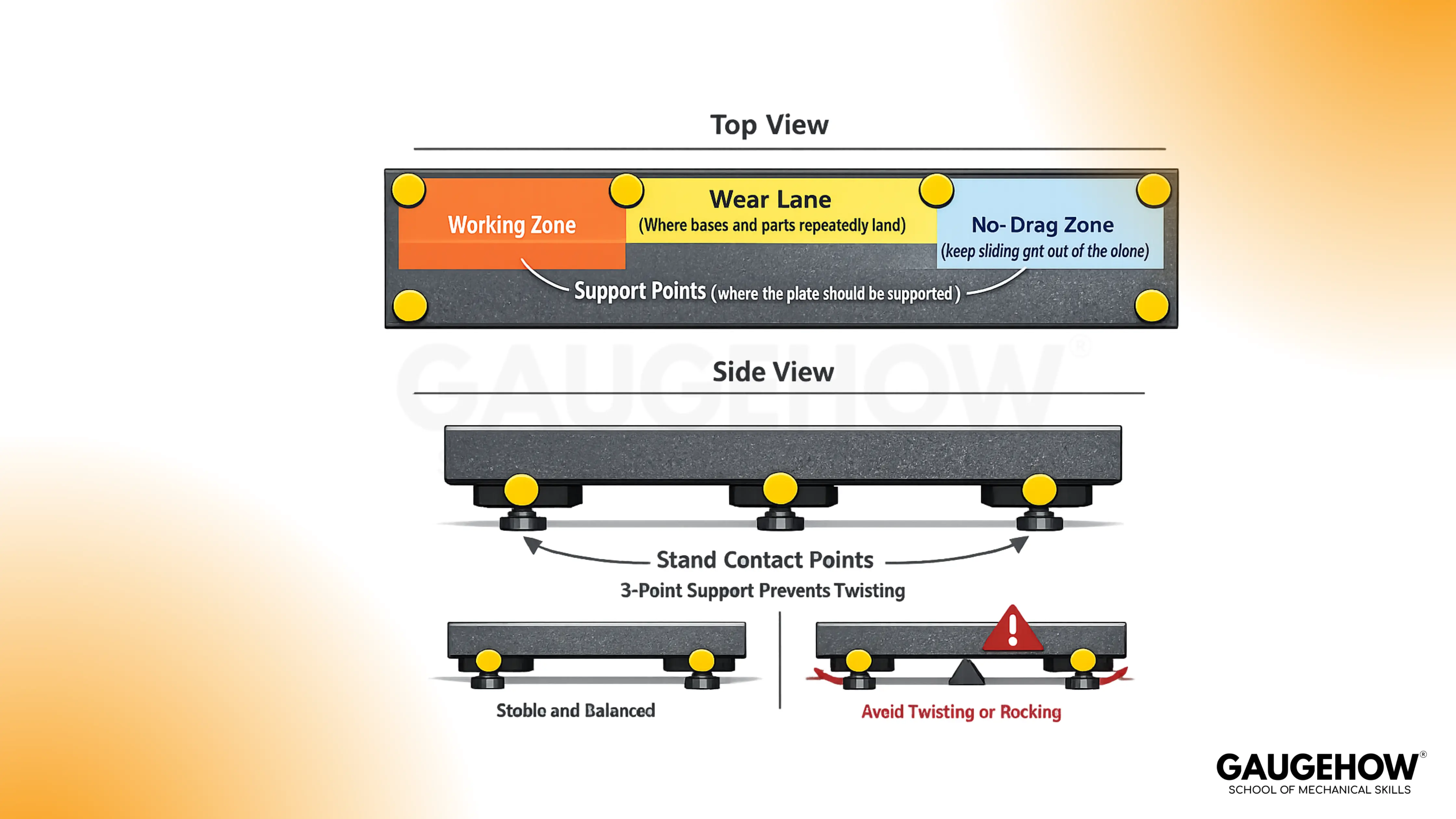
Working zone
Wear lane (where bases and parts repeatedly land)
No-drag zone (keep sliding grit out of the plane)
Support points concept (where the plate should be supported)
Stand contact points and why 3-point support matters
In a training handout, a surface plate diagram is incomplete if it shows only a rectangle. It must show the support idea, because support placement decides twist.
Parts And Features
Naming features is easy. The advantage comes from one strict rule: feature → role → what goes wrong.
Element | Role At The Bench | Typical Failure | Fast Check |
Working surface | Datum plane for inspection and layout | Dirt, chips, localized wear lane | Wipe + repeat-touch |
Stand and support pads | Holds support geometry stable | Sag or twist from poor support | Push test: reading should not shift |
Inserts and lifting points | Safe handling and mounting | Point loads and edge damage | Verify lifting method before use |
Cover and cleaning routine | Protects the plane between jobs | Grit contamination and daily wear | Cover when idle, clean before checks |
Working Principle
The mechanism is simple when you track the reference path:
The plate provides a plane you treat as the datum.
Your instrument references off that plane through its base or stand.
You set a baseline on a known point or surface.
You sweep, reposition, or compare, and read change from that baseline.
Errors enter through dirt, rocking, support distortion, and temperature gradients.
A surface plate rewards disciplined contact and stable support more than an expensive specification.
Surface Plate Calibration And Care
Good surface plate calibration documents the plane under defined conditions so your decisions stay defensible.
Treat it as a map and a story: overall behavior, plus where wear is forming.
What Calibration Is
A record of the plate’s condition at a point in time, including the plane deviation across the checked area and any localized zones that behave worse than the rest.
How To Read A Report
If a report shows acceptable overall deviation but one front-edge lane trends worse, treat that lane as a developing wear path. Shift your daily working zone away from it, tighten cleaning discipline, and make repeat-touch return mandatory for tight calls. This is the typical way a certified plate starts drifting in practice.
How Often (Interval Guidance + Trigger Rule)
A common starting interval is 6–12 months for inspection rooms and 12–24 months for light workshop use, then adjust based on observed drift.
Shorten the interval if any trigger occurs: relocation, stand changes, a major chip in the working zone, persistent repeat-touch failures, or a new wear lane forming where you work.
Care habits that matter: cover when idle, keep a dedicated wipe routine, avoid dragging parts, rotate your working zone, and keep the plate away from sunlight and strong drafts.
Surface Plate Uses
In practice, surface plate uses matter only when they tell you what to set up and what to trust.
Common bench uses:
Height gauge measurement and scribing from a stable datum
Comparative checks with an indicator on a stand
Flatness spot checks by sweeping and confirming return
Fixture setup and assembly baseline checks
Proof checks tied to the job:
For height work, repeat-touch the reference point until return is stable.
For sweep checks, sweep twice and confirm the same peak returns.
For assemblies, reposition and confirm the baseline does not shift.
Surface Plate Price
As of Feb 2026, surface plate price in India is driven mainly by size, thickness, accuracy grade, stand quality, certificate requirement, and shipping weight. The numbers below are typical online listing anchors. They vary by brand and what is included.
Here are practical size-based ranges:
6"×6" bench granite plates: roughly ₹8,500–₹9,500 (usually plate-only).
300×300 mm granite plates: roughly ₹3,000–₹6,000 (range shifts with grade and thickness).
600×600 mm cast iron plates: roughly ₹28,000–₹35,000 (weight and stand quality drive spread).
Plate + stand + certificate bundles: commonly ₹15,000–₹40,000+ for mid sizes, higher as size and documentation climb.
Always confirm what is included or excluded: stand, calibration certificate, shipping, installation, and handling support. Those items move the real total faster than the plate itself.
FAQ
How often should a surface plate be calibrated?
The clean answer depends on usage intensity, environmental stability, and the cost of a wrong decision. If measurements drive acceptance decisions or external reports, use a shorter interval and track drift with your repeat-touch habit.
Is granite always better than cast iron?
A granite surface plate is often the easier path for general inspection habits, but it is not automatically better. A cast iron surface plate can be the better choice when heavy work, sliding contact, and reconditioning culture dominate, and you control rust and burrs.
What should I look for in a calibration report?
Focus on whether the working zone stays stable and whether the repeat behavior supports your tolerance decisions. A plate can look “certified” and still cause trouble if your setup or support conditions are unstable.
How do I protect a surface plate day to day?
Cover it when idle, clean before checks, avoid dragging parts, and rotate the working area so a wear lane does not form.
What are the first signs that a plate is losing trustworthiness?
Repeat-touch drift, new rocking behavior, localized damaged zones creeping into your working area, and results that change when the part is simply repositioned.