ETQ Reliance
ETQ software

ETQ Software: The Complete Guide to ETQ Reliance QMS (2026)
If you work in manufacturing, pharma, or any regulated industry, chances are someone on your quality team has mentioned ETQ software at least once. Maybe you are evaluating it. Maybe you have been assigned to implement it and have no idea where to start.
Either way, this guide breaks it all down what it does, how it works, what it costs, and whether it is actually worth it for your organisation.
What is ETQ Reliance Used For?
Overview: ETQ Reliance is a cloud-based Quality Management System (QMS) and Environmental Health & Safety (EHS) platform built for manufacturers and regulated industries.
ETQ Reliance, now part of Hexagon's manufacturing intelligence portfolio, helps companies manage and automate their quality and compliance processes in one centralised place.
Instead of tracking corrective actions in spreadsheets, storing documents in shared drives, and chasing audit sign-offs over email, ETQ pulls all of that into a single configurable platform.
It is used by over 600 companies globally — including names like Johnson & Johnson, Novartis, Kimberly-Clark, and Chobani — across industries like pharmaceuticals, medical devices, food and beverage, aerospace, automotive, and electronics manufacturing.
The short version: if your industry has regulatory requirements (FDA, ISO, IATF, AS9100), ETQ Reliance is the kind of software that helps you stay compliant without drowning in paperwork.
Key Features of ETQ Reliance
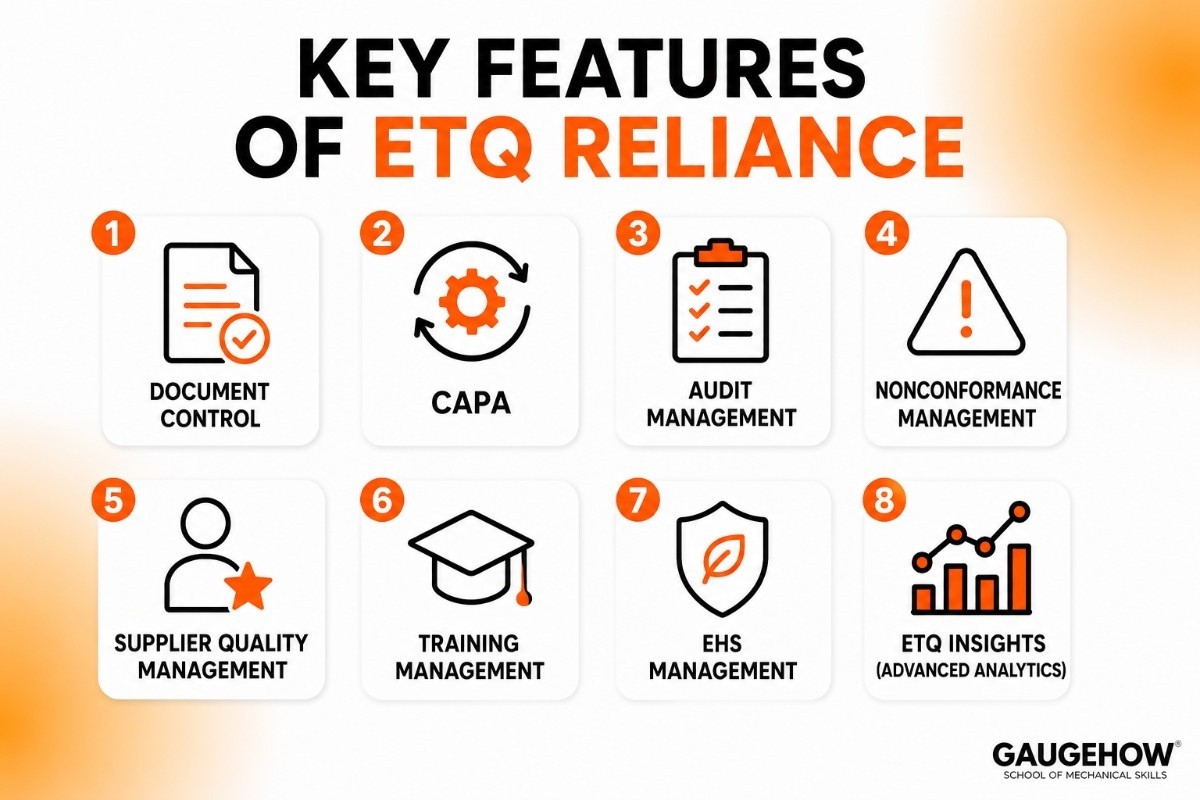
ETQ Reliance runs on 40+ modular applications. You do not have to use all of them — most companies start with the core quality modules and expand from there. Here are the ones that actually matter:
1. Document Control Create, review, approve, and archive controlled documents from a single location. Version control is automatic. You can also integrate Microsoft Office and Google Docs files directly, which removes a lot of the friction of working between systems.
2. CAPA (Corrective and Preventive Action) This is one of ETQ's strongest modules. When something goes wrong — a failed inspection, a customer complaint, a supplier defect CAPA helps you log the issue, investigate the root cause, assign corrective tasks, and verify that the fix actually worked. Everything is tracked with a full audit trail.
3. Audit Management Plan internal and external audits, assign auditors, track findings, and close out action items all within the platform.
You can schedule recurring audits and generate reports for regulatory inspections without pulling data from multiple places.
4. Nonconformance Management Captures product or process deviations as they happen on the manufacturing floor. Links directly to CAPA so that non-conformances that need corrective action do not fall through the cracks.
5. Supplier Quality Management Track your suppliers' quality performance, send out supplier corrective action requests (SCARs), manage approved vendor lists, and monitor incoming material quality all in one workflow.
6. Training Management Assign training tasks to employees when new documents are released or when job roles change. Tracks completion and can trigger automated reminders. Useful for keeping up with FDA 21 CFR Part 11 and ISO training record requirements.
7. EHS Management (Environmental, Health & Safety) Incident reporting, safety data sheet management, permit tracking, and environmental compliance tools are built into the same platform as the quality modules. This is relatively rare most QMS tools treat EHS as a separate product.
8. ETQ Insights (Advanced Analytics) A built-in analytics layer that pulls data from across your quality modules and gives you dashboards, trend reports, and predictive flags. Useful for understanding patterns in complaints, CAPA closure rates, or supplier defect frequency.
ETQ Reliance Pricing
This is the section most people are actually looking for, so let's be direct about what is publicly known.
Pricing model: ETQ Reliance uses subscription-based SaaS pricing. There is no publicly listed price on their website — you have to request a quote.
What influences the cost:
Number of users (typically priced per user, per year)
Which modules you license
Company size and industry
Implementation and onboarding support
Ballpark estimates (based on third-party review sites and analyst data):
A 10-user license for the core QMS suite is estimated around $40,000–$50,000 per year
Full enterprise deployments with EHS, analytics, and supplier management modules can reach $150,000–$200,000+ per year over a 3-year total cost of ownership
Competitors like Qualio start around $15,000/year for small teams, making ETQ noticeably more expensive at the entry level
Free trial:
ETQ does not offer a standard self-serve free trial. You can request a live demo through their website, and they typically walk you through a configured environment.
Who it is priced for: Mid-size to enterprise manufacturers. If you are a startup or a company with under 200 employees, the price point will likely feel steep — Qualio or Greenlight Guru are worth considering first.
Manufacturing Quality Management Software: Where ETQ Sits in the Market
The eQMS software market is crowded. Tools like MasterControl, Veeva Vault, Sparta TrackWise, and Qualio all compete for similar buyers. So where does ETQ actually fit?
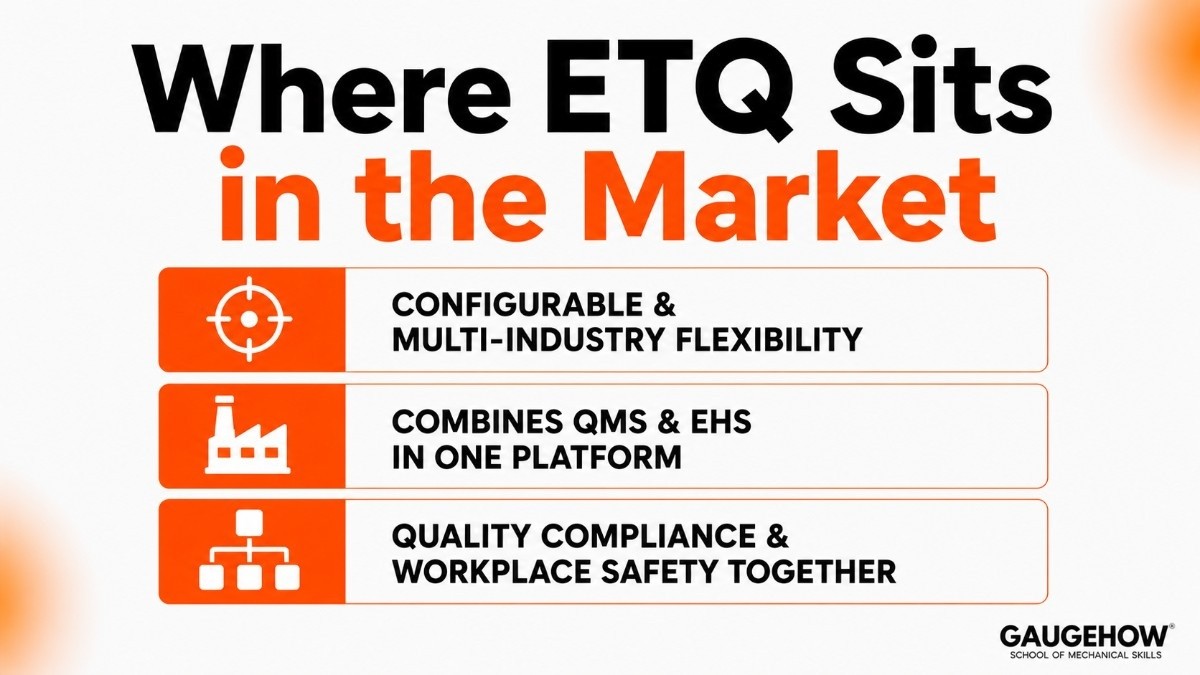
ETQ's main positioning is around configurability and multi-industry flexibility. Most QMS tools are either built specifically for life sciences (like Veeva) or are relatively rigid in how workflows are set up.
ETQ tries to sit in the middle regulated industry support with enough flexibility to customise workflows without hiring a developer.
For manufacturing quality management software specifically, ETQ is one of the few platforms that combines QMS and EHS under the same roof, which matters for companies that need both quality compliance and workplace safety managed together. Most competitors require separate software for each.
ETQ Reliance vs MasterControl
This is one of the most searched comparisons in the QMS space, and for good reason both tools target regulated industries and have overlapping feature sets.
ETQ Reliance | MasterControl | |
|---|---|---|
Best for | Multi-industry manufacturing, EHS + QMS combined | Pharma, biotech, medical devices |
Configurability | High — codeless workflow builder | Moderate — more out-of-the-box |
EHS module | Built-in | Separate product |
Pricing | Higher end | Comparable |
Ease of use | Moderate learning curve | Slightly steeper initially |
Regulatory focus | FDA, ISO, IATF, AS9100 | Primarily FDA, GxP |
Implementation time | 3–6 months typically | 4–8 months typically |
The honest take: If your company is primarily in pharma or biotech and heavily GxP-regulated, MasterControl's out-of-the-box validation documentation gives it an edge.
If you are in a mixed manufacturing environment and need EHS + quality on one platform with room to customise, ETQ has the advantage.
Pros and Cons
What ETQ Reliance does well
Genuinely flexible workflow configuration without needing IT or developers
One platform for QMS and EHS — reduces system sprawl
Strong audit trail and electronic signature features for 21 CFR Part 11
40+ modules means you can grow into it as your quality programme matures
Active user community (ETQ Community) and training resources (ETQ Academy)
Where it falls short
Navigation is not intuitive. Multiple user reviews on Capterra and G2 mention that finding older documents or navigating between modules takes getting used to. New users often need training before they feel confident.
Auto-logout is aggressive. The system logs users out after a few minutes of inactivity — which, when you are reading a long compliance document, happens constantly.
Price is a barrier for smaller companies. It is genuinely enterprise-priced. Small teams will find better value elsewhere.
Implementation requires planning. This is not a tool you spin up in a week. You need documented business requirements before you go live, or you will spend months reconfiguring things.
Language support is limited. The platform primarily operates in English, which can be a challenge for global deployments in non-English-speaking plants.
Best For
Fit | Details |
|---|---|
Company size | Mid-market (500–5,000 employees) to enterprise |
Industries | Pharma, medical devices, food & beverage, aerospace, automotive, electronics, chemicals |
Use case | Companies managing both quality and EHS under one function |
Regulatory environment | FDA 21 CFR Part 11, ISO 9001, IATF 16949, AS9100, HACCP/FSMA |
Not ideal for | Startups, small teams under 200 people, or companies needing a quick setup |
Integrations
ETQ Reliance is built to connect with the broader enterprise tech stack. Key integrations include:
ERP systems: SAP, Oracle, Infor CloudSuite (official partnership announced 2023)
Microsoft ecosystem: Office 365, SharePoint, Teams (document and notification workflows)
Google Workspace: Google Docs integration for document control
MES systems: Connects to manufacturing execution systems for production quality data
LIMS: Laboratory Information Management Systems for lab investigation workflows
Open API: REST API available for custom integrations with other enterprise tools
The Infor CloudSuite partnership is worth highlighting — it allows companies already on Infor's ERP to connect quality specifications, inspection workflows, and compliance tracking directly between the two systems.
Deployment
Cloud (SaaS): ETQ Reliance is primarily a cloud-native SaaS platform. This is the standard and recommended deployment for most customers. Hosted on secure cloud infrastructure with role-based access control and audit trails built in.
On-premise: Not the primary offering. ETQ has shifted its focus almost entirely to SaaS. If your IT policy requires on-premise deployment, this may be a limitation worth raising early in vendor conversations.
Mobile: A mobile app is available for EHS tasks — incident reporting, safety inspections, and task completion — which can be used offline and synced later. Quality workflows are primarily web-based.
Brownfield readiness: ETQ can connect to existing legacy systems through its API, but brownfield integration (plugging into older factory systems or on-prem ERP) typically requires custom integration work or middleware.
Alternatives to ETQ Reliance
If ETQ is not the right fit, here are the tools most commonly evaluated alongside it:
1. MasterControl Strong choice for pharma and biotech companies with heavy GxP validation needs. Better out-of-the-box compliance documentation but less flexible for non-life-sciences manufacturing.
2. Veeva Vault QMS Purpose-built for life sciences. If your entire business is pharma or medical devices and you already use other Veeva products (CRM, regulatory), this makes the most sense. Overkill for general manufacturing.
3. Qualio Best for startups and growing life sciences companies. Much lower price point, faster to implement, simpler interface. Lacks the depth of ETQ for complex multi-site operations.
4. Greenlight Guru Medical device-specific QMS with a focus on design controls and clinical evidence management. A strong pick if you are exclusively in the medical device space and want purpose-built FDA/MDR compliance.
5. TrackWise Digital (Honeywell) Enterprise-grade, particularly strong in pharma. High implementation complexity and cost. Best for large global organisations with dedicated QA IT resources.
6. Ideagen QMS
Ideagen is a popular quality management platform used across manufacturing, aerospace, healthcare, and regulated industries. It offers document control, audit management, CAPA, risk management, and compliance workflows. Compared with ETQ Reliance, Ideagen is often considered easier to deploy for organisations focused primarily on quality management rather than a combined QMS and EHS environment.
FAQ
Is ETQ Reliance cloud-based? Yes. ETQ Reliance is a cloud-native SaaS platform. It is hosted on secure cloud infrastructure, which means no on-site server maintenance for your IT team.
Most new customers deploy on the cloud version. An older on-premise version exists but is not the focus of current product development.
What industries use ETQ Reliance? ETQ Reliance is used across pharmaceuticals, medical devices, food and beverage, aerospace, automotive, electronics, and heavy manufacturing.
It has specific compliance support for FDA 21 CFR Part 11, ISO 9001, IATF 16949, AS9100, and food safety standards like HACCP and FSMA.
How long does ETQ Reliance implementation take? Most implementations run between 3 and 6 months, depending on how many modules you are deploying and how complex your existing processes are.
Companies that go in with well-documented business requirements tend to go live faster. Rushing implementation without that groundwork is one of the most common reasons projects run long.
Is there a free trial for ETQ Reliance? No standard self-serve free trial is available. You can request a live demo from ETQ's website, where a solutions consultant walks you through a configured environment.
If you want hands-on access before buying, ask specifically about a pilot or proof-of-concept engagement during your sales conversation.
What is the difference between ETQ Reliance and Octave Reliance? They are the same product. After Hexagon acquired ETQ in 2022, the platform was rebranded as Octave Reliance.
If you see both names, they refer to the same software. Some third-party review sites still list it under the ETQ Reliance name.
ETQ Reliance is a cloud-based QMS that automates quality, compliance, audits, CAPA, documents, training, and risk management in one platform.