
PLC Programmer Roadmap: A Step-by-Step Career Guide
Learn More in This Video
Subscribe to GaugeHow for More
Want to become a PLC programmer but not sure where ladder logic, wiring, and SCADA all fit together? You are not alone. Most beginners learn one PLC brand in a short course and then get handed a real control panel with zero idea how it connects to the sensors, drives, and HMI screen sitting right next to it.
This roadmap breaks the career down into seven practical stages. No vague advice like "learn PLCs." Just the skills, tools, and certifications that actually show up in real job postings, in the order you should learn them.
What Does a PLC Programmer Actually Do?
A PLC programmer writes and maintains the logic that controls how machines and processes behave on the factory floor. In practice, this means:
Writing and editing ladder logic, function block, or structured text programs
Wiring and testing inputs and outputs against the electrical drawing
Building or updating HMI screens operators use to run the line
Troubleshooting faults on a live machine without stopping production longer than needed
Commissioning new equipment and proving it runs to spec before handover
Working closely with mechanical, electrical, and automation teams on the same project
It's a hands-on role. You will spend as much time inside a control panel with a multimeter as you will in front of a programming laptop.
PLC Programmer Roadmap: Step by Step
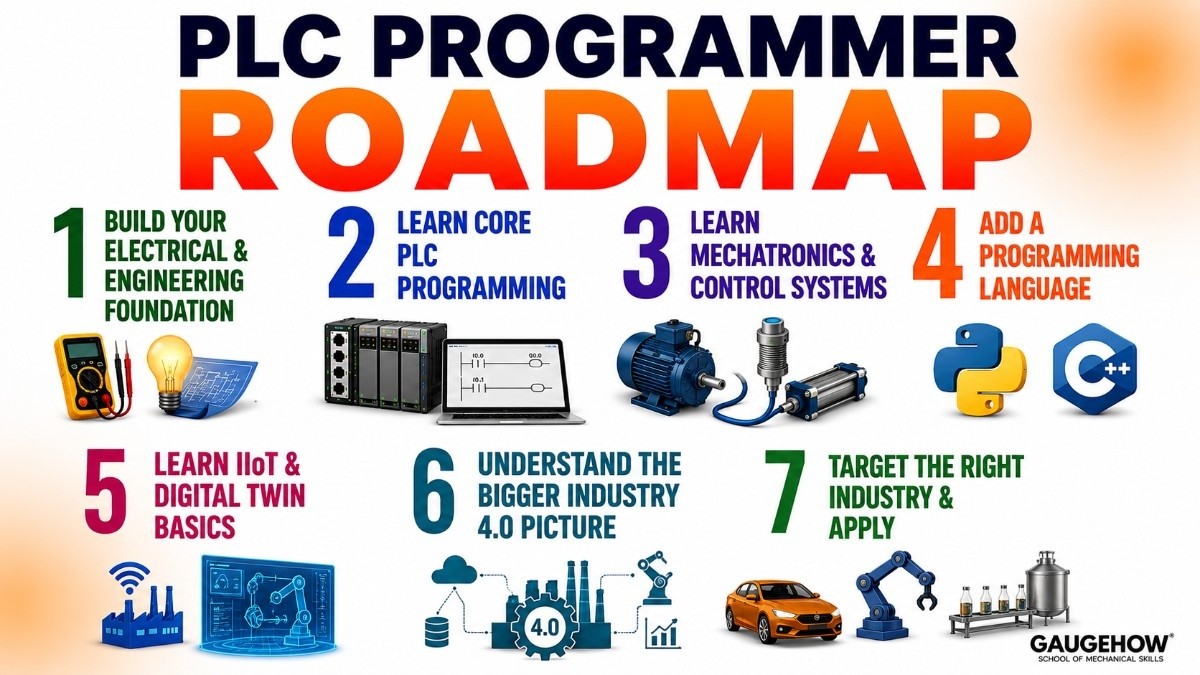
Step 1: Build Your Electrical and Engineering Foundation
Most PLC roles ask for a diploma or bachelor's degree in electrical, electronics, mechatronics, or instrumentation engineering.
If you are still studying, focus your electives on electrical circuits, control systems, and instrumentation. If you already have the qualification, this step is done. Move on.
Step 2: Learn Core PLC Programming
This is the heart of the job. You need to understand ladder logic, timers, counters, function blocks, and how to structure a program that is easy for the next engineer to read and troubleshoot.
You also need to get comfortable with the practical side: wiring diagrams, input and output addressing, and basic fault finding on a live panel. The PLC Programming and Automation course covers this exact foundation, from core logic through real industrial control scenarios.
Step 3: Learn Mechatronics and Control Systems
PLC logic does not exist in isolation. It controls real sensors, actuators, drives, and motors, and understanding how those components behave physically makes your programs far more reliable.
A programmer who understands why a sensor gives a false signal writes better fault-handling logic than one who only knows the software side. The Mechatronics for Beginners course covers this exact mechanical, electrical, and control mix.
Step 4: Add a Programming Language
More PLC-adjacent roles now expect basic scripting skills, especially for pulling data out of a PLC for reporting or connecting it to a higher-level system.
Python is the fastest entry point for most engineers, while C++ shows up in more embedded and real-time control work. The Python for Mechanical Engineers & Robotics course and C and C++ for Mechanical Engineering course both build this skill set from an engineering angle rather than a pure software one.
Step 5: Learn IIoT and Digital Twin Basics
Connected manufacturing is changing what plants expect from a PLC programmer. Many facilities now want programs that also feed data into monitoring dashboards, and some want new logic validated in a digital twin before it ever touches the real machine.
The Industrial Internet of Things (IIoT) course and Digital Twins course both build this layer directly on top of your core PLC skills.
Step 6: Understand the Bigger Industry 4.0 Picture
Once your PLC and mechatronics foundation is solid, the next step is seeing how a single control panel fits into a full connected factory.
This means understanding how data moves from a machine level program up to plant-wide decisions, and where PLC programming sits inside that bigger system.
The Introduction to Industry 4.0 course covers this system-level view, which usually separates a mid-level programmer from a senior one.
Step 7: Target the Right Industry and Apply
PLC hiring looks different by sector. Automotive plants want high-speed sequencing and robust fault recovery. Robotics-heavy cells want tight integration between the PLC and the robot controller.
Food and pharma want strict traceability and hygienic design logic. If you are targeting automotive specifically, the Automotive industry page is a good place to see what skills that sector emphasizes, and the Robotics industry page is useful if robot-integrated cells interest you more.
Before interviews, review common technical questions so a ladder logic or fault-finding scenario does not catch you off guard. The Interview Q&A Hub has role-specific practice questions, and the Practice / MCQ Tests section is useful for a quick knowledge check before a technical round.
PLC Programmer Skills Checklist
Skill Area | Beginner | Job Ready |
|---|---|---|
Ladder logic and function blocks | Can read a simple program | Can write and troubleshoot a full control program |
Electrical wiring and I/O | Knows basic input and output concepts | Can trace and fix a live wiring fault |
Mechatronics awareness | Understands sensors and actuators separately | Can explain why a sensor is misbehaving in a running system |
Scripting / data handling | Knows basic Python or C++ syntax | Can pull PLC data into a report or dashboard |
IIoT and digital twins | Aware connected sensors exist | Can validate new logic in a digital twin before deployment |
Commissioning and fault finding | Follows a checklist with guidance | Can commission and troubleshoot independently on a live line |
PLC Programmer vs Controls Engineer vs Automation Engineer
These three titles overlap constantly, and many job postings blend all three into one role.
Role | Main Focus | Typical Tools |
|---|---|---|
PLC Programmer | Writing and maintaining machine control logic | Ladder logic, function blocks, HMI screens |
Controls Engineer | Designing the control hardware and logic architecture | PLCs, sensors, relay logic, wiring diagrams |
Automation Engineer | Running a full process with minimal manual input | PLCs, SCADA, HMI, scripting |
A strong PLC programmer usually understands enough controls and automation to work across all three without needing a specialist for every small change. If you want a course sequence built around this broader overlap, the Automation & Robotics Engineer career track is worth reviewing before you specialize too narrowly.
Frequently Asked Questions
Q: Do I need a specific degree to become a PLC programmer?
A: Most employers prefer a diploma or bachelor's degree in electrical, electronics, mechatronics, or instrumentation engineering, though many technicians move into full PLC programming roles through hands-on experience and targeted certifications.
Q: Which PLC brand should I learn first?
A: The concepts behind ladder logic and function blocks transfer across brands like Siemens, Allen-Bradley, and Mitsubishi, so start with whichever brand is most common in your target industry or region and build the fundamentals there first.
Q: Is coding necessary for a PLC programmer?
A: Ladder logic itself is a form of coding, and many modern roles also expect basic scripting in Python for pulling data out of the PLC or connecting it to a higher-level reporting system.
Q: How long does it take to become job ready as a PLC programmer?
A: With an electrical or engineering background already in hand, most people reach job ready in six months to a year by learning core PLC programming, basic wiring and fault finding, and completing one hands-on commissioning project they can walk through in an interview.
Q: Which industries hire the most PLC programmers?
A: Automotive, food and beverage, pharmaceuticals, oil and gas, and general industrial manufacturing all hire heavily for this role, since each depends on reliable, automated control of physical equipment.
Conclusion
Becoming a PLC programmer is less about memorizing one software package and more about being able to walk up to a control panel, understand what is wired to what, and get a stalled process running again with clean, reliable logic.
Follow the roadmap in order: electrical foundation, core PLC programming, mechatronics, a scripting language, IIoT and digital twins, then Industry 4.0 systems thinking.
Ready to build the skill set? Start with the PLC Programming and Automation course on GaugeHow to build the core programming skills this roadmap is built around.
Mechanical Engineering Courses That Industry Actually Uses
Learn Tools of Design & CAD, Analysis & Simulation, Automation & Robotics, and Industry 4.0 used in modern factories.
Join 40+ Mech Courses like GD&T, Siemens NX, SolidWorks, CATIA V5, AutoCAD, ANSYS (FEA & Fluent), ABAQUS, Creo, Fusion 360, CNC Programming, Digital Twins, Python for Mechanical, and Industry 4.0.
Our Courses
Complete Course Library
Access to 40+ courses covering various fields like Design, Simulation, Quality, Manufacturing, Robotics, and more.