Robotics Engineer Roadmap: A Step-by-Step Career Guide
Learn More in This Video
Subscribe to GaugeHow for More
Want to become a robotics engineer but not sure whether to start with mechanics, electronics, or code? You are not alone. Most beginners jump between YouTube tutorials on arms, sensors, and Python without ever connecting the pieces into one coherent skill set employers actually look for.
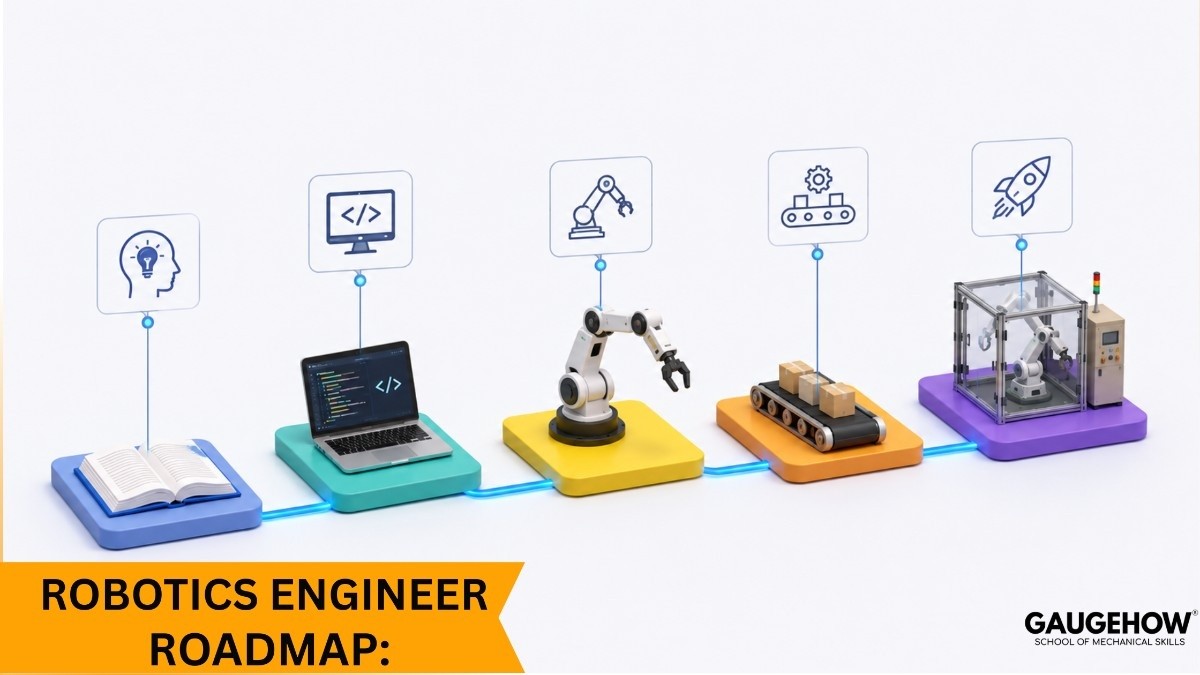
This roadmap breaks the career down into seven practical stages. No vague advice like "learn robotics." Just the tools, languages, and systems that actually show up in real job postings, in the order you should learn them.
What Does a Robotics Engineer Actually Do?
A robotics engineer designs, builds, and programs machines that sense their environment and act on it with minimal human input. In practice, this means:
Designing or selecting the mechanical structure of a robot or robotic cell
Programming motion, sequencing, and pick-and-place logic
Integrating sensors, cameras, and actuators into one working system
Writing code that lets a robot make decisions, not just repeat fixed motions
Testing and debugging a system on the actual hardware, not just in simulation
Working with mechanical, electrical, and controls teams on shared projects
It's a role that blends mechanical design, electronics, and software into one job. You do not need to master all three at an expert level, but you need enough fluency in each to build a system that actually works outside a simulator.
Robotics Engineer Roadmap: Step by Step
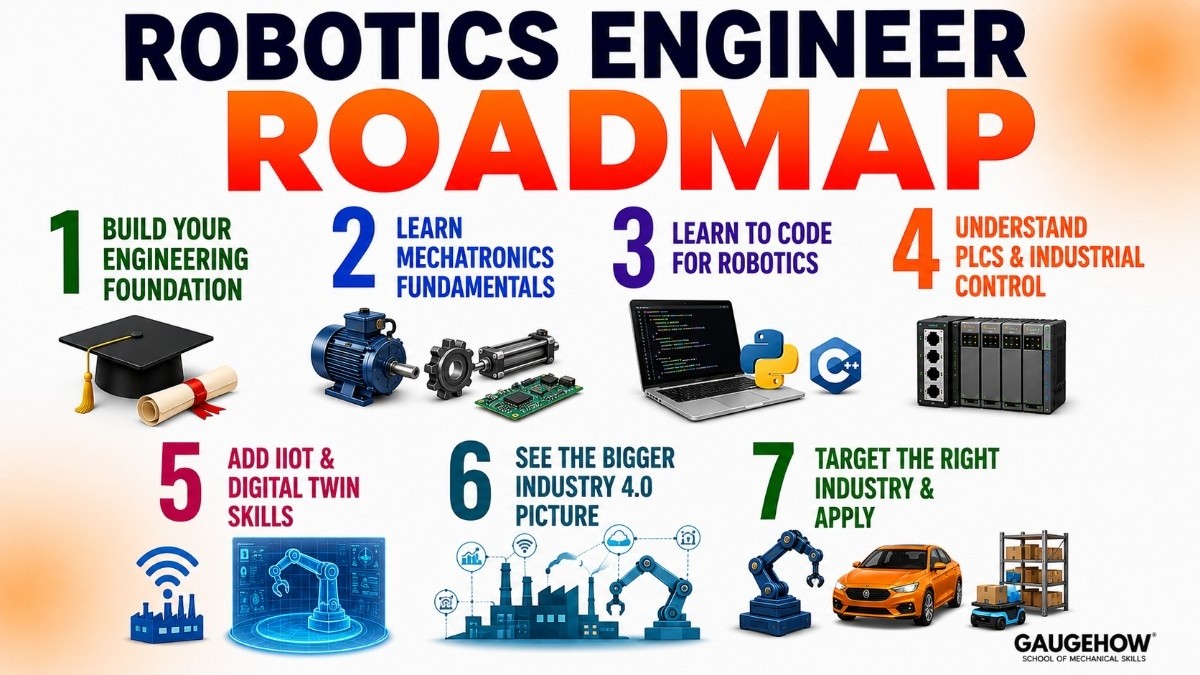
Step 1: Build Your Engineering Foundation
Most robotics roles ask for a bachelor's degree in mechanical, electrical, mechatronics, or robotics engineering. If you are still studying, focus your electives on dynamics, control systems, and electronics. If you already have the degree, this step is done. Move on.
Step 2: Learn Mechatronics Fundamentals
This is where mechanical, electrical, and control concepts come together, and it is the single most important foundation for robotics work.
You need to understand how sensors, actuators, and controllers interact as one system, not as separate subjects. The Mechatronics for Beginners course covers exactly this mix, using the same building blocks you will see in a real robotic system.
Step 3: Learn to Code for Robotics
Modern robots run on code, not just wiring. You need a language you can actually use to control motion, process sensor input, and make decisions in real time.
Python is the fastest entry point for most engineers and dominates robotics research and prototyping, while C++ shows up constantly in production and embedded robotics work. The Python for Mechanical Engineers & Robotics course and C and C++ for Mechanical Engineering course both build this from an engineering angle rather than a pure computer science one.
Step 4: Understand PLCs and Industrial Control
Not every robot lives in a research lab. Most industrial robots operate as part of a larger automated cell controlled by a PLC, and understanding how a robot arm talks to that PLC is a skill that separates hobby-level knowledge from job-ready knowledge.
The PLC Programming and Automation course covers this integration layer, which shows up constantly in manufacturing-based robotics roles.
Step 5: Add IIoT and Digital Twin Skills
Connected robotics is becoming the norm rather than the exception. Plants increasingly expect engineers to understand how a robot's sensor data feeds into a larger monitoring system, and how a digital twin can simulate and validate a robot's behavior before it ever touches the physical cell.
The Industrial Internet of Things (IIoT) course and Digital Twins course both build this layer on top of your mechatronics and coding foundation.
Step 6: See the Bigger Industry 4.0 Picture
Once the individual pieces click, the next step is understanding how a robot fits into a full connected factory, not just its own cell. This means seeing how data flows from a single robotic arm up to plant-wide decisions, and where robotics sits inside that larger system.
The Introduction to Industry 4.0 course covers this system-level view, which usually separates a mid-level robotics engineer from a senior one.
Step 7: Target the Right Industry and Apply
Robotics hiring looks different by sector. Automotive plants want high-speed pick-and-place and welding cell experience. Electronics wants precision assembly at a small scale.
Warehousing and logistics want navigation and fleet coordination skills. If robotics is your main focus, the Robotics industry page is a good place to see what that sector actually prioritizes before you apply.
Before interviews, review common technical questions so a kinematics or troubleshooting scenario does not catch you off guard.
The Interview Q&A Hub has role-specific practice questions, and the Practice / MCQ Tests section is useful for a quick knowledge check before a technical round.
Robotics Engineer Skills Checklist
Skill Area | Beginner | Job Ready |
|---|---|---|
Mechatronics fundamentals | Understands sensors and actuators separately | Can design a full sensor-actuator-controller loop |
Programming for robotics | Knows basic Python or C++ syntax | Can write control logic that runs on real hardware |
PLC and industrial integration | Aware PLCs exist in industrial cells | Can wire and program a robot to work with a PLC |
IIoT and digital twins | Aware connected sensors exist | Can validate a robot's behavior in a digital twin before deployment |
Industry 4.0 systems thinking | Knows the terminology | Can explain how robot data feeds plant-wide decisions |
Hardware debugging | Follows a checklist with guidance | Can diagnose an unfamiliar hardware fault independently |
Robotics Engineer vs Automation Engineer vs Mechatronics Engineer
These three titles overlap constantly, and many job postings blend all three into one role.
Role | Main Focus | Typical Tools |
|---|---|---|
Robotics Engineer | Designing and programming robot motion and behavior | Robot programming, kinematics, vision systems |
Automation Engineer | Running a full process with minimal manual input | PLCs, SCADA, HMI, scripting |
Mechatronics Engineer | Integrating mechanical, electrical, and control subsystems | Sensors, actuators, embedded controllers |
A strong robotics engineer usually understands enough automation and mechatronics to integrate a robot into a real production cell, not just make it move in isolation. For a course sequence built around this exact overlap, the Automation & Robotics Engineer career track is worth reviewing before you specialize.
Frequently Asked Questions
Q: Do I need a specific degree to become a robotics engineer?
A: Most employers prefer a bachelor's degree in mechanical, electrical, mechatronics, or robotics engineering, though candidates from computer science or physics backgrounds are sometimes hired if they can show strong hands-on project experience.
Q: Which programming language should I learn first for robotics?
A: Python is the fastest way in for most beginners and is widely used in robotics research, simulation, and prototyping. C++ becomes important once you move into production or embedded robotics, where speed and real-time performance matter more.
Q: What is the difference between robotics and automation engineering?
A: Robotics engineering focuses specifically on designing and programming robot motion and behavior. Automation engineering covers running an entire process with minimal manual input, which may or may not include robots. Many roles combine both under one title.
Q: How long does it take to become job ready as a robotics engineer?
A: With an engineering degree already in hand, most people reach job ready in six months to a year by learning mechatronics fundamentals, a programming language, and completing one hands-on robot project they can walk through in an interview.
Q: Which industries hire the most robotics engineers?
A: Automotive, electronics, warehousing and logistics, and general industrial manufacturing all hire heavily for this role, since each depends on repeatable, precise automated motion.
Conclusion
Becoming a robotics engineer is less about memorizing terminology and more about being able to design a system, write the code that controls it, and get it running reliably on real hardware.
Follow the roadmap in order: engineering foundation, mechatronics, coding for robotics, PLC integration, IIoT and digital twins, then Industry 4.0 systems thinking.
Ready to build the skill set? Start with the Automation & Robotics Engineer career track on GaugeHow to see the full course sequence mapped to this exact roadmap.
Mechanical Engineering Courses That Industry Actually Uses
Learn Tools of Design & CAD, Analysis & Simulation, Automation & Robotics, and Industry 4.0 used in modern factories.
Join 40+ Mech Courses like GD&T, Siemens NX, SolidWorks, CATIA V5, AutoCAD, ANSYS (FEA & Fluent), ABAQUS, Creo, Fusion 360, CNC Programming, Digital Twins, Python for Mechanical, and Industry 4.0.
Our Courses
Complete Course Library
Access to 40+ courses covering various fields like Design, Simulation, Quality, Manufacturing, Robotics, and more.