Engineering Mechanics
Career Applications In Engineering Mechanics
Ask any second year mechanical student what engineering mechanics is for, and you usually get a shrug and something about clearing the paper.
That is a costly misunderstanding. Engineering mechanics is not a subject you pass and forget. It is the subject that quietly sits underneath almost every mechanical, civil, automotive, aerospace, and robotics job you will ever apply for.
This guide covers the real career applications of engineering mechanics: which jobs use it daily, what the work actually looks like, the software that turns the theory into a paycheck, and how interviewers test it.
What Is Engineering Mechanics in Simple Words?
Engineering mechanics is the study of how forces act on bodies, and what happens as a result.
It splits into two halves:
Statics deals with bodies that are not moving. A bridge, a bolted joint, a shelf bracket, a crane standing still with a load hanging from it.
Dynamics deals with bodies that are moving. A piston, a car braking, a robot arm swinging, a turbine spinning.
Everything else in that syllabus, free body diagrams, friction, moments, centroids, moment of inertia, work and energy, is a tool for answering two questions: will it hold, and how will it move?
Every mechanical career is built on some version of those two questions.
Why Engineering Mechanics Matters for Your Career
Most college subjects teach you facts. Mechanics teaches you a way of looking at a problem, and that habit transfers to every job.
Here is what it actually gives you:
The ability to read a real object as a force diagram. An experienced engineer looks at a bracket and instantly sees where it will crack.
Confidence with loads and reactions. Almost every design decision starts with "what forces is this thing seeing?"
The base layer for later subjects. Strength of Materials, Machine Design, Theory of Machines, Vibrations, and FEA all assume you already know this. Weak mechanics means weak everything after it.
A common language in interviews. A recruiter cannot check your CAD skills in ten minutes, but they can absolutely check whether you understand a free body diagram.
Jobs That Use Engineering Mechanics Every Day
This is the section students actually want. These are not vague "scope" claims. This is what the work looks like.
Design Engineer
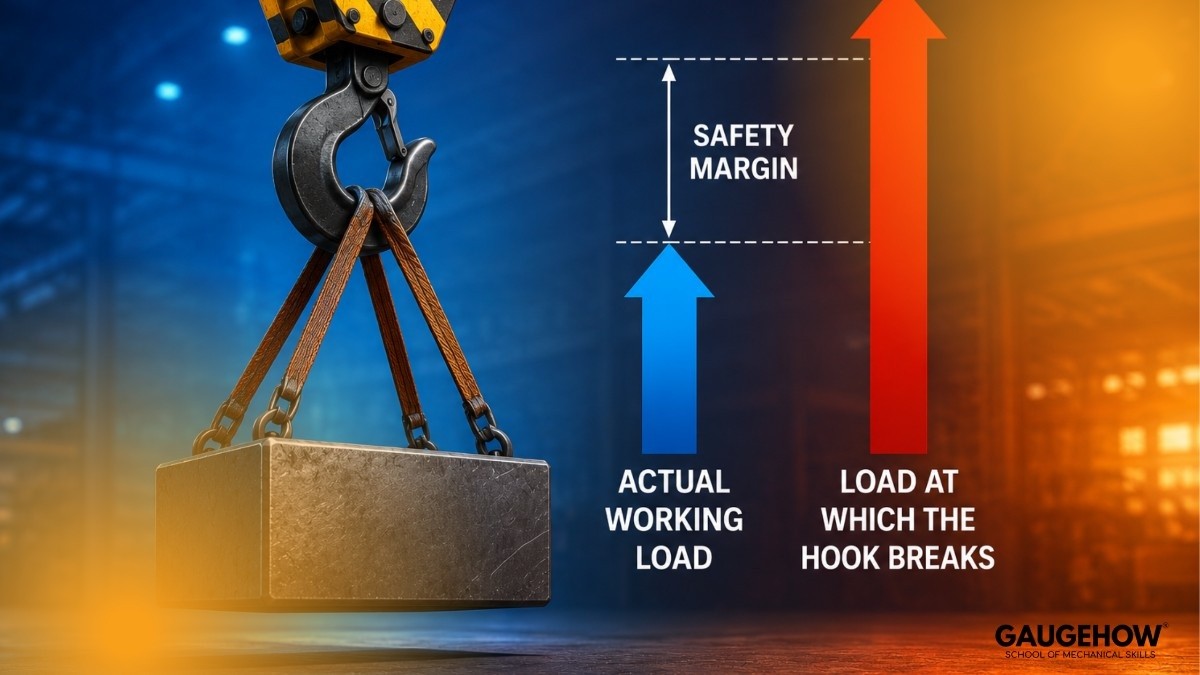
You take a requirement, a hook that must lift 2 tonnes, and turn it into a part with real dimensions and a real material.
Mechanics is the entire middle step. You calculate the load, find the stress, apply a factor of safety, and pick a thickness. Then you model it. If you skip the mechanics, you are not designing, you are drawing.
Daily tools: free body diagrams, moments, stress, factor of safety, plus CAD.
If this is the direction you want, the Design Engineer career track lays out the full skill sequence.
CAE and Simulation Engineer
You run stress and motion simulations to test a design before anyone cuts metal.
Here is the part students underestimate: the software will always give you an answer, even when the answer is nonsense. The only way to know that a result is wrong is to have a rough hand calculation in your head first. That rough calculation is mechanics.
Simulation engineers who cannot sanity check their own results do not last. Ones who can are extremely hard to replace.
Daily tools: FEA, boundary conditions, loads, constraints, mesh quality. The FEA with ANSYS course and the wider CAE / Simulation Engineer track cover this path.
Structural and Civil Engineer
Beams, trusses, columns, supports, reactions, bending moments. Open a structural engineer's calculation sheet and you will find your mechanics syllabus staring back at you, just with bigger numbers.
Truss analysis by method of joints is not an exam trick. It is a real working method.
Automotive and EV Engineer
Suspension geometry, braking forces, chassis loads, crash energy absorption, battery pack mounting that survives road vibration. All of it is statics and dynamics.
An EV battery pack is a heavy mass bolted to a moving frame. Working out what that mass does to those bolts over a pothole is a mechanics problem before it is anything else. See the Automotive industry page and the EV / Battery Engineer track for where that leads.
Aerospace Engineer
Aerospace is mechanics at its most unforgiving, because every extra kilogram costs fuel for the entire life of the aircraft. Safety factors are low, so the calculations have to be right.
Loads, moments, structural members, vibration. Explore the Aerospace industry page for the bigger picture.
Robotics and Automation Engineer
A robot arm is a chain of links with motors at the joints. To size those motors, you calculate the torque each joint must produce, which depends on link weights, payload, and moment arms.
That is the moment equation, M = F × d, doing real work for real money.
Dynamics goes further: how fast can the arm move without shaking the whole cell apart? The Automation and Robotics Engineer track and the Mechatronics course sit on top of exactly this foundation.
Production and Manufacturing Engineer
Fixtures, jigs, clamping forces, conveyor loads, machine frames, material handling. A fixture that flexes under cutting force ruins the part.
Friction, one of the least loved chapters, is the whole reason a clamp holds a workpiece at all. The Production Engineer track covers this side.
Quality and Metrology Engineer
Less obvious, but real. Measurement setups deform. Fixtures sag. Contact force in a probe matters. Understanding how a part behaves under load is what separates a measurement you can trust from a number you wrote down.
The Quality Engineer track goes deeper here.
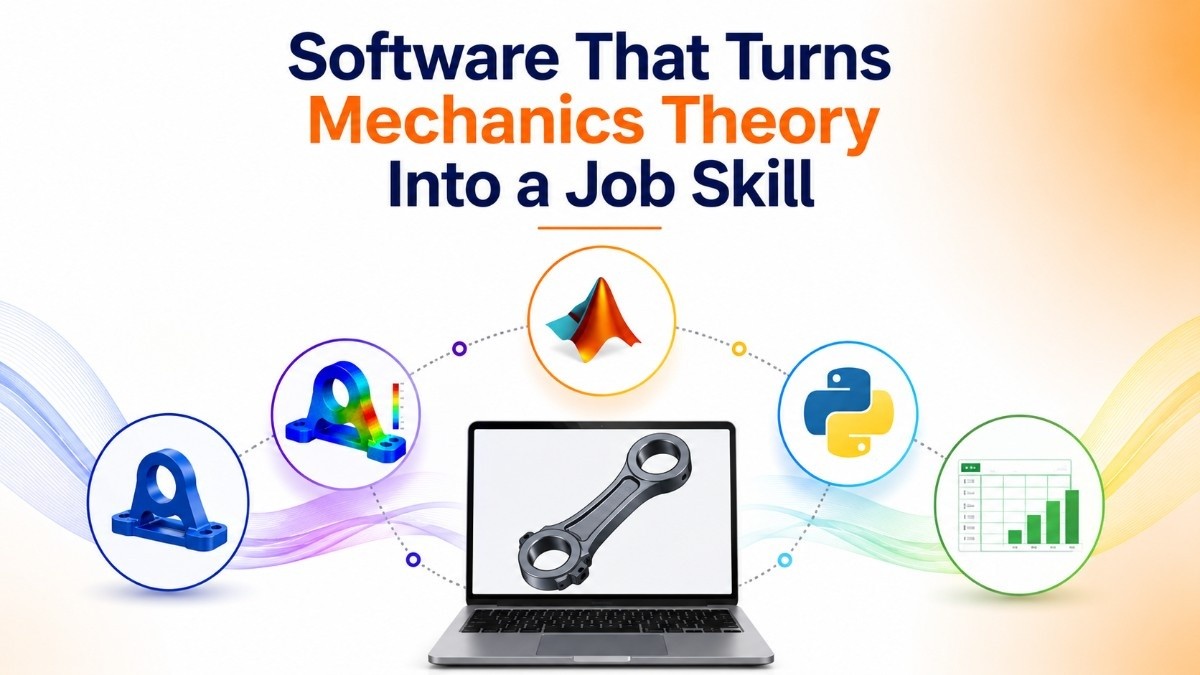
Software That Turns Mechanics Theory Into a Job Skill
Theory alone will not get you hired. Theory plus a tool will.
The pattern is always the same: mechanics tells you what to calculate, software tells you the answer faster.
CAD (SolidWorks, Fusion 360, AutoCAD). You model the part you sized by hand. Start with SolidWorks or Fusion 360.
FEA (ANSYS). Stress and deflection on complex shapes where hand calculation gets impractical. That is what FEA with ANSYS is for.
MATLAB. Solving equations of motion, plotting dynamic behaviour. Covered in the MATLAB course.
Python. Increasingly common for automating repetitive force calculations and for robotics work. See Python for Mechanical Engineers and Robotics.
Spreadsheets. Genuinely underrated. A huge share of professional design calculation still lives in a well built spreadsheet.
A student who can do a hand calculation and back it up with an FEA result is far ahead of one who can only do the second.
How Engineering Mechanics Shows Up in Interviews and Exams
Mechanics is the favourite hunting ground for interviewers, because it exposes whether you understand or just memorised.
Typical things you will be asked to do:
Draw a free body diagram for a simple situation, like a ladder against a wall.
Explain why a factor of safety exists, and what value you would choose.
Find the reactions at supports of a simply supported beam.
Explain the difference between static and kinetic friction, with an everyday example.
Work out the torque a motor needs for a given arm and payload.
For GATE and PSU exams, mechanics is high value because the questions are formula driven and predictable once your concepts are firm.
You can practise this style of question on the GaugeHow practice tests and see how it is asked in real hiring rounds at the Interview Q&A hub.
How to Turn Mechanics Into an Actual Job
A practical order that works:
Get the fundamentals solid. Free body diagrams, equilibrium, friction, moments, centroid, moment of inertia. Not memorised. Understood.
Learn one CAD tool properly. Depth in one beats a shallow list of five on a CV.
Add one simulation tool. FEA is the natural next step because it is mechanics with a mesh.
Do a real project. Size a bracket, a hook, or a small frame by hand. Model it. Simulate it. Compare the two answers and explain any difference. That single project is more convincing in an interview than a whole page of course names.
Target a track. Design, simulation, production, robotics, quality, or EV. Pick one and go deep. Start from the Mechanical Engineer hub if you are undecided.
Apply while learning, not after. Openings are listed on the GaugeHow jobs page.
Common Mistakes Students Make
Treating mechanics as an exam subject. It is the base layer for six later subjects. Weak foundations show up two years later, badly.
Jumping to software first. A student who learns ANSYS before mechanics produces colourful pictures they cannot defend.
Memorising formulas without the free body diagram. The diagram is the actual skill. The formula is just the last line.
Ignoring units. Mixing mm and m has ruined more answers than any conceptual error.
Believing it is only for "core" jobs. Robotics, EV, and even quality roles are full of mechanics.
Key Points to Remember
Engineering mechanics answers two questions that every mechanical job asks: will it hold, and how will it move?
Design, simulation, structural, automotive, aerospace, robotics, production, and quality roles all use it directly.
Simulation software gives an answer whether or not it is correct. Mechanics is how you know the difference.
Every later subject, from Strength of Materials to Machine Design to FEA, assumes this foundation.
Interviewers test mechanics because it cannot be faked in ten minutes.
The strongest student profile is hand calculation plus one CAD tool plus one simulation tool plus one real project.
Frequently Asked Questions
Is engineering mechanics important for a mechanical engineering career?
Yes, more than almost any other early subject. It is the foundation for Strength of Materials, Machine Design, Theory of Machines, Vibrations, and FEA. Being weak here limits every specialisation that follows.
Which jobs use engineering mechanics the most?
Design engineer, CAE or simulation engineer, structural engineer, robotics engineer, and production engineer use it almost daily. Automotive, aerospace, heavy machinery, and energy sectors depend on it heavily.
Do I still need mechanics if software can calculate everything?
Yes. Software solves what you tell it to solve. Choosing the loads, supports, and constraints is a mechanics decision, and a wrong setup produces a confident, professional looking, completely wrong result.
Is engineering mechanics useful for non mechanical branches?
Yes. Civil and structural engineering use statics constantly. Robotics and mechatronics use dynamics. Even production and quality roles rely on it for fixtures, clamping, and measurement setups.
How do I make my mechanics knowledge visible to a recruiter?
Build one small project where you size a part by hand, model it in CAD, verify it in FEA, and explain any difference between the two results. That single project demonstrates more than a list of subjects on a CV.
Conclusion
Engineering mechanics is not a hurdle between you and a degree. It is the thing that makes an engineer useful, in a design office, on a shop floor, or in front of a simulation screen.
Learn it once, properly, and it keeps paying out for the rest of your career.
If you are ready to build on it, start with the Mechanical Engineer hub to pick a direction, then take the FEA with ANSYS course to turn that theory into a skill an employer will pay for.
Internal links:
Design Engineer track — Design Engineer section
CAE / Simulation Engineer track — CAE section
FEA with ANSYS — CAE section, software section, conclusion
Automation and Robotics Engineer track — Robotics section
Mechatronics — Robotics section
Production Engineer track — Production section
Quality Engineer track — Quality section
EV / Battery Engineer track — Automotive section
Automotive industry page and Aerospace industry page — industry sections
SolidWorks, Fusion 360, MATLAB, Python for Mechanical Engineers and Robotics — software section
Practice tests, Interview Q&A hub, Jobs, Mechanical Engineer hub — interview and next steps sections