CAE Engineer Roadmap: From Fresher to Senior Simulation Engineer

Deepak S Choudhary
Every part that survives a crash test, a thermal cycle, or years of vibration has already failed and passed hundreds of times inside a computer before it was ever built.
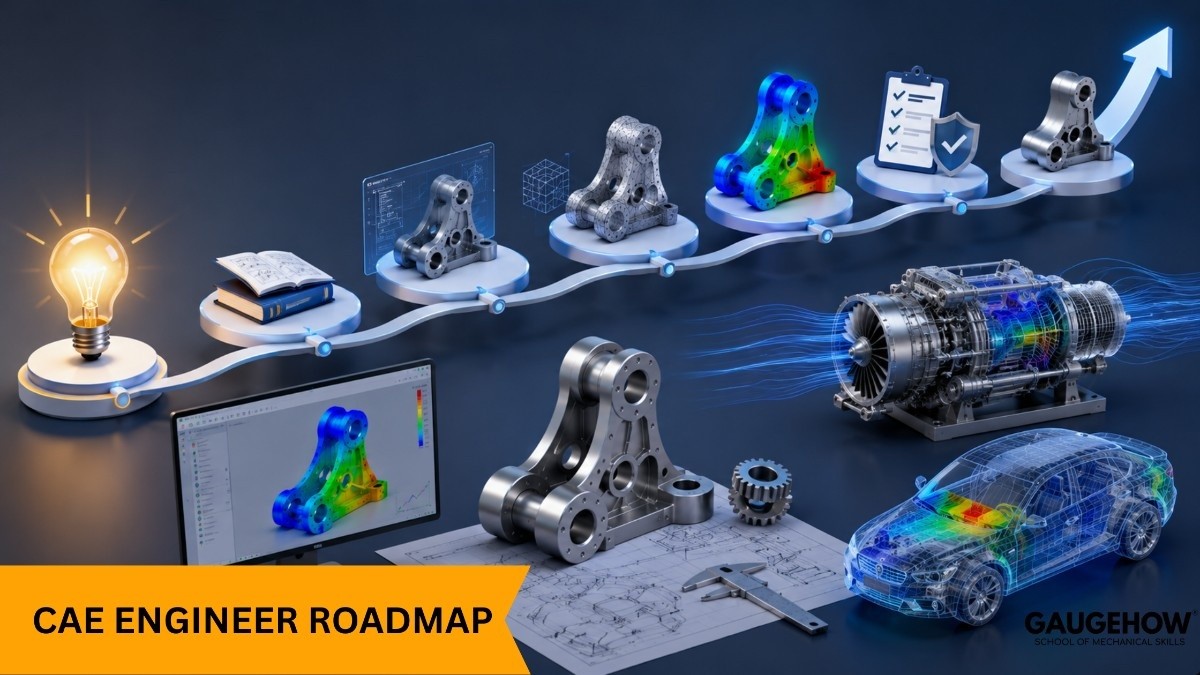
That is the job of a CAE engineer. If you want a clear CAE engineer roadmap for 2026, one that shows exactly what to learn, in what order, and what your career looks like at each stage, this guide from GaugeHow covers it end to end.
What Is a CAE Engineer?
A CAE engineer uses Computer Aided Engineering software to predict how a design will behave under real world conditions before it is manufactured.
This covers structural analysis through Finite Element Analysis, fluid and thermal behavior through Computational Fluid Dynamics, and sometimes combined multiphysics problems.
A CAE engineer typically reviews a design engineer's CAD model, sets up and runs the simulation, interprets the results, and recommends changes when a design does not meet strength, thermal, or durability targets.
CAE Engineer Roadmap
Stage 1, Build Your Fundamentals First
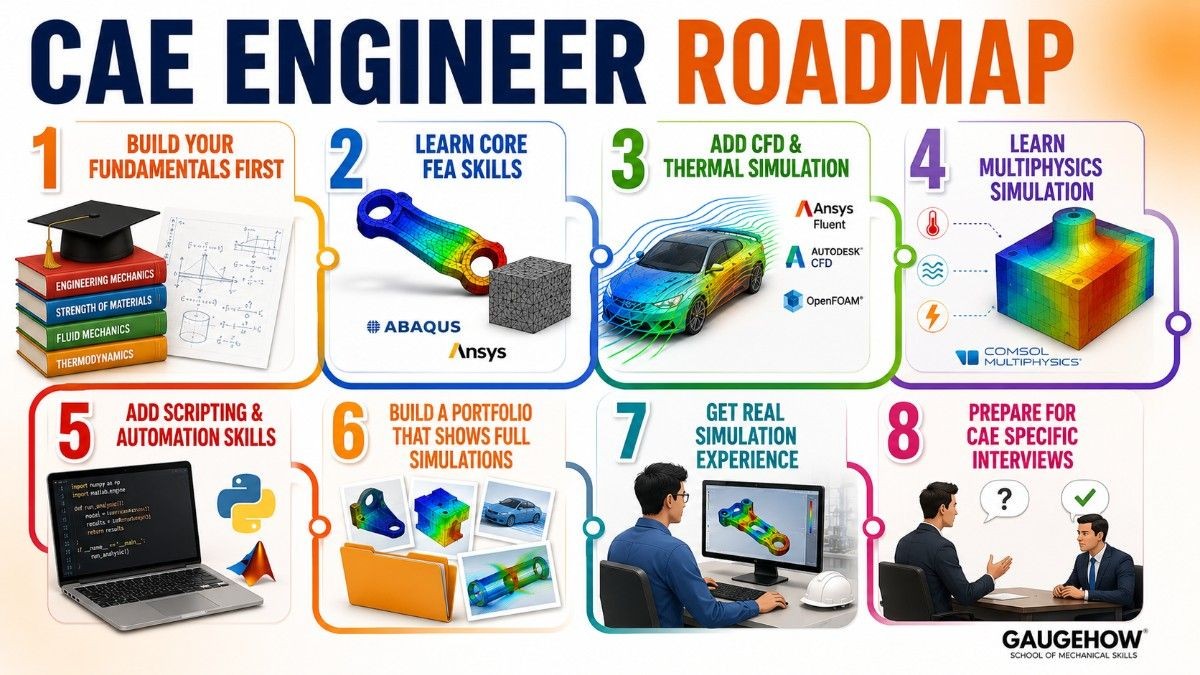
Before touching any simulation software, you need a solid grip on engineering mechanics, strength of materials, and basic fluid mechanics and thermodynamics.
A bachelor's degree in mechanical, automotive, or aerospace engineering is the standard route into this stage. These fundamentals are what let you judge whether a simulation result actually makes physical sense, instead of trusting whatever number the software shows you.
Stage 2, Learn Core FEA Skills
This is where most CAE careers actually begin. Meshing, boundary conditions, and result interpretation are the core skills every CAE engineer needs before anything more advanced.
ABAQUS is widely used for both linear and nonlinear structural analysis across automotive, aerospace, and general mechanical work. Our ABAQUS CAE course takes you from basics to advanced simulation.
ANSYS is one of the most requested tools across CAE job listings. Our FEA with ANSYS course covers the full FEA workflow from meshing through result interpretation.
Pick one solver and understand the entire workflow properly. Employers care far more about whether you can defend your meshing and boundary condition choices than how many tools you have briefly opened.
Stage 3, Add CFD and Thermal Simulation
Once your FEA foundation is solid, most CAE roadmaps branch into fluid and thermal simulation, which is now central to automotive, electronics cooling, and EV design work.
ANSYS Fluent is heavily used for thermal and fluid problems, including battery pack cooling in EV design. Our ANSYS Fluent EV Battery Cooling course teaches this on a real, in demand application.
Autodesk CFD is a more accessible entry point for general fluid and thermal problems. See our Autodesk CFD course.
OpenFOAM is a strong open source option, and employers value CAE engineers who are not locked into a single commercial ecosystem. Our OpenFOAM for CFD course covers this path.
You do not need every CFD tool on this roadmap. Learn one properly, including the underlying setup logic, and that understanding transfers easily to other CFD software later in your career.
Stage 4, Learn Multiphysics Simulation
Some of the most valuable and best paid CAE work involves problems where structural, thermal, and fluid effects act together, such as an engine component under both mechanical load and heat.
Our COMSOL Multiphysics course introduces this kind of combined simulation, which is becoming increasingly common in EV, electronics, and aerospace work.
Stage 5, Add Scripting and Automation Skills
CAE teams increasingly expect engineers who can automate repetitive meshing and post processing tasks rather than repeating the same manual steps on every project. Basic scripting in Python or MATLAB is enough to start standing out.
Our MATLAB Programming course is a practical starting point, since MATLAB is widely used for post processing simulation data and connecting different tools inside a CAE workflow.
Stage 6, Build a Portfolio That Shows Full Simulations
A CAE portfolio needs to prove you can run and interpret a complete analysis, not just that you know which menus to click.
Build two or three full projects that show a real problem, your meshing and setup choices, the results, and your interpretation of what those results actually mean for the design.
A stress analysis on a bracket, a thermal simulation on an enclosure, or a basic CFD study on airflow are strong starting points. Document every assumption clearly, since interviewers often ask exactly why you made a specific setup decision.
Stage 7, Get Real Simulation Experience
An internship on an active CAE team is the fastest way to see how simulation actually fits into a real product cycle, including deadlines, design iterations, and explaining results to design engineers who are not simulation specialists themselves.
If an internship is not available, well documented personal projects are a reasonable substitute, as long as they show a complete, defensible workflow rather than a partial setup.
Stage 8, Prepare for CAE Specific Interviews
CAE interviews usually test three things.
First, your grasp of FEA or CFD fundamentals, such as why you picked a specific mesh density or boundary condition.
Second, your ability to catch an unrealistic result rather than accepting it blindly.
Third, your communication skills, since you will often need to explain a technical failure clearly to someone who is not a simulation expert. Practice with real questions on the Interview Q&A Hub before your first interview.
CAE Engineer Roadmap: Career Growth by Stage
Stage | Experience | What Changes |
|---|---|---|
CAE Modeler or Junior CAE Engineer | 0 to 2 years | Building meshes, running basic setups under supervision |
CAE Engineer or Analyst | 2 to 5 years | Owns full simulation setups, interprets results independently |
Senior CAE Engineer | 5 to 8 years | Leads complex simulations, works across FEA and CFD, mentors juniors |
Lead or Principal CAE Engineer | 8 plus years | Sets simulation standards, technical authority across projects |
CAE Manager | 8 plus years, people track | Leads a simulation team, manages resourcing and project priorities |
Around the 5 to 8 year mark, most CAE engineers choose a direction. The individual contributor path means going deeper into one simulation domain, such as crash analysis or thermal management, and becoming the specialist others rely on.
The management path means moving into leading a simulation team and planning project priorities. Both build on the same roadmap.
CAE Engineer Roadmap: Salary Expectations in India
Salary figures vary by source, city, and sector, but the general pattern across recent salary data is consistent:
Career Stage | Approximate Annual Salary (India) |
|---|---|
Fresher, 0 to 2 years | 3 to 6 LPA |
Mid level, 2 to 5 years | 6 to 12 LPA |
Senior, 5 to 8 years | 12 to 20 LPA |
Lead or Principal, 8 plus years | 20 LPA and above |
CAE engineers who combine FEA and CFD skills, along with scripting for automation, tend to land at the higher end of each band, especially in automotive, EV, and aerospace companies that lean heavily on simulation before physical testing.
FAQ: CAE Engineer Roadmap
Q: Where should the CAE engineer roadmap actually start, FEA or CFD?
A: Start with FEA. It introduces core simulation concepts like meshing and boundary conditions in a slightly simpler context, and that foundation makes CFD easier to pick up later.
Q: Is ABAQUS or ANSYS the better tool to prioritize?
A: Both are widely used. ANSYS has broader use across many sectors, while ABAQUS is especially strong for nonlinear and advanced structural problems, so the right choice depends on your target industry.
Q: Do I need programming skills to follow this roadmap?
A: Not to get started, but basic Python or MATLAB scripting becomes valuable quickly, since CAE teams value engineers who can automate repetitive simulation tasks.
Q: How is a CAE engineer roadmap different from a design engineer roadmap?
A: A design engineer roadmap focuses on creating CAD models and manufacturable designs. A CAE engineer roadmap focuses on analyzing those designs through simulation to confirm they will actually perform correctly before they are built.
Q: How long does it take to move through this roadmap to a senior CAE role?
A: Roughly 5 to 8 years of hands on experience, assuming steady growth from basic FEA modeling into independent CFD and multiphysics work along the way.
Conclusion
A CAE engineer roadmap follows a clear order: strong fundamentals, deep FEA skill in one solver, CFD and thermal simulation, multiphysics awareness, and basic scripting for automation, backed by a portfolio that proves you can run and interpret a full simulation. Follow this sequence, and the path from fresher to senior CAE engineer becomes a well defined climb rather than a guessing game.
Start Your CAE Engineer Roadmap With GaugeHow
Explore the full FEA/CAE Simulation Path or the CAE / Simulation Engineer career track on GaugeHow for a structured route through FEA, CFD, multiphysics, and automation skills built for exactly this roadmap.
CAD-CAM-CAE Work Platform
Find or Post CAD, CAM and CAE freelance projects, full-time jobs and Internships.
GaugeHow is the platform built for core engineering work. Whether you need a freelancer for a CAD project, a full-time hire, or an engineering intern,post it here and get matched with the right person.
Our Courses
Complete Course Library
Access to 40+ courses covering various fields like Design, Simulation, Quality, Manufacturing, Robotics, and more.