FEA Engineer Roadmap: From Fresher to Senior Analyst

Deepak S Choudhary
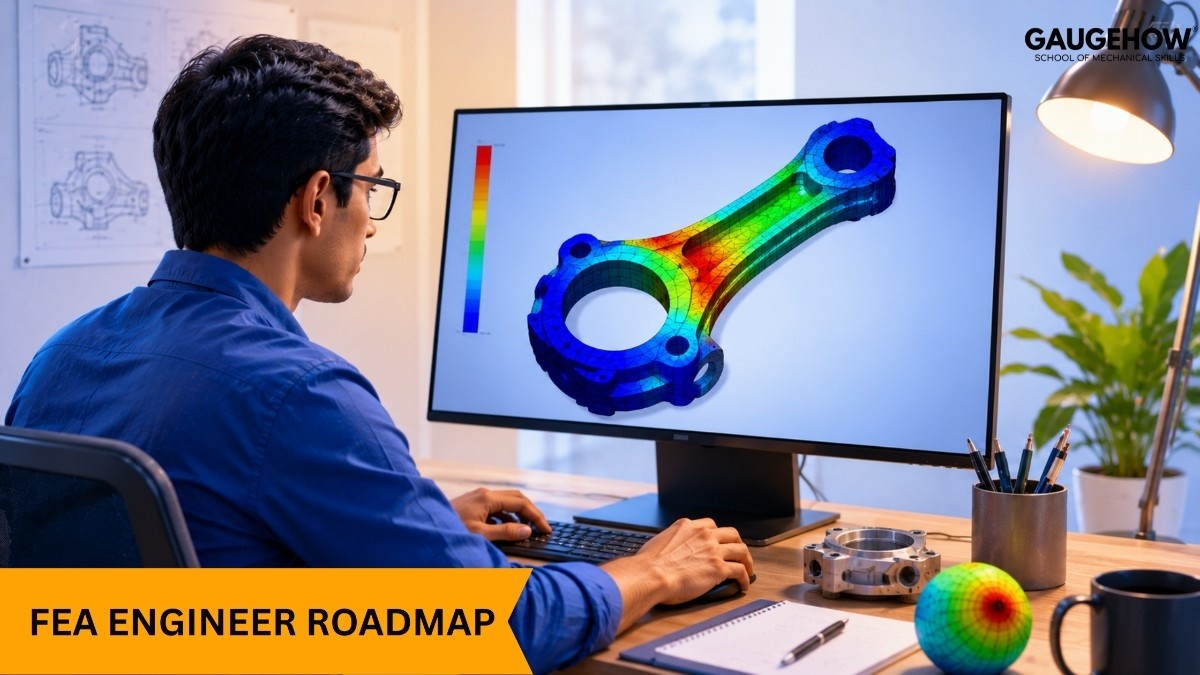
Before a bracket, chassis, or pressure vessel is ever machined, an FEA engineer has already broken it, bent it, and stressed it inside a computer, over and over, until the design holds up.
Finite Element Analysis is one of the most focused and in demand specializations inside CAE, and it rewards engineers who are precise, patient, and genuinely curious about why a part fails.
If you want a clear FEA engineer roadmap for 2026, this guide from GaugeHow lays out exactly what to learn, in what order, and what your career looks like at each stage.
What Does an FEA Engineer Actually Do?
An FEA engineer uses Finite Element Analysis to predict how a part or assembly behaves under real world loads before it is manufactured.
That includes building an accurate mesh, applying the right boundary conditions and material properties, running the simulation, and interpreting stress, deformation, or fatigue results correctly.
Unlike a CAE engineer who may also handle CFD or multiphysics work, an FEA engineer usually specializes deeply in structural simulation, which makes this roadmap narrower and more focused than a general CAE or simulation engineer path.
FEA Engineer Roadmap
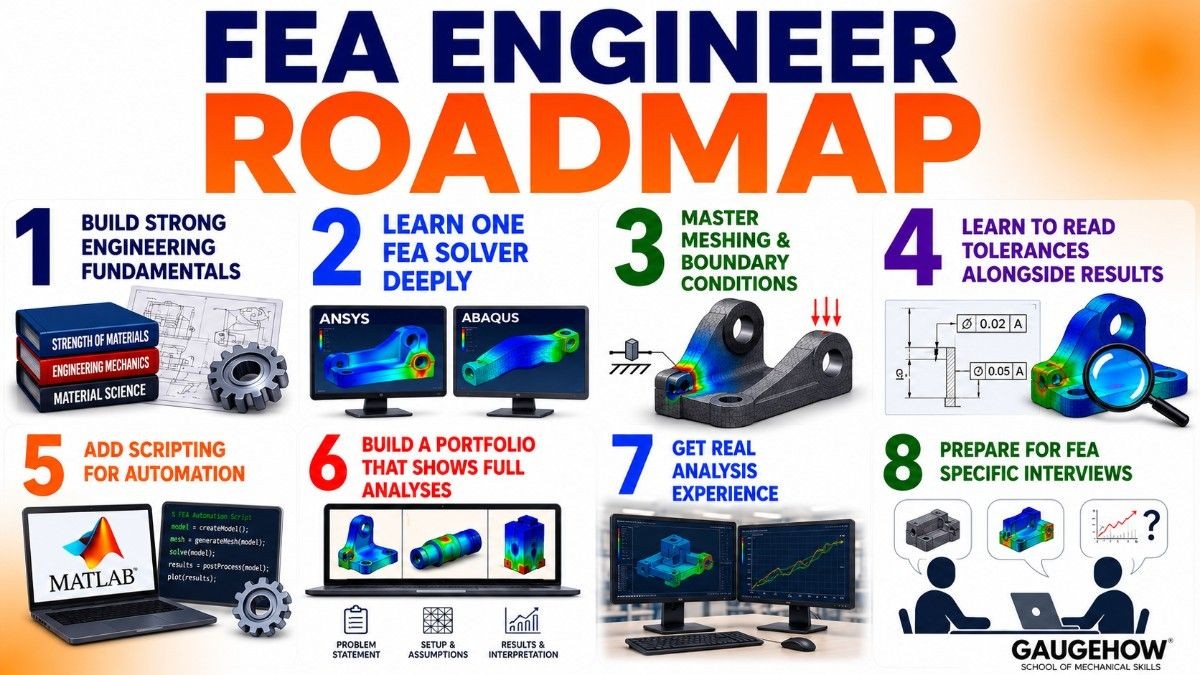
Step 1, Build Strong Engineering Fundamentals
Before opening any FEA software, you need a solid grip on strength of materials, engineering mechanics, and basic material science.
A bachelor's degree in mechanical, automotive, or aerospace engineering is the standard entry point.
These fundamentals are what let you judge whether a stress result actually makes physical sense, instead of trusting whatever number the software produces on the first run.
Step 2, Learn One FEA Solver Deeply
This is the single most important step in the roadmap, and it is worth choosing deliberately rather than picking whatever tutorial you find first.
ANSYS is one of the most requested tools across FEA job listings, covering linear static, thermal, and modal analysis as a strong starting point. Our FEA with ANSYS course covers the full workflow from meshing through result interpretation.
ABAQUS is widely used for advanced nonlinear structural analysis, including material nonlinearity, large deformation, and contact problems. Our ABAQUS CAE course takes you from basics to advanced simulation.
Learn one solver until you can independently build a mesh, apply correct boundary conditions, and defend every setup choice in an interview.
Employers hire based on this kind of depth far more than on how many solvers you have briefly opened.
Step 3, Master Meshing and Boundary Conditions
Meshing is where most FEA results actually go wrong, long before the solver runs. Learn how mesh density affects accuracy, when to refine a mesh around stress concentrations, and how to choose boundary conditions that reflect the real constraint conditions of a part rather than a convenient simplification.
This step is less about software buttons and more about engineering judgment, and it is exactly what separates a dependable FEA engineer from someone who only runs default settings.
Step 4, Learn to Read Tolerances Alongside Results
An FEA result only means something if it is checked against the actual manufactured part, which is where tolerancing knowledge becomes surprisingly useful for an FEA engineer.
Our GD&T and Engineering Graphics course helps you understand how real world tolerances affect stress concentrations and fit, so your simulation assumptions match what will actually be manufactured rather than an idealized drawing.
Step 5, Add Scripting for Automation
FEA teams increasingly expect engineers who can automate repetitive meshing, boundary condition setup, and post processing tasks instead of repeating the same manual steps on every project.
Our MATLAB Programming course is a practical starting point, since MATLAB is widely used for post processing FEA results, running custom fatigue or safety factor calculations, and batching repetitive analysis tasks.
Step 6, Build a Portfolio That Shows Full Analyses
An FEA portfolio needs to prove you can run and interpret a complete analysis, not just that you know which menus to click.
Build two or three full projects that show a real problem, your meshing and boundary condition choices, the results, and your interpretation of what those results actually mean for the design.
A stress analysis on a bracket, a fatigue check on a rotating component, or a basic nonlinear contact study are all strong starting points. Document every assumption clearly, since interviewers almost always ask exactly why you made a specific setup decision.
Step 7, Get Real Analysis Experience
An internship on an active FEA team is the fastest way to see how structural analysis actually fits into a real product cycle, including design iterations and explaining a failure clearly to a design engineer who is not a simulation specialist.
If an internship is not available, well documented personal projects are a reasonable substitute, as long as they show a complete, defensible workflow rather than a partial setup.
Step 8, Prepare for FEA Specific Interviews
FEA engineer interviews usually test three things.
First, your understanding of meshing and boundary conditions, such as why you chose a specific mesh density near a stress concentration.
Second, your ability to catch an unrealistic result rather than accepting it blindly.
Third, your communication skills, since you will often need to explain a structural failure clearly to someone who is not an analysis expert. Practice with real questions on the Interview Q&A Hub before your first interview.
FEA Engineer Roadmap: Career Growth by Stage
Stage | Experience | What Changes |
|---|---|---|
FEA Modeler or Junior FEA Engineer | 0 to 2 years | Building meshes, running basic linear static setups under supervision |
FEA Engineer or Analyst | 2 to 5 years | Owns full structural analysis independently, starts nonlinear and fatigue work |
Senior FEA Engineer | 5 to 8 years | Leads complex nonlinear or fatigue analysis, mentors juniors, reviews designs directly |
Lead or Principal FEA Engineer | 8 plus years | Sets analysis standards, technical authority across projects |
CAE Manager | 8 plus years, people track | Leads an analysis team, manages resourcing and project priorities |
Around the 5 to 8 year mark, most FEA engineers pick a direction. The individual contributor path means going deeper into a specific analysis type, such as fatigue, crash, or nonlinear contact, and becoming the specialist others rely on.
The management path means moving into leading an analysis team and planning project priorities. Both build on the same roadmap.
FEA Engineer Roadmap: Salary Expectations in India
Salary figures vary by source, city, and sector, but the general pattern across recent salary data is consistent:
Career Stage | Approximate Annual Salary (India) |
|---|---|
Fresher, 0 to 2 years | 3 to 6 LPA |
Mid level, 2 to 5 years | 6 to 12 LPA |
Senior, 5 to 8 years | 12 to 20 LPA |
Lead or Principal, 8 plus years | 20 LPA and above |
FEA engineers who combine solid meshing judgment with nonlinear analysis skills and basic scripting tend to land at the higher end of each band, especially in automotive, aerospace, and heavy equipment companies that depend heavily on structural simulation before physical testing.
FAQ: FEA Engineer Roadmap
Q: Should I learn ANSYS or ABAQUS first?
A: ANSYS is a strong general starting point for linear static and thermal analysis. ABAQUS becomes more important once you move into nonlinear or advanced contact problems, so many FEA engineers learn both over time.
Q: Is an FEA engineer the same as a CAE engineer?
A: FEA engineer is usually a more specialized title, focused specifically on structural simulation. CAE engineer is a broader title that can also include CFD or multiphysics work.
Q: How much does meshing knowledge really matter?
A: It matters more than most beginners expect. Poor mesh decisions are one of the most common causes of misleading results, so strong meshing judgment is one of the clearest signals of a capable FEA engineer.
Q: Do I need programming skills to follow this roadmap?
A: Not to get started, but basic MATLAB or Python skills become valuable quickly, since FEA teams value engineers who can automate repetitive setup and post processing tasks.
Q: How long does it take to move through this roadmap to a senior role?
A: Roughly 5 to 8 years of hands on experience, assuming steady growth from basic linear static analysis into independent nonlinear, fatigue, or contact analysis work.
Conclusion
An FEA engineer roadmap follows a clear order: strong fundamentals, deep skill in one solver, real meshing and boundary condition judgment, tolerancing awareness, and basic scripting for automation, all backed by a portfolio that proves you can run and interpret a full structural analysis.
Follow this sequence, and the path from fresher to senior FEA engineer becomes a well defined climb rather than a guessing game.
Start Your FEA Engineer Roadmap With GaugeHow
Explore the full FEA/CAE Simulation Path or the CAE / Simulation Engineer career track on GaugeHow for a structured route through FEA, meshing, and analysis skills built for exactly this roadmap.
CAD-CAM-CAE Work Platform
Find or Post CAD, CAM and CAE freelance projects, full-time jobs and Internships.
GaugeHow is the platform built for core engineering work. Whether you need a freelancer for a CAD project, a full-time hire, or an engineering intern,post it here and get matched with the right person.
Our Courses
Complete Course Library
Access to 40+ courses covering various fields like Design, Simulation, Quality, Manufacturing, Robotics, and more.