
How to Become a Mechanical Engineer in 2026
Learn More in This Video
Subscribe to GaugeHow for More
Thinking about a mechanical engineering career but not sure what the field actually looks like right now? You are not alone.
The core of the job, designing and validating physical systems, has not changed, but what employers expect on day one has shifted noticeably, with EV work, connected manufacturing, and basic scripting skills now showing up in postings that would not have mentioned them a few years ago.
This guide walks through exactly what to learn and in what order, based on what mechanical engineering roles actually ask for in 2026, not just the theory from a textbook.
What Is a Mechanical Engineer in 2026?
The fundamentals of mechanical engineering are unchanged: design parts and systems, validate them against real physical conditions, and make sure they can be manufactured reliably. What has shifted is the surrounding context. More roles now expect at least basic familiarity with:
Electric vehicle systems, since automakers and suppliers are hiring mechanical engineers into battery and thermal design roles at a growing rate
Connected manufacturing concepts like IIoT and digital twins, even outside dedicated automation roles
Basic scripting, since automating a repetitive simulation or data task is now considered a practical time-saver rather than a specialist skill
Sustainability-driven design choices, including lightweighting and material selection with lifecycle impact in mind
None of this replaces the core fundamentals. It sits on top of them, which is exactly how this roadmap is structured.
How to Become a Mechanical Engineer: Step by Step
Step 1: Get the Right Education
A bachelor's degree in mechanical engineering remains the standard entry point, covering statics, dynamics, thermodynamics, and materials science.
If you are choosing electives, prioritize manufacturing processes, control systems, and applied mathematics, since these show up constantly in real job requirements.
If you are early in your studies or exploring the field before committing, GaugeHow's Free Course is a low-pressure way to get a feel for the kind of material you will be working with.
Step 2: Learn CAD Software
Every mechanical design starts as a 3D model or a 2D drawing, which makes CAD the single most universal skill in the field, regardless of which specialization you eventually choose.
AutoCAD covers 2D drafting fundamentals, while SolidWorks 2024 and Fusion 360 are both widely used platforms worth learning early, since most companies standardize on one or the other.
Step 3: Learn GD&T and Engineering Drawings
This step gets skipped by a lot of beginners, and it shows up fast in both interviews and real projects.
A design that looks correct on screen can still fail to assemble or fail inspection if the tolerancing is wrong. The GD&T and Engineering Graphics course covers exactly the symbols and logic used on real production drawings.
Step 4: Learn Simulation Basics
Before a design becomes a physical part, most companies expect it to be validated digitally first, catching structural or thermal problems before they become expensive prototype failures.
The FEA with ANSYS course covers this exact simulation foundation, using realistic load cases rather than abstract textbook problems.
Step 5: Understand Manufacturing Processes
A design that ignores how it will actually be manufactured usually comes back for a costly redesign. Understanding both traditional and modern manufacturing methods helps you design parts that work the first time.
The CNC Programming course covers traditional machining, while modern shops increasingly expect at least basic awareness of additive manufacturing as well.
Step 6: Learn Quality Fundamentals
Every part eventually gets measured against its drawing, and understanding that process, even at a basic level, makes you a stronger engineer regardless of your specialization.
The Basics of 6 Sigma course covers this quality-minded thinking that shows up constantly in real engineering work, not just in dedicated quality roles.
Step 7: Build a Portfolio of Real Projects
Certifications and coursework matter, but one real project you can walk through confidently in an interview matters more.
Pick something specific: a redesigned bracket that reduced weight, a simulation that predicted a failure mode, or a small mechanism you built end to end. Document the process and the numbers, not just the finished result.
Step 8: Add the Skills Employers Expect in 2026
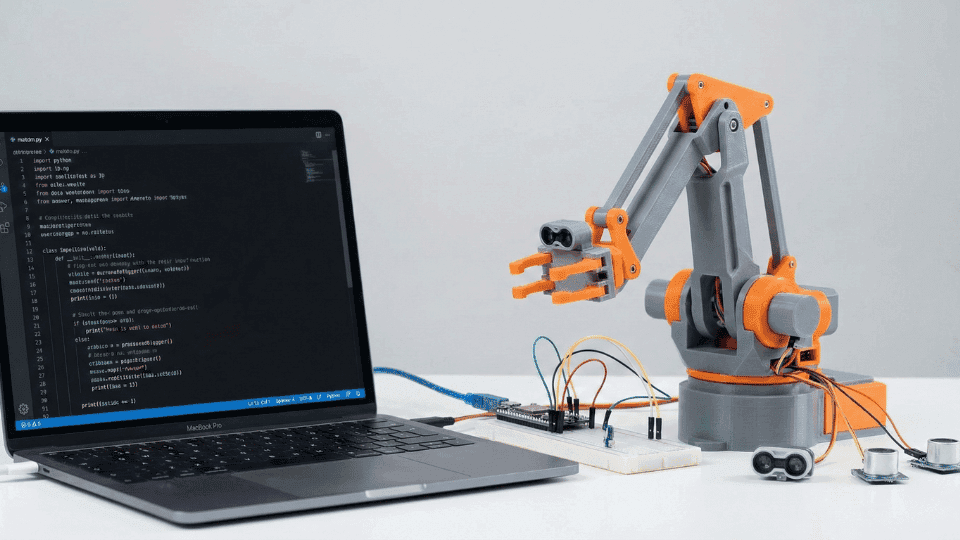
This is where the roadmap adjusts for the current job market. Basic scripting in Python for Mechanical Engineers & Robotics is increasingly expected for automating repetitive tasks.
If EV work interests you, the EV Battery Technology & Electric Vehicle Fundamentals course covers a fast-growing area of hiring. And a basic grounding in the Introduction to Industry 4.0 course helps you speak the same language as the connected manufacturing systems most modern plants now run on.
Step 9: Apply Strategically
Mechanical engineering hiring varies a lot by sector in 2026. Automotive and EV-adjacent companies are hiring aggressively for battery and thermal design skills. Aerospace still prioritizes documentation discipline and tight tolerance control.
The Automotive industry page and Aerospace industry page are good places to see what each sector actually prioritizes before you apply, and the Jobs section is worth checking for current openings that match your skill set.
Before interviews, review common technical questions so a design or calculation scenario does not catch you off guard. The Interview Q&A Hub has role-specific practice questions, and the Practice / MCQ Tests section is useful for a quick knowledge check before a technical round.
Mechanical Engineer Skills Checklist for 2026
Skill Area | Beginner | Job Ready |
|---|---|---|
CAD modeling | Can open and view a model | Can design a full assembly from scratch |
GD&T and print reading | Recognizes basic symbols | Can interpret full feature control frames |
Simulation (FEA basics) | Knows what FEA is used for | Can set up and interpret a basic structural simulation |
Manufacturing awareness | Knows machining exists as a concept | Can design a part with manufacturing constraints in mind |
Quality fundamentals | Knows what a defect is | Can explain how a process is checked against spec |
Modern 2026 skills | Aware EV and Industry 4.0 trends exist | Can hold a real conversation about either in an interview |
Where Do Mechanical Engineers Work in 2026?
Sector | What It Prioritizes | Good Fit If You Enjoy |
|---|---|---|
Automotive and EV | Battery, thermal, and high-volume production skills | Fast-moving projects with real vehicle impact |
Aerospace | Documentation discipline and tight tolerance control | Precision work with strict safety standards |
Industrial manufacturing | Process efficiency and connected systems | Improving how things are made at scale |
Robotics | Mechatronics and automation integration | Hands-on hardware and control systems work |
Frequently Asked Questions
Q: Do I still need a mechanical engineering degree in 2026?
A: Yes, in almost all cases. A bachelor's degree remains the standard entry requirement, providing the theoretical foundation that every specialization and modern skill in this roadmap builds on.
Q: Is coding necessary to become a mechanical engineer now?
A: Not at an expert level, but basic scripting, especially in Python, is increasingly expected for automating repetitive simulation or data tasks, and its absence is starting to stand out on a resume.
Q: Should I learn EV-specific skills even if I am not sure I want to work in automotive?
A: It is worth at least a basic foundation, since EV and battery-adjacent hiring is one of the fastest-growing areas in mechanical engineering right now, and the skills transfer reasonably well to other thermal and structural design work.
Q: How long does it take to become job ready after graduating?
A: Most graduates need three to six months of focused skill-building, CAD, GD&T, basic simulation, and one strong portfolio project, before they are genuinely competitive for entry-level roles.
Q: What is the biggest mistake beginners make in this field?
A: Spending too long on theory without building anything real. A single well-documented project you can explain clearly in an interview is worth more than a stack of certificates with nothing to show for them.
Conclusion
Becoming a mechanical engineer in 2026 still starts with the same fundamentals it always has, CAD, tolerancing, simulation, and manufacturing awareness, but it now expects a layer of modern skills on top: basic scripting, EV fundamentals, and connected manufacturing awareness.
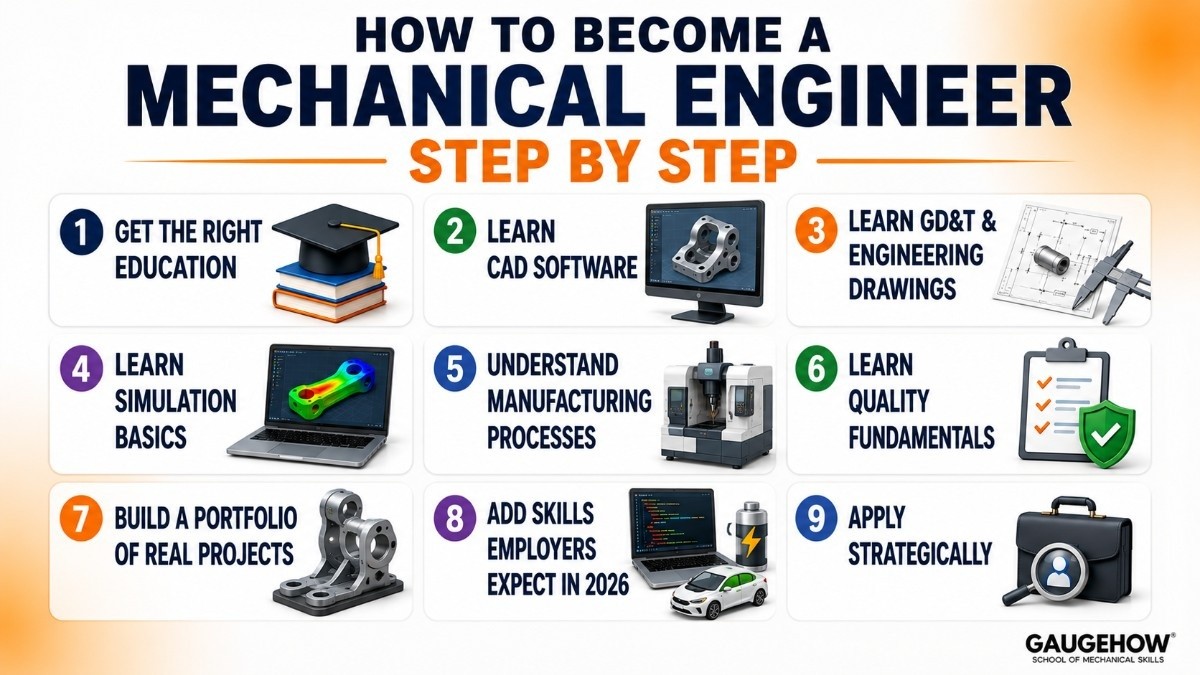
Follow the roadmap in order: education, CAD, GD&T, simulation, manufacturing processes, quality fundamentals, a real portfolio project, then the 2026-specific skills that make you stand out.
Ready to get started? Visit the Mechanical Engineer Hub on GaugeHow to see the full course sequence mapped to this exact roadmap.
Mechanical Engineering Courses That Industry Actually Uses
Learn Tools of Design & CAD, Analysis & Simulation, Automation & Robotics, and Industry 4.0 used in modern factories.
Join 40+ Mech Courses like GD&T, Siemens NX, SolidWorks, CATIA V5, AutoCAD, ANSYS (FEA & Fluent), ABAQUS, Creo, Fusion 360, CNC Programming, Digital Twins, Python for Mechanical, and Industry 4.0.
Our Courses
Complete Course Library
Access to 40+ courses covering various fields like Design, Simulation, Quality, Manufacturing, Robotics, and more.