
How to Become an EV Engineer: A Step-by-Step Roadmap
Learn More in This Video
Subscribe to GaugeHow for More
Want to move into electric vehicle engineering but not sure whether to focus on batteries, thermal systems, or vehicle design first? You are not alone. Most mechanical engineers know combustion vehicles well but have never touched a battery pack, a thermal simulation, or the specific design constraints that come with EV architecture.
This roadmap breaks the transition into clear, ordered stages. No vague advice like "learn EVs." Just the tools, simulations, and skills that actually show up in real job postings, in the order you should learn them.
What Does an EV Engineer Actually Do?
An EV engineer designs, simulates, and validates the systems that make an electric vehicle safe, efficient, and reliable. In practice, this means:
Designing battery pack layouts, enclosures, and structural mounts
Running thermal simulations to keep battery cells within safe operating limits
Selecting materials that balance weight, strength, and thermal performance
Validating designs with FEA and CFD before physical prototypes are built
Working with electrical teams on battery management and cooling system integration
Testing and iterating designs against range, safety, and durability targets
It's a role that blends mechanical design with a working understanding of battery chemistry and thermal behavior.
You do not need to become an electrochemist, but you do need to understand the constraints batteries put on the mechanical systems around them.
How to Become an EV Engineer: Step by Step
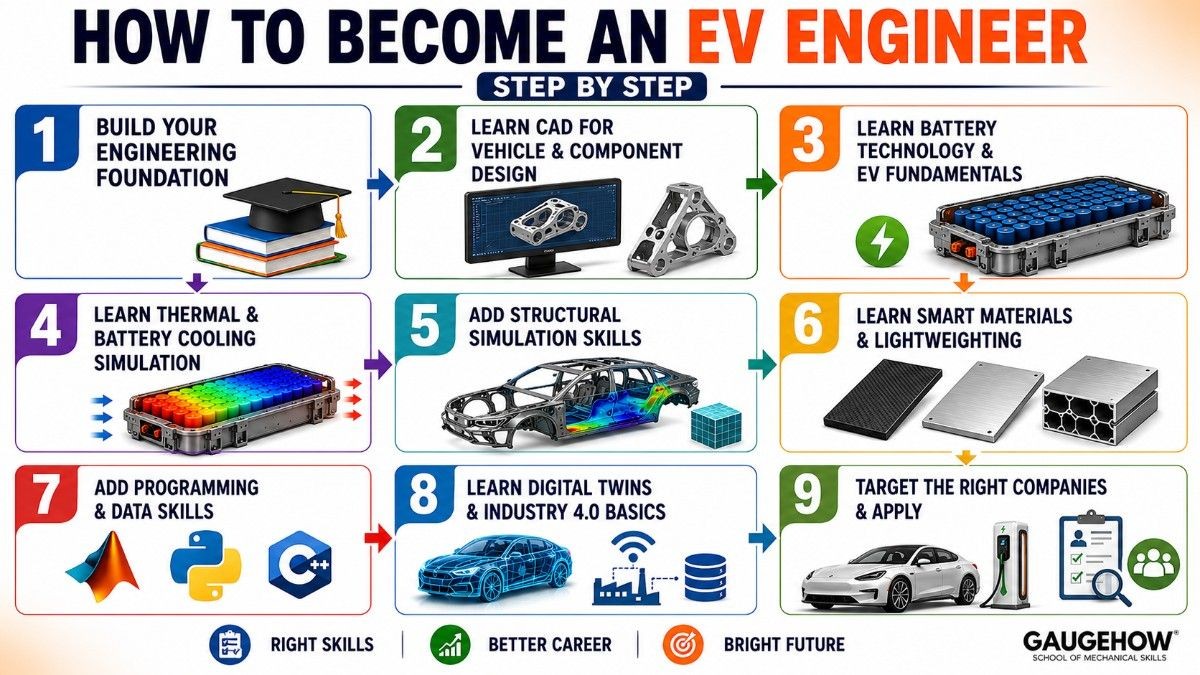
Step 1: Build Your Engineering Foundation
Most EV roles ask for a bachelor's degree in mechanical, automotive, or electrical engineering.
If you are still studying, prioritize electives in thermodynamics, materials science, and vehicle dynamics. If you already have the degree, this step is done. Move on.
Step 2: Learn CAD for Vehicle and Component Design
Every EV component starts as a 3D model before it becomes hardware. You need to be comfortable designing enclosures, brackets, and structural components that meet tight packaging constraints, since EV platforms leave far less room to spare than a combustion engine bay.
A strong CAD foundation in a widely used platform like SolidWorks 2024 or Fusion 360 is the right starting point here.
Why CAD Skills Matter More in EV Design
Battery packs, cooling plates, and structural mounts all have to fit around each other with almost no wasted space.
Engineers who can model and iterate these parts quickly are far more valuable on a fast-moving EV program than those who rely on someone else to translate their sketches into a working model.
Step 3: Learn Battery Technology and EV Fundamentals
This is the knowledge that separates a general mechanical engineer from someone genuinely job-ready for EV work.
You need to understand battery chemistry basics, pack architecture, thermal behavior under load, and how range and charging constraints shape the rest of the vehicle design. The EV Battery Technology & Electric Vehicle Fundamentals course covers exactly this foundation.
Step 4: Learn Thermal and Battery Cooling Simulation
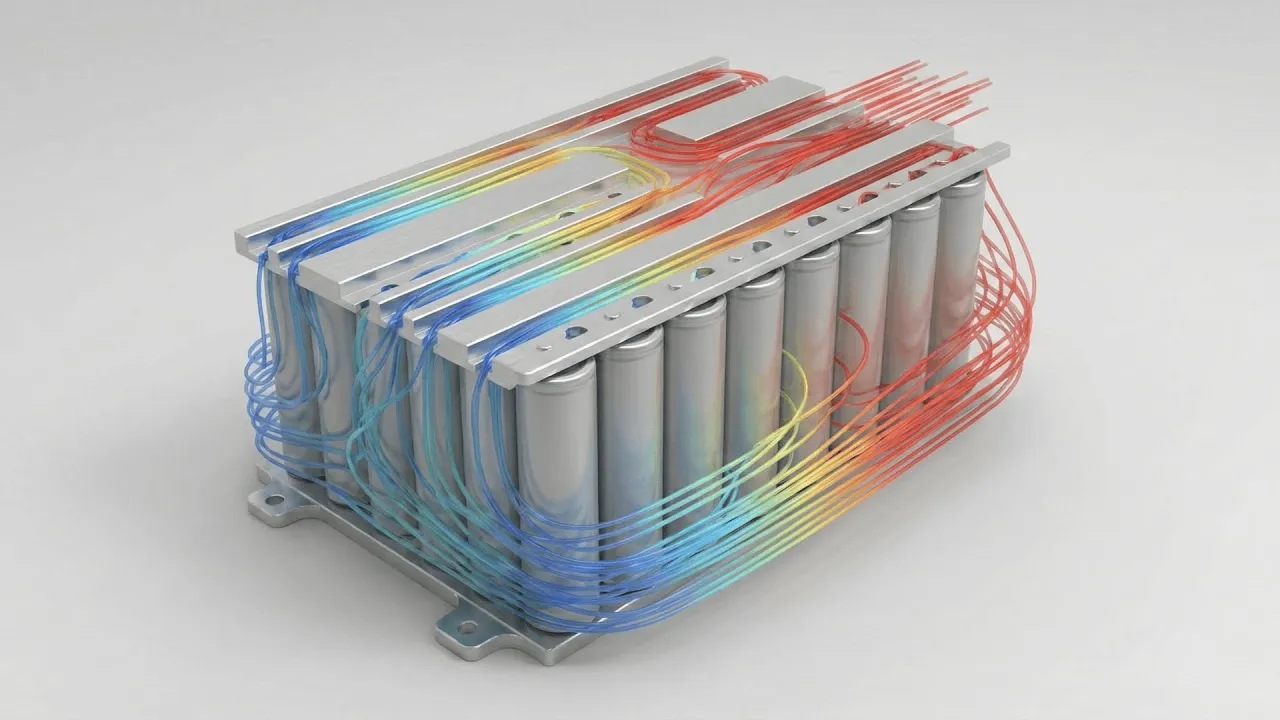
Battery packs generate heat, and managing that heat is one of the most safety-critical parts of EV engineering. You need to be able to simulate cooling performance before a physical prototype is ever built, since a design flaw caught late in a battery thermal system is expensive and slow to fix.
The ANSYS Fluent / EV Battery Cooling course walks through this exact simulation workflow, and Autodesk CFD is a strong complementary tool for broader airflow and cooling analysis.
Step 5: Add Structural Simulation Skills
Alongside thermal performance, EV components still need to survive real mechanical loads: vibration, impact, and structural fatigue over the vehicle's life. FEA skills let you validate a design digitally before committing to expensive tooling.
The FEA with ANSYS course covers this, and COMSOL Multiphysics is useful when thermal and structural effects need to be modeled together, which happens constantly in battery enclosure design.
Step 6: Learn Smart Materials and Lightweighting
Every kilogram matters in an EV, since weight directly affects range. Understanding smart and lightweight materials, and how material choice interacts with thermal and structural performance, is becoming a genuine differentiator for EV-focused roles.
The Smart Materials Science course covers this material-level knowledge that pure CAD or simulation training usually skips.
Step 7: Add Programming and Data Skills
Modern EV development increasingly relies on scripting for simulation automation, battery management data analysis, and control system prototyping.
MATLAB is heavily used for battery modeling and control logic, while Python and C++ show up across simulation automation and embedded systems work.
The MATLAB Programming course, Python for Mechanical Engineers & Robotics course, and C and C++ for Mechanical Engineering course all build this skill set from an engineering angle.
Step 8: Learn Digital Twins and Industry 4.0 Basics
EV manufacturing increasingly relies on connected systems to catch quality issues early and validate designs before physical builds. Understanding how a digital twin can simulate a battery pack or production line before committing resources to it is a skill that is quickly becoming standard rather than advanced.
The Digital Twins course and Introduction to Industry 4.0 course both build this layer on top of your design and simulation foundation.
Step 9: Target the Right Companies and Apply
EV hiring is concentrated heavily in the automotive sector, but the specific focus varies by company: some prioritize battery pack design, others focus on thermal systems, and others on vehicle-level integration.
The Automotive industry page is a good place to see what skills that sector emphasizes before you apply.
Before interviews, review common technical questions so a thermal management or battery layout scenario does not catch you off guard. The Interview Q&A Hub has role-specific practice questions, and the Practice / MCQ Tests section is useful for a quick knowledge check before a technical round.
EV Engineer Skills Checklist
Skill Area | Beginner | Job Ready |
|---|---|---|
CAD for EV components | Can open and modify a model | Can design a battery enclosure within tight packaging limits |
Battery and EV fundamentals | Knows basic terminology | Can explain how pack design affects range and safety |
Thermal simulation | Aware simulation tools exist | Can run and interpret a battery cooling simulation |
Structural simulation | Knows what FEA is used for | Can validate a component against real load cases |
Materials knowledge | Knows common lightweight materials | Can justify a material choice against weight and thermal targets |
Programming / scripting | Knows basic MATLAB or Python syntax | Can automate a simulation workflow or analyze battery data |
EV Engineer vs Automotive Engineer vs Battery Engineer
These three titles overlap heavily on EV programs, and many job postings blend all three into one role.
Role | Main Focus | Typical Tools |
|---|---|---|
EV Engineer | Designing and validating EV-specific systems and components | CAD, FEA, CFD, battery fundamentals |
Automotive Engineer | Broader vehicle-level design across powertrain types | CAD, simulation, vehicle dynamics tools |
Battery Engineer | Specializing specifically in cell, pack, and thermal design | Battery modeling, thermal simulation, MATLAB |
A strong EV engineer usually understands enough battery and thermal fundamentals to work closely with specialists without needing every detail explained. If battery-specific work interests you most, the EV / Battery Engineer career track is worth reviewing before you specialize further.
Frequently Asked Questions
Q: Do I need a specific degree to become an EV engineer?
A: Most employers prefer a bachelor's degree in mechanical, automotive, or electrical engineering, though candidates from other engineering backgrounds are hired regularly if they can show relevant simulation or design project experience.
Q: Is battery chemistry knowledge required for EV engineering roles?
A: A working understanding of battery behavior, thermal limits, and pack architecture is expected, but deep electrochemistry knowledge is usually the responsibility of specialized battery chemists rather than mechanical EV engineers.
Q: What simulation software should I learn for EV work?
A: ANSYS Fluent and Autodesk CFD are commonly used for thermal and cooling analysis, while ANSYS and COMSOL are widely used for structural and multiphysics simulation, especially around battery enclosures.
Q: How long does it take to transition into EV engineering from a mechanical background?
A: With an engineering degree already in hand, most people can become job ready in six months to a year by learning EV fundamentals, thermal simulation, and completing one hands-on battery-related project they can walk through in an interview.
Q: Which companies hire the most for EV engineering roles?
A: Traditional automakers expanding into EVs, dedicated EV manufacturers, and battery pack suppliers all hire heavily for this role, since each depends on safe, efficient battery and thermal system design.
Conclusion
Becoming an EV engineer is less about switching fields entirely and more about layering battery, thermal, and materials knowledge on top of a solid mechanical design foundation.
Follow the roadmap in order: engineering foundation, CAD for EV components, battery and EV fundamentals, thermal and structural simulation, materials knowledge, programming skills, then digital twins and Industry 4.0 basics.
Ready to build the skill set? Start with the EV / Battery Engineer career track on GaugeHow to see the full course sequence mapped to this exact roadmap.
Mechanical Engineering Courses That Industry Actually Uses
Learn Tools of Design & CAD, Analysis & Simulation, Automation & Robotics, and Industry 4.0 used in modern factories.
Join 40+ Mech Courses like GD&T, Siemens NX, SolidWorks, CATIA V5, AutoCAD, ANSYS (FEA & Fluent), ABAQUS, Creo, Fusion 360, CNC Programming, Digital Twins, Python for Mechanical, and Industry 4.0.
Our Courses
Complete Course Library
Access to 40+ courses covering various fields like Design, Simulation, Quality, Manufacturing, Robotics, and more.