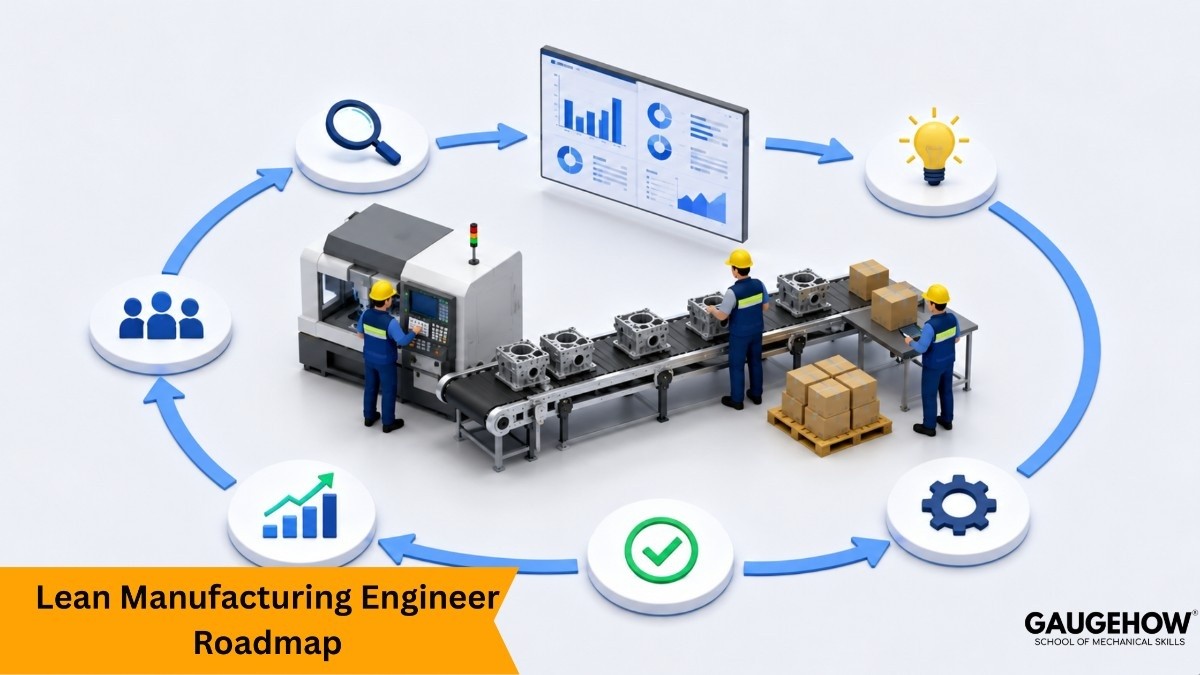
Lean Manufacturing Engineer Roadmap: A Step-by-Step Career Guide
Learn More in This Video
Subscribe to GaugeHow for More
Want to become a lean manufacturing engineer but not sure where to start? You are not alone. Most mechanical and industrial engineering graduates learn the theory of lean in one semester and then get thrown onto a shop floor with zero idea how Kaizen, 5S, or Value Stream Mapping actually work in practice.
This roadmap breaks the career down into seven practical stages. No fluff, no vague advice like "learn lean principles." Just the skills, tools, and certifications that actually show up in real job postings, in the order you should learn them.
What Does a Lean Manufacturing Engineer Actually Do?
A lean manufacturing engineer's job is to find waste in a production process and remove it, without hurting output or quality. In practice, this means:
Mapping current production flow and finding bottlenecks
Running Kaizen events with operators and supervisors
Reducing setup time, scrap, rework, and downtime
Standardizing work instructions so processes stay consistent
Working with quality and production teams to track KPIs like first pass yield and OEE
It's a hands-on role. You will spend as much time on the shop floor with a stopwatch and a whiteboard as you will in meetings.
Lean Manufacturing Engineer Roadmap: Step by Step
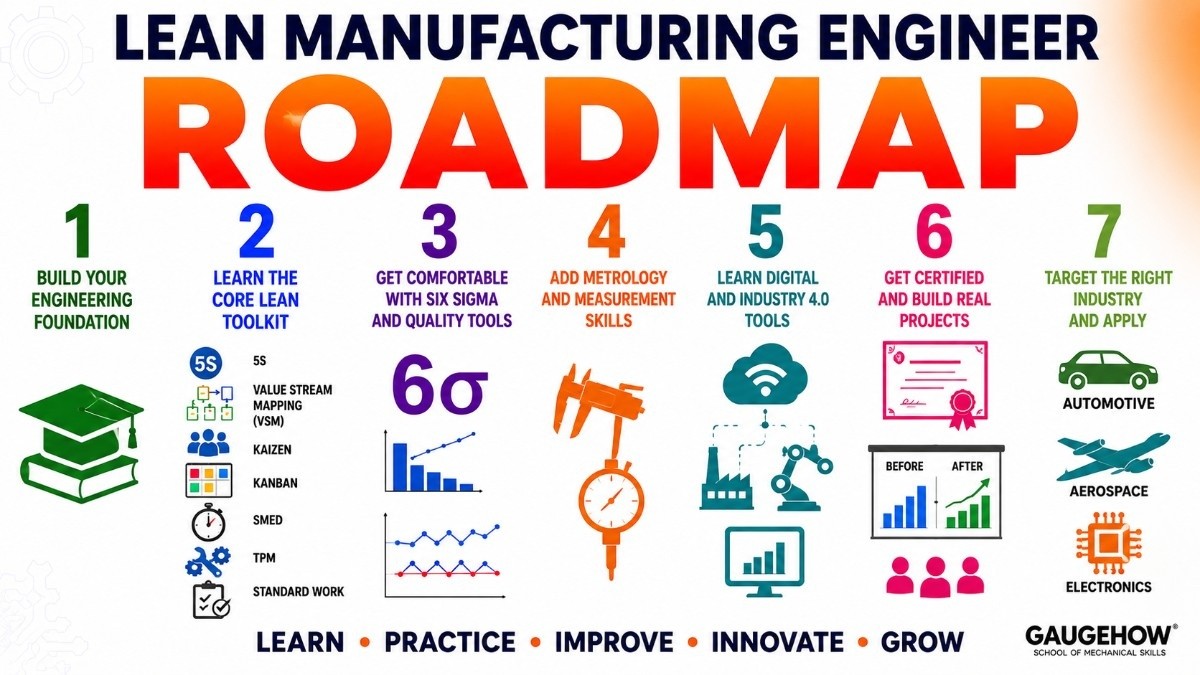
Step 1: Build Your Engineering Foundation
Most lean roles ask for a bachelor's degree in mechanical, industrial, or manufacturing engineering. If you are still studying, focus your electives on manufacturing processes, quality control, and statistics. If you already have the degree, this step is done. Move on.
Step 2: Learn the Core Lean Toolkit
This is the actual heart of the job. You need working knowledge of:
Tool | What it's used for |
|---|---|
5S | Workplace organization and standardization |
Value Stream Mapping (VSM) | Visualizing flow and finding waste |
Kaizen | Structured continuous improvement events |
Kanban | Pull based inventory and production control |
SMED | Reducing changeover and setup time |
TPM | Preventing equipment downtime |
Standard Work | Documenting the one best way to do a task |
Rather than reading about these in isolation, a structured course helps you see how they connect. Lean Manufacturing Tools covers this exact toolkit with practical examples, and 5S System goes deep on the workplace organization piece most beginners underestimate.
Step 3: Get Comfortable With Six Sigma and Quality Tools
Lean and Six Sigma overlap heavily in real jobs. Lean removes waste, Six Sigma removes variation, and most employers expect you to speak both languages. You do not need a Black Belt on day one, but you should understand DMAIC, root cause analysis, and basic statistical process control.
Pair this with the classic quality toolkit: Pareto charts, fishbone diagrams, control charts, and histograms. These come up constantly in interviews and on the job. Basics of 6 Sigma and 7 QC Tools cover both foundations in a job ready format.
Step 4: Add Metrology and Measurement Skills
You cannot reduce variation you cannot measure. Lean engineers who also understand measurement systems, gauge R&R, and inspection basics are far more valuable, especially in regulated industries like automotive and aerospace where every process change needs data to back it up.
Engineering Metrology & 3D Measurement is worth adding here even if measurement is not your main job title.
Step 5: Learn Digital and Industry 4.0 Tools
Lean is no longer just a whiteboard and a stopwatch. Plants are adding IoT sensors, real time dashboards, and predictive maintenance systems, and lean engineers are expected to interpret that data, not just collect it manually.
Understanding how Industry 4.0 concepts and Digital Manufacturing fit into a lean program is quickly becoming a differentiator between candidates, not a nice to have.
Step 6: Get Certified and Build Real Projects
Certifications alone will not get you hired, but they signal that you can actually apply the tools.
Pick two or three from Step 2 and Step 3, then apply them on a real or simulated project you can talk through in an interview: a line rebalance, a setup time reduction, a defect reduction study.
Document the before and after numbers. That single project, explained clearly, matters more than a stack of certificates.
Step 7: Target the Right Industry and Apply
Lean hiring looks different by sector. Automotive plants want SMED and Kanban experience. Aerospace wants documentation discipline and measurement rigor.
Electronics wants fast changeover and defect tracking. If you are targeting automotive specifically, the Automotive industry page is a good place to see what skills that sector emphasizes before you apply.
Before interviews, review common questions so you are not caught off guard by a scenario based Kaizen question. The Interview Q&A Hub has role specific practice questions worth going through the week before an interview.
Lean Manufacturing Engineer Skills Checklist
Skill Area | Beginner | Job Ready |
|---|---|---|
5S and workplace organization | Knows the 5 steps | Has led a 5S audit |
Value Stream Mapping | Can read a VSM | Has drawn current and future state maps |
Kaizen facilitation | Understands the format | Has run or co-led an event |
Six Sigma / DMAIC | Knows the phases | Has used it on a real defect problem |
Data and metrics | Knows OEE, FPY definitions | Can calculate and track them weekly |
Digital tools | Aware of IoT and dashboards | Has interpreted real time production data |
Lean Manufacturing Engineer vs Six Sigma Engineer vs Quality Engineer
These three titles get confused constantly, and job descriptions often blend them. Here is the real difference.
Role | Main Focus | Typical Tools |
|---|---|---|
Lean Manufacturing Engineer | Removing waste and improving flow | 5S, Kaizen, VSM, Kanban, SMED |
Six Sigma Engineer | Reducing process variation | DMAIC, control charts, statistical analysis |
Quality Engineer | Ensuring product meets spec | Inspection, CMM, calibration, root cause analysis |
In practice, a strong lean manufacturing engineer usually understands enough of both neighboring fields to work across the line. If quality and measurement interests you more than process flow, it's worth comparing this against the Quality Engineer career track before committing to one path.
Frequently Asked Questions
Q: Do I need a specific degree to become a lean manufacturing engineer?
A: Most employers prefer a bachelor's degree in mechanical, industrial, or manufacturing engineering, but it is not always mandatory. Many companies hire from quality or production roles and train employees on lean tools internally, especially if the candidate can show relevant project experience.
Q: Is Six Sigma certification necessary for a lean manufacturing role?
A: Not always required, but a Green Belt or equivalent understanding of DMAIC is expected in most postings above entry level. It signals that you can back up process improvements with data, not just observation.
Q: What is the difference between lean manufacturing and Six Sigma?
A: Lean focuses on removing waste and improving flow, while Six Sigma focuses on reducing variation using statistical methods. Most modern roles expect familiarity with both, often under the combined label "Lean Six Sigma."
Q: How long does it take to become job ready as a lean manufacturing engineer?
A: With an engineering degree already in hand, most people can become job ready in three to six months by learning the core lean toolkit, basic Six Sigma, and completing one documented improvement project.
Q: Which industries hire the most lean manufacturing engineers?
A: Automotive, aerospace, electronics, and medical device manufacturing hire heavily for this role, since all four run high volume or highly regulated production lines where waste and variation directly affect cost and compliance.
Conclusion
Becoming a lean manufacturing engineer is less about collecting certificates and more about being able to walk onto a shop floor, spot the waste, and fix it with data behind you. Follow the roadmap in order: foundation, lean tools, Six Sigma and quality tools, measurement, digital skills, then a real project you can defend in an interview.
Ready to build the skill set? Start with the Production Engineer career track on GaugeHow to see the full course sequence mapped to this exact roadmap.
Mechanical Engineering Courses That Industry Actually Uses
Learn Tools of Design & CAD, Analysis & Simulation, Automation & Robotics, and Industry 4.0 used in modern factories.
Join 40+ Mech Courses like GD&T, Siemens NX, SolidWorks, CATIA V5, AutoCAD, ANSYS (FEA & Fluent), ABAQUS, Creo, Fusion 360, CNC Programming, Digital Twins, Python for Mechanical, and Industry 4.0.
Our Courses
Complete Course Library
Access to 40+ courses covering various fields like Design, Simulation, Quality, Manufacturing, Robotics, and more.