
Manufacturing Engineer Roadmap: From Fresher to Senior Engineer
Learn More in This Video
Subscribe to GaugeHow for More
Before a product ever reaches a production line, someone has to design the tooling, plan the process, and figure out how to build it consistently at scale. That is the job of a manufacturing engineer.
This role sits right at the point where a good design either becomes an efficient, repeatable product or turns into a costly, error prone process. If you want a clear manufacturing engineer roadmap for 2026, one that covers the tools, skills, and career stages in order, this guide from GaugeHow walks through it end to end.
What Is a Manufacturing Engineer? A Quick Refresher
A manufacturing engineer designs and develops the processes, tooling, and equipment needed to actually produce a part or product.
This includes creating jigs and fixtures, planning machining or forming processes, selecting manufacturing methods, and working closely with design engineers to make sure a product can be built cost effectively at scale.
This is different from a production engineer, who focuses on the ongoing efficiency of an existing process. A manufacturing engineer is usually more involved earlier, in developing how a new product gets made in the first place.
Manufacturing Engineer Roadmap
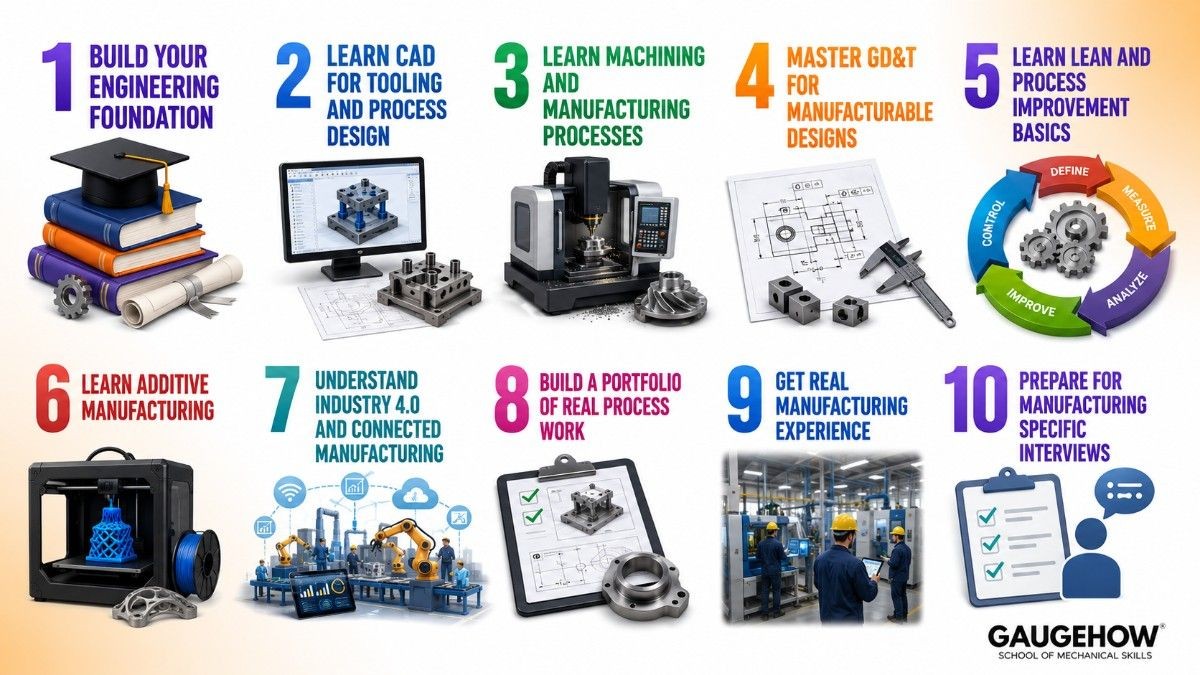
Stage 1, Build Your Engineering Foundation
A bachelor's degree in mechanical, manufacturing, industrial, or production engineering is the standard starting point.
Focus on manufacturing processes, materials science, and basic mechanics during your degree, since these subjects directly shape how practical and cost effective your process decisions will be later.
This foundation is what lets you judge whether a manufacturing method is actually viable, instead of just following a textbook example.
Stage 2, Learn CAD for Tooling and Process Design
Manufacturing engineers regularly design jigs, fixtures, and tooling, which makes CAD skill essential from early on.
SolidWorks is widely used for tooling, fixture, and equipment design across manufacturing environments. Our SolidWorks 2024 course covers part modeling, assemblies, and production ready drawings.
Learn this tool deeply enough to design a functional fixture or tool, not just a part, since tooling design has its own practical constraints around access, repeatability, and wear that a simple component model does not.
Stage 3, Learn Machining and Manufacturing Processes
Understanding how a part is actually produced, whether by machining, casting, or forming, is central to this roadmap.
Our CNC Programming course is a practical way to learn how a CAD model becomes a real machined part, which helps you design processes that are efficient and manufacturable from the start rather than fixed after the fact.
Stage 4, Master GD&T for Manufacturable Designs
Geometric Dimensioning and Tolerancing is how a manufacturing engineer communicates and interprets tolerances clearly enough to build a repeatable process around them.
Skipping this step is one of the most common gaps in fresh graduate resumes, which makes it one of the easiest ways to stand out. Our GD&T and Engineering Graphics course is built specifically to close this gap before you start applying for roles.
Stage 5, Learn Lean and Process Improvement Basics
A manufacturing engineer who understands lean principles designs better processes from the very start, rather than fixing waste after a line is already running.
Our Lean Manufacturing Tools course and Basics of 6 Sigma course cover the core methods used to reduce waste and variation, both of which are directly useful when designing a new manufacturing process rather than only maintaining an existing one.
Stage 6, Learn Additive Manufacturing
3D printing has become a standard part of the manufacturing engineer's toolkit, both for rapid prototyping of tooling and, increasingly, for producing certain final parts directly.
Our 3D Printing course covers how additive manufacturing fits into a real process development cycle, which is useful when deciding whether a part should be printed, machined, or molded.
Stage 7, Understand Industry 4.0 and Connected Manufacturing
Modern manufacturing engineering increasingly involves connected, data driven production systems rather than isolated machines.
Our Introduction to Industry 4.0 course, Digital Manufacturing course, and Industrial Internet of Things (IIoT) course help you understand how sensors, data, and connected systems are reshaping process design, a shift that is becoming a real expectation rather than an optional extra for manufacturing engineers.
Stage 8, Build a Portfolio of Real Process Work
Manufacturing engineering is provable through concrete examples, not certificates alone.
Document two or three real or practice projects that show a manufacturing problem, such as designing a fixture for a new part or planning a machining sequence, the process decisions you made, and the reasoning behind them, including cost and manufacturability tradeoffs.
This kind of concrete example is exactly what interviewers ask for, and most fresh candidates only have generic textbook answers ready instead.
Stage 9, Get Real Manufacturing Experience
An internship or entry level role in a manufacturing or process engineering department is the fastest way to see how tooling and process decisions actually play out on a real production floor, under real cost and time constraints.
If a formal internship is not available, look for opportunities to shadow a manufacturing or tooling design team, since direct exposure to how a new process actually gets developed builds intuition that no course alone can fully replace.
Stage 10, Prepare for Manufacturing Specific Interviews
Manufacturing engineer interviews usually test three things. First, your process knowledge, such as how you would choose between machining, casting, or forming for a specific part.
Second, your tooling and fixture design reasoning, including how you would ensure repeatability across production. Third, your ability to balance cost, quality, and speed when designing a new process. Practice with real questions on the Interview Q&A Hub before your first interview.
Manufacturing Engineer Roadmap: Career Growth by Stage
Stage | Experience | What Changes |
|---|---|---|
Junior Manufacturing Engineer | 0 to 2 years | Learning processes, tooling design, and manufacturing basics under supervision |
Manufacturing Engineer | 2 to 5 years | Owns tooling and process design for new parts, works closely with design teams |
Senior Manufacturing Engineer | 5 to 8 years | Leads process development for major products, mentors juniors |
Lead or Principal Manufacturing Engineer | 8 plus years | Sets manufacturing standards, technical authority across projects |
Manufacturing Engineering Manager | 8 plus years, people track | Leads a manufacturing engineering team, manages resourcing and project priorities |
Around the 5 to 8 year mark, most manufacturing engineers pick a direction.
The individual contributor path means going deeper into a specific process domain, such as tooling design, additive manufacturing, or connected factory systems, and becoming the specialist others rely on.
The management path means moving into leading a manufacturing engineering team and planning project priorities. Both build on the same roadmap.
Manufacturing Engineer Roadmap: Salary Expectations in India
Salary figures vary by source, city, and sector, but the general pattern across recent salary data is consistent:
Career Stage | Approximate Annual Salary (India) |
|---|---|
Fresher, 0 to 2 years | 3 to 6 LPA |
Mid level, 2 to 5 years | 6 to 12 LPA |
Senior, 5 to 8 years | 12 to 18 LPA |
Lead or Principal, 8 plus years | 18 LPA and above |
Manufacturing engineers who combine CAD and tooling design skills with lean, GD&T, and Industry 4.0 knowledge tend to land at the higher end of each band, especially in automotive, electronics, and high volume manufacturing companies.
FAQ: Manufacturing Engineer Roadmap
Q: What is the difference between a manufacturing engineer and a production engineer?
A:manufacturing engineer typically focuses on designing tooling and developing new manufacturing processes for a product. A production engineer focuses on the ongoing efficiency, quality, and reliability of a process that is already running.
Q: Do I need CNC programming skills to become a manufacturing engineer?
A: Not as a full time machinist skill, but understanding how CNC machining works helps you design more manufacturable parts and processes, which is a core part of the role.
Q: Is GD&T really necessary for a manufacturing engineer?
A: Yes. Manufacturing engineers need to interpret and apply tolerances correctly to design a process that consistently produces parts within specification, which makes GD&T one of the most practical skills on this roadmap.
Q: How important are Industry 4.0 skills for a manufacturing engineer today?
A: Increasingly important. Modern manufacturing lines are more connected and data driven, and manufacturing engineers who understand these systems are better positioned to design processes that fit into a smart factory environment.
Q: How long does it take to move through this roadmap to a senior role?
A: Roughly 5 to 8 years of hands on experience, assuming steady growth from basic tooling and process support into independently leading process development for new products.
Conclusion
A manufacturing engineer roadmap follows a clear order: strong fundamentals in manufacturing processes, real CAD skill for tooling design, GD&T fluency, lean process thinking, and growing comfort with additive manufacturing and Industry 4.0, all backed by a portfolio of real process design work.
Follow this sequence, and the path from fresher to senior manufacturing engineer becomes a well defined climb rather than a guessing game.
Start Your Manufacturing Engineer Roadmap With GaugeHow
Explore the Digital / Industry 4.0 Engineer career track or the Production Engineer career track on GaugeHow for a structured route through the tooling, process, and digital manufacturing skills covered in this roadmap.
Mechanical Engineering Courses That Industry Actually Uses
Learn Tools of Design & CAD, Analysis & Simulation, Automation & Robotics, and Industry 4.0 used in modern factories.
Join 40+ Mech Courses like GD&T, Siemens NX, SolidWorks, CATIA V5, AutoCAD, ANSYS (FEA & Fluent), ABAQUS, Creo, Fusion 360, CNC Programming, Digital Twins, Python for Mechanical, and Industry 4.0.
Our Courses
Complete Course Library
Access to 40+ courses covering various fields like Design, Simulation, Quality, Manufacturing, Robotics, and more.