CAD careers: Job Opportunities and Salary Insights

CAD careers are the job paths where you use CAD tools to create 2D drawings and 3D models that manufacturing, construction, and product teams can actually build.
The main CAD jobs span drafting, design engineering, BIM, tooling, and product modeling, and your growth depends on software skills plus drawing standards, GD&T, and clean project documentation.
By the end, you will know roles, salary signals, skills, and a practical path to enter.
In 2026, market researchers project the drafting services market to grow from $5.98B (2025) to $6.24B (2026).
That growth tracks with steady demand from manufacturing, AEC, electronics, and automotive teams that run on drawings, revisions, and buildable models.
If you’re starting fresh or stuck mid-way, you’ll leave with role options, education routes, day-to-day responsibilities, salary bands, skill expectations, and a practical path to enter.
Pick a lane
Track | Typical deliverables | Common tools | Best-fit industries |
Mechanical drafting | 2D drawings, layouts, revision updates | AutoCAD, DraftSight | Fabrication, vendor drawing teams |
Mechanical design | 3D parts, assemblies, drawing packs | SolidWorks, NX, Creo, CATIA | Automotive, industrial products |
BIM / MEP | Models, families, views, coordination sets | Revit, Navisworks | Construction, MEP, infrastructure |
Tooling support | Fixture or tooling drawings, manufacturing packs | NX, SolidWorks, CAM-adjacent | Tool rooms, production plants |
Product modeling | Surfaces, prototypes, vendor-ready packs | Fusion 360, SolidWorks, Rhino | Consumer products, startups |
What Is A CAD Engineer
A CAD engineer creates detailed technical drawings and 3D models using CAD software, so design ideas become production-ready documentation that teams can manufacture, build, or install.
In day-to-day work, you take inputs from engineers, architects, and project leads, then turn them into clear drawings, assemblies, and updated file sets that match standards, fit real constraints, and stay consistent through revisions.
Required Education To Get Started
A degree can help in structured OEM teams, while a diploma or ITI route often fits vendor and project-service hiring. Either way, your education only becomes valuable when it shows up as clear drawings, stable models, and clean file sets.
Most entry screens quietly check two things: whether you understand drafting basics and whether your work can survive a change request without falling apart.
Deliverables recruiters recognize at each level.
Starter: One clean 2D sheet with correct dimension style, notes, and title block discipline
Job-ready junior: One complete drawing pack for a small assembly (parts + assembly drawing + BOM)
Early mid-level: One assembly set that stays stable through revisions (clear naming, controlled exports, consistent updates)
Key Responsibilities Of A CAD Engineer
Responsibilities change by lane, but the daily expectation stays practical: convert requirements into drawings and models that other teams can build, inspect, and revise without confusion.
Core responsibilities
Turn sketches, specs, and reference data into accurate 2D and 3D deliverables.
Publish drawing sheets that communicate intent through dimensions, notes, and view clarity.
Build assemblies with dependable constraints and a clear structure for downstream edits.
Maintain revision discipline through version naming, exports, and update notes.
Coordinate review inputs from design, manufacturing, QA, vendors, and site teams.
Deliverables that map to the responsibility level
Drafting-focused: Updated 2D sheets that close reviewer comments quickly
Design-focused: A full drawing pack that includes parts, assembly drawing, and BOM
Ownership-focused: An assembly set plus vendor-ready exports (STEP + PDF pack) that remain consistent after changes
CAD Jobs
Hiring in this space is easiest to read by deliverables. Titles vary across companies, but the work stays consistent once you look at the outputs teams expect.
Across India, CAD jobs are usually split into three big hiring lanes that match industry demand.
Role lane | Best-fit industries | Typical employers | Common deliverables |
Mechanical drafting | Fabrication, EPC | Fabricators, EPC vendors, drawing offices | GA drawings, detail drawings, revision updates |
Mechanical design | Manufacturing, OEM | OEMs, tier suppliers, product companies | 3D parts, assemblies, drawing packs |
BIM / MEP | AEC, MEP | Consultants, contractors, BIM service firms | Models, families, coordinated views/sets |
Mechanical drafting roles
Drafting roles reward clarity and consistency. Expect a steady cycle of layouts, detailing, dimensioning, and fast revisions. Strong performers make drawings readable enough that shop-floor and vendor teams do not need repeated clarifications.
Mechanical design roles
Design roles move deeper into 3D ownership. Parts, assemblies, and drawing packs become your daily output, along with change rounds. Growth comes when your assemblies stay stable, and your drawing packs remain clean after updates.
BIM and coordination roles
BIM roles focus on model structure and coordination deliverables. The value shows up when views, sheets, and model elements stay consistent across revisions, and coordination sets remain usable for site teams.
Tooling and production-support roles
Tooling work sits close to production pace. Fixture concepts, tool drawings, and manufacturing packs need practical detailing that works on the floor. Employers trust people who reduce trial time and keep documentation predictable.
Product modeling roles
Product-facing roles lean into prototypes, iteration speed, and vendor communication. Surface quality matters, but final outcomes still depend on disciplined drawings and exports once a design moves toward manufacturing.
CAD designer salary in 2026
Indeed’s India page shows an average base pay of ₹21,064 per month, updated 22 February 2026, while PayScale lists ₹341,081 per year as the average for 2026. (Sources - Indeed)
The gap between “average” and “strong” pay usually comes from deliverable ownership: complete drawing packs, stable assemblies, standards familiarity, and disciplined revision habits.
Job Role | Avg. Annual Salary (INR) | Experience | Key Skills | Industries |
Junior Drafter | ₹1.8–3.5 LPA | 0–2 years | 2D drafting, layouts, annotations | Fabrication, EPC vendors |
Junior Designer | ₹2.5–4.8 LPA | 0–2 years | basic 3D drawings, revisions | Manufacturing, design services |
Mechanical CAD Designer | ₹4–8 LPA | 2–6 years | assemblies, drawing packs, GD&T basics | Automotive, industrial products |
BIM Modeler | ₹4.5–10 LPA | 2–8 years | families, coordination sets, drawing extraction | Construction, MEP, infra |
Tooling / Fixture Designer | ₹5–12 LPA | 3–10 years | manufacturing packs, fixture detailing | Tool rooms, production plants |
Product CAD Specialist | ₹6–14 LPA | 4–12 years | surfacing, prototyping, vendor packs | Consumer products, startups |
CAD Lead / Checker | ₹8–18 LPA | 6–14 years | review discipline, standards control, release hygiene | OEMs, consultancies |
Career in CAD
A career in CAD grows fastest when your deliverables survive review with fewer loops and fewer rebuilds downstream.
Stage 1: Foundation (0–2 years)
Strong drafting habits come first. Clean dimensions, notes, projection discipline, and steady revision updates build trust quickly.
Basic 3D follows next. Simple parts and drawings from models matter more than flashy features.
Stage 2: Ownership (2–6 years)
Assemblies and drawing packs become your core output. Stable constraints, interference awareness, and consistent file naming start to separate you from casual users.
This is also where standards start paying back. GD&T basics, datums, fits, and clear notes reduce inspection confusion.
Stage 3: Leadership (6+ years)
Review speed and release discipline become your contribution. Check habits, drawing consistency, and clean updates raise team throughput without extra headcount.
A practical example helps here. A sheet-metal enclosure with mounting holes and a PCB standoff layout starts as a clean model and drawing. It matures into bend notes, tolerance intent, and revision-ready exports that vendors can use without callbacks.
Skills That Make CAD Designers Hire-Ready
Hard Skills
Drafting standards: Controls readability through projection, line types, notes, and title blocks.
GD&T basics: Communicates tolerance intent so inspection and machining align with design.
Assembly discipline: Stable mates, naming consistency, and interference checks reduce rebuild cycles.
Drawing pack structure: Views, sections, callouts, and notes that survive reviewer scrutiny.
File formats: DWG, DXF, STEP, IGES, and PDF packs for clean vendor handoffs.
Revision control: Version naming, update notes, and export hygiene keep teams aligned.
Sheet metal basics: Bends, reliefs, and thickness rules that match common fabrication practice.
Soft Skills
Review Communication: Clear clarifications reduce markups and stop comment loops early.
Attention to detail: Small drafting errors often become expensive fabrication rework later.
Prioritization: Shipping the critical drawings first keeps schedules stable under pressure.
Team coordination: Smoother handoffs across design, QA, vendors, and site teams.
Self-check habit: Fewer preventable errors mean faster approvals and stronger trust.
How to Become a CAD Engineer
Start with outputs that employers can evaluate in minutes, not claims that need interpretation.
Step 1: Build drawing fundamentals
Projection basics, dimension style, notes, and title block discipline come first.
Step 2: Add 3D part modeling
Keep features simple, stable, and easy to edit during change rounds.
Step 3: Move into assemblies and drawings from models
Aim for one clean assembly with a complete drawing pack.
Step 4: Build three portfolio projects
Sheet-metal enclosure with mounting holes and a PCB standoff layout
Bracket-frame assembly with interference awareness and a drawing set
Lane-specific build: BIM coordination set or a tooling fixture drawing pack
Step 5: Prepare for interviews with real checks
Expect questions around standards, tolerances, file formats, and revision discipline.
If you prefer structured learning, GaugeHow CAD courses are grouped by job tracks and include project-based practice plus interview preparation resources that support placements.
Wrap-Up
Becoming confident in CAD is an ongoing process. Demand is strong, and competition is strong too. The people who move faster are the ones with a solid base in design thinking, reliable software skills, and the habit of producing professional-grade deliverables that hold up in manufacturing, construction, and product work.
Keep learning, keep building, and keep refining. A clean portfolio, consistent drafting standards, and steady revision discipline can take you from entry-level tasks to higher-ownership work sooner than most people expect.
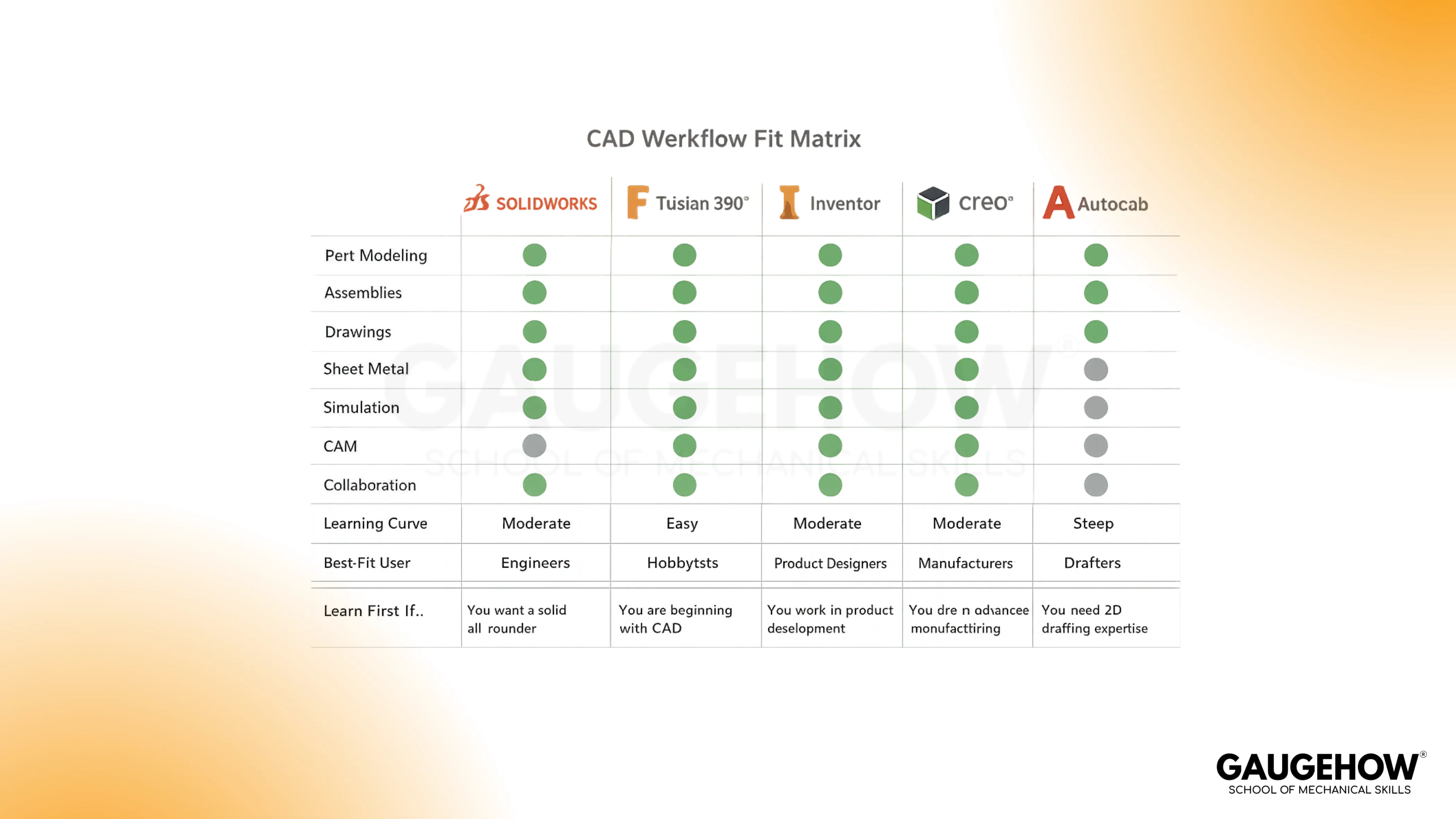
If you want a structured path, GaugeHow CAD courses are designed around job tracks and project outputs recruiters actually review. You first learn drawing basics and GD&T, then move step by step into popular CAD tools like AutoCAD for general 2D/3D drafting, SolidWorks for mechanical design, and Autodesk Fusion 360 for cloud-based, integrated CAD/CAM/CAE.
FAQs
Is CAD a good career path?
Yes, when you build dependable outputs. Teams still need drawings and models for fabrication, construction, and vendor work. Competition is real, so strong drafting standards, clean files, and portfolio proof usually decide who gets shortlisted.
Are CAD designers in demand?
Demand stays steady across manufacturing and AEC. Outsourcing and fast revision cycles keep documentation work active. Hiring moves fastest for people who can deliver stable drawings, readable notes, and assemblies that do not break during updates.
Is CAD a stressful job?
Stress usually comes from late changes and unclear inputs. Clean revision discipline and good self-check habits reduce last-minute firefighting. A predictable workflow, strong file naming, and clear communication make the day-to-day far more manageable.
Is CAD an IT skill?
It is a technical engineering skill, not an IT discipline. Software use is part of the work, but the real value sits in standards, geometry intent, drawings, and build-ready documentation. Engineering judgment matters more than tool shortcuts.
Which CAD jobs pay the most?
Roles tied to higher ownership tend to pay more. Tooling, BIM coordination leadership, product surfacing, and checker or lead roles often sit higher. Pay also rises when you control release-quality drawing packs and standards across projects.
CAD-CAM-CAE Work Platform
Find or Post CAD, CAM and CAE freelance projects, full-time jobs and Internships.
GaugeHow is the platform built for core engineering work. Whether you need a freelancer for a CAD project, a full-time hire, or an engineering intern,post it here and get matched with the right person.