Branches of Mechanical Engineering: A Complete Map
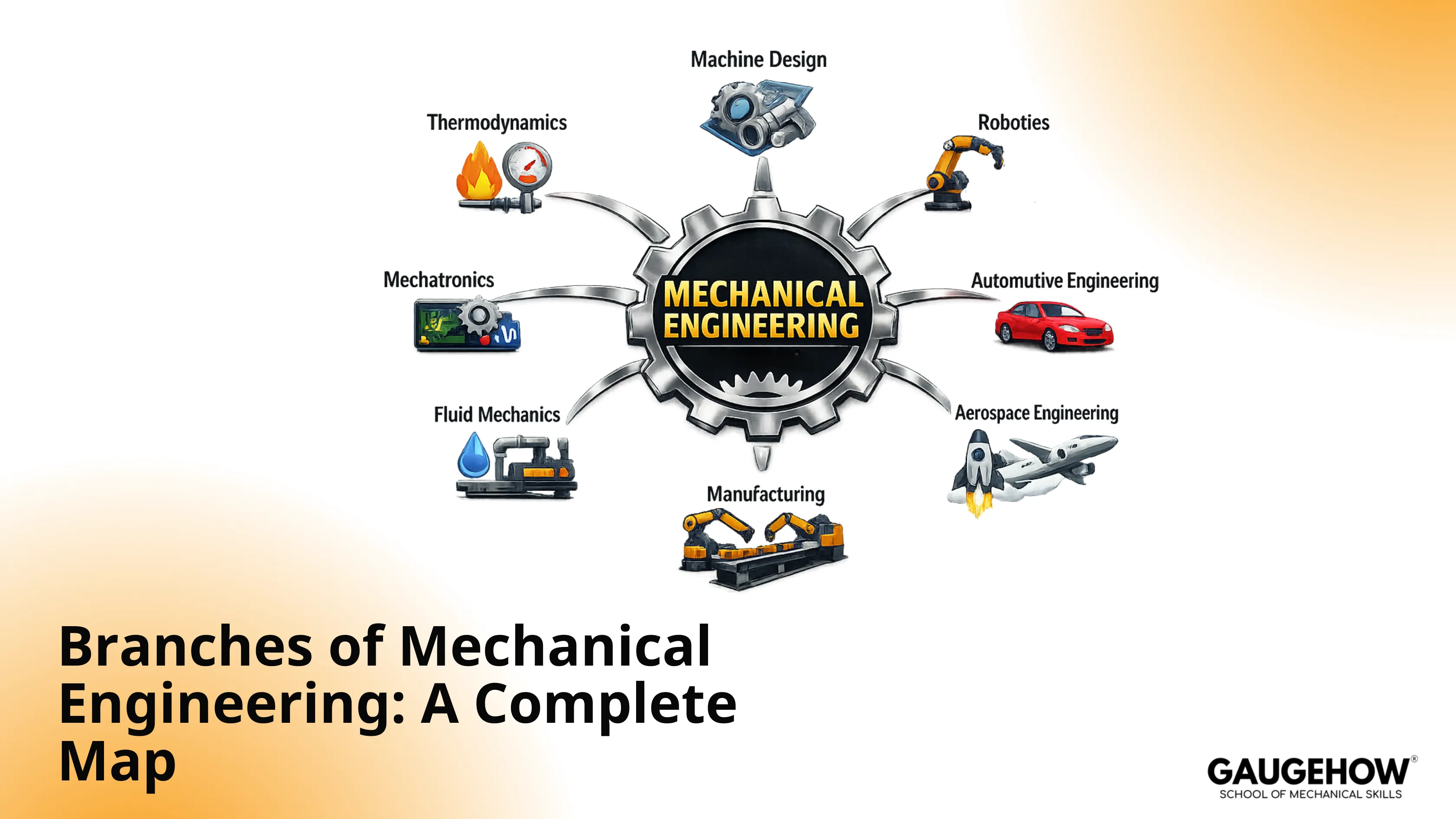
Branches of mechanical engineering are the primary technical areas for designing, analysing, building, inspecting, automating, and maintaining machines and systems.
A clear branch map links design, thermal work, manufacturing, fluid systems, materials, reliability, CAE, and QA/QC inside one broad field.
A clearer map helps you judge which branch owns drawings, stress review, process planning, inspection control, and long-term machine performance.
Table of Contents
Branches of Mechanical Engineering
Types of Mechanical Engineering
Mechanical Engineering Specialisations
How to Pursue Mechanical Engineering
Mechanical engineering often looks simple from far away, but real work spreads across several technical areas, and each area owns a different part of the product story.
Design teams control geometry and drawings; thermal teams solve heat problems; manufacturing teams turn released models into repeatable process steps; and quality teams ensure release checks and traceability.
Reliability work remains important because machines continue to experience wear, vibration, heat, and service loads after production starts.
Current U.S. labor data projects 9% growth for mechanical engineers from 2024 to 2034, with about 18,100 openings each year, so branch clarity now helps you choose projects and tools with more intent.
Recruiters still look for clean proof of work rather than broad reading alone. A drawing pack, a stress report, a process sheet, or an inspection record says more than a long skill list, because each file shows how engineering decisions move into usable output. (Bureau of Labor Statistics)
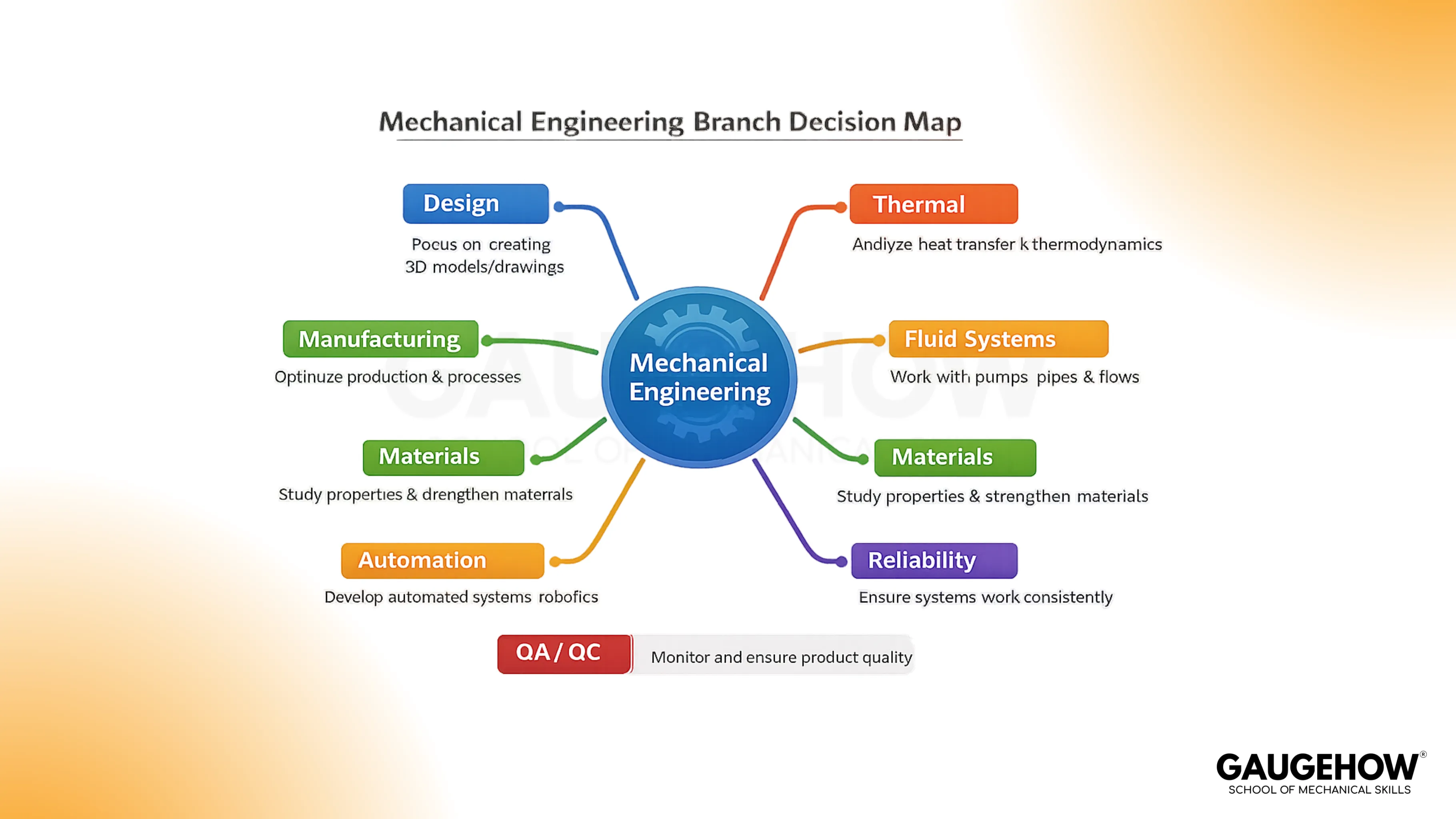
Branches of Mechanical Engineering
Mechanical work does not sit inside one narrow lane, because products move through design, analysis, process planning, checking, automation, and service life review.
A clean branch map helps because each area controls a different decision, and each decision changes cost, safety, speed, or durability in a different way.
Design Engineering
Design engineering focuses on the shape, size, fit, and movement of parts and assemblies. Daily work includes CAD models, assembly files, drawings, dimensions, tolerance notes, and BOM structure.
A design engineer does more than make shapes on a screen. The main job is to make sure parts work properly, join well, and move into production in an orderly way.
With that foundation in place, assembly becomes easier and drawings become easier to read.
Production teams can follow the work with less doubt. Inspection teams also get clearer dimensions and notes. As a result, the final product usually works in a more stable way.
Thermal Engineering
Thermal engineering addresses heat, temperature rise, cooling, and heat flow under real operating conditions.
Engines, HVAC units, battery packs, furnaces, and heat exchangers all depend on temperature control. Too much heat can lower performance and shorten product life.
Once heat is managed properly, systems stay within safe temperature limits. Energy use also improves in many cases.
Cooling paths become more effective when heat flow is studied early. Because of that, products often run longer during regular use.
Manufacturing Engineering
Manufacturing engineering takes a finished design and turns it into a process people can use every day. Common work includes process planning, tooling choice, machining steps, fixture setup, cycle time review, and production control. The aim is not only to make one part. The aim is to make the same part properly every time.
From there, daily production becomes easier to control. Material loss also comes down when steps are planned well. Tool use stays more organized across the process. In many cases, output becomes more even from batch to batch. Fluid Systems Engineering
Fluid systems engineering focuses on how liquids and gases move through a system. Pressure, flow speed, leakage, sealing, cavitation, and energy loss all belong to this area. Pumps, compressors, piping systems, hydraulics, pneumatics, turbines, and HVAC networks all depend on fluid behavior.
After flow is planned well, pressure stays more stable across the system. Energy loss can also be reduced. Pipe routes become easier to manage when movement is understood clearly. Over time, the full system performs in a steadier way.
Materials and Failure Engineering
Materials and failure engineering deal with material choice and part behavior during use. Strength, wear resistance, fatigue life, corrosion behavior, and product life all depend on this branch.
Engineers in this area study how materials respond to load, heat, surface contact, and environment before service problems appear.
In that way, the right material helps a part last longer. Load handling also improves when the material matches the job.
Surface damage becomes easier to control in service. Over a longer period, wear and crack risk can stay lower.
Mechatronics and Automation Support
Mechatronics and automation support connect mechanical parts with sensors, actuators, controls, and repeated machine movement.
Alignment, backlash, vibration, repeatability, guarding, and service access become important here. Automated lines, robotics cells, CNC machines, and moving systems all depend on mechanical stability along with control accuracy.
Because the setup stays stable, machine movement becomes more accurate. Repeat motion also becomes easier to hold across many cycles. Position control improves when vibration and alignment are handled early. For that reason, automated systems usually run in a more dependable way.
For this reason, automated systems usually run in a more dependable way.
Industrial and Systems Engineering
Industrial and systems engineering look at the full workflow inside a plant or production setup.
Layout, bottlenecks, line balance, material movement, maintenance planning, and capacity use all come together in this branch.
Rather than focusing on one part, this area looks at how the full system works together.
At that level, work moves more smoothly across daily operations. Time use also improves when the flow is planned well. Machine use becomes easier to balance across the line. Along with that, people and material movement are easier to manage.
Maintenance and Reliability Engineering
Maintenance and reliability engineering focus on keeping machines running properly during regular use.
Service timing, lubrication, spare planning, inspection routines, machine history, and repeated breakdown patterns all belong here.
This branch becomes important after installation, because machine value depends a lot on how reliably it performs over time.
Through planned service, machines stay available for longer periods. The repair effort also becomes easier to control. Routine checks help teams notice issues earlier. So daily operation stays steadier and easier to support.
Types of Mechanical Engineering
These types of mechanical engineering become easier to separate when outputs, tools, and release checks sit side by side.
Role/Task | Output | Tools | Downstream Use | Proof Check |
Product Design | CAD model, assembly, drawing, BOM | SolidWorks, Creo, NX, CATIA | File manufacturing and inspection teams use next | Fit, tolerance, revision check |
Thermal and Fluid Review | Heat-load note, CFD plot, cooling layout | ANSYS, Fluent, hand calculations | Design update, sizing, safety review | Temperature margin, pressure-drop check |
Process Planning | Operation sheet, fixture plan, control points | CAM, CNC methods, lean tools | Production launch, cost control | Capability, cycle time, scrap review |
CAE Validation | Stress, deflection, vibration, fatigue report | FEA solver, pre-processor, and hand checks | Release review, risk reduction | Set up check and result check |
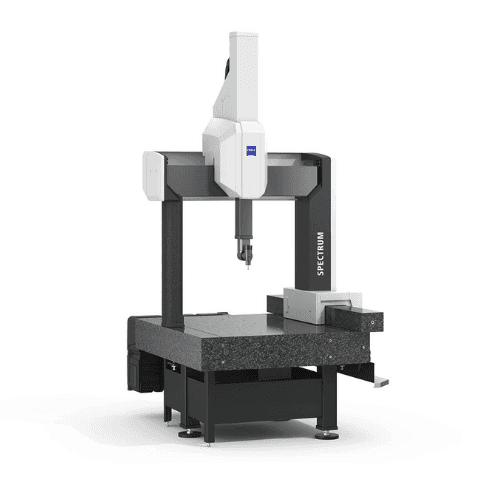
QA/QC Release | Inspection plan, gauge list, report | CMM, gauges, SPC, check sheets | Part approval, process control | Acceptance limit and traceability check |
Mechanical Engineering Specializations
Many mechanical engineering specializations sit across more than one branch, because real products rarely move in a straight line from design to production without analysis or checking.
CAE is one clear example. Finite element analysis in mechanical engineering helps teams study stress, deflection, vibration, fatigue, and thermal response before metal gets cut or parts get ordered.
Good analysis starts with sound loads, clear constraints, and basic hand checks, so the result stays close to service reality rather than software guesswork.
QA/QC forms another strong example. Quality assurance vs quality control in mechanical engineering is a useful split, because QA builds the system, the plan, and the discipline, while QC checks the actual part against dimensions, datums, finish, and acceptance limits.
Manufacturing, design, and reliability work all improve when checking stays clean and traceable.
One Bracket Across the Full Mechanical Chain
A small motor bracket shows the field more clearly than a long theory list, because one part can move through almost every major branch.
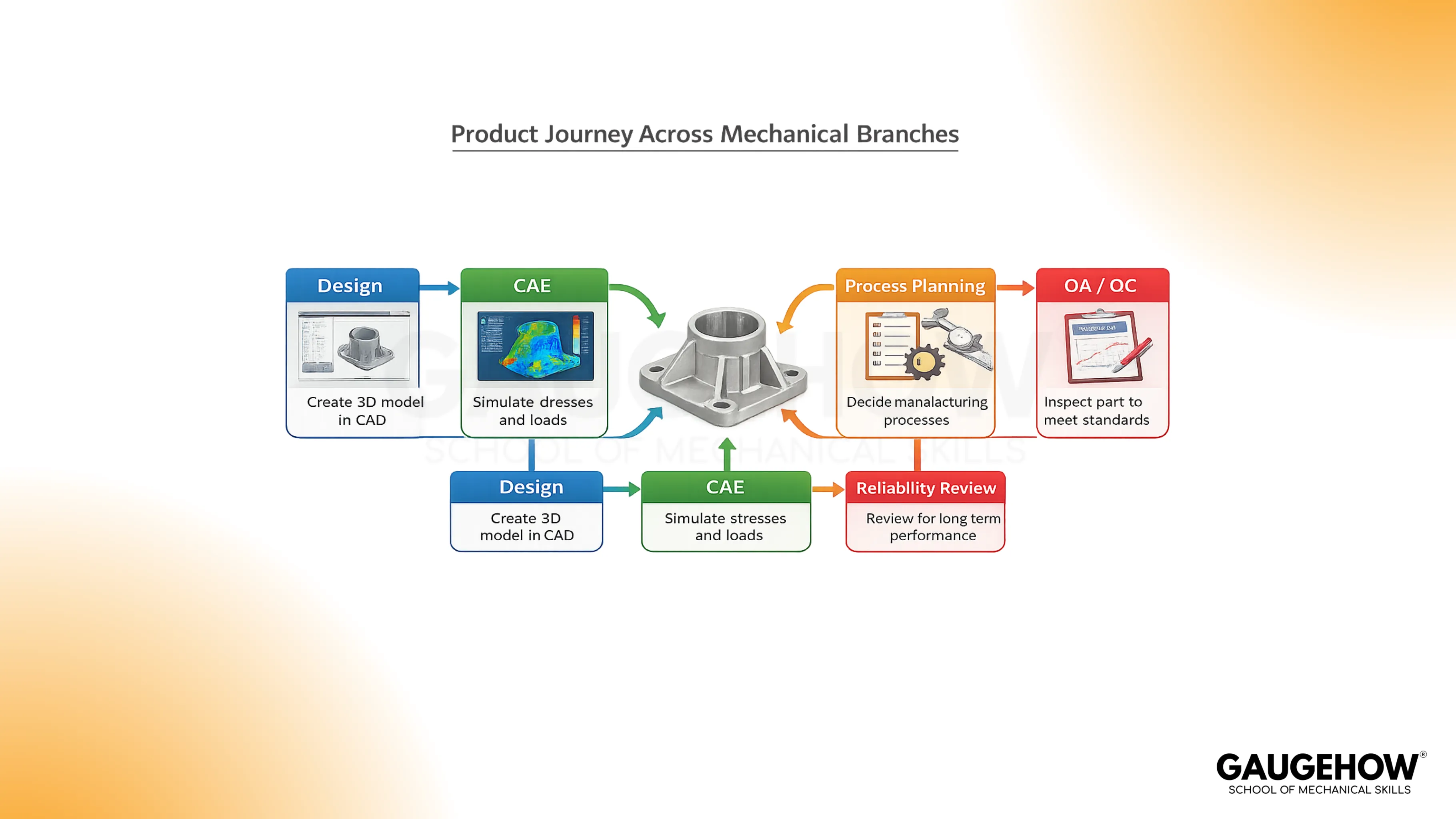
Design starts with mounting space, hole pattern, edge distance, stiffness, and assembly clearance. CAE checks stress around the bolt zone and also checks whether the bracket bends too much under service load.
Manufacturing then chooses stock form, operation order, fixture method, and tolerance control.
QA/QC turns the drawing into measurable points, gauge choice, and release records. Reliability work comes later through vibration marks, loose fasteners, or crack patterns after field use.
Core Work Across the Chain
Design prepares the model, drawing, and revision notes.
CAE checks whether load and stiffness logic stay sound.
Manufacturing decides how the part gets made each day.
QA/QC prepares the release check and measurement plan.
Reliability reads service damage and repeat failure signs.
The engineering review sends the next change into the file set.
Skills Map
Drawing and tolerance control keep dimensions, datums, and notes clean, and that reduces machining trouble as well as assembly errors later.
Load estimation and basic hand calculations give analysis a sound starting point, so stress review begins from logic rather than software hope.
Material choice shapes strength, wear, corrosion resistance, and long-term product life, and the same choice also affects machining effort, coating need, and cost.
Process thinking helps a good model become a usable part, because a neat screen model can still create scrap, delay, and fixture problems on the shop floor.
Measurement planning keeps checking useful, because a drawing only helps when critical dimensions and acceptance limits are clear from the start.
Report writing sounds simple, but one short, clear note saves time across design, manufacturing, and quality teams, because everyone reads the same issue in the same language.
How to Pursue Mechanical Engineering
A bachelor’s degree still remains the standard entry route into mechanical engineering, and core study usually covers mechanics, materials, thermodynamics, fluid mechanics, manufacturing, and machine design.
Formal study gives the base, but branch strength grows faster when coursework turns into drawings, reports, process sheets, and measurable project proof. (Bureau of Labor Statistics)
Courses close the gap between theory and usable output, and GaugeHow should be part of that move directly.
CAD, CAE, GD&T, metrology, manufacturing workflow, and QA/QC training help build stronger project proof, cleaner software depth, and better interview language around actual engineering files.
Conclusion
Start with one branch, one software tool, and one proof file, because a drawing, a stress report, a process sheet, or an inspection record will build more confidence than broad reading ever will. Then, map the branches of mechanical engineering against one real product and keep the first project small enough to finish well.
FAQs
Which branch should a beginner start with first?
Start with the branch closest to the work file you can build soonest. A drawing, a stress report, a process sheet, or an inspection record gives better direction than broad reading alone.
Where does CAE sit in mechanical work?
CAE supports design, thermal work, fluid review, and durability checks. Finite element analysis in mechanical engineering becomes useful when loads, constraints, and result reading are tied to real service conditions.
How should QA and QC be understood?
Quality assurance vs quality control in mechanical engineering becomes easier when you split system control from part checking. QA builds the plan and discipline, and QC checks whether the finished part meets the drawing.
Which branch connects most closely with factories?
Manufacturing stays closest to daily factory output, but quality, reliability, and systems work also stay close because process stability, checking, and uptime all affect delivery and cost.
Can one project cover more than one branch?
Yes, and a bracket, pump housing, or sheet metal enclosure can show design, analysis, process planning, checking, and service review together when the files are prepared cleanly.