Mechanical Engineering: Definition, Scope & Applications
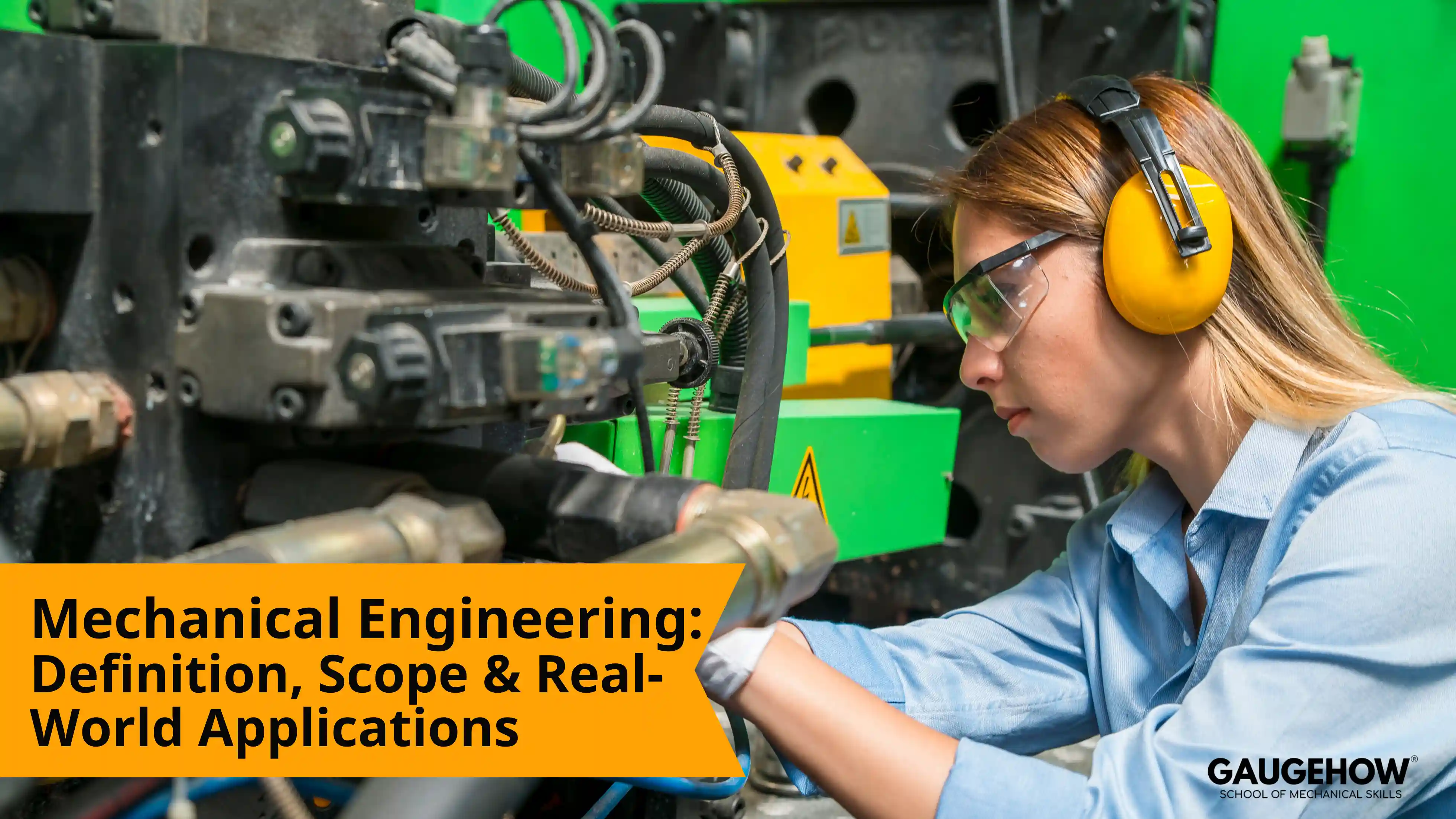
Mechanical engineering is the discipline that designs, analyzes, manufactures, and maintains mechanical systems using physics and mathematics.
Work relies on mechanics, thermodynamics, and materials behavior to control motion, force, heat, and reliability. Practice spans precision components and assemblies, as well as large industrial machines and energy systems.
Mechanical engineering sits at the center of modern physical systems. Scope includes machine design, thermal and fluid systems, production engineering, materials behavior, maintenance planning, and performance improvement.
Branches show where engineers specialize, and applications show where that work delivers real value across industries.
Careers and salary in India rise with responsibility, domain depth, and measurable results, while smart degree planning and early experience shorten the path from classroom learning to industry-ready work.
What is Mechanical Engineering
Mechanical engineering is the applied engineering discipline that converts scientific principles into dependable physical systems through design, analysis, production planning, and lifecycle support.
Industrial work rarely stops at “machines” as objects. Practical coverage includes machine elements, mechanisms, and structural parts that carry loads and transmit motion.
Thermal engineering covers heating, cooling, heat transfer limits, and energy efficiency. Fluid engineering supports pumps, piping, compressors, valves, and aerodynamic performance.
Manufacturing systems engineering connects design intent with process capability, tooling, inspection, and the production of repeatable outputs. Materials engineering handles selection, heat treatment, fatigue behavior, wear, corrosion, and failure prevention.
Maintenance planning includes reliability strategies, spare parts logic, condition monitoring, and downtime reduction.
Performance improvement ties everything together through cost reduction, energy savings, noise control, weight optimization, and field failure fixes.
Key Responsibilities of a Mechanical Engineer
The key responsibilities of a Mechanical Engineer are listed below:
Design ownership: Work starts with concept development, component sizing, material selection, tolerance planning, and manufacturability reviews, because early design decisions lock cost, safety, and service life.
Strength and stiffness evaluation: Loads, reactions, stresses, deformations, and buckling risks are assessed through calculations and simulations as needed, so parts do not fail silently under real-world duty cycles.
Manufacturing readiness: Process selection, tooling approach, inspection strategy, and quality controls get defined before launch, because a design that cannot be produced consistently becomes an expensive redesign later.
Testing and validation: Test plans, instrumentation, acceptance criteria, and failure investigation close the loop between model and reality by preventing the same defect from recurring across batches.
Documentation control: Drawings, GD&T, BOMs, specifications, process sheets, and revision control must be disciplined, because unclear documentation leads to scrap, delays, and supplier disputes.
Supplier and shop coordination: Technical discussions with vendors, procurement, production, and quality resolve interface problems, because real products fail at handoffs, not inside a CAD file.
Reliability and maintenance planning: Failure modes, service intervals, maintainability, and spare logic get designed into systems because uptime and safety depend on predictable maintenance outcomes.
Continuous improvement delivery: Cost, scrap, cycle time, energy use, and defect rates are reduced through structured root-cause work, improving performance without destabilizing production.
Branches of Mechanical Engineering
The main branches of mechanical engineering are given below:
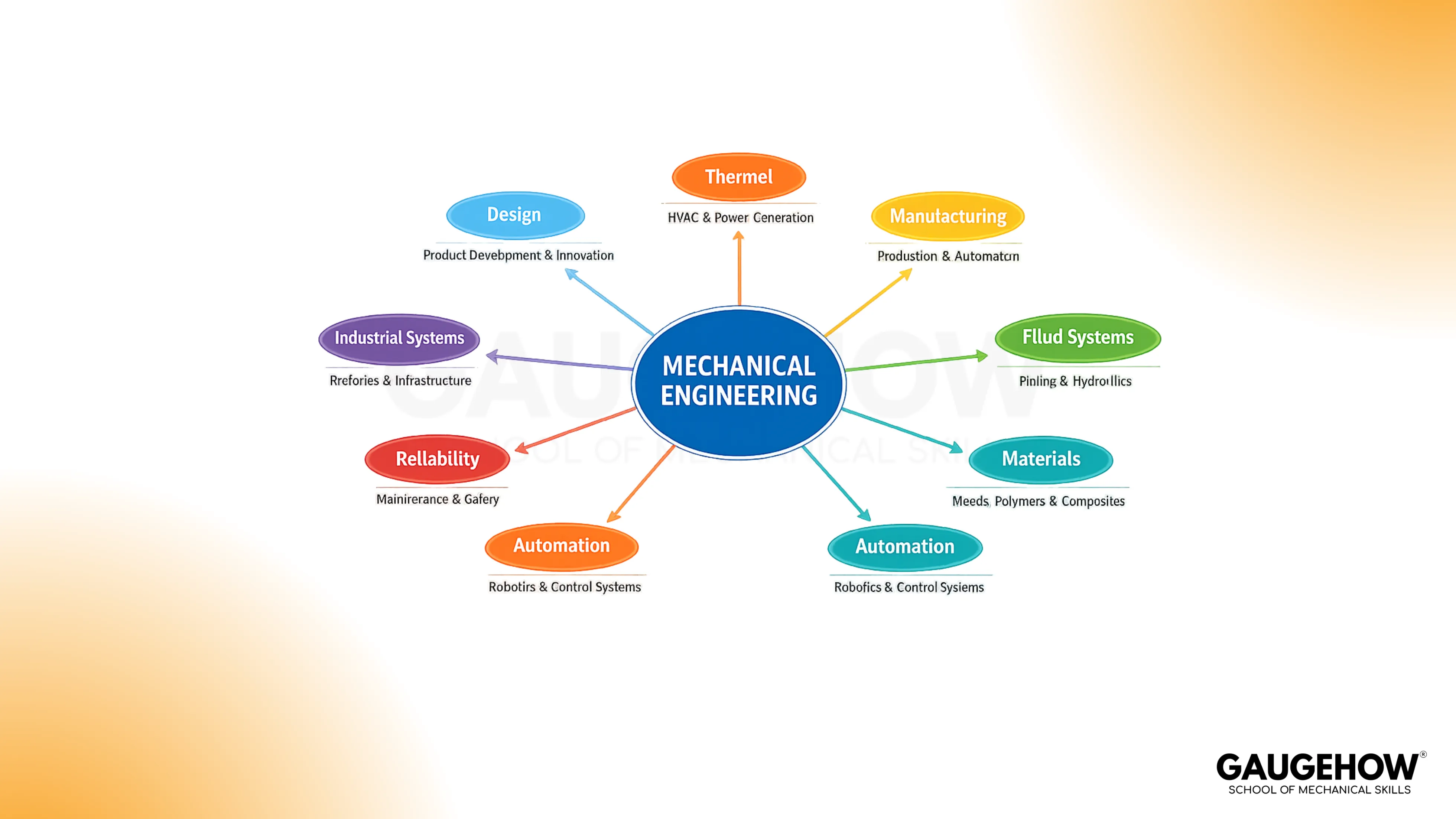
Design engineering: Mechanisms, machine elements, structural layouts, and product architecture sit at the center. Motion control, load transfer, stiffness targets, wear points, and assembly fit drive the real decisions.
Product teams, industrial equipment makers, automotive suppliers, and heavy engineering firms rely on this branch because geometry and tolerances decide durability and safety.
Thermal engineering: Thermodynamics and heat transfer shape how systems survive temperature limits. Efficiency losses, cooling capacity, and heat rejection under real duty cycles dominate day-to-day work.
Engines, EV battery packs, HVAC plants, power stations, furnaces, and heat exchangers depend on stable thermal control to protect performance and reliability.
Manufacturing engineering: Production success comes from process capability, tooling readiness, stable output, and disciplined quality control.
Cycle time, dimensional variation, scrap, rework, and throughput constraints set the problem frame. Factory floors, supplier plants, and assembly lines need this branch because process control decides cost per part and on-time delivery.
Fluid systems engineering: Flow behavior and pressure management decide whether systems run efficiently or waste energy. Cavitation risk, leakage paths, pressure loss, and flow instability often appear in real operations.
Process industries, HVAC ducting, hydraulics, pneumatics, turbomachinery, and aerospace systems depend on this branch because fluid behavior controls efficiency and safety.
Materials and failure engineering: Material selection and life prediction protect products from avoidable breakdowns. Fatigue life, fracture risk, corrosion resistance, and surface engineering guide choices long before failures appear in the field.
Aerospace, automotive, rotating machinery, tooling, and structural applications lean on this branch because lifecycle performance matters more than initial strength.
Mechatronics and automation support: Mechanical design here must stay accurate under motion, load, and repeated cycles. Backlash, vibration, alignment, repeatability, and safeguarding become the daily constraints.
Robotics cells, automated lines, CNC platforms, and packaging machines need this branch because mechanical stability supports control accuracy and uptime.
Industrial and systems engineering: Plant-level performance improves when layout, flow, and maintenance strategy are engineered together. Bottlenecks, downtime, capacity gaps, and poor integration create pressure points.
Large facilities invest in this branch because small process improvements can reduce costs and save time.
Maintenance and reliability engineering: Uptime improves when inspection, failure-mode control, and service planning stay disciplined. Recurring breakdowns, spare shortages, weak maintainability, and unsafe operating habits shape the reality on-site.
Utilities, manufacturing plants, process industries, and infrastructure operations depend on this branch because the cost is measurable and urgent.
Also Look at: Types of Mechnical Engineering
Real World Applications of Mechanical Engineering
The real-world applications present in the mechanical engineering domain are given below:
Automotive
Vehicle programs demand safe load paths, stable thermal behavior, and predictable durability at scale.
Engineers handle drivetrains, suspension geometry, braking systems, crash structures, sealing interfaces, and manufacturability for high-volume output.
EV platforms add battery thermal management, motor cooling, and structural integration, where temperature control protects range and lifetime. Fatigue, vibration, tribology, and assembly variation dominate practical outcomes.
Aerospace
Extreme conditions define aerospace engineering, so margins stay tight and validation stays rigorous. Work includes lightweight structures, thermal protection, vibration control, and materials behavior under cyclic loads.
Engineers support airframe components, propulsion hardware interfaces, thermal management, qualification testing, and traceable documentation.
Fracture control, fatigue life, and reliability planning matter because failures carry high human and financial costs.
HVAC
Buildings depend on stable airflow, reliable heat exchange, and controlled humidity.
Engineers size and integrate chillers, AHUs, pumps, ducts, diffusers, and heat recovery units based on real loads and operating schedules. Pressure drops, acoustics, condensation risks, and maintenance access shape design choices.
Thermodynamics and fluid mechanics drive performance because comfort, compliance, and energy bills all respond to good system design.
Energy and Power Systems
Power generation and process equipment operate continuously, so reliability is a design requirement. Engineers work on turbines, boilers, compressors, pumps, heat exchangers, piping networks, and the health of rotating equipment.
Heat-transfer limits, vibration behavior, sealing integrity, and material degradation guide improvements.
Efficient work matters here because small reductions in losses compound into large operating savings.
Manufacturing
Factory performance depends on process capability, not only product design intent. Engineers develop machining, forming, casting, welding, additive processes, and assembly methods that stay stable over time.
Tooling, fixtures, inspection plans, and line balancing convert drawings into repeatable output.
Variation control matters because defects scale quickly when volume rises.
Robotics and Automation
Automation succeeds when mechanisms stay stiff, repeatable, and maintainable under production cycles.
Engineers design end-effectors, linkages, frames, guarding, and fixturing to maintain alignment and accuracy.
Kinematics, dynamics, vibration damping, and tolerance stack-up determine the actual results on the floor. Downtime reduction also depends on serviceability, part access, and robust mechanical interfaces.
Healthcare
Medical systems demand predictable motion and strict safety behavior, with reliability built into every interface. Engineers support prosthetics, hospital equipment, precision mechanisms, and assistive devices that must remain stable under repeated use.
Materials selection, fatigue behavior, sterilization compatibility, and ergonomics shape design decisions.
Verification and risk control stay central because human safety remains non-negotiable.
Consumer Products
High volumes punish weak design decisions, so detail quality becomes business-critical.
Engineers design mechanisms, thermal layouts, plastic and metal parts, noise-control features, and assembly strategies to protect yield.
Tolerance planning, material behavior, and cost-focused manufacturability decide success.
Field failures here quickly damage brand trust, so durability and quality consistency carry real value.
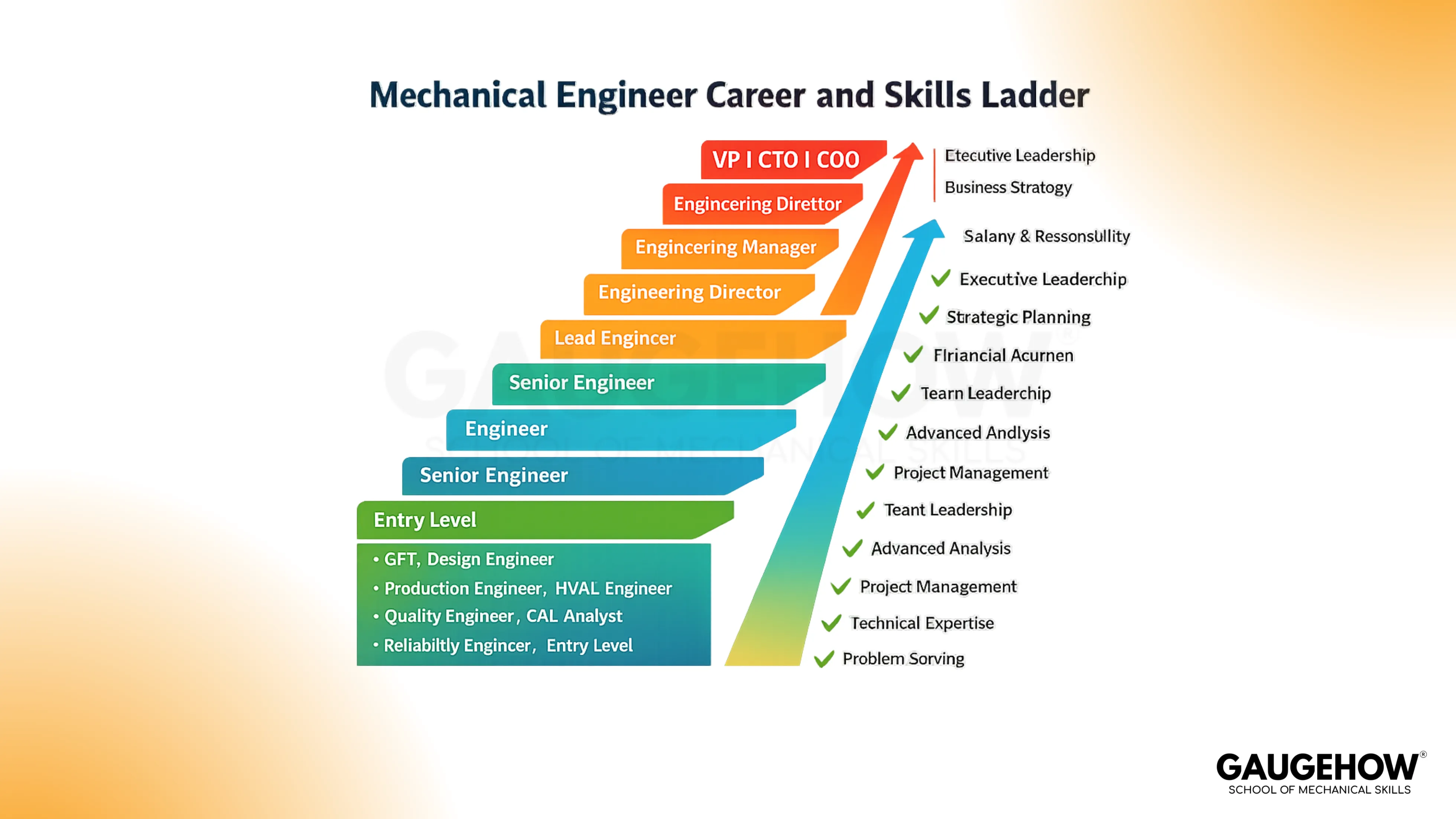
Mechanical Engineering Careers Path & Salary in India (2026)
Job Role | Avg. Annual Salary (INR) | Experience | Key Skills | Industries |
Graduate Engineer Trainee (GET) | ₹2.8–5.0 Lakhs | 0–2 years | Basics of design, shop exposure, measurement, and reports | Manufacturing, Automotive, Energy, MEP |
Design Engineer | ₹4.0–8.5 Lakhs | 1–5 years | CAD, GD&T, mechanism design, material selection | Automotive, Industrial Equipment, Consumer Products |
Production Engineer | ₹3.5–7.5 Lakhs | 1–6 years | Process planning, SOPs, cycle time, lean methods | Manufacturing, Tooling, Electronics, FMCG |
Maintenance Engineer | ₹3.5–8.0 Lakhs | 2–8 years | Troubleshooting, TPM, spares planning, uptime control | Plants, Utilities, Process Industries, Heavy Engineering |
HVAC Engineer | ₹4.0–9.5 Lakhs | 2–8 years | Load calculations, ducting, chillers, site execution | Buildings, Data Centers, Pharma, Commercial Projects |
Quality Engineer | ₹3.5–8.5 Lakhs | 1–7 years | Metrology, root cause, audits, PPAP basics | Automotive, Manufacturing, Aerospace Suppliers |
CAE Analyst | ₹5.0–12.5 Lakhs | 2–8 years | FEA/CFD, correlation, fatigue, reporting | Automotive, Aerospace, Product Design, Energy |
Reliability Engineer | ₹5.0–11.5 Lakhs | 3–10 years | FMEA, failure analysis, reliability growth, RCM | Energy, Process, Manufacturing, Heavy Machinery |
Salary growth tracks responsibility more than titles. Design ownership, plant exposure, and measurable outcomes raise earning power.
Specialization in thermal systems, simulation, reliability, or manufacturing improvement usually accelerates progression.
Domain depth matters because deep expertise reduces failures and improves uptime.
Full Guide: Mechanical Engineer Jobs: Freshers Roadmap and Career Path
TOP 7 Skills Mechanical Engineers Must Have (2026)
1) Robotics and automation literacy
Automation has become normal across manufacturing and product lines, so mechanical engineers gain an advantage by understanding how automated systems behave physically.
Sensors and code do not compensate for weak mechanics. Accuracy comes from stiffness, alignment, backlash control, repeatable fixturing, and stable interfaces under load.
Teams trust engineers who can examine a robot cell and diagnose the mechanical causes of drift, vibration, and inconsistent pick accuracy.
That literacy also improves communication with control teams because mechanical constraints are expressed clearly.
Career growth tends to accelerate when automation knowledge combines with strong fundamentals, since modern plants prioritize throughput, safety, and uptime.
2) Designing and simulation judgment
CAD skills matter, but judgment matters more than software familiarity. Strong engineers use CAD to control geometry intent, tolerance stack-up, assembly sequence, and service access.
Simulation adds value when questions are framed properly and boundary conditions match reality.
Stress checks protect against hidden load paths and local stress concentrations. Thermal studies reveal bottlenecks and hotspots that shift material behavior. Flow studies expose pressure losses, recirculation, and sealing risks.
Good judgment means knowing when a calculation is enough, when a simulation is necessary, and when a test must settle the decision.
Strong judgment reduces redesign loops by keeping decisions disciplined and evidence-based.
3) Mathematical and reasoning ability
Engineering work arrives with incomplete information and competing constraints, so reasoning becomes the real tool.
Mechanics depends on free-body thinking, load decomposition, and margin evaluation.
Thermodynamics depends on energy balance, efficiency losses, and limits on heat transfer. Material decisions require an understanding of stress-strain behavior and fatigue intuition, not just tables.
Statistics support tolerance analysis, capability studies, and quality decisions that affect production stability.
Reasoning ability also protects against two common failures: overdesign that inflates cost, and underdesign that creates field issues.
Teams rely on engineers who can translate messy data into clear assumptions and defend decisions calmly.
4) Material science and lean manufacturing thinking
Materials determine reliability, weight, manufacturability, and lifecycle cost, so understanding materials cannot remain theoretical.
Practical knowledge includes strength, toughness, fatigue response, wear behavior, corrosion risk, and the effect of heat treatment and surface finishes.
Lean manufacturing thinking adds the production layer that many beginners miss. Variation and waste often come from designs that ignore process capability.
Engineers who link material selection to production realities reduce scrap and rework without compromising performance. That mindset also improves supplier conversations because requirements stay clear and measurable.
Strong material and lean thinking often separate average design from production-ready engineering.
5) Project management expertise
Mechanical projects fail more often due to coordination breakdowns than to missing formulas.
Project management in engineering involves defining scope, sequencing work, tracking risks, and making evidence-based closing decisions.
Timelines must account for supplier lead times, tooling windows, test availability, and review cycles.
Good engineers manage interfaces between design, production, procurement, and quality so handoffs do not create late-stage surprises.
Ownership shows up as clear status, clear assumptions, and disciplined follow-through. Trust grows when planning prevents rework and avoids crisis-mode launches.
This skill becomes even more valuable as projects become multi-site and cross-functional.
6) Manufacturing and prototyping capability
A design earns credibility when it can be built, measured, and improved.
Manufacturing knowledge helps engineers shape geometry that machines, forms, molds, or welds consistently.
Prototyping exposes fit problems, noise sources, thermal issues, distortion, and assembly bottlenecks early, when change remains cheaper.
Engineers who understand tooling, fixtures, and inspection methods design with production in mind rather than hoping quality teams will fix it later.
Prototyping capability also includes test planning, measurement discipline, and unbiased data interpretation.
Faster prototyping cycles shorten development time and reduce the chance of expensive redesign after launch.
7) Thermodynamics and energy systems understanding
Thermal behavior influences engines, HVAC, energy plants, electronics cooling, and industrial processes, so thermodynamics remains a career accelerator.
Engineers who understand energy balance, efficiency losses, and heat-transfer modes design systems that remain stable under real-world loads.
Conduction paths, convection behavior, radiation effects, and changes in fluid properties shape outcomes in practice.
Thermal knowledge also connects directly to sustainability goals because efficiency gains reduce energy use and operating costs.
Many failures first manifest as heat issues, such as overheating, poor heat dissipation, or material degradation. Engineers with a strong understanding of thermal systems prevent failures through better sizing, better layouts, and disciplined validation.
Also Read: 7 Mechanical Engineer Skills for Beginners in 2026
Future of Mechanical Engineering
Future demand will continue to shift toward integrated physical systems. Electrification raises the importance of thermal design and materials performance.
Automation increases demand for reliable mechanisms and high repeatability. Manufacturing continues to move toward smarter process control and tighter quality expectations.
Simulation continues expanding, yet correlation and test discipline remain essential.
Energy efficiency remains a permanent driver across industries. Reliability engineering is increasingly important as downtime costs continue to rise.
Engineers who combine fundamentals with practical tools will stay valuable. Progress will favor those who can design, validate, and launch systems that perform consistently.
How to Become a Mechanical Engineer?
Entry into mechanical engineering starts with fundamentals and honest self-selection.
Comfort with physics and mathematics matters because daily decisions depend on force balance, energy flow, and material behavior.
Tips for High School and College Students
High-school preparation works best when math and physics remain consistent strengths rather than last-minute efforts.
Interest in building and testing things also matters, because practical work rewards hands-on confidence.
College success depends on connecting subjects to real outcomes instead of studying for marks alone.
Projects and Portfolio Building
Projects build credibility because they demonstrate applied thinking and execution. Internships accelerate readiness because plant exposure reveals production constraints, quality realities, and the cost of downtime.
Networking helps when it stays technical and sincere, through mentors, professors, internships, and industry contacts.
Career readiness improves when a portfolio shows drawings, calculations, test results, and clear learning outcomes. Recruiters trust evidence, especially when the story stays precise and measurable.
How to achieve a Mechanical Engineering Degree?
Choosing the Right Program?
Degree planning begins with choosing Mechanical Engineering Courses Online that support practical learning. Accreditation, faculty quality, labs, and industry ties matter because they shape exposure.
Program choice should align with areas of interest such as design, thermal systems, manufacturing, automation, or reliability, while keeping fundamentals strong.
College evaluation works best through lab access, project culture, internship support, and the seriousness of assessment. Strong outcomes come from taking courses as tools and applying them through projects, design reviews, and testing.
Use Faculty and Internships to Create Real Outcomes
Relationships with faculty help because guidance, recommendations, and research exposure can open doors. Internships should be treated as learning contracts where real deliverables get owned and documented.
Resume development becomes easier when experiences are written as engineering outcomes rather than vague participation.
A degree becomes powerful when it produces competence, clear evidence, and professional habits that transfer into industry work.
Conclusion
Mechanical engineering remains a core discipline because modern life runs on physical systems. Mobility, energy, manufacturing, healthcare, buildings, and automation all depend on controlled motion, heat, materials behavior, and reliable production.
Engineers in this domain create value through safe design, verified performance, repeatable manufacturing, and disciplined maintenance planning.
Career growth follows responsibility, domain depth, and the ability to deliver measurable outcomes. Strong fundamentals, combined with practical exposure, keep the discipline relevant as technologies change.
FAQs
1) What is the scope of mechanical engineering in India?
Scope remains broad because industries continue to need design, production, maintenance, quality, thermal, and simulation capabilities. Demand rises in automotive and EV, energy, HVAC, manufacturing, and automation. Growth improves when specialization matches industry needs and measurable outcomes.
2) Is mechanical engineering difficult for beginners?
Difficulty comes from fundamentals, not from memorization load. Mechanics, thermodynamics, and materials require steady practice and clear reasoning. Success improves when concepts are applied through projects and labs.
3) Which branch offers the best career growth?
Growth usually improves where responsibility is high and outcomes are measurable. Reliability, CAE, thermal systems, production improvement, and design ownership often scale well. The best choice depends on interest and willingness to build deep expertise.
4) What are the best industries for long-term stability?
Energy, manufacturing, HVAC, and maintenance-heavy sectors offer consistent demand because uptime and efficiency remain critical. Automotive and automation can grow quickly, especially with strong skills and domain focus.
5) How high can salary go in mechanical engineering?
Salary increases with design ownership, specialization, and proven impact. Engineers who reduce failures, improve efficiency, or lead critical programs earn more. Plant exposure, simulation capability, and reliability depth often raise ceilings faster.