Mechanical Engineer Jobs: Freshers Roadmap and Career Path
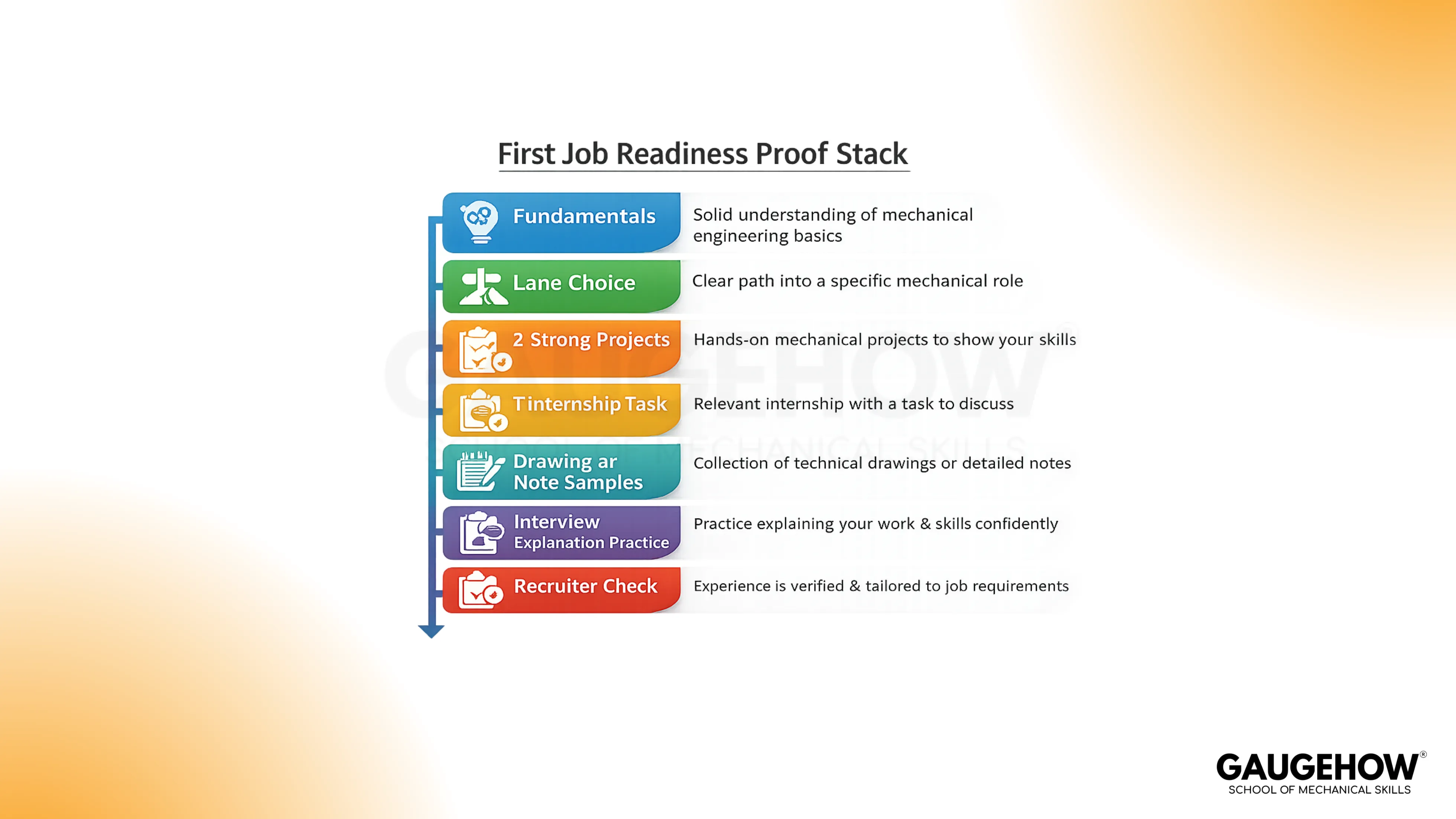
A mechanical engineering career roadmap is a clear sequence of learning steps that takes you from fundamentals to employability.
Freshers move faster when they link subjects to real work tasks, then build projects and internship proof that matches entry roles.
Many freshers feel stuck after graduation, and that is normal. You study hard, but shortlisting still feels unclear.
Hiring is rarely about marks alone, because teams look for proof of practical understanding.
This roadmap shows how study, skills, projects, and interviews connect, so mechanical engineer jobs stop feeling like guesswork.
What Is Mechanical Engineering
Mechanical engineering is the branch of engineering that designs, builds, and improves physical systems.
It covers parts, machines, thermal systems, fluids, manufacturing processes, and maintenance practices. The work sits between an idea and a working product.
What Is A Mechanical Engineering Career Roadmap
A career roadmap is a structured preparation plan for your first role. It sets an order for learning and practice, so preparation stays tight.
It also keeps decisions clear when options feel endless.
Most freshers prepare in fragments. CAD comes first, then a random course. Interview prep starts late, so confidence stays uneven. A roadmap fixes the sequence, and it removes noise.
a) Pick a lane before picking tools
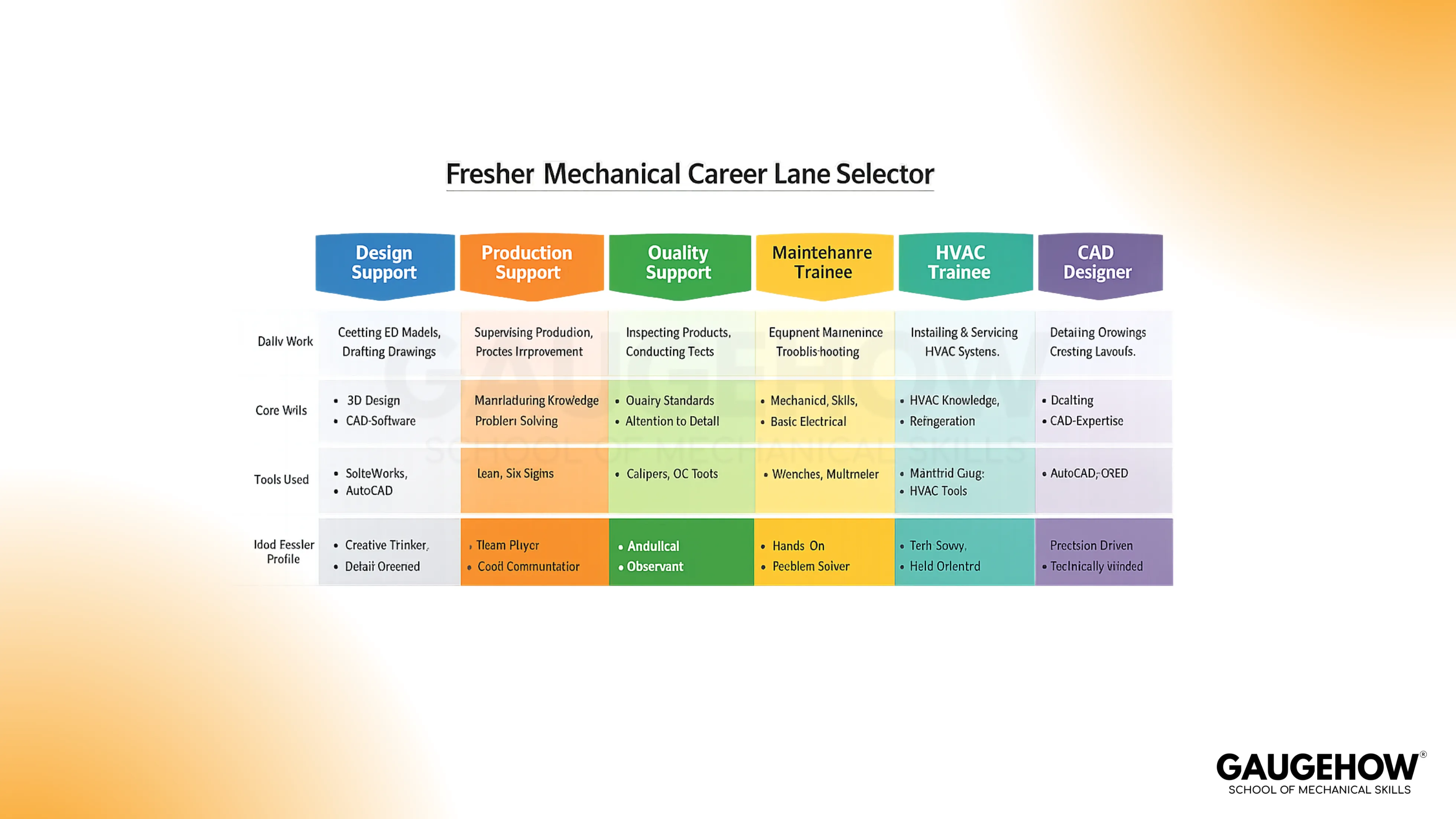
Design support, production support, quality, maintenance, and HVAC are different lanes.
Each lane runs on different daily work, so preparation cannot stay generic. Once the lane is chosen, practice becomes repeatable and cleaner.
b) Convert core learnings into reviewable work
Subjects turn employable when they become work samples. A drawing pack with revision notes can be reviewed quickly. A check sheet shows thinking in steps.
A short report shows decision clarity under questions. That is how to get hired without experience in mechanical engineering, because work becomes testable.
c) Practice thinking
Follow-ups come fast in fresher interviews. Assumptions need one clear line, then consistency.
Checks need simple logic, then a clear explanation. Work should sound like a review discussion, not exam memory.
How To Become A Mechanical Engineer
High school preparation builds math comfort and physics clarity. Strong fundamentals reduce friction later, because subjects stack quickly.
Interviews also feel steadier when the basics stay stable.
High School Preparation for Mechanical Engineering
The preparation mentioned here refers to building a core understanding early. Strong basics in math and science create smoother learning later.
a) Mathematics foundation
Focus on algebra, geometry, and early calculus ideas. Comfort here makes problem framing faster and cleaner.
b) Physics foundation
Strengthen mechanics, energy, and basic heat concepts. These core learnings make later subjects easier to digest.
B.Tech Core Learnings and Tools
The degree mentioned here refers to job-facing learning, not only marks. Core subjects become useful when linked to outputs.
a) Core mechanical subjects
Thermodynamics, fluid mechanics, strength of materials, and machine design form the base. These topics shape sizing logic, interface thinking, and practical reasoning.
b) Software and tools
CAD tools are learned for drawings and revisions, not for commands. Simulation tools are learned for checks and short notes, not screenshots.
A clean way to frame how to become a mechanical engineer stays simple. Fundamentals first, then outputs for review and approval.
Mechanical Engineer Career Path For Freshers
Many titles look similar, so freshers get confused early. Work still splits into lanes with different daily ownership. A good start comes from choosing a lane where you can learn fast.
Trainee roles build vocabulary, rhythm, and discipline. GET roles add rotation and broader task exposure.
Early performance looks steady, because follow-ups close on time. Review comments are reduced when the documentation stays clean.
Entry-Level Mechanical Engineering Roles for Freshers
Entry roles usually start with assigned pieces of work. You handle drawings, notes, checks, and coordination. Over time, those pieces become ownership.
Design support work stays close to drawings and revisions.
Production roles stay close to plant issues and updates.
Quality roles stay close to drawings and inspection discussions.
Maintenance roles stay close to logs and repeat issue control.
HVAC roles stay close to site checks and selections.
Entry-level mechanical engineering roles for freshers become easier to target when lane choice is clear. Hiring conversations improve when your work samples match the lane.
Beginner to Industry-Ready Growth in the First Year
Progress speeds up when learning stays narrow and repeated. One lane builds a deeper understanding than five tracks. Weekly repetition creates cleaner revisions and fewer review loops.
A simple pattern works through the first year. Start with small tasks and learn standards quickly. Move into controlled revisions and clean notes.
Then own handoffs and approvals without reminders. That is when your mechanical engineer career path stops feeling random.
Top Industries Hiring Mechanical Engineer Freshers
Industries hire freshers when teams need dependable support work. Manufacturing needs drawing updates and production coordination. Automotive ecosystems need documentation and quality discipline.
HVAC needs fundamentals applied on-site with coordination. EPC and fabrication need drafting sense and clean handoffs. Service and maintenance sectors need records and repeatability.
Internships matter when they produce real work samples. A mechanical engineer internship for freshers becomes valuable when you leave with one deliverable you can explain clearly.
Look at what freshers with less than one year of experience get paid:-
Company | Role | Ave Salary | Top skills |
Manufacturing plants and suppliers | GET / Production support | ₹5.10 LPA | Drawing, reading, follow-up, reporting |
Automotive OEM and Tier suppliers | Quality / Design support | ₹2.01 LPA | GD&T basics, documentation, coordination |
HVAC contractors and consultants | HVAC trainee / Site support | ₹2.31 LPA | Fundamentals, selection sense, communication |
EPC and fabrication shops | Design support / QA support | ₹2.48 LPA | Drafting discipline, inspection thinking, handoffs |
Service and maintenance providers | Maintenance trainee | ₹1.93 LPA | Logs, troubleshooting, reliability habits |
Skills That Help Mechanical Engineering Freshers Get Hired
The mechanical engineer skills mentioned here refer to the working basics used daily. Freshers often study a lot, yet interviews still feel uncertain.
The difference shows up in clarity, not vocabulary. When fundamentals are clear, answers stay steady under follow-ups.
Let us break the skills into practical blocks. Each block is written in the language used during reviews. The aim is simple: sound consistent and job-ready.
Drawing Literacy and Release Discipline
Drawing literacy is the ability to read intent from drawings. Release discipline is the habit of managing changes cleanly.
Most entry roles touch drawings in some form. So this skill becomes visible early.
a) Drawing reading
Start with views, sections, and notes as routine. Interfaces deserve extra attention, because errors hide there. Once intent is clear, dimensions stop feeling random.
b) Revision habits
Changes happen throughout a project’s life. A clear trail prevents confusion during review rounds. When revisions are readable, handoffs become smoother.
c) Standards awareness
Conventions keep drawings readable across different people. Notes and symbols should follow a consistent style. That consistency reduces repeated clarifications later.
CAD That Produces Manufacturing-Ready Output
CAD skills show up during change requests and rework. Early models look fine for everyone. The real test comes when edits arrive mid-way. Clean modelling habits handle that pressure better.
a) Parametric discipline
Build features in a logical order with clear intent. Dimensioning should not fight during common edits. Stable models reduce rework during review cycles.
b) Assembly thinking
Assemblies should reflect realistic fits and clearances. Constraints need to match actual movement and limits. This avoids “looks correct” models in discussions.
c) Handoff hygiene
File names and folders must stay readable. Versions should stay traceable across updates. When structure is clean, downstream work moves faster.
GD&T and Inspection Thinking
GD&T and Inspection Thinking are about measurement comfort and drawing intent. Deep GD&T mastery can come later with role depth. Early hiring expects clean basics and calm language. That calmness carries well in quality discussions.
a) Datum basics
Datums explain how measurement references are established. Once that idea is clear, drawings read faster. Inspection conversations also feel less confusing.
b) Tolerance sense
Tolerances must match function and process capability. Tight tolerances raise cost and delays. Loose tolerances create fit issues at assembly.
c) Inspection reading
Read measurement reports with steady logic. Link numbers back to drawing intent. Guessing here weakens otherwise good answers.
Manufacturing Sense That Prevents Rework
Manufacturing sense means thinking about how parts get made. It also means speaking clearly with shops and suppliers. Freshers stand out when choices sound buildable. That practical feel matters in many entry roles.
a) Process awareness
Machining, welding, forming, and casting create real constraints. Tool access and sequence change feature choices. Process awareness prevents “CAD-only” decisions.
b) Fits and fasteners
Fit decisions affect assembly effort and serviceability. Fastener selection affects reliability under heat and vibration. Joint thinking appears in many entry interviews.
c) Material basics
Material selection begins with load and environment. Process limits come next, so choices stay workable. Simple reasoning sounds stronger than over-smart claims.
Calculation and Estimation for Everyday Decisions
Early roles use estimation more than heavy analysis. The goal is stable fundamentals and clear reasoning. Strong basics show up as steady steps. Complex math has its place, but clarity comes first.
a) Back-of-envelope estimates
Rough sizing should feel comfortable and repeatable. State assumptions once, then stay consistent. This prevents wrong directions early.
b) Load path clarity
Explain where forces travel through the part. Clear load paths shorten review discussions. Formula dumping rarely convinces a reviewer.
c) Thermal and flow basics
Reason about heat and flow in plain terms. Pressure loss and temperature rise need intuition. HVAC and product roles ask this regularly.
Documentation and Communication That Hiring Managers Trust
Engineering work moves through notes, reviews, and approvals. Communication here means clarity across people and time. Good writing keeps meaning intact during handoff. Good speaking keeps meetings short and clear.
a) Short technical notes
A good note reads like a clean trail. First state the change, then the reason. Add the key reference so context survives later.
b) Shop and vendor follow-up
Questions should point to drawings and facts. Replies should be recorded in one place. Repeated confusion usually comes from missing records.
c) Review behaviour
Comments are part of normal engineering life. Calm response, followed by quick correction, earns trust. Defensive replies slow learning and slow progress.
How Freshers Build Experience Before The First Job
Experience here means examples that can be discussed clearly. A resume line becomes stronger when examples stay specific.
Interviews also go better when the story stays consistent. For freshers, clarity beats quantity every time.
Internships and projects both work when scope stays realistic. The goal is not to collect ten items. The goal is to finish a few items cleanly. That is also how to get hired without experience in mechanical engineering, without sounding rehearsed.
Internships help when responsibility is defined. A mechanical engineer internship for freshers works best when one task is followed end-to-end.
Notes, drawings, and change history from that task carry weight. Vague exposure becomes hard to explain under follow-ups.
Projects help when they resemble engineering work. Mechanical engineering projects for resume should have one goal and one constraint. Keep drawings, calculations, and revisions together. When the file trail is clean, explanations become calm.
A small portfolio beats a long folder list. Three strong items are enough for most entry interviews. Know the story behind each item well. Then the conversation stays practical and controlled.
Mechanical Engineer Jobs Freshers Can Target First
First roles usually involve support work, and that is normal. Support roles teach workflows, standards, and review habits quickly.
Many entry-level mechanical engineering roles for freshers fit best when you target one lane and prepare proof for it.
What Employers Check Before Hiring Mechanical Engineering Freshers
Shortlisting is usually quick, and interview time is limited. So employers look for signals that stay consistent across roles. A fresher gets selected when the profile reads specific, and the discussion stays steady.
1. Resume and portfolio presentation
A resume should read clean in one pass, rather than feeling crowded. Projects, internships, and skills should match the role language naturally. Along with that, a small portfolio helps because it anchors the conversation.
2. Project explanation quality
Interviewers listen for a simple, structured explanation, not fancy terms. A good project story covers what was built, why it was built, and what changed later. To be honest, most candidates lose marks here by staying vague.
3. Fundamentals under follow-ups
Most interviews test basics, then push one level deeper. Answers should stay consistent when the same idea is asked differently. When fundamentals are stable, confidence looks natural rather than rehearsed.
4. Tool discipline in real workflows
Tools are judged through habits, rather than tool names. File naming, version handling, and change discipline show up quickly. A calm explanation of how work was organised builds trust.
5. Depth inside the work, not the project size
A big project does not guarantee a strong interview. Employers prefer clear constraints, reasonable choices, and honest limits. That depth shows understanding, which is basically what entry roles need.
6. Communication and follow-through
Early roles involve updates, review comments, and coordination across people. So employers watch how clearly information gets passed on. Missed follow-ups create confusion later, even when the work is good.
FAQs
Which mechanical engineering job is best for freshers?
Pick the role that matches your strongest proof and learning pace. Design support fits drawing-heavy practice, while production support fits shop exposure and reporting. A lane match improves shortlisting speed.
How many projects are enough to get shortlisted?
Two strong projects usually work for shortlisting. Each should show one goal, one constraint, and one deliverable set. A drawing pack plus a small test report covers most entry lanes.
Do internships matter more than certifications?
Internships matter when they leave work, you can show. Certifications matter when they support real outputs and understanding. When forced to choose, visible work proof usually wins.
What skills do recruiters actually expect from freshers?
Recruiters expect fundamentals, drawing comfort, and clean communication. Basic CAD helps, but intent reading and revision discipline matter more. They also expect you to explain projects calmly.
How should a fresher explain a project in interviews?
Explain the goal, the constraint, the decision, and the check. Mention what you changed during learning and why. Keep language simple, and show the deliverables during the discussion.
Conclusion
Pick one entry lane and prepare proof for it. Build two clean work samples and rehearse explanations calmly. Then apply to matching roles and improve using real feedback.
Want the fastest structured path from beginner to industry-ready? Enrol in GaugeHow Mechanical Engineering courses and train on real project tasks. Learn Engineering Drawing, GD&T, SolidWorks, CATIA, and ANSYS through guided practice, then build a portfolio that recruiters can assess quickly.