Learn Mechanical Engineering in 2026: Beginner Roadmap

Mechanical engineering builds capability in design, motion, energy, materials, manufacturing, testing, and system improvement. Strong progress comes from learning core subjects in the right order, then turning them into drawings, models, checks, and small projects that show practical capability for study, internships, and early roles.
Mechanical engineering feels easier once the path becomes clear. Early topics build understanding that later tools can actually use. Small projects turn study into practical progress that feels real.
Gaugehow mechanical engineering blogs support each stage with cleaner guidance.
What is Mechanical Engineering
Mechanical engineering deals with machines, parts, systems, tools, energy transfer, motion control, and manufacturing decisions. The field sits at the intersection of physics, mathematics, material behavior, thermal science, design thinking, and production reality.
Engineers shape products, check performance, improve manufacturability, support maintenance, and turn ideas into usable output.
Real work usually falls into a few practical streams. Design teams build geometry, assemblies, drawings, and release packages. Analysis teams check stress, deformation, heat, vibration, or flow behavior.
Manufacturing teams decide process routes, tolerances, fixtures, and production logic. Quality teams protect inspection and repeatability. Maintenance teams keep equipment stable after deployment.
Learning becomes easier once the field is seen through output rather than subject names.
Mechanics influences design choices, materials influence part behavior, drawing skill influences communication quality, and process knowledge influences whether a part can be built without unnecessary cost or delay.
What Should You Learn First
Early study should build strength in sequence, not in scattered fragments. Foundation matters first because later software and project work depend on it more than most beginners expect.
Mathematics comes first because calculations, units, and engineering logic all depend on it. Physics follows because force, motion, heat, energy, pressure, and load behavior drive most mechanical decisions.
Engineering drawing should begin early because drawings teach views, dimensions, proportion, and communication discipline. Without that base, even good 3D models often stay weak in real review conditions.
Materials should come next because part performance depends on strength, hardness, wear resistance, heat response, corrosion behavior, weight, and cost.
Manufacturing awareness should grow alongside materials because process limits shape design quality. Machining, welding, forming, casting, assembly access, and inspection feasibility all influence whether a design remains practical.
Software should be entered after basics feel stable. One CAD path is enough in the early stage, so clean progress matters more than software variety.
Learn Mechanical Engineering With A Simple Roadmap
Strong roadmaps reduce confusion because each stage prepares the next one. Better results come when study moves from concepts into tools, then into judgment, and finally into proof.
Stage 1: Build Foundation
Start with mathematics, physics, engineering drawing, units, dimensions, fits, tolerances, and basic material understanding. Sketch simple parts, read basic drawings, solve small force and motion problems, and practice neat calculation steps.
Stage 2: Learn One Design Tool Properly
Move into one CAD tool and stay there long enough to become stable. Part modelling, assemblies, drawing generation, section views, constraints, dimensions, and revision updates should all feel familiar before another software path gets added.
Stage 3: Add Engineering Judgment
Judgment begins when design stops being only shape creation. Material choice, fit, manufacturability, assembly logic, thermal behavior, stress concerns, and weak points should start entering review. Simple hand checks help here, but reasoning should lead, while software supports the decision.
Stage 4: Build Small Proof Projects
Finished proof changes everything. One bracket, clamp, shaft support, housing, frame, or fixture can already show real seriousness when the work includes a model, drawing, material choice, and a short explanation.
Roadmap Table
Learning Stage | Main Focus | Benefits | Tools Involved | Example Output |
Foundation | Maths, physics, drawing, units | Better concept clarity | Sketching, solved sheets, drawing practice | Dimensioned part sketch |
Design | Part models and assemblies | Better geometry control | One CAD software | 3D model with drawing |
Judgment | Materials, fits, and checks | Better decision quality | Hand calculations, review logic | Material-backed part revision |
Manufacturing | Process awareness and feasibility | Better practical design sense | Shop basics, process knowledge | Buildable design update |
Proof | Portfolio-ready mini work | Better hiring trust | CAD, drawing, and notes | Finished mini project |
First 3 Mechanical Projects To Build
A compact project set works better than ten half-finished exercises because completion builds real confidence.
L Bracket With Drawing
Simple geometry, dimension control, and drawing practice come together here.Small Clamp Assembly
Mates, fit logic, and part interaction become easier to understand.Motor Mount Or Support Frame
Material choice, manufacturability, and a simple strength check fit well here.
Each one should end with a model, drawing, notes, and one design decision explained clearly.
Skills That Turn Learning Into Real Work
Skills start carrying value only when they create visible output. Better structure ties each skill to one work result.
Design And Drawing Control
Design skill means more than making geometry on a screen. Real value appears when the part intent stays clear, assembly relations stay stable, and drawing output stays readable for others.
Good drawing control also includes dimensions, tolerances, views, notes, and revision discipline.
Analysis And Engineering Judgment
Engineering judgment grows through repeated review of whether a part can work, survive, fit, and get built without unnecessary trouble. Load paths, weak zones, heat effects, stiffness needs, and basic safety thinking belong here.
Early learners do not need deep simulation skills immediately, but they do need the habit of checking assumptions.
Materials And Manufacturing Sense
Material choice affects performance, cost, weight, durability, wear, and process suitability. Manufacturing sense affects geometry, tolerances, surface finish, assembly effort, and inspection ease.
Learners who connect these two areas early usually make stronger project decisions.
Communication And Handoff Discipline
Engineering work moves through drawings, BOM entries, review comments, calculations, and change notes.
Clear communication reduces confusion during design review, production handoff, and inspection work.
Automation And Digital Tools
Modern mechanical roles increasingly touch controls, data, automation, and digital workflows. Early exposure to Python, sensors, PLC basics, spreadsheet logic, and structured data thinking can help later growth.
Those tools do not replace core engineering, but they expand where mechanical skill can go.
Mistakes That Slow Beginners Down
Many learners lose time because study looks active while output stays weak. Random effort feels productive for a while, but long-term progress depends on sequence and completion.
Jumping across too many software tools too early creates shallow skill in all of them. Stable growth usually comes from one solid path first.
Watching endless tutorials without making anything also slows progress. Notes accumulate, but confidence stays fragile because nothing finished exists to review.
Skipping drawing practice causes another major gap. Screen models may look strong, but drawings carry dimensions, fit logic, notes, views, and release clarity.
Poor drawing skills often show up later during interviews, projects, and internships.
Ignoring materials and manufacturing creates quieter damage. Designs begin looking correct on screen while staying weak in reality. Sharp internal corners, unrealistic tolerances, poor material selection, impossible access, and awkward assembly choices usually come from that gap.
Advancement in Mechanical Engineering Field
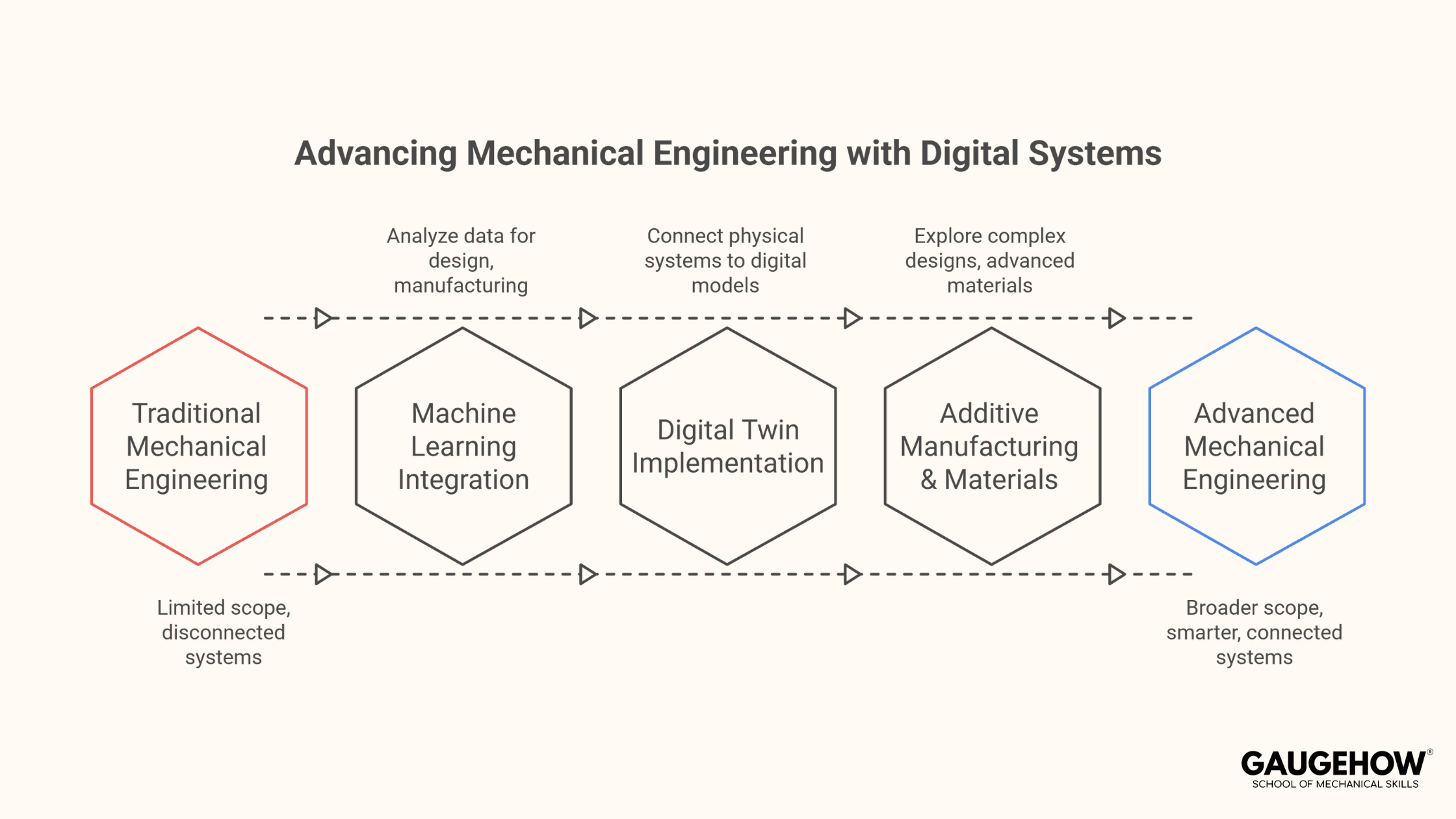
Mechanical engineering is moving forward in ways that make the field broader, smarter, and more connected with digital systems.
Core fundamentals still matter deeply, but newer directions are changing role opportunities and skill demand.
Machine Learning In Mechanical Engineering
Machine learning in mechanical engineering is gaining importance because many design, manufacturing, quality, and maintenance problems now involve useful data patterns.
Design teams can compare options faster when historical data supports decisions. Manufacturing teams can use pattern recognition to detect defects, reduce variation, and improve process stability. Maintenance teams can study condition trends and support better service planning.
A strong entry point here is understanding data flow, basic Python logic, spreadsheet discipline, sensor data structure, and simulation result interpretation.
Digital Twins In Mechanical Engineering
Digital twin thinking connects physical systems with a live or updated digital representation.
That connection helps engineers observe performance, compare expected behavior with actual behavior, and improve decisions across operation, maintenance, and system improvement.
Beginners should see digital twins as an extension of strong engineering basics. Geometry still needs to be right. Sensor data still needs to be meaningful. System logic still needs to be understood.
Additive Manufacturing And Advanced Materials
Additive manufacturing opens more design freedom in selected applications because complex internal features, lightweight structures, and faster iteration cycles become easier to explore.
Advanced materials are also expanding performance choices through better temperature resistance, improved strength-to-weight balance, and application-specific behavior.
A good learning approach here is balanced, not trend-driven. Conventional manufacturing still wins in many cases, but additive methods win in others.
Mechanical Engineering Roadmap for the First 90 Days
The first month should build drawing habit, unit discipline, basic calculation confidence, and clear subject understanding.
The second month should focus on one CAD path, one simple assembly, and one proper drawing sheet. The third month should add material logic, manufacturability review, and one finished mini project with a short explanation.
Consistent, smaller sessions work better when each session ends with visible movement.
Learn Faster With GaugeHow
Random learning stretches effort and weakens momentum. GaugeHow offers a cleaner next step because the path is guided, practical, and built around real engineering outputs.
Courses
Start with structured training in fundamentals, CAD, simulation, manufacturing, and automation.Blog
Use beginner-friendly articles to strengthen concepts between course sessions.YouTube
Watch short lessons and topic explainers when a fast visual review helps.Free Course
Try a low-risk starting point before moving into a deeper learning path.
A simple path works best for fresh learners. Start with core mechanical fundamentals and drawing clarity.
Move into one CAD software. Add manufacturing or simulation based on role interest. Then build one project with a model, drawing, notes, and review logic.
Conclusion
Start with the scope, then build fundamentals, then learn one design tool properly. Add engineering judgment after that, and finish small proof work on a steady rhythm. That path makes progress visible, reviewable, and easier to improve. Learn mechanical engineering in the right order, build proof that others can trust, and move into real engineering work faster.
Frequently Asked Questions
What is mechanical engineering, and why is it important?
Mechanical engineering focuses on the design, analysis, manufacturing, and maintenance of physical systems. Its importance stays high because industries still depend on machines, thermal systems, production lines, quality control, automation, and product development.
Can I learn mechanical engineering online or by myself?
Yes, but progress improves when learning follows a clear order. Strong self-learning usually starts with maths, physics, and drawing, then moves into one CAD path, small projects, and practical review.
What should I learn first in mechanical engineering?
Start with mathematics, physics, engineering drawing, units, dimensions, and material basics. Those subjects support later work in CAD, design review, manufacturing, and simple analysis.
How long does it take to learn mechanical engineering?
Basic orientation can begin in weeks, but solid career-ready depth takes much longer. Strong early progress usually appears within a few months when learning stays structured, and output remains consistent.
Is mechanical engineering hard for beginners?
Mechanical engineering can feel demanding because it combines maths, physics, design, and practical thinking. Difficulty drops once subjects are learned in sequence,e and each stage ends with visible proof.