7 Career Roadmaps for Mechanical Engineers
Learn More in This Video
Subscribe to GaugeHow for More
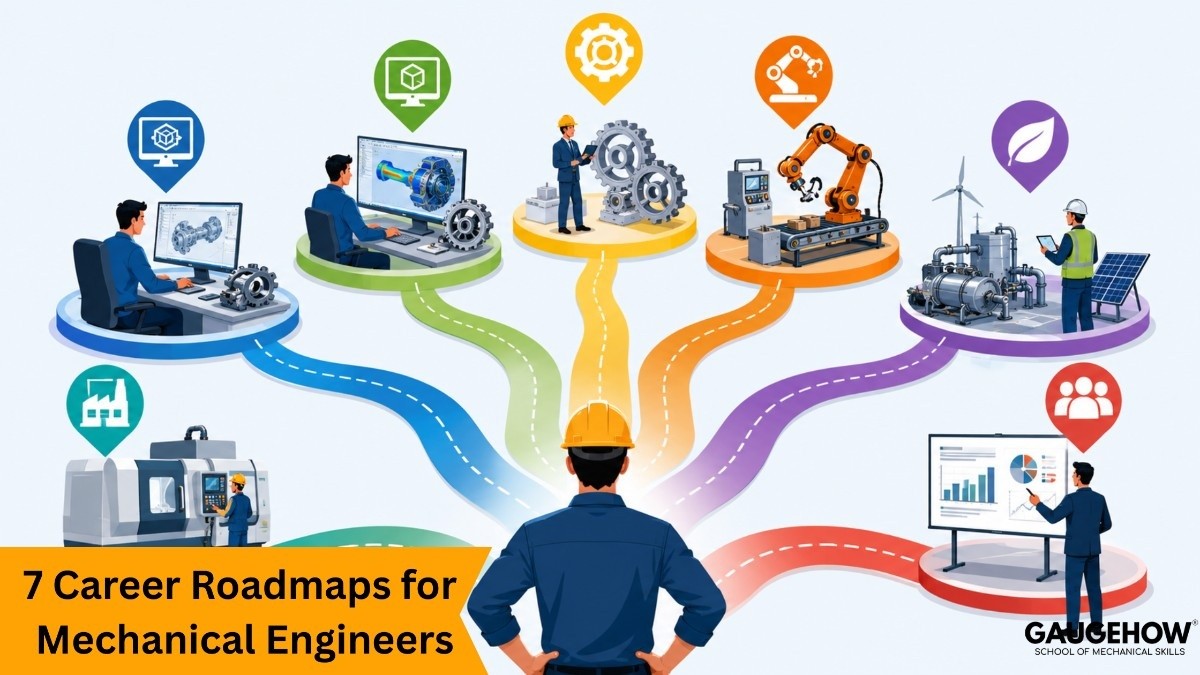
Mechanical engineering degree in hand, but not sure which direction to actually take it? You are not alone. The field is broad enough that "mechanical engineer" can mean seven genuinely different jobs, and most graduates never see all of them laid out side by side before picking one almost by accident.
This guide breaks down the seven major career roadmaps inside mechanical engineering: what each one actually involves, the core skills to learn, and who each path tends to suit best.
How These Seven Roadmaps Compare
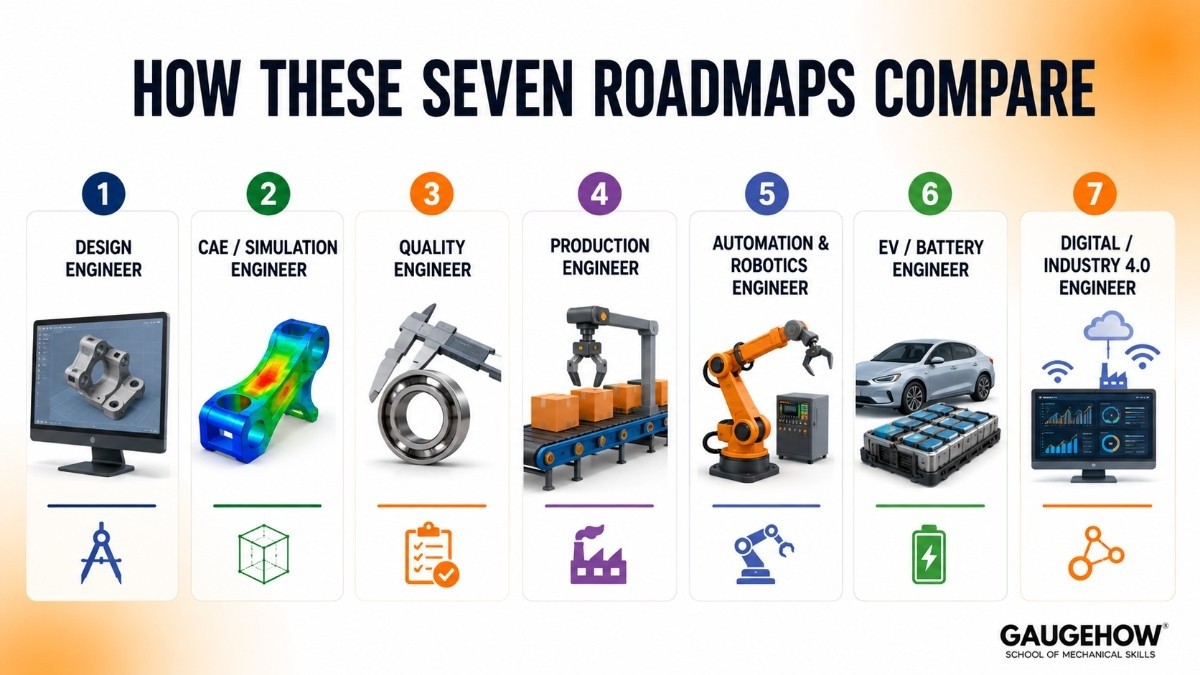
Before diving into each path individually, here is a quick side by side view.
Roadmap | Main Focus | Best For |
|---|---|---|
Design Engineer | Creating and refining part and assembly designs | Engineers who enjoy CAD and hands-on design work |
CAE / Simulation Engineer | Validating designs through structural and thermal simulation | Engineers who enjoy analysis over hands-on design |
Quality Engineer | Ensuring finished parts meet spec and safety standards | Detail-oriented engineers who enjoy process and inspection |
Production Engineer | Running and improving day to day manufacturing output | Engineers who like being on the shop floor solving real problems |
Automation & Robotics Engineer | Programming and integrating automated and robotic systems | Engineers who enjoy control systems and hardware integration |
EV / Battery Engineer | Designing and validating EV-specific systems and components | Engineers drawn to fast-moving automotive and energy work |
Digital / Industry 4.0 Engineer | Connecting shop floor data to plant-wide decisions | Engineers who enjoy data, connected systems, and big-picture thinking |
1. Design Engineer Roadmap
What This Role Involves
Design engineers turn ideas into manufacturable parts and assemblies. This means spending most of your time in CAD, applying tolerances correctly, and iterating designs based on manufacturing and cost feedback.
Key Skills to Learn
Start with a strong CAD foundation in SolidWorks 2024 or Fusion 360, then add GD&T and Engineering Graphics so your designs actually assemble correctly at scale, not just in a single prototype.
If this path appeals to you, the Design Engineer career track lays out the full course sequence.
2. CAE / Simulation Engineer Roadmap
What This Role Involves
Simulation engineers validate designs digitally before physical prototypes exist, catching structural, thermal, or fluid-related problems early. This role suits engineers who enjoy analysis and problem-solving more than hands-on design work.
Key Skills to Learn
The FEA with ANSYS course covers structural simulation fundamentals, while ABAQUS CAE and Autodesk CFD round out structural and fluid analysis skills for more advanced work.
If this path appeals to you, the CAE / Simulation Engineer career track lays out the full course sequence.
3. Quality Engineer Roadmap
What This Role Involves
Quality engineers make sure finished parts actually meet the drawing and the safety standard, not just look right on a screen. This means inspection, root cause analysis, and process control rather than design work itself.
Key Skills to Learn
The Basics of 6 Sigma course builds the statistical and process thinking this role depends on, while Engineering Metrology & 3D Measurement and CMM Inspection & ISO 10360 cover the practical inspection side.
If this path appeals to you, the Quality Engineer career track lays out the full course sequence.
4. Production Engineer Roadmap
What This Role Involves
Production engineers focus on keeping a manufacturing line running efficiently day to day, identifying waste, and improving throughput without sacrificing quality. This role suits engineers who like being on the shop floor solving real, immediate problems.
Key Skills to Learn
The Lean Manufacturing Tools course and 5S System course build the core process improvement toolkit, and the 7 QC Tools course adds the classic quality toolkit that comes up constantly in this kind of work.
If this path appeals to you, the Production Engineer career track lays out the full course sequence.
5. Automation & Robotics Engineer Roadmap
What This Role Involves
This path focuses on programming and integrating the systems that let machines and robots operate with minimal manual input. It suits engineers who enjoy control systems and hands-on hardware integration over pure design work.
Key Skills to Learn
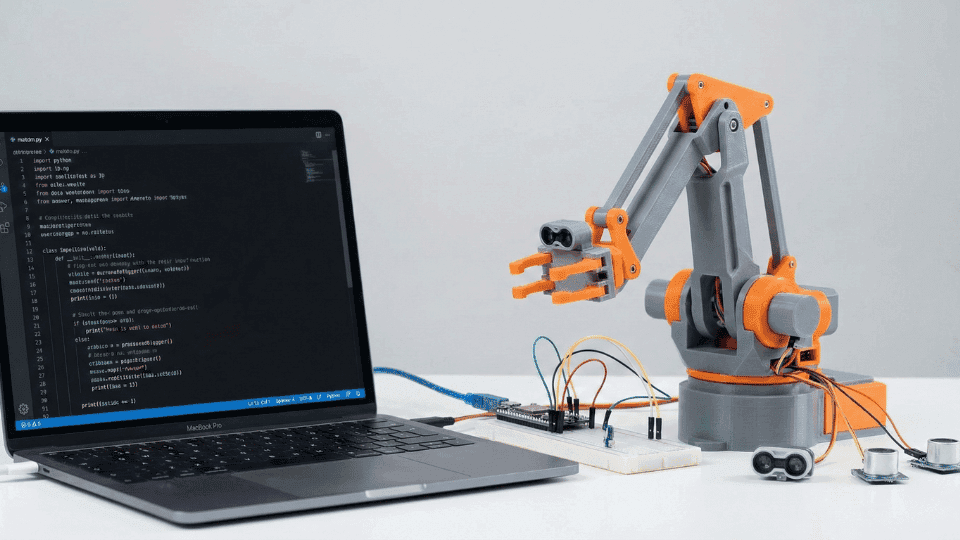
The PLC Programming and Automation course covers the core control logic every automation role depends on, while Mechatronics for Beginners and Python for Mechanical Engineers & Robotics round out the mechanical, electrical, and coding mix this field requires.
If this path appeals to you, the Automation & Robotics Engineer career track lays out the full course sequence.
6. EV / Battery Engineer Roadmap
What This Role Involves
This is one of the fastest-growing paths inside mechanical engineering right now, focused on designing and validating the battery, thermal, and structural systems specific to electric vehicles.
Key Skills to Learn
The EV Battery Technology & Electric Vehicle Fundamentals course builds the core battery and EV knowledge this path depends on, while the ANSYS Fluent / EV Battery Cooling course and Smart Materials Science course cover the thermal and materials side of pack design.
If this path appeals to you, the EV / Battery Engineer career track lays out the full course sequence.
7. Digital / Industry 4.0 Engineer Roadmap
What This Role Involves
This path connects shop floor equipment and data into a larger, smarter manufacturing system. It suits engineers who enjoy data, connected systems, and seeing how individual machines fit into a bigger picture.
Key Skills to Learn
The Introduction to Industry 4.0 course covers the overall framework, while Industrial Internet of Things (IIoT) and Digital Twins build the connected data and virtual modeling skills this field is built on.
If this path appeals to you, the Digital / Industry 4.0 Engineer career track lays out the full course sequence.
How to Choose the Right Roadmap for You
If you are still unsure which of these seven fits best, a few honest questions help narrow it down. Do you enjoy building things in CAD, or do you enjoy analyzing whether something will hold up under stress? Would you rather be on the shop floor solving live problems, or working with data and dashboards? Are you drawn to a specific industry, like EVs, more than a specific skill set?
There is no wrong answer here, and it is common for engineers to move between these paths over a career as interests shift. Starting with a strong shared foundation, CAD, GD&T, and basic simulation, keeps every one of these seven paths open to you for longer.
Frequently Asked Questions
Q: Can I switch between these mechanical engineering career paths later?
A: Yes, and it happens often. A strong shared foundation in CAD, tolerancing, and basic simulation transfers across most of these paths, which makes switching specializations mid-career far more realistic than starting over completely.
Q: Which of these seven roadmaps is growing the fastest?
A: EV and Battery Engineering, along with Digital and Industry 4.0 roles, are currently seeing some of the strongest hiring growth, driven by the shift toward electric vehicles and connected manufacturing.
Q: Do I need to pick a specialization right after graduating?
A: Not immediately. Most engineers benefit from building the shared foundation first, CAD, GD&T, and basic simulation, before specializing, since this keeps more of these seven paths realistically open.
Q: Is one of these roadmaps easier to break into than the others?
A: Design Engineering is generally considered the most accessible entry point, since CAD skills are foundational to almost every other path and widely taught. From there, specializing becomes a matter of adding the specific skills each roadmap requires.
Q: Do these roadmaps require different degrees?
A: No. A standard mechanical, or closely related, engineering degree supports all seven paths. The difference comes from which elective courses, certifications, and hands-on skills you build on top of that shared degree.
Conclusion
Mechanical engineering is not one career path, it is seven overlapping ones, all built on the same core foundation.
Whether you are drawn to design, simulation, quality, production, automation, EV systems, or connected manufacturing, the fastest way forward is building strong fundamentals first, then specializing with intent rather than by accident.
Ready to explore a path? Browse the full course catalog on GaugeHow, or visit the Mechanical Engineer Hub to see every one of these seven roadmaps mapped out in detail.
Mechanical Engineering Courses That Industry Actually Uses
Learn Tools of Design & CAD, Analysis & Simulation, Automation & Robotics, and Industry 4.0 used in modern factories.
Join 40+ Mech Courses like GD&T, Siemens NX, SolidWorks, CATIA V5, AutoCAD, ANSYS (FEA & Fluent), ABAQUS, Creo, Fusion 360, CNC Programming, Digital Twins, Python for Mechanical, and Industry 4.0.
Our Courses
Complete Course Library
Access to 40+ courses covering various fields like Design, Simulation, Quality, Manufacturing, Robotics, and more.