
Which Mechanical Engineering Career Is Right for You?
Learn More in This Video
Subscribe to GaugeHow for More
Mechanical engineering degree done, but still not sure which direction to actually take it? You are not alone.
The field branches into several genuinely different jobs, and most graduates pick a specialization based on whatever internship they happened to land, not because they actually thought through what fits them best.
This guide works backward from your preferences instead of forward from a list of job titles. Answer the questions honestly, match your answers against the paths below, and you will land on a specialization that actually fits how you like to work.
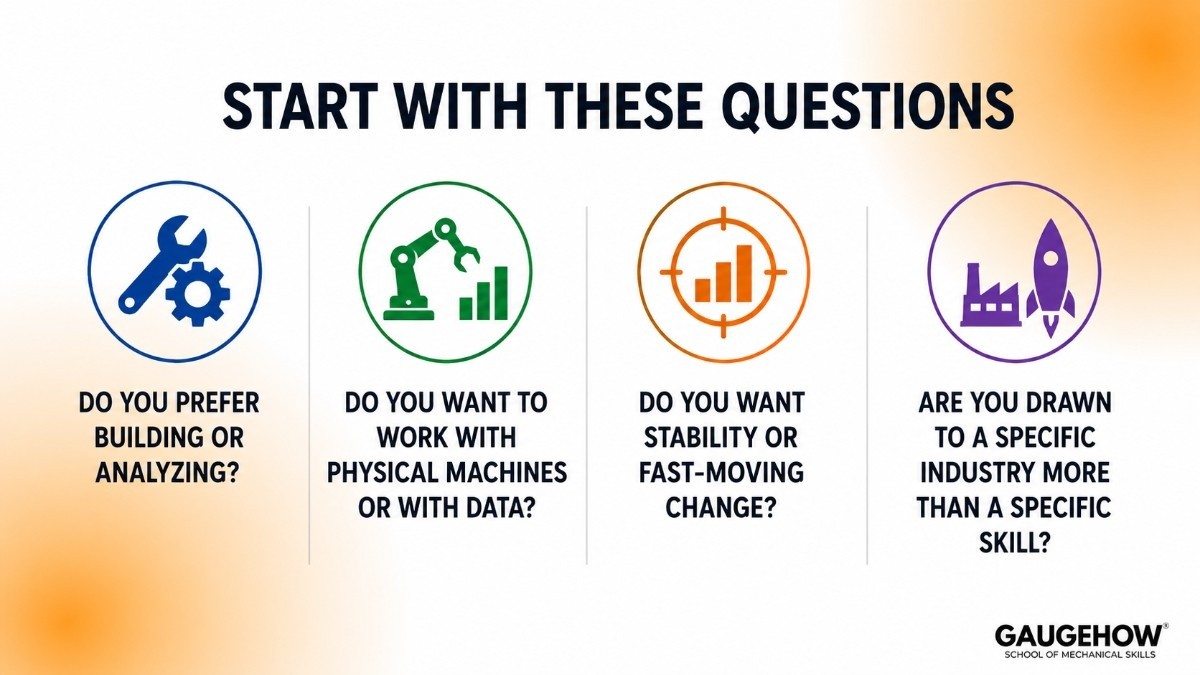
Start With These Questions
Before looking at specific career paths, be honest with yourself about a few things.
Do You Prefer Building or Analyzing?
Some engineers love the act of creating something in CAD, sketching, iterating, and seeing a design come together.
Others get more satisfaction from testing whether something will actually hold up, running the numbers, and finding the failure point before it happens in the real world. Neither is better, but they point toward very different day to day work.
Do You Want to Work With Physical Machines or With Data?
Some roles keep you close to physical hardware every day: machines, robots, control panels, physical prototypes.
Others are increasingly about interpreting data, building dashboards, and using virtual models to make decisions before anything physical happens. Both are mechanical engineering, but the daily experience is very different.
Do You Want Stability or Fast-Moving Change?
Some specializations, like quality and production engineering, tend to follow established, well-documented processes. Others, like EV systems and digital manufacturing, are evolving quickly, with new tools and expectations shifting year over year. Some people thrive on that pace, others find it exhausting.
Are You Drawn to a Specific Industry More Than a Specific Skill?
If you already know you want to work in automotive, aerospace, or robotics specifically, that can be a stronger starting point than picking a skill set first and hoping it leads somewhere interesting.
Match Your Answers to a Career Path
You Might Fit Design Engineering If You Love Building Things in CAD
If your favorite part of any project is opening a CAD file and shaping a part until it works exactly right, design is likely your path. This role rewards patience with iteration and an eye for how parts fit and function together.
Start with SolidWorks 2024 or Fusion 360, then add GD&T and Engineering Graphics so your designs hold up at production scale. The Design Engineer career track lays out the full sequence.
You Might Fit CAE / Simulation Engineering If You'd Rather Predict Failure Than Build the Part
If you find yourself more curious about whether a design will actually survive real conditions than about styling the geometry itself, simulation work suits you well.
The FEA with ANSYS course and Autodesk CFD course build the structural and fluid analysis skills this path depends on. The CAE / Simulation Engineer career track lays out the full sequence.
You Might Fit Quality Engineering If You Notice Small Inconsistencies Others Miss
If you are the person who spots the one measurement that is slightly off, or who cannot let an unexplained defect go without finding the root cause, quality engineering rewards that instinct directly.
The Basics of 6 Sigma course and Engineering Metrology & 3D Measurement course build this detail-oriented skill set. The Quality Engineer career track lays out the full sequence.
You Might Fit Production Engineering If You Like Solving Problems on the Shop Floor
If you would rather be walking the production line finding a real bottleneck than sitting at a desk running simulations, production engineering fits your energy.
The Lean Manufacturing Tools course and 7 QC Tools course build the process improvement skills this role depends on daily. The Production Engineer career track lays out the full sequence.
You Might Fit Automation & Robotics If You Enjoy Hardware That Talks Back to You
If you like the challenge of getting a physical system to behave exactly the way your code tells it to, and troubleshooting when it doesn't, automation and robotics is a strong match.
The PLC Programming and Automation course and Mechatronics for Beginners course build this hands-on control skill set. The Automation & Robotics Engineer career track lays out the full sequence.
You Might Fit EV / Battery Engineering If You Want Fast-Moving, High-Stakes Work
If you are energized by a field that is changing quickly and want your work tied directly to a visible, high-growth industry, EV and battery engineering delivers that pace.
The EV Battery Technology & Electric Vehicle Fundamentals course and ANSYS Fluent / EV Battery Cooling course build the specific knowledge this path requires. The EV / Battery Engineer career track lays out the full sequence.
You Might Fit Digital / Industry 4.0 Engineering If You Think in Systems, Not Just Parts
If you naturally zoom out to see how one machine's data connects to a plant-wide decision, rather than focusing on a single component, this path rewards that big-picture instinct.
The Introduction to Industry 4.0 course and Digital Twins course build this systems-level skill set. The Digital / Industry 4.0 Engineer career track lays out the full sequence.
Career Path Quick-Match Table
If You Enjoy... | Consider... |
|---|---|
Building and iterating in CAD | Design Engineer |
Predicting whether something will fail | CAE / Simulation Engineer |
Catching small inconsistencies and root causes | Quality Engineer |
Solving real problems on the shop floor | Production Engineer |
Getting hardware to respond exactly to your code | Automation & Robotics Engineer |
Fast-moving, high-growth industry work | EV / Battery Engineer |
Seeing how data connects across an entire system | Digital / Industry 4.0 Engineer |
What If You're Still Not Sure?
That is completely normal, and it does not need to be solved before you start learning.
Every path in this guide shares the same foundation: CAD, GD&T, and basic simulation. Building that foundation first keeps every one of these seven directions realistically open, and it is common for engineers to try one path, learn something about themselves, and shift toward another a few years in.
The questions above are worth revisiting every year or two, since what excites you at 22 is not always what excites you at 30.
If you want a broader look at all seven paths side by side before committing, it is worth reviewing what each one actually involves day to day, not just which skills it requires, since the daily experience matters as much as the technical content.
Frequently Asked Questions
Q: What if I like more than one of these paths equally?
A: That is common, and it is not a problem to solve immediately. Start with the shared foundation, CAD, GD&T, and basic simulation, and let real project experience narrow your interest naturally rather than forcing a decision before you have enough information.
Q: Can my answers to these questions change over time?
A: Yes, and they often do. Many engineers start in design or production, then shift toward simulation, automation, or digital roles as their interests and the industry itself evolve.
Q: Is it a mistake to choose a path based on salary rather than genuine interest?
A: It can backfire long-term. Specializations tied to high-growth industries, like EV and Industry 4.0 roles, often pay well currently, but sustained career satisfaction usually comes from genuine fit, which also tends to produce better long-term performance and promotion opportunities.
Q: Do I need to fully commit to one path right after graduating?
A: No. Most engineers benefit from building the shared foundation first and trying a specialization through an internship or early role before fully committing, since real experience clarifies fit far better than self-assessment alone.
Q: What is the fastest way to test whether a path actually fits me?
A: Complete one small, real project in that specialization, a CAD redesign, a basic simulation, a process improvement exercise, and pay attention to whether the work itself felt energizing or draining, independent of the outcome.
Conclusion
There is no universally best mechanical engineering career, only the one that matches how you genuinely like to work.
Use the questions above honestly, match your answers against the seven paths, and build the shared foundation first so you have room to adjust course as you learn more about yourself.
Ready to explore a path? Browse the full course catalog on GaugeHow, or visit the Mechanical Engineer Hub to compare every specialization in one place.
Mechanical Engineering Courses That Industry Actually Uses
Learn Tools of Design & CAD, Analysis & Simulation, Automation & Robotics, and Industry 4.0 used in modern factories.
Join 40+ Mech Courses like GD&T, Siemens NX, SolidWorks, CATIA V5, AutoCAD, ANSYS (FEA & Fluent), ABAQUS, Creo, Fusion 360, CNC Programming, Digital Twins, Python for Mechanical, and Industry 4.0.
Our Courses
Complete Course Library
Access to 40+ courses covering various fields like Design, Simulation, Quality, Manufacturing, Robotics, and more.