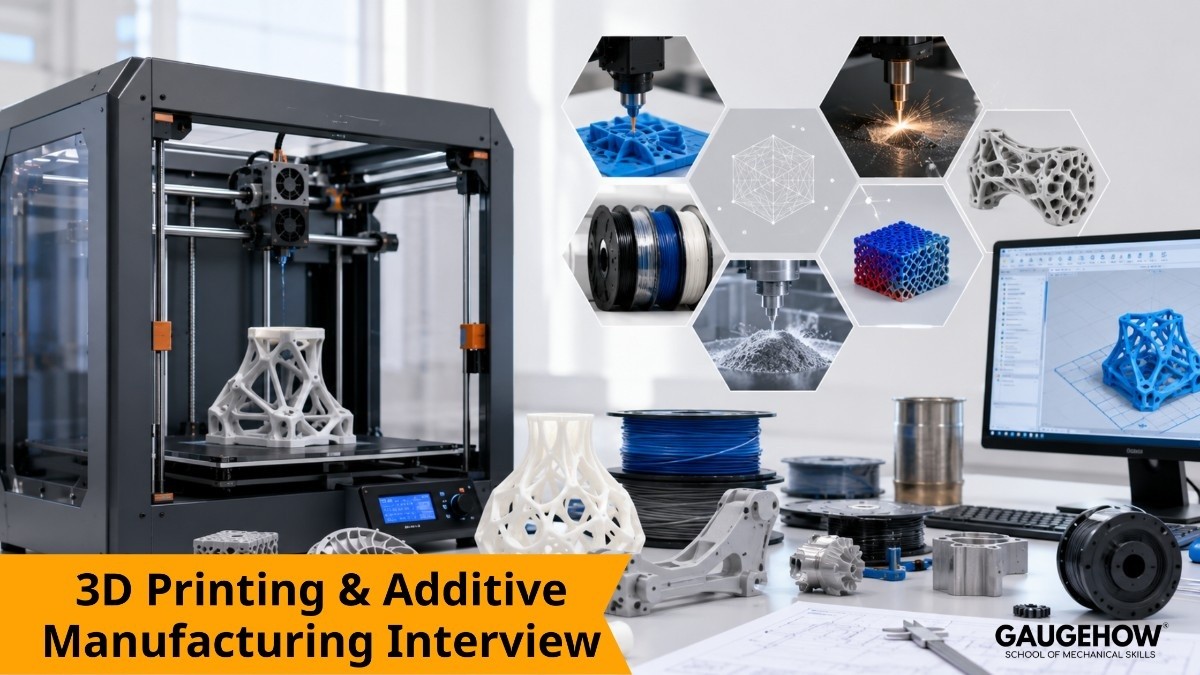
3D Printing & Additive Manufacturing Interview Questions and Answer

Deepak S Choudhary
Learn More in This Video
Subscribe to GaugeHow for More
Additive manufacturing interviews tend to separate candidates fast anyone can define FDM or SLA in a sentence, but far fewer can explain why a part warped during printing, how to choose infill for a load-bearing bracket, or when additive actually loses to CNC on cost.
Interviewers use these questions to find out whether you've actually printed and troubleshot parts, not just read about the process.
General Additive Manufacturing Questions
Q1. What is additive manufacturing, and how is it different from subtractive manufacturing?
Additive manufacturing builds a part layer by layer directly from a digital model, adding material only where it's needed. Subtractive manufacturing, like CNC machining, starts with a solid block and removes material to reach the final shape.
The distinction matters because it changes what geometries are even possible additive can produce internal channels and lattice structures that subtractive methods simply can't reach.
Q2. What are the main additive manufacturing processes, and how do they differ?
The major processes include FDM (Fused Deposition Modeling), which extrudes melted thermoplastic filament; SLA (Stereolithography), which cures liquid resin with a laser; SLS (Selective Laser Sintering), which fuses powdered material with a laser; and DMLS/SLM for metal powder.
Each differs in material compatibility, surface finish, mechanical properties, and cost, which is why process selection depends heavily on the part's actual function, not just what printer happens to be available.
Q3. What industries commonly use additive manufacturing, and for what applications?
Aerospace uses it for lightweight brackets and complex ducting where weight savings justify the cost. Medical applications include custom implants and surgical guides matched to patient anatomy.
Automotive and general manufacturing lean on it heavily for rapid prototyping and low-volume tooling, where the speed of iteration outweighs the higher per-part cost compared to injection molding.
Q4. What are the biggest limitations of additive manufacturing compared to traditional methods?
Per-part cost and production speed are the clearest limitations at higher volumes injection molding or CNC machining almost always wins once quantities scale up.
Additive parts can also have anisotropic mechanical properties, meaning strength varies depending on print orientation, which needs to be accounted for in any load-bearing design.
FDM (Fused Deposition Modeling) Questions
Q5. How does FDM printing work, and what materials are commonly used?
FDM works by feeding thermoplastic filament through a heated nozzle that extrudes melted material layer by layer onto a build platform, with each layer bonding to the one below as it cools.
Common materials include PLA for prototyping, ABS for higher heat resistance, PETG for a balance of strength and printability, and engineering filaments like nylon or polycarbonate for demanding applications.
Q6. What causes warping in FDM prints, and how do you prevent it?
Warping happens when a printed layer cools and contracts faster than the layers around it, pulling the part away from the bed, most commonly with materials like ABS that have high thermal contraction.
Prevention includes using a heated bed and enclosure to maintain consistent temperature, applying an adhesive like glue stick or specialized bed surfaces, and designing parts with larger contact areas or brims where warping risk is high.
Q7. What is layer adhesion, and why does it matter for part strength?
Layer adhesion refers to how well consecutive layers bond together during printing, and it directly determines the part's strength in the Z-axis direction perpendicular to the layers.
Poor adhesion, often from incorrect nozzle temperature or print speed, creates a part that looks fine but delaminates or fails under stress that a solid-molded equivalent would easily handle.
Q8. How do you choose infill percentage and pattern for a functional part?
Infill percentage balances strength against print time and material cost a display prototype might use 10-15% infill, while a load-bearing bracket needs considerably more, sometimes closer to 50-100% depending on the application.
Pattern choice also matters: a grid or honeycomb pattern generally offers better strength-to-material ratio than a simple linear infill for parts under multi-directional load.
SLA and Resin Printing Questions
Q9. How does SLA printing differ from FDM in terms of process and output quality?
SLA cures liquid photopolymer resin layer by layer using a UV laser, producing much finer surface detail and smoother finishes than FDM's extruded layers. The tradeoff is that SLA parts are typically more brittle than FDM thermoplastics and require post-processing steps like washing and UV curing that FDM doesn't need.
Q10. What post-processing steps are required for SLA prints?
SLA parts need to be washed in isopropyl alcohol to remove uncured resin from the surface, then post-cured under UV light to fully harden the material and reach its final mechanical properties. Skipping or rushing either step leaves a part that looks finished but is still tacky or under-strength compared to its actual rated performance.
Q11. What safety precautions are necessary when working with resin-based 3D printing?
Uncured resin is a skin and respiratory irritant, so nitrile gloves, adequate ventilation, and eye protection are standard practice when handling it. Isopropyl alcohol used for washing prints is also flammable, and both uncured resin and used alcohol require proper disposal rather than pouring down a drain.
SLS and Powder-Bed Questions
Q12. How does SLS printing work, and what's its main advantage over FDM or SLA?
SLS uses a laser to selectively fuse powdered material, typically nylon, layer by layer, with the surrounding unfused powder acting as built-in support for overhangs.
Its main advantage is that it doesn't require dedicated support structures the way FDM and SLA often do, which makes it well suited to complex geometries and enables denser part-packing within a single build.
Q13. What is powder recyclability in SLS, and why does it matter for cost?
Unfused powder from an SLS build can typically be sieved and blended with fresh powder for reuse in future prints, though the ratio of recycled to virgin powder affects final part properties.
Managing this ratio matters directly for cost, since powder is a significant expense in SLS production, but overusing recycled powder can degrade mechanical performance.
Metal Additive Manufacturing Questions
Q14. What is DMLS or SLM, and how does it differ from polymer-based additive processes?
DMLS (Direct Metal Laser Sintering) and SLM (Selective Laser Melting) use a high-powered laser to fuse metal powder layer by layer, producing fully dense metal parts rather than polymer ones.
The process requires far tighter control of atmosphere, powder handling, and thermal management than polymer printing, since metal parts are prone to residual stress and cracking if cooling isn't managed carefully.
Q15. Why do metal additive parts often require post-print heat treatment?
Metal additive parts build up internal residual stress from rapid, localized heating and cooling during the laser fusion process, which can cause warping or cracking if left untreated.
Stress-relief heat treatment, and sometimes hot isostatic pressing, restores dimensional stability and improves the part's final mechanical properties before it's put into service.
Q16. What support structures are typically needed in metal additive manufacturing, and why?
Metal AM parts need supports not just to prevent overhangs from collapsing but to anchor the part to the build plate and conduct heat away from the melt pool during printing. Removing these supports afterward is a significant post-processing step, often requiring wire EDM or CNC machining, which needs to be factored into both cost and design.
Design for Additive Manufacturing (DfAM) Questions
Q17. What is Design for Additive Manufacturing, and how does it differ from designing for CNC or injection molding?
DfAM means designing a part specifically around what additive manufacturing does well like consolidating multiple assemblies into a single printed piece or adding internal lattice structures for weight reduction rather than just adapting a design meant for traditional manufacturing.
It also means actively designing around additive's constraints, like overhang angles and support requirements, instead of ignoring them until the print fails.
Q18. What overhang angle typically requires support structures, and why?
Most FDM and resin processes need support for overhangs steeper than about 45 degrees from vertical, since unsupported material at shallower angles tends to sag or fail to bond properly to the layer below. Designing with self-supporting angles wherever possible reduces both print time and post-processing cleanup.
Q19. How do you design lattice structures for weight reduction without sacrificing strength?
Lattice design starts with understanding the actual load path through the part, then placing denser lattice material along that path while opening up lower-stress regions. Tools like Fusion 360's generative design features can help automate this process, covered in GaugeHow's Fusion 360 course, though validating the result with simulation before printing is still essential.
Q20. Why is part orientation during printing a design decision, not just a slicer setting?
Orientation determines which direction is mechanically weakest due to layer adhesion, how much support material is needed, and how visible layer lines are on critical surfaces.
A part oriented purely to minimize print time might end up structurally weak in exactly the direction it needs strength, which is why orientation should be considered during design, not left entirely to default slicer behavior.
Materials and Mechanical Properties Questions
Q21. What is anisotropy in 3D printed parts, and why does it matter for engineering applications?
Anisotropy means a printed part's mechanical properties differ depending on direction relative to the print layers typically weaker between layers (Z-axis) than within a layer (XY plane).
It matters because a part that passes a tensile test in one orientation could fail well below its rated strength if the actual load in service is applied along the weak axis.
Q22. How do you select the right material for a functional 3D printed part?
Material selection starts with the part's actual operating conditions temperature exposure, chemical exposure, expected load, and required stiffness or flexibility rather than defaulting to whatever material is already loaded in the printer.
GaugeHow's Smart Materials Science course covers how material properties translate into real-world part performance across different manufacturing processes.
Q23. What testing methods are used to validate the mechanical properties of a printed part?
Tensile testing evaluates strength and elongation, typically done in multiple print orientations to capture anisotropic behavior. For applications with cyclic loading, fatigue testing is also important, since a printed part can pass a single tensile test but fail prematurely under repeated stress that a solid molded part would tolerate.
Software, Tolerancing, and Quality Questions
Q24. What CAD or slicing software are you experienced with for additive manufacturing?
Most workflows involve a CAD platform like SolidWorks or Fusion 360 for the initial design, followed by slicing software that converts the model into printer instructions, controlling layer height, infill, and support placement. GaugeHow's SolidWorks 2024 course covers the modeling foundation most additive workflows are built on, before the file ever reaches a slicer.
Q25. How do dimensional tolerances in additive manufacturing compare to CNC machining?
Additive processes generally hold looser tolerances than CNC machining, with typical FDM accuracy around ±0.1-0.5mm depending on the machine and material, compared to CNC's ability to reliably hit ±0.01-0.05mm on critical features.
Understanding and correctly specifying tolerances using GD&T, covered in GaugeHow's GD&T and Engineering Graphics course, is essential for knowing which features on a printed part actually need secondary machining to meet spec.
Q26. How do you inspect and validate dimensional accuracy on a finished additive part?
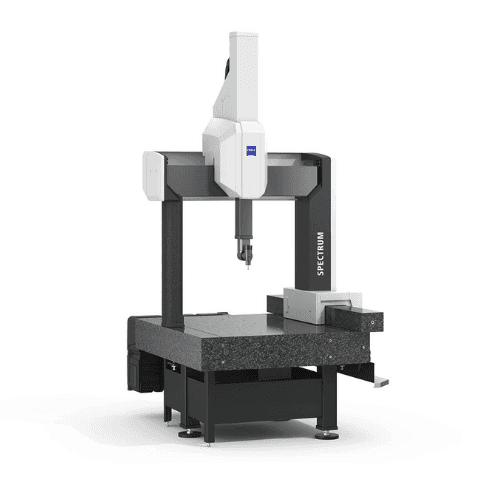
Common methods include calipers or micrometers for straightforward dimensions, and coordinate measuring machines (CMM) or 3D scanning for complex geometries where manual measurement isn't practical.
The inspection method should match the tolerance requirement using a caliper on a feature that needs CMM-level precision just gives a false sense of confidence.
Scenario and Behavioral Questions
Q27. A printed part failed under load in the field. How would you investigate the cause?
I'd start by examining the failure surface for signs of layer delamination versus a clean material fracture, which points to whether the issue was print orientation and adhesion or a material or design problem. Cross-checking the original print settings, orientation, and infill against the part's actual load case usually narrows down whether the failure was preventable with a design or process change.
Q28. How would you reduce print failures on a production floor running printers continuously?
I'd look at what's actually causing failures first nozzle clogs, bed adhesion issues, or filament moisture absorption are common culprits rather than assuming a single fix applies to all failures.
Standardizing maintenance schedules, storing filament properly to prevent moisture uptake, and building in automated failure detection where possible all reduce wasted print time.
Q29. A customer wants a part redesigned to cut additive manufacturing cost. How do you approach it?
Cost in additive manufacturing scales heavily with print time and material volume, so I'd look first at reducing infill where structurally acceptable, minimizing support material through better orientation, and checking whether hollowing non-critical sections is viable.
I'd also confirm the part actually needs additive manufacturing at all at higher volumes, redesigning for injection molding or CNC might cut cost far more than optimizing the print itself.
Q30. How do you decide whether a part should be made additively or through traditional manufacturing?
The decision usually comes down to volume, geometry complexity, and lead time needs. Low-volume, geometrically complex, or rapidly iterated parts tend to favor additive, while high-volume, simpler parts almost always favor injection molding or CNC on a per-unit cost basis once tooling investment is spread across enough units.
FAQ
What's the difference between 3D printing and additive manufacturing?
The terms are largely used interchangeably today, though "3D printing" is more common in casual or consumer contexts while "additive manufacturing" is typically used in industrial and engineering settings to describe the same layer-by-layer build process.
Do additive manufacturing engineers need to know CAD software?
Yes, strong CAD skills are expected for most roles, since designing for additive manufacturing requires understanding how geometry translates into print orientation, support needs, and post-processing requirements, not just producing a model that looks correct on screen.
Is metal 3D printing stronger than traditional metal casting?
It depends on the application. Metal AM parts can match or exceed cast parts in strength when properly heat-treated, but they can also carry more internal stress if post-processing is skipped, so the comparison depends heavily on how the part was finished, not just the process used to build it.
What's the biggest skill gap employers look for in additive manufacturing candidates?
Practical troubleshooting experience knowing why a print failed and how to fix the root cause is usually valued more than theoretical process knowledge alone.
Employers want to see that you've actually run into warping, delamination, or support failures and solved them, not just read about the causes.
How important is understanding tolerances for an additive manufacturing role?
Very important, especially for parts that need to mate with other components or meet functional specifications. Since additive processes generally hold looser tolerances than machining, knowing which features need secondary CNC finishing to meet a drawing's GD&T callouts is a core part of the job.
Conclusion
3D printing and additive manufacturing interviews reward candidates who can explain not just how each process works, but why a part warped, why a design needs supports, and when additive actually loses to traditional manufacturing on cost. Prepare specific examples of a print failure you diagnosed and a design decision you made to improve strength or reduce cost.
To build the hands-on foundation behind these interview topics, GaugeHow's 3D Printing / Additive Manufacturing course covers the process fundamentals end to end, while Fusion 360 and SolidWorks 2024 build the design skills needed to actually apply DfAM principles rather than just discuss them.