5S, Kaizen & 7 QC Tools Interview Questions and Answers

Deepak S Choudhary
Learn More in This Video
Subscribe to GaugeHow for More
Quality and continuous improvement interviews lean heavily on 5S, Kaizen, and the 7 QC Tools. Interviewers want proof you've actually used them on a floor, not just memorized the names.
5S Interview Questions
Q1. What are the 5S's?
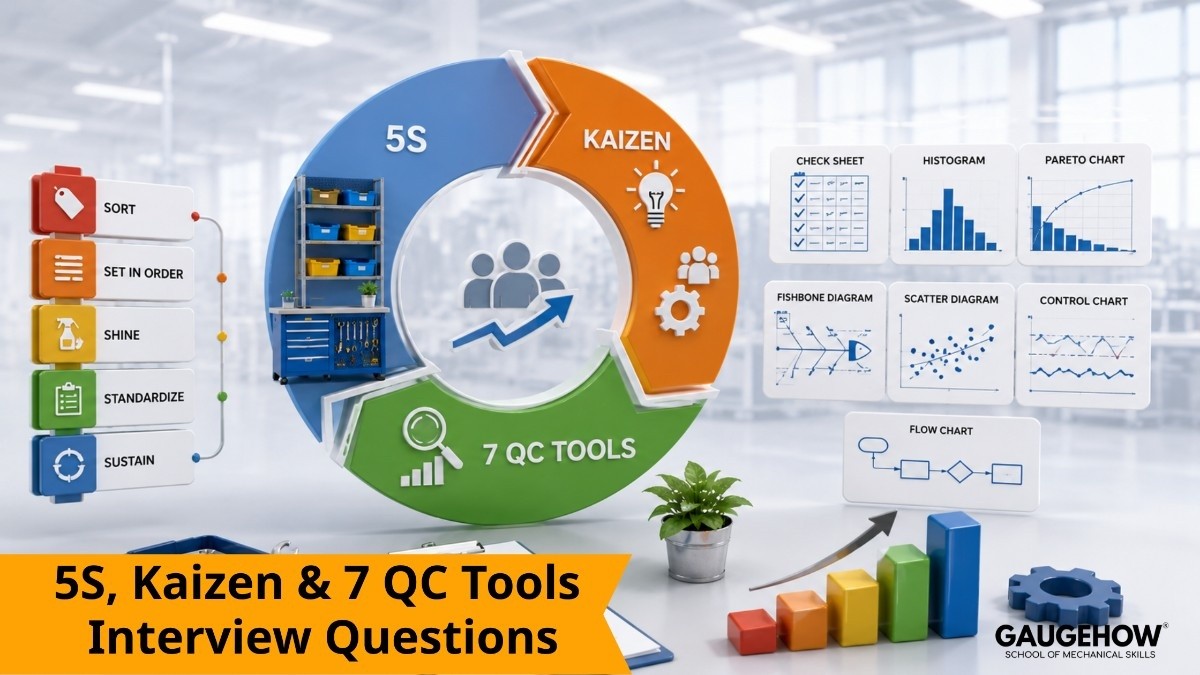
The 5S's are Sort, Set in Order, Shine, Standardize, and Sustain. They're a system for organizing a workplace so problems become visible fast. GaugeHow's 5S System course covers each step in practical detail.
Q2. Which of the 5S's is hardest to sustain, and why?
Sustain is usually the hardest. The first four steps give a visible, satisfying result. Sustain requires daily discipline with no dramatic before-and-after moment.
Q3. How does 5S connect to safety, not just tidiness?
A well-organized 5S area makes missing tools or spills instantly obvious. That visibility catches hazards before they cause an incident. It's a safety system disguised as a cleaning system.
Q4. How would you introduce 5S to a skeptical team?
I'd connect it to problems they already care about, like lost time hunting for tools. Running one small pilot area with visible results builds buy-in faster than a company-wide mandate. Skeptics respond to proof, not policy.
Q5. How do you audit whether 5S is actually being followed?
I use a simple scoring checklist per area, reviewed on a set schedule. Scores get posted visibly so teams see their own trend over time. Audits without visible follow-up tend to fade out within months.
Q6. What's the difference between Sort and Set in Order?
Sort means removing anything unnecessary from the workspace entirely. Set in Order means giving everything that remains a clear, labeled place. One clears clutter; the other prevents it from coming back.
Kaizen Interview Questions
Q7. What is Kaizen?
Kaizen means continuous improvement through small, consistent changes. It's both a mindset and a structured event format. GaugeHow's Lean Manufacturing Tools course covers Kaizen alongside the other lean fundamentals.
Q8. How would you run a Kaizen event?
I'd pick one narrow process, not the whole line. The team maps the current state, tests a change, then documents new standard work. A follow-up check after 30 days confirms the change actually held.
Q9. What's the difference between Kaizen and Kaikaku?
Kaizen is small, continuous improvement, usually driven by the people doing the work. Kaikaku is radical, large-scale change, usually led by management. Both matter, but they operate at different speeds.
Q10. How do you get operators to actually participate in Kaizen?
Operators need to see their suggestions lead to real change, not disappear into a suggestion box. Public credit and quick wins build that trust fast. Without it, participation stays surface-level.
Q11. How do you measure whether a Kaizen event succeeded?
I track the specific metric the event targeted, checked again weeks later, not just on closing day. A good result on day one that fades by week four means the change didn't stick. Follow-up data is what separates real improvement from a nice event.
Q12. What's a Kaizen example you'd give in an interview?
A strong example names a specific bottleneck, the change tested, and the measured result. For instance, cutting changeover time by applying SMED principles during a focused event. Specificity is what makes the answer credible.
7 QC Tools Interview Questions
Q13. What are the 7 QC Tools?
They are the cause-and-effect diagram, check sheet, control chart, histogram, Pareto chart, scatter diagram, and flowchart. GaugeHow's 7 QC Tools course walks through when to use each one.
Q14. What is a cause-and-effect diagram used for?
Also called a fishbone diagram, it organizes possible causes of a problem into categories like people, method, machine, and material. It helps a team brainstorm systematically instead of guessing randomly. It's most useful early in root cause analysis.
Q15. When would you use a Pareto chart?
A Pareto chart ranks problems by frequency or impact, showing which few causes account for most of the issue. It's based on the 80/20 rule a small number of causes usually drive most defects. It helps prioritize where to focus limited time.
Q16. What is a control chart, and what does it tell you?
A control chart plots process data over time against upper and lower control limits. It shows whether variation is normal or signals a real problem. It's the main tool for distinguishing noise from an actual process shift.
Q17. How is a histogram different from a control chart?
A histogram shows the distribution shape of data at one point in time. A control chart shows how data behaves across time. One tells you the pattern; the other tells you the trend.
Q18. What is a scatter diagram used for?
A scatter diagram plots two variables against each other to check for a relationship. It's useful for testing whether a suspected cause actually correlates with a defect. Correlation shown here still needs further verification before confirming causation.
Q19. What is a check sheet, and why does it matter?
A check sheet is a simple structured form for collecting data consistently as events happen. It turns "we think this happens a lot" into actual counted data. Reliable data is what makes the other QC tools meaningful.
Q20. How do these seven tools work together in a real investigation?
A typical flow starts with a check sheet to gather data, then a Pareto chart to prioritize, a fishbone diagram to brainstorm causes, and a control chart to confirm the fix worked. They're rarely used in isolation. Interviewers like hearing that sequence explained clearly.
Combined and Applied Questions
Q21. How does 5S support the 7 QC Tools?
An organized 5S workspace makes abnormalities visible fast, which feeds cleaner data into check sheets and control charts. Messy areas hide the very problems these tools are meant to find. 5S is the foundation the other tools build on.
Q22. How does Kaizen use the 7 QC Tools during an event?
A Kaizen event often opens with a Pareto chart to pick the biggest opportunity, then a fishbone diagram to find causes. Data collected during testing gets checked with a control chart afterward. The tools give the event structure instead of just gut feel.
Q23. What's the difference between Lean and Six Sigma tools like these?
Lean tools like 5S and Kaizen focus on flow and waste. The 7 QC Tools lean more statistical, closer to what Six Sigma uses for defect reduction. GaugeHow's Basics of 6 Sigma course covers how the two approaches complement each other.
Q24. How do you decide which QC tool fits a given problem?
I match the tool to the question I'm actually asking. Need to prioritize causes? Pareto chart. Need to check if a process is stable? Control chart. The tool follows the question, not the other way around.
Scenario and Behavioral Questions
Q25. A 5S audit score keeps dropping in one area. How do you respond?
I'd talk to the team first rather than assume laziness often a process change upstream is creating new clutter. I'd walk the area with them to see the real cause. A dropping score is usually a symptom, not the problem itself.
Q26. Describe a Kaizen event that didn't go as planned.
A strong answer names what went wrong honestly maybe the scope was too broad, or follow-up never happened. It then explains what changed afterward. Interviewers trust an honest miss more than a suspiciously perfect story.
Q27. How do you use a Pareto chart to justify a resource request?
I show management which few causes are driving most of the cost or defects, backed by real data. That framing makes the request about impact, not opinion. Numbers move budget conversations faster than descriptions.
Q28. A control chart shows a process going out of control. What's your first step?
I check for an assignable cause before touching the process itself a material change, a new operator, a machine issue. Adjusting the process without knowing the cause often makes variation worse. Diagnosis comes before correction.
Q29. How do you keep a team engaged with 5S and Kaizen long term?
Regular small wins matter more than one big launch event. Visible metrics, quick response to suggestions, and rotating ownership keep it from feeling like a one-time initiative. Long-term engagement is built, not announced.
Q30. How do you explain the value of these tools to someone who thinks they're just paperwork?
I connect each tool to a result they already care about fewer defects, less wasted time, fewer surprises. Data from a real example usually convinces faster than an explanation of the method itself. Results, not process names, change minds.
FAQ
Are 5S, Kaizen, and the 7 QC Tools part of Lean or Six Sigma?
5S and Kaizen are core Lean tools focused on waste and flow. The 7 QC Tools are used across both Lean and Six Sigma for data-driven problem solving.
Do I need certification to discuss these tools in an interview?
No, but certification can help your resume stand out. Employers still weight hands-on examples of using these tools more heavily than the certificate itself.
What's the most commonly asked 5S question in interviews?
Which of the 5S's is hardest to sustain, and why. It tests whether you understand the system beyond the initial cleanup phase.
Which QC tool comes up most often in interviews?
The Pareto chart and the fishbone diagram are asked about most, since they're the most commonly used in real root cause work.
How technical do these interviews usually get?
Quality-focused roles may ask you to interpret a sample control chart or histogram. Operations roles lean more toward behavioral questions about implementation and team buy-in.
Conclusion
Interviews on 5S, Kaizen, and the 7 QC Tools reward candidates who connect each tool to a real result, not just a definition. Prepare one specific example for each area a 5S rollout, a Kaizen event, and a QC tool that solved a real problem.
To build hands-on familiarity before your next interview, GaugeHow's 5S System and 7 QC Tools courses cover these fundamentals in practical depth, while Lean Manufacturing Tools ties Kaizen into the broader lean toolkit these interviews expect you to know.