Battery Technology Interview Questions and Answers (Cells to Packs)

Deepak S Choudhary
Learn More in This Video
Subscribe to GaugeHow for More
Battery technology interviews move from cell chemistry all the way up to full pack design, testing how well you understand each level and how they connect. Interviewers want specifics on chemistry tradeoffs, thermal behavior, and pack engineering, not just surface-level definitions.
Cell Chemistry Questions
Q1. What are the main lithium-ion battery chemistries used today?
NMC (Nickel Manganese Cobalt) offers high energy density, common in EVs needing longer range. LFP (Lithium Iron Phosphate) offers lower energy density but better thermal stability and longer cycle life. Choosing between them depends on the specific application's priorities.
Q2. What's the difference between energy density and power density in a battery cell?
Energy density measures how much energy a cell can store relative to its weight or volume. Power density measures how quickly that energy can be delivered or absorbed.
A cell optimized for energy density isn't always optimized for high-power applications like fast acceleration.
Q3. Why is LFP chemistry gaining popularity despite lower energy density than NMC?
LFP offers significantly better thermal stability, reducing thermal runaway risk compared to NMC. It also typically achieves longer cycle life and avoids cobalt, addressing both cost and supply chain concerns. These advantages often outweigh the energy density tradeoff for many applications.
Q4. What is solid-state battery technology, and why is it considered a major advancement?
Solid-state batteries replace the liquid electrolyte with a solid material, potentially improving energy density and safety significantly. They reduce fire risk since there's no flammable liquid electrolyte to leak or ignite. Manufacturing challenges and cost currently limit widespread commercial adoption.
Q5. What is C-rate, and why does it matter for battery performance?
C-rate describes how fast a battery is charged or discharged relative to its capacity, where 1C means a full charge or discharge in one hour. Higher C-rates generate more heat and stress the cell more than slower rates. Understanding a cell's rated C-rate limits is essential for safe pack design.
Cell Design and Manufacturing Questions
Q6. What are the main physical formats for lithium-ion cells?
Cylindrical cells are common for their manufacturing consistency and mechanical robustness. Prismatic cells offer better space utilization within a pack. Pouch cells are lightweight and flexible in shape but require more structural support.
Q7. How does cell manufacturing quality affect overall battery pack performance?
Inconsistent manufacturing can cause cell-to-cell variation in capacity or internal resistance, leading to imbalance across a pack over time. This imbalance reduces overall pack capacity and can accelerate degradation of weaker cells. Tight manufacturing tolerances are essential for reliable pack-level performance.
Q8. What is cell internal resistance, and why does it matter?
Internal resistance determines how much energy is lost as heat during charging and discharging. Higher internal resistance reduces efficiency and increases heat generation under load. It typically increases as a cell ages, which is one common indicator of degradation.
Q9. What is cycle life, and what factors affect it?
Cycle life is the number of charge-discharge cycles a cell can undergo before capacity degrades below a usable threshold. Factors like depth of discharge, temperature, and charge rate all significantly affect actual cycle life. Real-world cycle life often differs meaningfully from lab-tested ratings depending on usage conditions.
Battery Management System Questions
Q10. What is a Battery Management System, and what are its core functions?
A BMS monitors cell voltage, temperature, and current, protecting against unsafe conditions like overcharge, over-discharge, or overheating. It also balances cells and communicates state of charge to the rest of the system. Without a reliable BMS, a pack risks unsafe operation and reduced lifespan.
Q11. What is cell balancing, and why is it necessary in a battery pack?
Cell balancing corrects small differences in charge level between cells connected in series, since even minor imbalance limits overall pack capacity.
Passive balancing dissipates excess energy as heat, while active balancing redistributes it more efficiently. Without balancing, the weakest cell effectively limits the whole pack's usable capacity.
Q12. What's the difference between passive and active cell balancing?
Passive balancing bleeds excess charge from higher-voltage cells as heat until all cells match. Active balancing transfers charge between cells more efficiently, reducing energy waste.
Active balancing is more complex and costly but performs better in packs with larger cell counts.
Q13. How does a BMS estimate state of charge, and why is it difficult to do accurately?
State of charge is typically estimated using a combination of voltage measurement and coulomb counting, tracking current flow over time. It's difficult because voltage alone doesn't map perfectly to charge level, especially as cells age.
Advanced algorithms often use modeling to improve accuracy beyond simple voltage lookup.
Q14. What is state of health, and how is it different from state of charge?
State of charge reflects how full a battery currently is. State of health reflects the battery's overall condition and remaining usable capacity compared to when it was new. A battery can have a high state of charge but a degraded state of health after significant use.
Thermal Management Questions
Q15. What causes thermal runaway in a lithium-ion battery?
Thermal runaway occurs when a cell overheats and triggers an uncontrolled chain reaction, often from internal short circuits, physical damage, or overcharging.
Once triggered, it can spread rapidly to neighboring cells if not contained. Preventing it requires both cell-level safety features and pack-level thermal management.
Q16. How do you design thermal management for a battery pack?
I'd model heat generation under expected charge and discharge conditions, then design cooling, whether liquid or air-based, to keep cells within their safe operating range.
GaugeHow's ANSYS Fluent / EV Battery Cooling course covers this simulation process in practical depth. Uneven cooling across a pack can cause cells to degrade at different rates.
Q17. Why does temperature affect battery performance and lifespan so significantly?
High temperatures accelerate chemical degradation inside the cell, reducing both capacity and cycle life over time. Low temperatures reduce available power and increase internal resistance temporarily.
Keeping cells within an optimal temperature range is one of the most important factors in long-term pack reliability.
Q18. What safety features are typically built into a battery pack to prevent thermal propagation?
Thermal barriers between cells slow the spread of heat if one cell fails. Venting systems direct gas away from other cells and passengers during a failure event. Fuses and current interrupt devices also disconnect a failing cell from the rest of the circuit.
Pack Design and Integration Questions
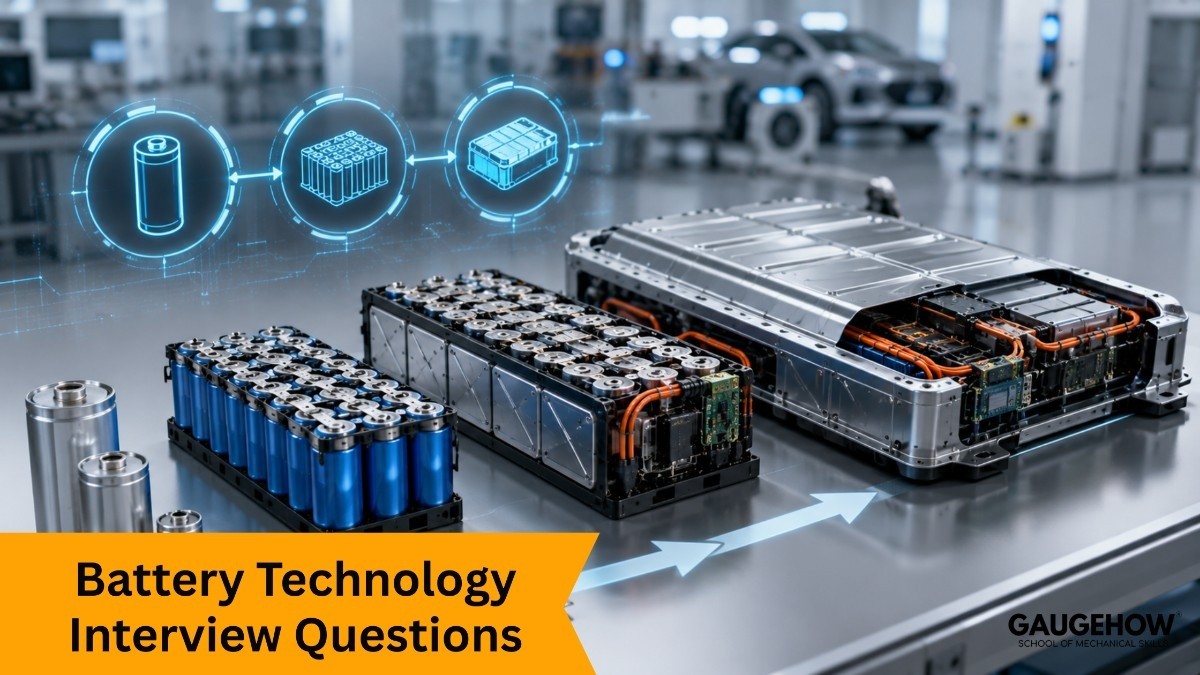
Q19. How do individual cells get organized into a complete battery pack?
Cells are grouped into modules, connected in series and parallel configurations to reach the required voltage and capacity.
Modules are then combined into the full pack, along with the BMS, cooling system, and structural enclosure. This hierarchy of cell, module, and pack is standard across most EV battery designs.
Q20. What's the difference between series and parallel cell configurations in a pack?
Series configuration increases total voltage by connecting cells end to end. Parallel configuration increases total capacity by connecting cells side by side at the same voltage.
Most packs combine both to reach target voltage and capacity requirements simultaneously.
Q21. How does the "cell-to-pack" design trend differ from traditional module-based pack construction?
Cell-to-pack designs integrate cells more directly into the pack structure, skipping the intermediate module step to save weight and space. This improves energy density but can complicate serviceability and thermal management design.
It reflects an ongoing industry push to maximize usable space within tight vehicle packaging constraints.
Q22. How do you validate a battery pack's structural design against crash and vibration requirements?
Finite element simulation models expected crash loads and vibration profiles before physical prototyping, catching structural weaknesses early.
GaugeHow's COMSOL Multiphysics course covers multiphysics simulation relevant to combined structural and thermal validation. Physical testing then confirms simulation predictions before full production approval.
Testing and Quality Questions
Q23. What tests are commonly performed on battery cells before they're approved for use in a pack?
Capacity and internal resistance testing confirm the cell meets its rated specifications. Cycle life testing under accelerated conditions predicts long-term degradation behavior. Safety testing, including overcharge and short-circuit scenarios, confirms the cell fails safely under abuse conditions.
Q24. How do you use data analysis to identify weak cells during pack manufacturing?
I'd compare individual cell voltage, capacity, and internal resistance measurements against expected tolerances, flagging outliers before assembly.
GaugeHow's MATLAB Programming course covers building this kind of statistical analysis workflow. Catching weak cells before pack assembly prevents costly rework or field failures later.
Q25. What is a battery abuse test, and why is it performed?
Abuse testing intentionally pushes a cell or pack beyond normal operating limits, like overcharge, crush, or short circuit, to confirm safe failure behavior.
It's performed to validate that safety features actually work under worst-case conditions, not just normal use. Regulatory approval for many battery applications requires passing these specific tests.
Materials and Emerging Technology Questions
Q26. What role do materials science advancements play in improving battery technology?
New electrode and electrolyte materials directly drive improvements in energy density, safety, and cycle life. GaugeHow's Smart Materials Science course covers how material properties translate into real battery performance.
Much of the next generation of battery improvement depends on materials research, not just pack engineering.
Q27. What are silicon anodes, and why are they of interest for future battery designs?
Silicon anodes can theoretically store significantly more lithium than traditional graphite anodes, improving energy density. The challenge is that silicon expands substantially during charging, causing mechanical stress and degradation over repeated cycles. Solving this expansion problem is an active area of battery research.
Q28. What sustainability considerations are increasingly relevant in battery technology design?
Reducing reliance on scarce materials like cobalt, along with designing packs for easier recycling and material recovery, are growing priorities. Battery second-life applications, reusing degraded EV batteries for stationary storage, are also gaining attention. These considerations increasingly influence chemistry and design choices, not just performance metrics.
Scenario and Behavioral Questions
Q29. A battery pack is showing faster-than-expected capacity degradation. How would you investigate it?
I'd check whether cells are operating outside their intended temperature or charge rate range, since that's a common cause of accelerated degradation. Reviewing BMS data for imbalance or abnormal cycling patterns across cells often narrows the cause further. Comparing field data against original lab test conditions helps identify what's actually different in real use.
Q30. Describe a time you had to balance energy density against safety in a battery design decision.
A strong answer names a specific tradeoff, like choosing a chemistry or design change and explaining how it was validated against thermal and safety data before approval. Interviewers want the reasoning process, not just the final choice. A real tradeoff story with actual constraints is far more convincing than a generic answer.
FAQ
What's the most commonly asked battery technology interview question?
Explaining the difference between NMC and LFP chemistry, and describing how a BMS protects a pack, come up in nearly every battery-focused interview.
Do I need a chemistry background for a battery engineering role?
Not always, especially for pack design or thermal management roles, but a working understanding of cell chemistry fundamentals is generally expected.
Is solid-state battery experience required for most battery interviews today? Not yet, since it's still an emerging technology. Familiarity with the concept and its tradeoffs is valued, but hands-on solid-state experience is uncommon industry-wide.
How important is thermal management knowledge for battery interviews?
Very important, since thermal issues are the most common cause of battery safety failures and a major factor in pack design decisions.
What's the biggest mistake candidates make in battery technology interviews?
Discussing cell chemistry in isolation without connecting it to pack-level safety, thermal, or performance implications. Interviewers want systems-level understanding, not just chemistry trivia.
Conclusion
Battery technology interviews reward candidates who understand the full picture from cell chemistry to pack integration, not just isolated facts about one level. Prepare a specific example involving a thermal management decision, a chemistry tradeoff, and how testing data shaped a real design choice.
To build the technical foundation behind these interview topics, GaugeHow's ANSYS Fluent / EV Battery Cooling course covers thermal simulation in practical depth, while Smart Materials Science and COMSOL Multiphysics build the materials and simulation skills these interviews increasingly test for.