Casting & Foundry Interview Questions and Answers (Defects & Gating)

Deepak S Choudhary
Learn More in This Video
Subscribe to GaugeHow for More
Casting and foundry interviews reward candidates who can explain not just what a defect looks like, but why the metal actually behaved that way as it filled and solidified in the mold.
Interviewers move quickly between gating system design, solidification theory, and defect root causes testing whether you understand casting as a fluid dynamics and metallurgy problem, not just a shape-making process.
1. Foundry and Casting Fundamentals
Interviewers open here to confirm you understand the basics before diving into gating and defects.
1. What is Casting, and what are its main advantages over other manufacturing processes?
Casting is a manufacturing process where molten metal is poured into a mold cavity and allowed to solidify into the desired shape. Its main advantages include the ability to produce complex internal geometries in a single step, economical production of both small and very large parts, and a wide range of usable alloys compared to processes limited by machinability or formability.
2. What is the difference between a Casting and a Forging?
Casting shapes metal by pouring it in liquid form into a mold, while forging shapes metal in a solid state using compressive force, typically producing a finer grain structure and generally higher strength.
Castings are often preferred for complex geometries, while forgings are typically chosen when maximum strength and fatigue resistance are the priority.
3. What is the difference between a Pattern and a Core in sand casting?
A pattern is a replica of the external shape of the desired casting, used to form the mold cavity in the sand. A core is a separate sand shape placed inside the mold cavity to create internal features, like a hollow passage, that the pattern alone couldn't produce. Both need to be removed cleanly without damaging the mold before pouring.
4. What is Pattern Allowance, and why is it added to a casting pattern?
Pattern allowance is extra dimension deliberately added to a pattern to compensate for factors like metal shrinkage during solidification, machining stock needed for finish operations, and draft angle for mold removal. Without these allowances, the final cast part would come out undersized or lacking the machining stock needed to reach final dimensions.
2. Casting Processes
5. What is the difference between Sand Casting and Investment Casting?
Sand casting uses a mold made of compacted sand around a reusable pattern, offering low tooling cost and flexibility for larger parts but generally rougher surface finish.
Investment casting (lost-wax casting) uses a wax pattern coated in ceramic shell, which is melted out before pouring, producing much finer detail and surface finish, but typically at a higher per-part cost.
6. What is Die Casting, and when is it typically chosen over sand casting?
Die casting injects molten metal under high pressure into a reusable steel mold (die), producing excellent dimensional accuracy, surface finish, and very fast cycle times, making it well suited to high-volume production of parts like aluminum or zinc components.
It's typically chosen over sand casting when production volume is high enough to justify the significant upfront tooling cost.
7. What is Investment Casting's Lost-Wax Process, step by step?
A wax pattern is coated in successive layers of ceramic slurry to build a shell, then heated to melt out the wax, leaving a hollow ceramic mold cavity. Molten metal is poured into this shell, allowed to solidify, and the ceramic shell is then broken away to reveal the finished casting.
This process is especially valued for producing complex, high-precision parts that would be difficult to achieve any other way.
8. What is Centrifugal Casting, and what advantage does it offer for certain part geometries?
Centrifugal casting pours molten metal into a rotating mold, using centrifugal force to push the metal outward against the mold wall, producing dense, defect-free material particularly well suited to cylindrical parts like pipes and rings.
The rotation naturally pushes lighter impurities and gas toward the center, away from the outer working surface of the part.
9. What is Permanent Mold Casting, and how does it differ from Die Casting?
Permanent mold casting pours metal into a reusable metal mold using gravity alone, rather than the high-pressure injection used in die casting. It offers better mechanical properties than sand casting due to faster cooling, but generally can't achieve the thin walls or fine detail possible with pressurized die casting.
3. Pattern Design, Gating, and Risering System
10. What is a Gating System, and what is it designed to control?
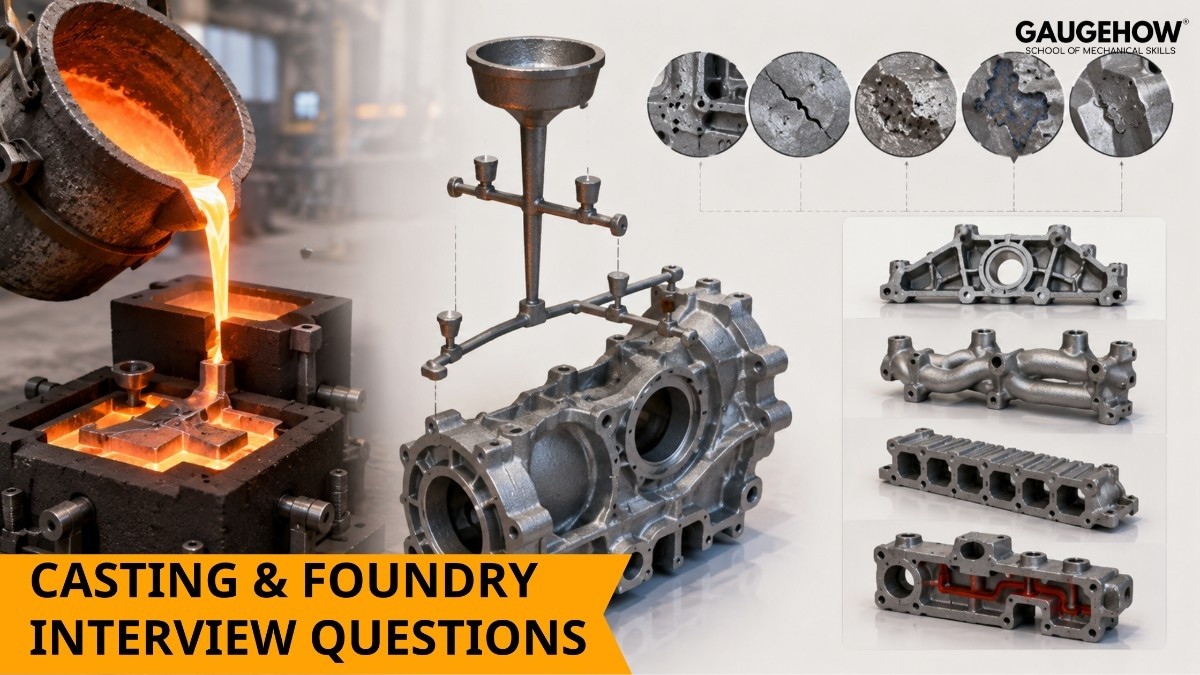
A gating system is the network of channels pouring basin, sprue, runner, and ingate that guides molten metal from the pouring point into the mold cavity, designed to control flow rate, minimize turbulence, and ensure the mold fills completely before the metal begins to solidify.
A poorly designed gating system is one of the most common root causes of multiple different casting defects.
11. What is the difference between a Sprue, Runner, and Ingate?
The sprue is the vertical channel through which molten metal first enters the gating system from the pouring basin. The runner is the horizontal channel that distributes metal from the sprue to one or more ingates.
The ingate is the final, narrow opening where metal actually enters the mold cavity itself. Each stage is sized and shaped to control velocity and minimize turbulence at that specific point.
12. Why is Turbulence in the gating system a problem, and how is it minimized?
Turbulent metal flow entraps air and mold gases into the liquid metal, leading to gas porosity, and can also erode the mold walls, introducing sand inclusions into the casting.
Turbulence is minimized through gradual, tapered gating channel transitions and by keeping metal velocity below a critical threshold, particularly for metals like aluminum that oxidize readily when disturbed.
13. What is a Riser, and what problem does it solve?
A riser is a reservoir of extra molten metal connected to the casting, designed to feed liquid metal into the casting as it shrinks during solidification, preventing internal voids from forming in the final part.
Without a properly placed and sized riser, the last area of the casting to solidify has no additional metal to draw from, resulting in shrinkage porosity right where it's needed least.
14. What is Directional Solidification, and how does riser placement support it?
Directional solidification means designing the casting and gating system so that the part solidifies progressively from the areas farthest from the riser toward the riser itself, ensuring liquid metal is always available to feed shrinkage as it happens.
A riser placed at the wrong location, away from the last area to solidify, won't be able to feed shrinkage effectively no matter how large it is.
15. What is Chvorinov's Rule, and how is it used in riser design?
Chvorinov's Rule states that solidification time is proportional to the square of the volume-to-surface-area ratio of a casting section, meaning thicker sections take disproportionately longer to solidify than thinner ones.
It's used to size a riser so that it solidifies later than the casting section it's feeding, ensuring liquid metal remains available in the riser exactly when the casting needs it most.
16. What is the difference between a Blind Riser and an Open (Top) Riser?
An open riser is exposed to the atmosphere at the top of the mold, allowing visual confirmation that it's still liquid metal filling as needed, but losing heat faster due to that open exposure.
A blind riser is fully enclosed within the sand mold, retaining heat longer and solidifying later for the same volume, but requiring careful design since its fill level can't be visually confirmed during pouring.
4. Casting Defects and Causes
17. What is Shrinkage Porosity, and what causes it?
Shrinkage porosity is internal voids formed when a thick or isolated section of a casting solidifies without adequate liquid metal available to feed the volume reduction that occurs as metal transitions from liquid to solid.
It's typically caused by inadequate riser size, poor riser placement, or a casting design lacking proper directional solidification.
18. What is Gas Porosity, and how is it different from Shrinkage Porosity?
Gas porosity is caused by dissolved gases in the molten metal, or gases generated from the mold and core materials, becoming trapped as small, generally round pores during solidification.
Unlike shrinkage porosity, which tends to appear as irregular, jagged voids concentrated in thick sections, gas porosity often appears as smaller, more uniformly distributed round pores throughout the casting.
19. What is a Cold Shut, and what typically causes it?
A cold shut is a defect where two streams of metal meet but fail to fuse completely, often visible as a linear discontinuity or crack-like line on the casting surface.
It's typically caused by metal that's too cool when it meets, insufficient pouring rate, or a poorly designed gating system that allows metal to flow in separate streams that lose too much heat before merging.
20. What is a Misrun, and how is it different from a Cold Shut?
A misrun occurs when molten metal solidifies before completely filling the mold cavity, leaving an incomplete section of the casting entirely missing.
A cold shut involves metal that did reach the area but failed to fuse with adjacent metal, while a misrun means the metal never got there at all. Both share similar root causes insufficient pouring temperature, slow pouring rate, or overly thin sections relative to the metal's fluidity.
21. What is Sand Inclusion, and what causes it?
Sand inclusion is loose mold or core sand that becomes embedded in the casting surface, typically caused by mold erosion from excessive metal velocity, poor mold or core strength, or improper mold handling before pouring.
Controlling gating system velocity and ensuring adequate sand mold strength are the primary prevention strategies.
22. What is Hot Tearing, and what causes it?
Hot tearing is a crack that forms while the casting is still partially liquid and at high temperature, typically caused by the casting's shrinkage being restrained by the mold or a core, generating tensile stress the still-weak, partially solidified metal can't withstand.
Redesigning the mold or core to allow the casting to contract more freely during solidification is a common prevention approach.
23. How would you investigate a recurring casting defect appearing across multiple production runs?
Start by reviewing whether pouring temperature, pouring rate, and gating design match the established process specification, then check mold and core quality, sand condition, and metal chemistry, since a recurring defect usually traces back to a specific process drift rather than a one-off mistake.
GaugeHow's 7 QC Tools course covers structured root cause tools like fishbone diagrams that help organize this kind of multi-variable investigation systematically.
5. Solidification and Metallurgy
24. What is the difference between Columnar and Equiaxed grain structure in a casting, and why does it matter?
Columnar grains grow long and directional, typically forming near the mold wall where cooling is fastest and most directional, while equiaxed grains are roughly uniform in all directions and typically form in the slower-cooling center of the casting.
The balance between the two affects mechanical properties, with equiaxed structure generally providing more uniform strength in different directions.
25. What is Segregation in casting metallurgy, and why does it occur?
Segregation is the uneven distribution of alloying elements or impurities within a casting, occurring because different elements solidify at different rates and concentrations as the metal cools, pushing certain elements toward the last-to-solidify regions.
This can create localized weak spots or inconsistent properties within an otherwise dimensionally correct casting.
26. How does Pouring Temperature affect both fluidity and defect risk?
Higher pouring temperature improves fluidity, helping metal fill thin sections and complex geometry more completely, but also increases the risk of gas absorption, mold erosion, and larger grain structure.
Finding the right pouring temperature is a balance between filling the mold completely and avoiding the defects that come with excessive superheat.
6. Molding Sand and Materials
27. What properties make a good molding sand, and why does each matter?
Good molding sand needs adequate strength to hold its shape during pouring, permeability to allow trapped gases to escape rather than becoming porosity, refractoriness to withstand the molten metal's heat without breaking down, and good collapsibility to allow easy removal from the solidified casting.
A sand mix optimized for strength alone, without considering permeability, often trades one defect risk for another.
28. What is the role of a Core, and how does poor core venting contribute to defects?
A core creates internal features within a casting and, because it's often more fully surrounded by molten metal than the outer mold, needs its own venting path for gases to escape during pouring.
Poor core venting traps gas that has nowhere to go except into the surrounding molten metal, directly contributing to gas porosity right around that internal feature.
7. Testing and Inspection
29. What inspection methods are commonly used to detect internal casting defects?
Radiographic testing (RT) and ultrasonic testing (UT) are commonly used to detect internal defects like shrinkage porosity or inclusions that aren't visible from the surface, while dye penetrant testing detects surface-breaking defects like cracks.
Choosing the right method depends on whether the concern is internal or surface-level, and how critical the specific casting application is.
30. How does dimensional inspection of a casting differ from inspecting a machined part?
Castings often have wider dimensional tolerances than machined parts due to inherent shrinkage variation and pattern-related factors, and inspection frequently focuses on critical features like machining stock allowance and core positioning rather than every dimension equally.
GaugeHow's Engineering Metrology & 3D Measurement course and GD&T and Engineering Graphics course both cover how to apply appropriate tolerancing and measurement strategy to parts like castings that have process-inherent variation built in from the start.
Frequently Asked Questions
Is a casting and foundry interview more about metallurgy or process design?
It's genuinely both expect solid questions on gating and riser design alongside metallurgical concepts like solidification behavior and grain structure. Understanding how process decisions (gating velocity, pouring temperature) directly influence metallurgical outcomes (porosity, grain structure) is exactly what strong candidates connect in their answers.
Do I need simulation software experience for a foundry engineering interview?
It's a valuable asset but not always required mold filling and solidification simulation tools are increasingly used to predict defects before a physical pour, so mentioning familiarity with this kind of analysis can strengthen your answer even without deep hands-on software experience.
What's the most common mistake candidates make explaining a casting defect?
Describing what a defect looks like without explaining the underlying fluid flow or solidification cause for example, calling something "porosity" without distinguishing whether it's gas-related or shrinkage-related, since the prevention strategy for each is completely different. Interviewers are testing diagnostic reasoning, not just defect vocabulary.
How should I prepare for gating system design questions if I've never designed one from scratch?
Focus on explaining the core principles clearly controlling turbulence, ensuring directional solidification toward the riser, sizing the riser using solidification time logic using a simple hypothetical part as an example. Interviewers care about your reasoning process as much as direct hands-on design experience.
Conclusion
Casting and Foundry interviews reward candidates who can connect gating and riser design decisions directly to the metallurgical outcomes they produce explaining not just that shrinkage porosity happened, but why the riser wasn't positioned or sized to prevent it.
Get comfortable explaining directional solidification and Chvorinov's Rule in plain terms, know how to distinguish gas porosity from shrinkage porosity and cold shuts from misruns, and be ready to walk through how you'd investigate a recurring defect from symptom back to root cause. Review this list carefully before your interview, and you'll be prepared for almost any defects or gating question a foundry-focused panel throws at you.
Want to strengthen the analytical and inspection skills these interviews test for? Explore GaugeHow's Autodesk CFD course for mold filling and solidification simulation fundamentals, the 7 QC Tools course for structured defect root cause analysis, GD&T and Engineering Graphics and Engineering Metrology & 3D Measurement for casting inspection fundamentals, or the Basics of 6 Sigma course for structured, data-driven process improvement. If you're just getting started, GaugeHow's Free Course is a no-cost way to explore the platform, or browse the full course catalog to find the right fit for your next role.