CATIA V5 Interview Questions and Answers for Automotive & Aerospace Roles

Deepak S Choudhary
Learn More in This Video
Subscribe to GaugeHow for More
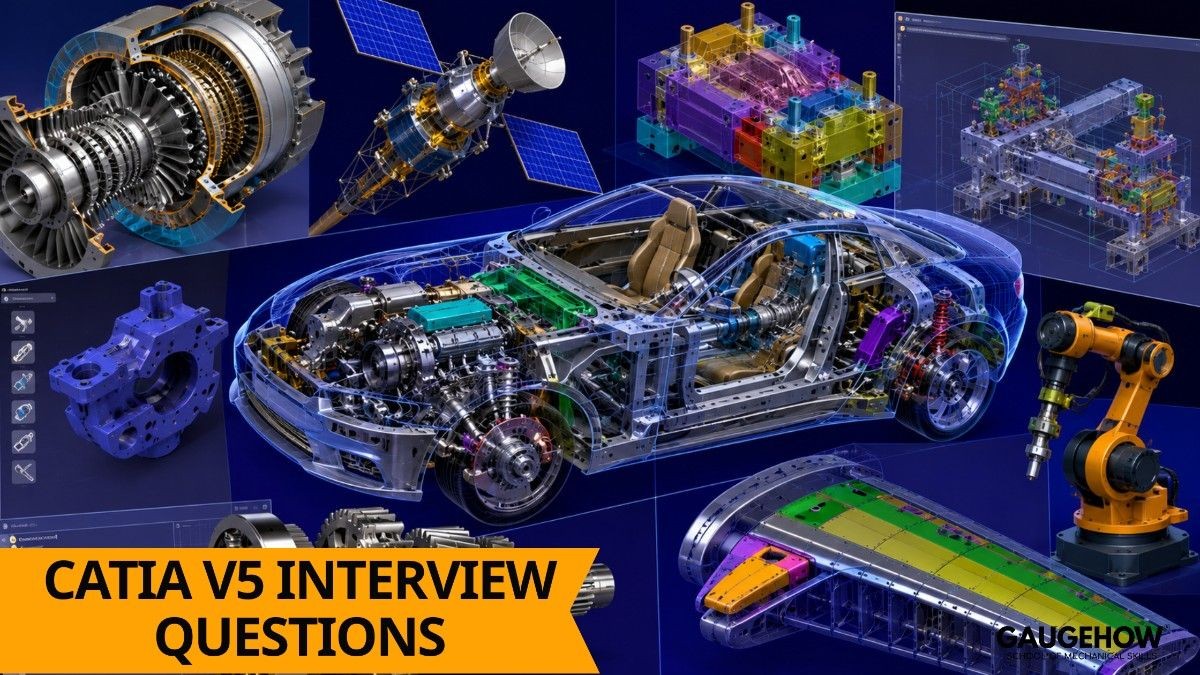
CATIA V5 is the tool of choice for automotive and aerospace giants and interviews for these roles go deeper than basic modeling. Recruiters want to know if you understand surfacing, large assemblies, and design rules that matter when you're shaping a car body or a wing component. Knowing where the buttons are isn't enough; you need to explain why CATIA is built the way it is.
This guide collects the questions that come up most for automotive and aerospace roles, sorted by topic so you can prepare the way real interviews flow.
CATIA V5 Basics and Workbenches
Interviews usually open here to confirm your foundations before testing surfacing and assemblies.
1. What is CATIA V5 and why is it widely used in automotive and aerospace?
CATIA V5 is a high-end 3D CAD/CAM/CAE software used to design complex products. Automotive and aerospace companies rely on it for its powerful surfacing, huge assembly handling, and full product lifecycle tools.
For example, car body panels and aircraft fuselage sections are designed in CATIA because of its advanced Class A surface capability.
2. What is a workbench in CATIA? Can you name a few?
A workbench is a dedicated environment with tools for a specific task. Common ones include Sketcher, Part Design, Assembly Design, Generative Shape Design (GSD), Drafting, and DMU. You switch workbenches depending on the job .
For example, GSD for surfacing a hood, Assembly Design for putting the engine together.
3. What are the main document types in CATIA?
The key ones are CATPart (a single part), CATProduct (an assembly of parts), and CATDrawing (2D drawings). There are also CATProcess files for manufacturing.
For example, you'd model a bracket as a CATPart, place it in a CATProduct assembly, then detail it in a CATDrawing.
4. What is the specification tree?
It's the panel that lists every feature, body, sketch, and constraint in your model, in creation order. It lets you edit, reorder, or hide items easily, much like a recipe of your design. Changing a step in the tree updates the model, which is essential for managing complex automotive and aerospace parts.
Sketcher and Constraints
Sketches are the base of solid modeling, so freshers get tested heavily here.
5. What is the Sketcher workbench used for?
Sketcher is where you draw 2D profiles lines, circles, splines that become the basis for 3D features. A clean, well-constrained sketch leads to a stable model.
For example, you sketch the cross-section of a bracket here before padding it into a solid.
6. What does it mean for a sketch to be iso-constrained (fully constrained)?
An iso-constrained sketch has exactly the right number of constraints and dimensions, so nothing can move unexpectedly it usually turns green. An under-constrained sketch (white) can shift around. Always aim for iso-constrained sketches to keep your model predictable when edited.
7. What are geometric and dimensional constraints? Give an example.
Geometric constraints control relationships like parallel, tangent, or coincident, while dimensional constraints set actual sizes like length or radius. Together they lock a sketch's shape and size.
For example, a tangent constraint keeps a fillet smoothly connected to a line even as dimensions change.
8. What's the difference between a profile and a construction element?
A profile is real geometry used to create features, while construction (reference) elements only help you build and don't become part of the model.
For example, a construction circle can guide where holes sit, without itself turning into a feature.
Part Design and Features
This section checks whether you can build solid models correctly, not just any way.
9. What are Pad and Pocket in CATIA?
Pad adds material by extruding a sketch into a solid, and Pocket removes material by cutting a sketch shape out. They're the most basic solid features.
For example, you'd pad a plate to give it thickness, then pocket holes or slots into it.
10. What are Shaft and Groove?
Shaft creates a solid by revolving a profile around an axis, and Groove cuts material by revolving. They're used for round, symmetrical shapes.
For example, a wheel hub or a shaft is made with the Shaft feature, while a sealing groove is cut using Groove.
11. What's the difference between sketch-based and dress-up features?
Sketch-based features (pad, pocket, shaft) create or remove material from a sketch. Dress-up features (fillet, chamfer, draft, shell) modify existing geometry without a new sketch.
For example, after padding a part, you add edge fillets as a dress-up feature for strength and looks.
12. What are Edge Fillet and Chamfer, and when do you use each?
An edge fillet rounds an edge; a chamfer creates an angled flat edge. Fillets reduce stress and improve safety and appearance, while chamfers ease assembly and remove sharp edges.
For example, you'd fillet a structural corner for strength and chamfer a hole edge so a pin slides in.
13. What is a multi-body part and how are Boolean operations used?
A multi-body part contains several separate solid bodies in one file, combined using Boolean operations like add, remove, or intersect. This helps build complex shapes step by step.
For example, you might model a main body and subtract a second body to create a complex cavity.
Assembly Design and DMU
Here interviewers check that you can bring parts together critical for large auto and aero products.
14. What is the Assembly Design workbench?
It's where you bring multiple parts together into a CATProduct and position them using constraints. It lets you check fit and relationships between components.
For example, you'd assemble pistons, rods, and a crankshaft into a working engine assembly here.
15. What are assembly constraints in CATIA? Name a few.
Constraints position parts relative to each other common ones are coincidence, contact, offset, and angle.
For example, a coincidence constraint aligns a bolt's axis with a hole, while a contact constraint makes two faces sit flush against each other.
16. What's the difference between bottom-up and top-down assembly?
Bottom-up means designing parts separately, then assembling and constraining them. Top-down means designing parts within the assembly context using shared references. Top-down is common in automotive and aerospace, where parts must fit precisely with their neighbors like panels around a door opening.
17. What is DMU and why does it matter in automotive and aerospace?
DMU (Digital Mock-Up) lets you analyze a full digital assembly checking clashes, clearances, and how parts move. It's vital when thousands of parts must fit, like in an aircraft.
For example, DMU clash analysis catches two components overlapping before anything is physically built.
Surface Design (Generative Shape Design)
Surfacing is the heart of automotive and aerospace work, so expect deep questions here. GaugeHow's CATIA V5 course covers these tools hands-on.
18. What is Generative Shape Design (GSD)?
GSD is the surfacing workbench used to create complex, smooth shapes that solid features can't easily make. It's essential for styling and aerodynamic surfaces.
For example, a car's flowing exterior body or an aircraft wing is built using GSD surfaces before being thickened into solids.
19. What's the difference between solid and surface modeling in CATIA?
Solid modeling creates complete 3D objects with volume, ideal for mechanical parts. Surface modeling builds thin, complex shapes face by face for styling and aerodynamics, then closes or thickens them into solids.
For example, a dashboard's smooth curves start as surfaces, not solids.
20. What is a Class A surface and why does it matter in automotive?
A Class A surface is a high-quality, smooth visible surface with perfect curvature and reflections the kind customers see and touch on a car body. It must meet strict continuity standards.
For example, the outer panels of a car require Class A surfacing for a flawless look.
21. What are common surface operations in GSD? Give examples.
Extrude, sweep, fill, blend, and join are common. Extrude and sweep create base surfaces, fill closes gaps, blend smoothly connects surfaces, and join combines them into one.
For example, you'd sweep a profile along a path to form a fender, then blend it into the adjoining panel.
22. How do you check surface quality and continuity (G0, G1, G2)?
Continuity describes how smoothly surfaces connect: G0 means they just touch, G1 means tangent (smooth slope), and G2 means matching curvature (visually seamless). Tools like zebra analysis reveal flaws. Automotive Class A surfaces usually need G2 continuity for perfect reflections.
Drafting and Drawings
Drawings turn your model into something the shop can build, so this remains essential.
23. How do you create a drawing in CATIA?
You open the Drafting workbench, choose a sheet and standard, then generate views from your 3D model. The drawing stays linked to the model, so changes update automatically.
For example, editing a part dimension updates the matching view and dimensions in the drawing.
24. What's the difference between generative and interactive drafting?
Generative drafting creates views directly from the 3D model and updates with it, keeping everything linked. Interactive drafting means drawing 2D geometry manually without a 3D link. Generative is preferred because it stays accurate and saves time when the model changes.
25. What's the difference between first-angle and third-angle projection?
Both arrange 2D views of a 3D model, but differently. In first-angle (used in India and Europe), the top view sits below the front view; in third-angle (used in the US), it sits above. A symbol in the title block shows which standard a drawing follows, so always check it.
Automotive and Aerospace Applications
These questions check that you understand why these industries rely on CATIA specifically.
26. Why is CATIA preferred in automotive and aerospace over other CAD tools?
Because of its world-class surfacing, ability to handle massive assemblies, strong DMU tools, and knowledge-based design. These industries need both beautiful surfaces and huge, precise assemblies.
For example, an entire aircraft or vehicle program can be managed within CATIA's connected environment.
27. What is Knowledgeware and how is knowledge-based design used?
Knowledgeware lets you add rules, formulas, and checks to a model so it follows engineering standards automatically. It captures know-how and speeds up repetitive design.
For example, a rule can automatically size a rib's thickness based on a panel's dimension, ensuring consistency across parts.
28. How do you handle very large assemblies with thousands of parts? Use sub-assemblies, cache/visualization mode, and load only needed parts to keep performance manageable. Good structure and naming are essential.
For example, in an aircraft assembly you'd work on one system at a time rather than loading every component at full detail.
HR and Behavioral Questions
Skills get you in the room, but these questions often decide the offer. Answer like a real person.
29. How would you rate your CATIA skills, and how did you learn?
Be honest and specific state your level and back it with what you've built. For example: "I'm comfortable with part, assembly, and basic surfacing, learned through coursework and a project modeling a car body panel." Concrete examples beat vague claims of being an expert.
30. Tell me about a CATIA project you worked on.
Pick a real project and explain it simply: what you designed, the challenges, and the outcome. Mention workbenches and features you used. Even a college or personal project works like surfacing a vehicle exterior or assembling a small mechanism as long as you explain your thinking clearly.
Frequently Asked Questions
What should freshers focus on most for a CATIA interview?
Master Sketcher, Part Design features, basic Assembly Design, and an introduction to GSD surfacing. Be ready to explain the specification tree and design intent simply. For automotive and aerospace, even basic surfacing knowledge gives you a real edge.
Are CATIA interview questions different for automotive vs aerospace roles?
Somewhat. Automotive leans heavily on Class A surfacing and styling, while aerospace emphasizes very large assemblies, DMU, and strict standards. Both value surfacing and assembly skills, so prepare examples that fit the industry you're targeting.
Do I need to know surfacing (GSD) to get hired?
For automotive and aerospace, it's a major advantage. You should at least understand what surfaces are, why they matter, and basic continuity (G0, G1, G2). Deep Class A skill grows with experience, but showing the fundamentals sets you apart.
Is CATIA hard to learn compared to other CAD tools?
It has a steeper learning curve because it's so powerful and feature-rich. But once you grasp workbenches and the specification tree, it becomes logical. Structured practice through a course like GaugeHow's CATIA V5 course makes it much easier.
How many questions should I prepare for a CATIA interview?
Aim for around 30 to 50 across sketching, features, assemblies, surfacing, and behavioral topics. This guide covers a strong core set. The real key is practicing out loud and trying each concept in the software so your answers feel natural.
Conclusion
Cracking a CATIA V5 interview for automotive or aerospace is about understanding the reasoning behind the tools why surfacing matters, how large assemblies stay manageable, and what makes a Class A surface.
If you can explain your modeling choices with real industry examples, you'll stand out from candidates who only know which buttons to press. Study these questions, practice out loud, and try each one in the software.
To turn this preparation into job-ready skills, explore GaugeHow's CATIA V5 course and the broader CAD learning path, or browse all engineering courses. You can even start free today. Good luck you've got this.