CFD Interview Questions and Answers for Freshers (Basics to Turbulence)


Deepak S Choudhary
Learn More in This Video
Subscribe to GaugeHow for More
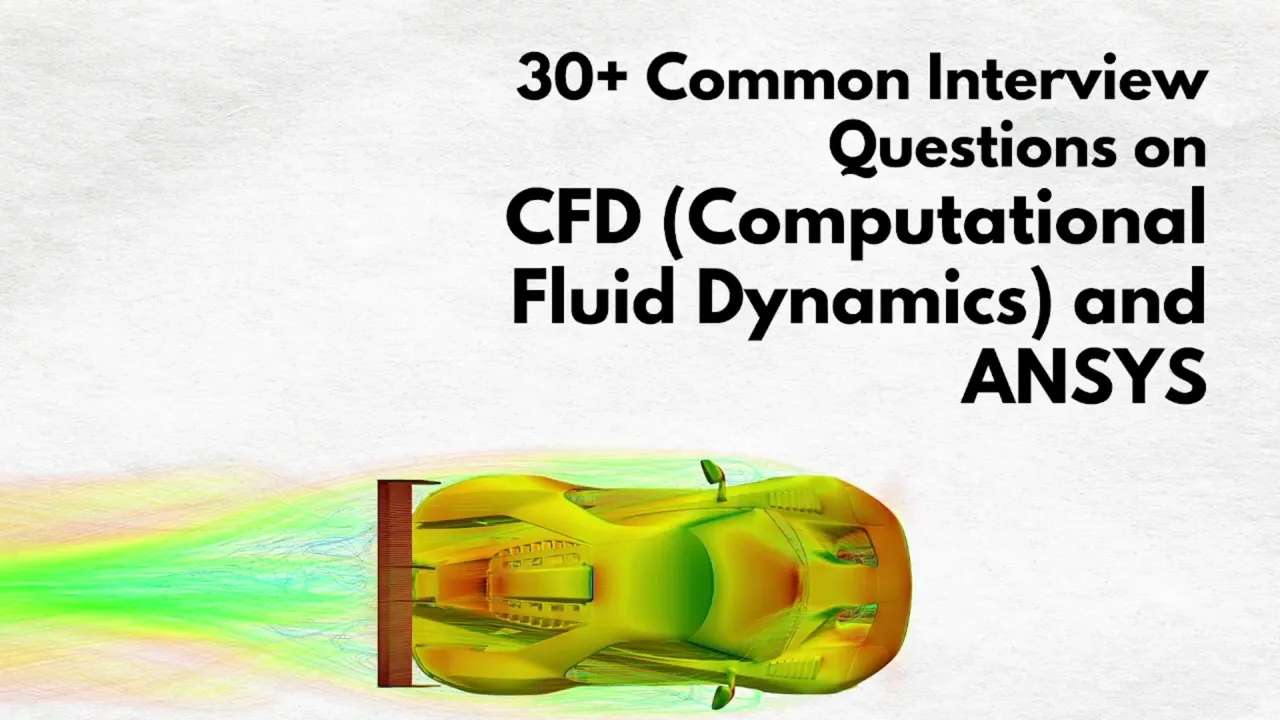
Walking into a CFD interview and blanking on "what's the Reynolds number again?" happens to almost every fresher once. CFD interviews follow a predictable path they start with basic fluid properties and equations, then move into meshing and boundary conditions, and finally test turbulence modeling, since that's where real understanding gets separated from memorized definitions.
Computational Fluid Dynamics uses numerical methods to solve the equations governing fluid motion mass, momentum, and energy conservation over a discretized domain, predicting how a fluid will behave around or through a design.
At the basic level, interviews test whether you understand fluid properties and the governing equations themselves. As the conversation deepens, it moves into meshing, solver setup, and boundary conditions, and finally into turbulence, since almost no real-world flow is perfectly smooth (laminar).
CFD Basics Interview Questions and Answers
Q1. What is Computational Fluid Dynamics (CFD)?
CFD is a numerical method that uses computers to solve the equations governing fluid flow, heat transfer, and related physics over a discretized domain.
Instead of solving equations by hand for simple cases, CFD breaks complex geometry into small cells and solves approximate equations at each one. The result is a detailed picture of velocity, pressure, and temperature throughout the flow field.
Q2. What is a fluid, and what are its key properties?
A fluid is a substance that continuously deforms under shear stress, unlike a solid, and includes both liquids and gases.
Key properties engineers track are density, viscosity, compressibility, and specific heat, since these determine how a fluid responds to pressure, temperature, and applied forces. Viscosity in particular controls how "thick" or resistant to flow a fluid behaves.
Q3. What is viscosity?
Viscosity is a fluid's internal resistance to flow, essentially a measure of its "thickness" or friction between adjacent fluid layers. High-viscosity fluids like honey flow slowly and resist deformation, while low-viscosity fluids like air flow easily.
It's a critical property because it directly controls whether a flow stays smooth (laminar) or becomes chaotic (turbulent).
Q4. What's the difference between compressible and incompressible flow?
Incompressible flow assumes fluid density stays constant, which is a good approximation for most liquids and low-speed gas flows (below roughly Mach 0.3).
Compressible flow accounts for density changes with pressure, which becomes important at high speeds, like around aircraft or in gas turbines. Choosing the wrong assumption can produce inaccurate pressure and velocity results.
Q5. What are the governing equations of fluid flow?
CFD solves three core conservation laws: continuity (mass conservation), the Navier-Stokes equations (momentum conservation), and the energy equation (energy conservation) when heat transfer matters.
Together these describe how mass, velocity, and temperature change throughout the flow domain. Almost every CFD solver is built around solving these equations numerically.
Q6. What is the Reynolds number, and why does it matter?
The Reynolds number is a dimensionless ratio of inertial forces to viscous forces in a flow, calculated from velocity, characteristic length, and viscosity.
It's the primary indicator of whether a flow will be laminar or turbulent low Reynolds numbers favor smooth, orderly flow, while high values favor chaotic, mixing flow. It's usually the first number an interviewer expects you to be able to explain confidently.
Q7. What is the difference between laminar and turbulent flow?
Laminar flow moves in smooth, parallel layers with little mixing between them, typical of low-speed or high-viscosity conditions. Turbulent flow is chaotic, with swirling eddies and strong mixing across the flow, typical of high-speed or low-viscosity conditions.
Most industrial and real-world flows are turbulent, which is why turbulence modeling gets so much interview attention.
Q8. What is the no-slip condition?
The no-slip condition states that fluid velocity at a solid wall equals the wall's velocity for a stationary wall, that means zero fluid velocity right at the surface.
It creates a velocity gradient near the wall called the boundary layer, which is critical for calculating drag, friction, and heat transfer accurately. Almost every wall-bounded CFD simulation depends on correctly resolving this region.
Q9. What is a boundary layer?
A boundary layer is the thin region near a solid surface where fluid velocity transitions from zero (at the wall, due to no-slip) up to the free-stream velocity away from the wall.
Most of the drag and heat transfer in a flow happens inside this thin layer, so it needs fine mesh resolution to capture accurately. Poorly resolved boundary layers are a common source of inaccurate CFD results.
Q10. What is the difference between steady-state and transient simulation?
Steady-state simulation assumes flow conditions don't change with time and solves for a single, final equilibrium solution.
Transient (unsteady) simulation tracks how the flow evolves over time, which is necessary for phenomena like vortex shedding, startup transients, or oscillating flows. Transient runs take considerably longer since the solver has to march through many time steps.
CFD Setup & Meshing Interview Questions and Answers
Q11. What is meshing in CFD, and why does mesh quality matter?
Meshing divides the fluid domain into small control volumes (cells) where the governing equations are solved numerically.
Poor mesh quality high skewness, bad aspect ratios, or insufficient resolution near walls can cause inaccurate results or solver divergence. A good mesh balances accuracy against computational cost.
Q12. What is a structured vs. unstructured mesh?
A structured mesh uses a regular, grid-like cell arrangement (usually hexahedral), which is efficient and accurate but harder to generate for complex geometry.
An unstructured mesh uses irregular cells (typically tetrahedral or polyhedral) that adapt easily to complex shapes but can cost more computationally per cell. Most industrial CFD today uses a hybrid or polyhedral mesh to balance the two.
Q13. What are inflation layers, and why are they used?
Inflation layers are thin, stacked prism cells added near walls to accurately capture the steep velocity gradient inside the boundary layer.
Without them, a general mesh is usually too coarse near the wall to resolve boundary-layer physics correctly. They're essential whenever drag, friction, or wall heat transfer accuracy matters.
Q14. What is y+ (y-plus), and why is it important?
Y+ is a dimensionless wall distance that tells you whether the first mesh cell near a wall falls inside the viscous sublayer, buffer layer, or log-law region of the boundary layer.
Different turbulence models and wall treatments require specific y+ ranges to work correctly getting this wrong is one of the most common causes of inaccurate near-wall results. Interviewers often ask this specifically to check real hands-on meshing experience.
Q15. What is mesh independence (grid convergence) study?
A mesh independence study involves running the same simulation on progressively finer meshes and checking whether key results, like drag force or outlet temperature, stop changing significantly.
Once further refinement barely changes the answer, the mesh is considered independent and results are considered trustworthy. It's the CFD equivalent of proving your answer isn't just a meshing artifact.
Q16. What are boundary conditions in CFD, and what are the common types?
Boundary conditions define how the fluid behaves at the edges of the simulation domain common types include velocity inlet, pressure outlet, wall, symmetry, and periodic conditions.
Choosing the right boundary condition for each domain edge is critical, since an incorrect one can produce a solution that doesn't reflect real flow behavior at all. They're set based on what's actually known about the real system being modeled.
Q17. What's the difference between a pressure-based and density-based solver?
Pressure-based solvers derive pressure from a correction equation and are traditionally used for low-speed, incompressible flows.
Density-based solvers solve continuity, momentum, and energy together and are better suited to high-speed, compressible flows like supersonic aerodynamics. Modern solvers offer both, letting engineers pick based on the flow regime.
Q18. What is convergence in a CFD solution, and how do you check it?
Convergence means the solver's residuals (the numerical error in each governing equation) have dropped below an acceptable threshold and stopped changing significantly between iterations.
It's checked by monitoring residual plots and tracking key output values, like drag or outlet temperature, until they stabilize. A simulation that hasn't converged shouldn't be trusted, even if it "finished running."
Q19. What is under-relaxation, and why is it used?
Under-relaxation is a numerical technique that limits how much a solution variable is allowed to change between iterations, which helps stabilize the solver for nonlinear or strongly coupled problems.
Too high a value can cause divergence; too low slows convergence unnecessarily. It's mainly a practical tuning tool for getting stubborn simulations to converge reliably.
Q20. What is the difference between explicit and implicit time integration in transient CFD?
Implicit schemes solve for the new time step using both current and future values, allowing larger, more stable time steps at higher computational cost per step.
Explicit schemes calculate the new time step directly from known current values, which is faster per step but requires very small time steps to stay stable. Most general-purpose transient CFD uses implicit schemes for stability.
Turbulence Modeling Interview Questions and Answers
Q21. What is turbulence, and why is it hard to simulate?
Turbulence is chaotic, three-dimensional fluid motion with a wide range of eddy sizes, from large swirls down to tiny dissipative scales.
It's hard to simulate directly because fully resolving every eddy (Direct Numerical Simulation) requires enormous computational power, well beyond practical reach for most industrial problems.
That's why engineers rely on turbulence models that approximate these effects instead.
Q22. What is a turbulence model, and why do we need one?
A turbulence model is a set of equations that approximates the effect of turbulent eddies on the mean flow, without resolving every individual eddy directly.
It's needed because directly simulating all turbulent scales (DNS) is computationally impossible for most real engineering geometries. Models like k-epsilon and k-omega SST trade some accuracy for a massive reduction in computational cost.
Q23. What is the k-epsilon turbulence model?
The k-epsilon model solves two additional transport equations turbulent kinetic energy (k) and its dissipation rate (epsilon) to estimate turbulence effects on the mean flow.
It's popular for its stability and low computational cost, and works well for free-shear and fully turbulent flows away from walls. It tends to be less accurate for flows with strong adverse pressure gradients or separation.
Q24. What is the k-omega SST turbulence model?
K-omega SST (Shear Stress Transport) blends the k-omega model near walls with the k-epsilon model in the free stream, aiming to get accurate near-wall behavior and stable far-field behavior together.
It's widely used in industry because it handles adverse pressure gradients and flow separation better than standard k-epsilon. It's often the default recommendation for general-purpose external aerodynamics.
Q25. What is Direct Numerical Simulation (DNS)?
DNS solves the Navier-Stokes equations directly without any turbulence model, resolving every scale of turbulent motion down to the smallest eddies.
It's the most accurate approach possible but requires such fine mesh and small time steps that it's limited to simple geometries and low Reynolds numbers in research settings. It's essentially the "ground truth" other turbulence models are validated against.
Q26. What is Large Eddy Simulation (LES)?
LES directly resolves the large, energy-containing turbulent eddies while modeling the smaller, more universal scales using a sub-grid model.
It sits between DNS and simpler models like k-epsilon in both accuracy and computational cost, making it useful for problems where large-scale unsteady turbulence really matters, like acoustics or combustion instability. It's still far more expensive than RANS-based models like k-epsilon or k-omega SST.
Q27. What does RANS stand for, and how does it relate to turbulence models?
RANS stands for Reynolds-Averaged Navier-Stokes, the approach of time-averaging the governing equations so only mean flow quantities are solved directly, with turbulence effects handled by a model.
K-epsilon and k-omega SST are both RANS-based models, which is why they're far cheaper computationally than LES or DNS. RANS is the default approach for most industrial CFD because it balances accuracy and turnaround time well.
Q28. What is flow separation, and why does it matter?
Flow separation happens when the boundary layer detaches from a surface, usually due to an adverse pressure gradient, creating a recirculating wake region behind the body.
It significantly increases drag and can cause loss of lift on aerodynamic surfaces like wings. Predicting separation accurately is one of the toughest tests of a turbulence model's quality.
Q29. What is turbulence intensity, and where is it used?
Turbulence intensity is the ratio of the root-mean-square of velocity fluctuations to the mean flow velocity, expressed as a percentage, and it's a required input at velocity inlets for many turbulence models.
Low intensity (around 1–5%) represents relatively smooth incoming flow, while high intensity (10%+) represents already-turbulent incoming flow, like downstream of a fan. Getting this input wrong can noticeably change near-wall and separation predictions.
Q30. How do you choose the right turbulence model for a given problem?
The choice depends on the flow physics, required accuracy, and available compute budget k-epsilon for robust, low-cost general flows, k-omega SST for flows with separation or adverse pressure gradients, and LES or DNS only when large-scale unsteady turbulence or research-grade accuracy is truly needed.
In an interview, showing you understand this trade-off matters more than naming every model that exists.
FAQ
Is CFD hard to learn for a fresher?
The fundamentals fluid properties, governing equations, and basic meshing are approachable with consistent practice, though turbulence modeling genuinely takes longer to build intuition for, which is exactly why it's tested so heavily in interviews.
Do freshers need to know the math behind the Navier-Stokes equations?
Most entry-level interviews expect you to understand what the equations represent physically (mass, momentum, energy conservation) rather than derive them from scratch, though knowing the basic terms helps you sound confident under follow-up questions.
Which turbulence model should I mention if asked for a "default" choice?
K-omega SST is the safest general answer for external and internal industrial flows, since it's widely used, well validated, and handles separation better than simpler models like standard k-epsilon.
How do I explain a CFD project in an interview?
Walk through it the way a solver actually runs: geometry and domain setup, mesh strategy and y+ target, boundary conditions, turbulence model choice, convergence criteria, and finally the result with a physical explanation that structure mirrors exactly how interviewers expect you to think.
Conclusion
CFD interviews for freshers almost always climb the same ladder: fluid basics, then meshing and boundary conditions, then turbulence. Master the reasoning behind each concept above not just the definitions and you'll be able to handle follow-up questions confidently in any CFD interview.
If you want structured, hands-on CFD practice covering these exact concepts, GaugeHow's ANSYS Fluent / EV Battery Cooling course walks through mesh setup, boundary conditions, and turbulence model selection on a real cooling problem. If you'd rather start with a zero-cost, open-source route, the OpenFOAM for CFD course covers the same fundamentals without needing a commercial license.