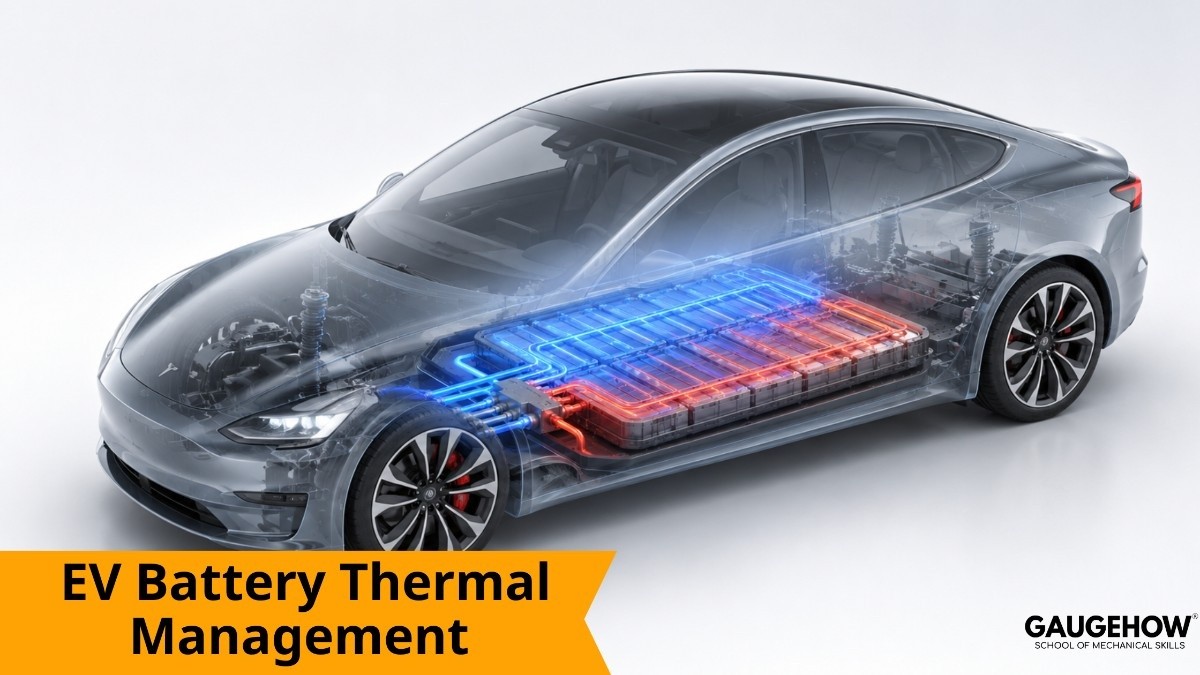
EV Battery Thermal Management Interview Questions and Answers

Deepak S Choudhary
Learn More in This Video
Subscribe to GaugeHow for More
EV battery thermal management interviews focus on one central risk: keeping cells within a safe temperature range while maximizing performance and life. Interviewers want specifics on cooling methods, thermal runaway prevention, and simulation, not just a general definition of heat management.
General Thermal Management Questions
Q1. Why is thermal management so critical in EV battery design?
Battery cells degrade faster and become less safe when operated outside their optimal temperature range. Poor thermal management directly shortens cycle life and increases the risk of thermal runaway. It's one of the most safety-critical aspects of the entire battery system design.
Q2. What is the ideal operating temperature range for most lithium-ion cells?
Most lithium-ion cells perform best roughly between 15 and 35 degrees Celsius, though exact ranges vary by chemistry. Outside this range, both performance and long-term degradation rates suffer. Thermal management systems are designed specifically to keep cells within this window during real-world use.
Q3. What happens to a battery cell's performance at low temperatures?
Cold temperatures increase internal resistance, reducing available power and slowing chemical reactions inside the cell. This can noticeably reduce both range and charging speed in cold weather.
Some designs include cell preheating specifically to counteract this effect before demanding operation.
Q4. What happens to a battery cell's performance and lifespan at high temperatures?
High temperatures accelerate chemical degradation, reducing usable capacity and cycle life over time. Sustained high heat also increases the risk of triggering thermal runaway under stress conditions. Effective cooling is essential for maintaining both performance and safety margin.
Thermal Runaway Questions
Q5. What is thermal runaway, and what typically triggers it?
Thermal runaway is an uncontrolled, self-sustaining temperature rise inside a cell, often triggered by internal short circuits, physical damage, or overcharging.
Once triggered, the reaction can escalate rapidly and spread to neighboring cells. Preventing it requires both cell-level protection and pack-level thermal design.
Q6. How does thermal runaway propagate between cells in a pack?
Heat and sometimes ejected material from a failing cell can raise the temperature of adjacent cells past their own failure threshold. Without adequate barriers or spacing, this can cause a cascading chain reaction across the pack.
Thermal barriers and controlled venting are specifically designed to slow or stop this propagation.
Q7. What design features help contain or prevent thermal runaway propagation?
Thermal barriers between cells slow heat transfer to neighboring cells during a failure event. Directed venting channels route hot gas away from other cells and passengers. Fuses and current interrupt devices also isolate a failing cell from the rest of the electrical circuit.
Q8. How do you validate that a pack design actually prevents thermal runaway propagation?
Abuse testing intentionally triggers thermal runaway in a single cell under controlled conditions to observe whether it spreads to neighbors. Simulation can model expected heat transfer before physical testing confirms the result. Regulatory approval for many EV applications requires passing this kind of propagation test.
Cooling Methods Questions
Q9. What are the main cooling methods used in EV battery thermal management?
Air cooling is the simplest approach but generally less effective for high-power or fast-charging applications. Liquid cooling removes heat more efficiently and supports higher performance packs. Immersion cooling, where cells sit directly in a dielectric fluid, is an emerging approach for even more demanding applications.
Q10. What's the difference between direct and indirect liquid cooling in a battery pack?
Indirect liquid cooling circulates coolant through channels or plates that contact the cells without direct fluid exposure. Direct liquid cooling, like immersion cooling, submerges cells directly in a dielectric coolant fluid for more efficient heat transfer.
Direct cooling offers better performance but adds complexity and sealing challenges.
Q11. How do you decide which cooling method fits a specific battery pack design?
The decision depends on expected heat generation, driven by cell chemistry, C-rate, and fast-charging requirements, weighed against cost and packaging constraints.
GaugeHow's ANSYS Fluent / EV Battery Cooling course covers modeling this decision through simulation. A high-performance pack with fast charging almost always needs liquid cooling over simpler air cooling.
Q12. What is a cold plate, and how is it used in battery thermal management?
A cold plate is a structural component with internal channels that circulate coolant beneath or between battery cells or modules. It provides consistent, efficient heat removal across the pack without submerging cells directly in fluid. Cold plate design significantly affects both cooling performance and overall pack weight.
Q13. What is phase change material cooling, and how does it work in battery applications?
Phase change materials absorb heat by changing state, like melting, providing passive thermal buffering without active pumps or fans. It's useful for smoothing out short temperature spikes but generally isn't sufficient alone for sustained high-heat conditions like fast charging. It's often combined with active cooling for a more complete thermal solution.
Thermal Modeling and Simulation Questions
Q14. How do you use simulation to design a battery pack's thermal management system?
I'd model heat generation under realistic charge and discharge profiles, then simulate coolant flow and temperature distribution across the pack.
GaugeHow's ANSYS Fluent / EV Battery Cooling course covers this exact modeling workflow. Simulation catches uneven cooling or hot spots before committing to physical prototyping.
Q15. What is a hot spot in a battery pack, and why does it matter?
A hot spot is a localized area within the pack running noticeably hotter than surrounding cells, often due to uneven cooling flow or cell placement. Hot spots accelerate degradation of the affected cells faster than the rest of the pack. Identifying and eliminating hot spots is a key goal of thermal simulation.
Q16. How does multiphysics simulation apply to battery thermal design specifically?
Battery thermal behavior involves interacting electrical, chemical, and fluid dynamics effects that a single-discipline simulation can't fully capture.
GaugeHow's COMSOL Multiphysics course covers combining these interacting physics into one simulation. This integrated approach gives a more accurate picture than modeling heat generation and cooling separately.
Q17. How accurate does a thermal simulation model need to be before trusting it for design decisions?
Accuracy requirements depend on how safety-critical the specific design decision is, with propagation and safety validation needing tighter correlation to physical testing than early concept exploration. I'd always validate simulation results against physical test data at key design milestones.
Overconfidence in an unvalidated model is a common and risky mistake in thermal design.
Q18. How do you use data analysis to correlate simulation predictions with real test results?
I'd compare temperature readings from physical test instrumentation against the corresponding simulated results at matching conditions and locations.
GaugeHow's MATLAB Programming course covers building this kind of comparison and analysis workflow. Consistent discrepancies usually point to a specific modeling assumption that needs correction.
BMS and Thermal Integration Questions
Q19. How does the Battery Management System interact with thermal management hardware?
The BMS monitors cell temperatures continuously and can trigger cooling system activation, adjust charge rates, or shut down operation if temperatures exceed safe limits.
It acts as the decision layer controlling how the thermal hardware responds to real conditions. Without accurate temperature sensing, the BMS can't protect the pack effectively.
Q20. How many temperature sensors are typically needed in a battery pack, and where are they placed?
Sensor count and placement depend on pack size and expected thermal gradient, with more sensors needed where uneven heating is likely, like near cooling inlets or high-current connections.
Too few sensors risk missing a developing hot spot entirely. Sensor placement decisions are usually informed by thermal simulation results first.
Q21. How does thermal derating work in a BMS, and why is it used?
Thermal derating reduces allowable charge or discharge current as cell temperature approaches unsafe limits, protecting the pack automatically. It trades some performance for improved safety and longevity during demanding conditions like fast charging.
This dynamic response is generally safer than relying purely on a fixed hard temperature cutoff.
Materials and Component Questions
Q22. What materials are commonly used for thermal barriers between cells?
Materials like mica, ceramic composites, or specialized intumescent materials provide thermal insulation and can expand to seal gaps during a failure event. GaugeHow's Smart Materials Science course covers how material properties translate into effective thermal protection.
Material choice involves balancing thermal performance against weight and cost.
Q23. What role does thermal interface material play in battery cooling design?
Thermal interface material fills microscopic gaps between a cell and cooling surface, improving heat transfer efficiency compared to a dry, imperfect contact.
Poor thermal interface application can create localized hot spots even with an otherwise well-designed cooling system. Consistent application during manufacturing is critical for uniform pack-level cooling performance.
Q24. How does enclosure material choice affect a battery pack's thermal behavior?
Enclosure material affects both structural protection and how heat is contained or dissipated during a thermal event. Some designs use materials specifically chosen to help contain and vent heat safely away from the vehicle cabin. Material selection here involves balancing thermal, structural, and weight requirements together.
Testing and Safety Standards Questions
Q25. What thermal-specific tests are commonly performed on battery packs before production approval?
Thermal cycling tests confirm cells and pack components withstand repeated temperature swings without degrading prematurely. Thermal runaway propagation tests confirm containment features actually work under a controlled single-cell failure.
Extreme temperature performance testing validates behavior in both hot and cold climate conditions.
Q26. What safety standards commonly apply to EV battery thermal management design?
Standards vary by region but often include requirements for thermal runaway containment, propagation testing, and extreme temperature performance validation.
Compliance testing typically requires third-party certification before a design can go into production vehicles. Staying current with evolving standards is an ongoing part of battery thermal engineering work.
Q27. How do you approach thermal testing for extreme climate conditions, like very hot or very cold environments?
I'd test the pack under both sustained high-heat and cold-soak conditions representative of real-world extreme climates the vehicle will operate in. Cold testing specifically validates preheating and charging behavior at low starting temperatures.
Extreme heat testing confirms cooling capacity holds up under worst-case ambient and load conditions combined.
Scenario and Behavioral Questions
Q28. A battery pack is showing a localized hot spot during testing that simulation didn't predict. How would you investigate it?
I'd first check whether the physical coolant flow matches what was assumed in the simulation model, since flow discrepancies are a common cause of this kind of mismatch.
Reviewing manufacturing tolerances around the affected area, like thermal interface material application, often reveals the actual cause. Correcting the simulation model afterward improves accuracy for future design iterations.
Q29. Describe a time you had to balance cooling performance against weight or cost constraints.
A strong answer names a specific tradeoff, like choosing between a more effective but heavier cooling system and a lighter, less capable one, and explains how the decision was validated against safety requirements.
Interviewers want the reasoning process, not just the final choice. A real constraint-driven story is more convincing than a generic answer.
Q30. How do you stay current with evolving battery thermal management techniques and standards?
I follow industry publications and technical conferences focused specifically on battery safety and thermal engineering. Reviewing evolving regulatory standards helps ensure designs stay compliant as requirements change.
Hands-on exposure through simulation and testing projects reinforces concepts far better than reading alone.
FAQ
What's the most commonly asked EV battery thermal management interview question?
Explaining what causes thermal runaway and how pack design prevents propagation comes up in nearly every interview on this topic.
Is liquid cooling always necessary for EV battery packs?
Not always, but it's generally required for high-performance packs or those supporting fast charging, since air cooling often can't remove heat quickly enough.
How important is simulation experience for battery thermal engineering roles?
Very important. Most modern thermal design work relies heavily on simulation to reduce cost and speed up iteration before physical prototypes are built.
Do thermal management engineers need a background in fluid dynamics?
A working understanding helps significantly, especially for liquid cooling system design, though deep specialization isn't always required depending on the specific role.
What's the biggest mistake candidates make in these interviews?
Discussing cooling methods without connecting them to actual safety outcomes like thermal runaway prevention. Interviewers want to see safety-focused reasoning, not just technical description.
Conclusion
EV battery thermal management interviews reward candidates who connect cooling design directly to safety outcomes, not just technical descriptions of cooling methods. Prepare a specific example involving a thermal design tradeoff, a simulation-to-test correlation, and how you validated a safety-critical thermal decision.
To build the technical foundation behind these interview topics, GaugeHow's ANSYS Fluent / EV Battery Cooling course covers thermal simulation in practical depth, while COMSOL Multiphysics and Smart Materials Science build the multiphysics and materials skills these interviews increasingly test for.