EV Powertrain Interview Questions and Answers (Motor & Drivetrain)

Deepak S Choudhary
Learn More in This Video
Subscribe to GaugeHow for More
EV powertrain interviews focus on how the motor, inverter, and drivetrain work together to deliver torque efficiently and reliably. Interviewers want specifics on motor types, control strategies, and real design tradeoffs, not just definitions.
General Powertrain Questions
Q1. What are the main components of an EV powertrain?
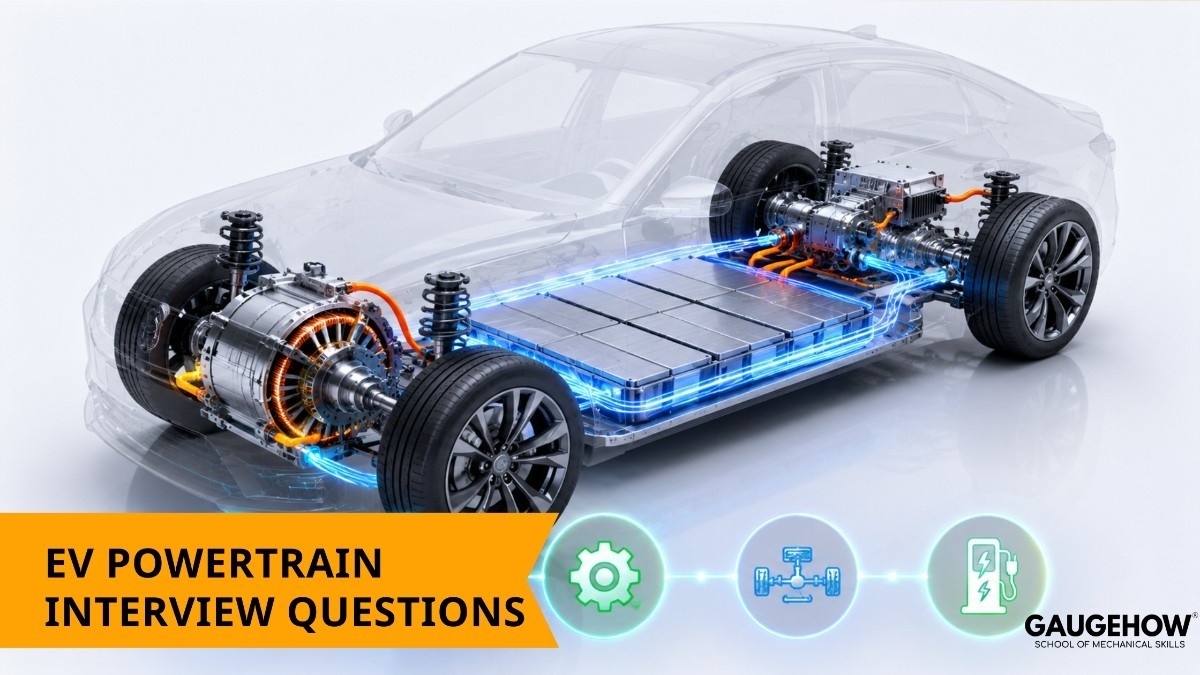
The main components are the electric motor, inverter, gear reduction unit, and the control system managing them. The battery supplies energy, but the powertrain converts that energy into usable torque and motion. Understanding how these components interact is central to powertrain engineering.
Q2. How is an EV powertrain fundamentally different from an internal combustion drivetrain?
An EV powertrain typically uses a single-speed gear reduction instead of a multi-speed transmission, since electric motors deliver strong torque across a wide RPM range.
There's no clutch, exhaust system, or complex fuel delivery to manage. This simplifies mechanical complexity but shifts engineering focus toward electrical and control system design.
Q3. What is torque, and why do electric motors deliver it differently than combustion engines?
Torque is the rotational force a motor produces, and electric motors deliver near-maximum torque instantly from zero RPM. Combustion engines need to build RPM before reaching peak torque, creating a noticeably different acceleration feel. This instant torque delivery is a defining characteristic of EV performance.
Q4. What factors go into sizing a motor for a specific EV application?
Target acceleration, top speed, and vehicle weight determine the required torque and power output. Continuous versus peak power ratings also matter, since sustained high-power demand generates more heat than brief bursts. Oversizing wastes weight and cost; undersizing compromises real-world performance.
Motor Types Questions
Q5. What types of electric motors are commonly used in EV powertrains?
Permanent magnet synchronous motors are widely used for their high efficiency and power density. Induction motors offer lower cost and simpler construction but somewhat lower efficiency. Switched reluctance motors are less common but avoid rare-earth magnets entirely.
Q6. What's the difference between a permanent magnet synchronous motor and an induction motor?
A permanent magnet synchronous motor uses embedded magnets in the rotor, generally offering higher efficiency and power density. An induction motor generates rotor magnetism through electromagnetic induction rather than fixed magnets, avoiding rare-earth material dependency.
The tradeoff is usually efficiency versus cost and material supply chain risk.
Q7. Why do some EV manufacturers avoid rare-earth magnets in their motor designs?
Rare-earth materials face significant supply chain and cost volatility risks, along with environmental concerns tied to their mining. Motors like induction or switched reluctance types avoid this dependency entirely.
This tradeoff typically comes at some cost to efficiency or power density compared to permanent magnet designs.
Q8. What is a switched reluctance motor, and what are its advantages and disadvantages?
A switched reluctance motor generates torque through magnetic reluctance rather than permanent magnets or induced currents, offering a simple, robust, low-cost design. Its main disadvantages are higher torque ripple and acoustic noise compared to other motor types. It remains a less common but growing option in cost-sensitive EV designs.
Power Electronics and Control Questions
Q9. What is an inverter, and what role does it play in an EV powertrain?
An inverter converts DC power from the battery into AC power to drive the motor, and converts it back during regenerative braking.
It also controls motor speed and torque by adjusting the frequency and amplitude of the output signal. Inverter efficiency directly affects overall vehicle range.
Q10. What is field-oriented control, and why is it commonly used for EV motors?
Field-oriented control precisely manages motor current in a rotating reference frame, allowing independent control of torque and magnetic flux.
This gives smoother, more efficient control than simpler control strategies. It's widely used because it significantly improves both performance and efficiency across the motor's operating range.
Q11. How does an inverter generate heat, and how is that managed in powertrain design?
Inverters generate heat through switching losses in their power semiconductor components during operation. GaugeHow's ANSYS Fluent / EV Battery Cooling course covers thermal simulation approaches relevant to power electronics cooling.
Effective cooling is essential to prevent efficiency loss and premature component failure under sustained high load.
Q12. What semiconductor materials are increasingly used in modern EV inverters, and why?
Silicon carbide, or SiC, semiconductors are increasingly replacing traditional silicon in EV inverters due to lower switching losses and better high-temperature performance.
This improves overall inverter efficiency and allows smaller, lighter cooling systems. The tradeoff is currently higher component cost compared to traditional silicon devices.
Gear Reduction and Drivetrain Layout Questions
Q13. Why do most EVs use a single-speed gear reduction instead of a multi-speed transmission?
Electric motors deliver strong torque across a wide RPM range, reducing the need for multiple gear ratios that combustion engines require. This simplifies the drivetrain significantly, reducing weight, complexity, and potential failure points.
Some performance-focused EVs still use multi-speed transmissions for specific top-speed or efficiency goals.
Q14. What factors affect the design of a gear reduction unit in an EV drivetrain?
Gear ratio selection balances acceleration performance against top speed and motor efficiency at typical cruising RPM. Noise, vibration, and harshness characteristics also matter significantly, since EVs lack engine noise to mask drivetrain sound.
Durability under sustained high-torque electric motor output is another key design consideration.
Q15. What's the difference between a single-motor and dual-motor EV drivetrain layout?
A single-motor layout typically drives one axle, using a differential to split torque between wheels. A dual-motor layout uses a separate motor for each axle, enabling all-wheel drive and independent torque control between front and rear.
Dual-motor designs add cost and complexity but improve traction and performance.
Q16. How does a dual-motor all-wheel-drive system distribute torque between axles?
The control system continuously adjusts torque split between front and rear motors based on traction conditions, driver input, and efficiency optimization.
This allows more precise, faster torque distribution than a traditional mechanical all-wheel-drive system. It also enables features like torque vectoring for improved handling.
Regenerative Braking Questions
Q17. How does regenerative braking work in an EV powertrain?
During deceleration, the motor operates as a generator, converting the vehicle's kinetic energy back into electrical energy stored in the battery.
This improves overall efficiency compared to traditional friction braking, which simply dissipates that energy as heat. The inverter manages this bidirectional energy flow between motor and battery.
Q18. How do engineers blend regenerative and friction braking smoothly?
The control system calculates how much braking force regenerative braking can safely and comfortably provide, then blends in friction braking as needed to match the driver's braking demand.
Poorly tuned blending creates an inconsistent, unnatural brake pedal feel. Smooth transition between the two systems is a key tuning challenge in braking system design.
Q19. What limits how much regenerative braking a motor can provide?
Regenerative braking capacity is limited by the motor's generating capability and the battery's ability to accept charge at that rate, especially when the battery is nearly full.
Extreme deceleration also generally still requires mechanical friction brakes for full stopping power. Battery temperature can further limit regenerative capacity in cold conditions.
Thermal and Efficiency Questions
Q20. How does motor cooling differ from battery cooling in an EV design?
Motor cooling addresses heat generated by electrical resistance and mechanical friction within the motor itself, often using liquid cooling jackets around the stator.
It shares design principles with battery cooling but faces different heat generation patterns and operating temperature ranges. Some designs share coolant loops between motor and battery systems for efficiency.
Q21. What is motor efficiency mapping, and why is it used in powertrain design?
Efficiency mapping charts a motor's efficiency across its full range of torque and RPM combinations, revealing where it performs best and worst.
Engineers use this map to optimize gear ratios and control strategies for the vehicle's typical driving conditions. It's a key tool for maximizing real-world range, not just peak performance specs.
Q22. How does drivetrain efficiency affect overall EV range?
Every efficiency loss in the motor, inverter, and gear reduction directly reduces the energy actually available for propulsion from the battery. Small efficiency improvements across multiple components can add up to meaningful real-world range gains.
This is why powertrain efficiency receives as much engineering focus as battery capacity itself.
Testing and Validation Questions
Q23. How is a motor typically tested and validated before integration into a vehicle?
Dynamometer testing measures torque, power, and efficiency across the motor's full operating range under controlled conditions. Thermal testing confirms cooling performance under sustained high-load scenarios.
Durability testing validates long-term reliability under repeated cycling before full vehicle integration.
Q24. What is a dyno test, and what data does it provide for powertrain development?
A dynamometer applies controlled resistance to a motor or drivetrain, measuring torque, power, and efficiency at various speeds under repeatable conditions. This data validates whether the design meets performance targets before real-world vehicle testing.
It's also used to generate the efficiency maps used in control system tuning.
Q25. How do you use simulation to validate powertrain performance before physical testing?
System-level models in tools like MATLAB and Simulink simulate motor, inverter, and drivetrain behavior under realistic driving conditions.
GaugeHow's MATLAB Programming course covers building this kind of system-level model. Simulation catches design issues early, reducing costly late-stage physical testing iterations.
Materials and Structural Questions
Q26. What materials are commonly used in motor construction, and why do they matter?
Electrical steel laminations reduce energy losses in the motor's core, while magnet material choice affects both performance and cost. GaugeHow's Smart Materials Science course covers how these material choices affect real motor performance.
Material selection directly impacts efficiency, weight, and overall cost of the motor.
Q27. How does motor housing design affect both structural integrity and thermal performance?
The housing needs to withstand mechanical loads and vibration while also often serving as part of the cooling system, like housing liquid cooling channels.
Balancing structural strength against weight and cooling effectiveness is a key design tradeoff. Poor housing design can compromise either durability or thermal performance.
Scenario and Behavioral Questions
Q28. A motor is overheating faster than expected during sustained high-load testing. How would you investigate it?
I'd check whether actual cooling flow matches design assumptions, since a coolant flow discrepancy is a common cause of this kind of issue. Reviewing whether the motor is operating outside its efficiency map's optimal zone under the tested conditions can also reveal excess heat generation.
Comparing test data against simulation predictions helps pinpoint where the model or the hardware diverged.
Q29. Describe a time you had to balance performance against efficiency in a powertrain design decision.
A strong answer names a specific tradeoff, like gear ratio selection balancing acceleration against highway cruising efficiency, and explains how the decision was validated with real data.
Interviewers want the reasoning process, not just the final choice. A concrete tradeoff story is far more convincing than a generic description.
Q30. How do you stay current with evolving EV motor and drivetrain technology?
I follow industry publications and technical conferences focused specifically on EV powertrain and power electronics development. Hands-on exposure through simulation and testing projects reinforces concepts better than reading alone.
Powertrain technology moves quickly enough that staying current requires ongoing, deliberate effort.
FAQ
What's the most commonly asked EV powertrain interview question?
Explaining the difference between permanent magnet and induction motors, and describing how field-oriented control works, come up in nearly every interview on this topic.
Do EV powertrain engineers need a background in power electronics?
A working understanding is generally expected, especially for inverter or motor control roles, even if the role isn't purely power electronics focused.
Why do some EVs use dual motors instead of a single motor?
Dual-motor layouts enable all-wheel drive and more precise torque control between axles, improving traction and performance at the cost of added complexity.
How important is simulation experience for powertrain engineering roles?
Very important. Most modern powertrain design work relies heavily on system-level simulation to validate performance before costly physical prototyping.
What's the biggest mistake candidates make in EV powertrain interviews?
Discussing motor or drivetrain components in isolation without connecting them to overall vehicle efficiency and range. Interviewers want systems-level reasoning, not isolated facts.
Conclusion
EV powertrain interviews reward candidates who understand how motor, inverter, and drivetrain choices connect to real-world performance and efficiency, not just component-level facts. Prepare a specific example involving a motor sizing decision, a thermal or efficiency tradeoff, and how simulation or testing data shaped a real design choice.
To build the technical foundation behind these interview topics, GaugeHow's MATLAB Programming course covers system-level powertrain modeling, while ANSYS Fluent / EV Battery Cooling and Smart Materials Science build the thermal and materials skills these interviews increasingly test for.