Maintenance Engineer Interview Questions and Answers (TPM & Breakdown)

Deepak S Choudhary
Learn More in This Video
Subscribe to GaugeHow for More
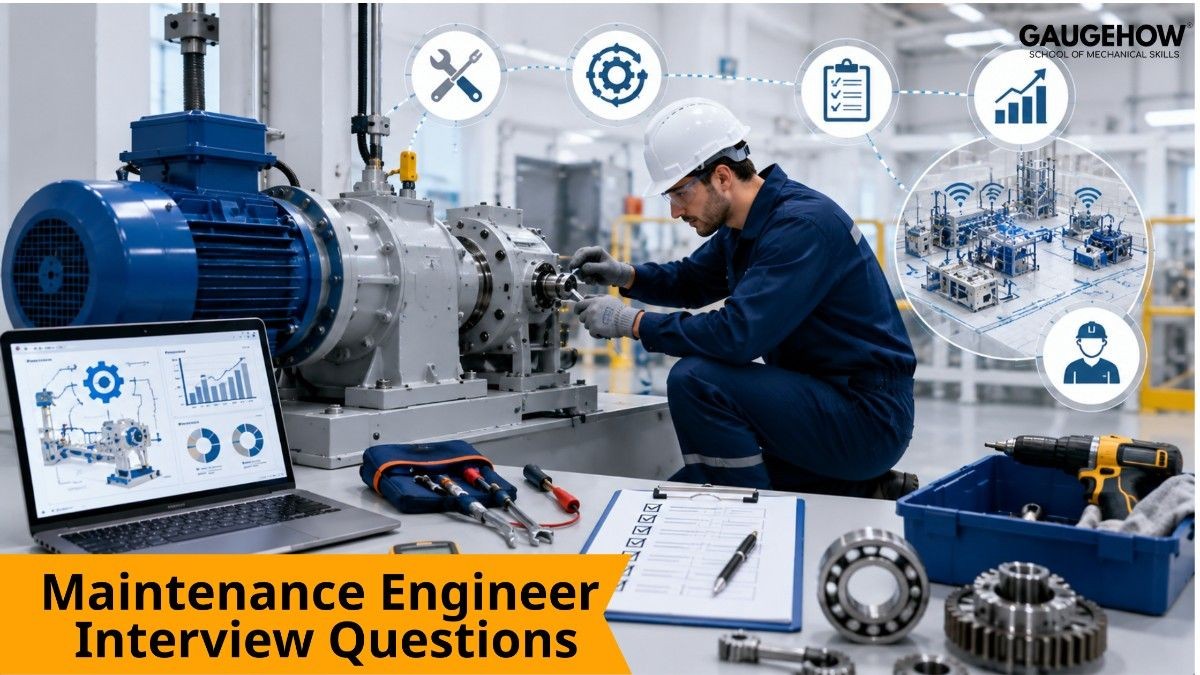
A maintenance engineer interview rarely stays theoretical. Interviewers want to know how you handle a critical machine going down mid-shift, and whether you can fix root causes, not just symptoms.
General Maintenance Engineering Questions
Q1. What are the main types of maintenance strategies?
The main types are reactive, preventive, predictive, and proactive maintenance. Reactive fixes things after they break. Preventive follows a fixed schedule. Predictive and proactive use data to act before failure happens.
Q2. What's the difference between planned and unplanned maintenance?
Planned maintenance is scheduled ahead of time and built into production plans. Unplanned maintenance happens when equipment fails without warning. A mature maintenance program keeps shifting work from unplanned into planned.
Q3. What is MTBF and MTTR?
MTBF is Mean Time Between Failures how long a machine runs before breaking. MTTR is Mean Time To Repair how fast you fix it once it does. Together they show whether the real problem is reliability or response speed.
Q4. How do you prioritize maintenance work with limited time?
I prioritize by criticality first anything that stops production or creates a safety risk goes to the top. Then I weigh downtime cost against repair cost. A CMMS helps make sure urgent items don't get buried.
TPM (Total Productive Maintenance) Questions
Q5. What is Total Productive Maintenance?
TPM makes equipment reliability a shared job between operators and maintenance, not maintenance alone. Operators handle basic checks and catch early warning signs. It shifts the culture from reactive to preventive.
Q6. What are the 8 pillars of TPM?
The eight pillars are autonomous maintenance, planned maintenance, quality maintenance, focused improvement, early equipment management, training, safety, and TPM in administration. In an interview, naming autonomous and planned maintenance clearly is usually enough.
Q7. What is autonomous maintenance?
Autonomous maintenance trains operators to clean, lubricate, and inspect their own machines instead of waiting for a technician. It starts with a simple checklist and a clear escalation path. GaugeHow's Lean Manufacturing Tools course covers this alongside the other TPM pillars.
Q8. How do you calculate OEE, and why does it matter?
OEE equals Availability times Performance times Quality. It gives one number showing how much of a machine's potential is actually being used. It separates downtime, speed, and quality losses so you know exactly where to focus.
Q9. How do you get operators to actually own TPM?
Ownership grows when operators see the checks they do prevent real disruptions to their own shift. Start small, keep checklists short, and respond fast when someone flags an issue. That builds trust the system works both ways.
Q10. How is TPM different from traditional preventive maintenance?
Traditional preventive maintenance is a fixed schedule run entirely by the maintenance department. TPM shares basic daily care with operators. Maintenance then focuses on technical work and continuous improvement instead.
Breakdown Maintenance Questions
Q11. What is breakdown maintenance, and when is it acceptable?
Breakdown maintenance means repairing equipment only after it fails. It's reasonable for low-cost, non-critical machines where downtime barely matters. Using it on critical equipment usually signals an immature maintenance program.
Q12. How would you respond to a critical equipment breakdown?
Safety comes first secure the area before touching anything. Then I run a quick diagnostic to see if it's a fast fix or needs parts. Once it's running, I document the failure and schedule a root cause review.
Q13. How do you perform root cause analysis after a breakdown?
I usually start with the 5 Whys, asking why repeatedly until I hit the real cause, not just the symptom. A fishbone diagram helps if the cause isn't obvious. The goal is a fix that prevents recurrence.
Q14. How do you reduce repeat breakdowns on the same machine?
Repeat failures usually mean the first repair fixed a symptom, not the cause. I pull the maintenance history and look for patterns in timing and failure type. I also check whether the PM interval actually matches real operating conditions.
Q15. How do you communicate downtime cost to management?
I translate downtime hours into numbers management already tracks — lost units, missed revenue, overtime cost. Technical detail matters less here than the business impact. That framing makes the case for preventive investment much clearer.
Preventive and Predictive Maintenance Questions
Q16. How do you set an effective preventive maintenance schedule?
I start with manufacturer recommendations, then adjust based on real failure history and operating conditions. Equipment running harder than the manual assumes needs a tighter interval. I also track whether the schedule is actually cutting breakdowns.
Q17. What is condition-based monitoring?
It tracks real-time equipment health signals like vibration, temperature, or oil condition to catch problems early. Vibration analysis is common for rotating equipment like motors and pumps. Changes in pattern often show bearing wear weeks before failure.
Q18. What's the difference between preventive and predictive maintenance?
Preventive maintenance follows a fixed schedule regardless of actual condition. Predictive maintenance uses real-time data to service equipment only when it needs it. GaugeHow's IIoT course covers the sensor setup predictive maintenance depends on.
Q19. How do digital twins support predictive maintenance?
A digital twin is a live virtual model of a physical asset, updated from sensor data. It lets you simulate changes, like a longer maintenance interval, without risking the real machine. GaugeHow's Digital Twins course covers this in depth.
Q20. How do you decide between predictive and simple preventive maintenance?
It comes down to criticality and cost. High-value equipment with high downtime impact usually justifies predictive investment. Lower-impact assets are often better served by a straightforward preventive schedule.
CMMS, Spare Parts, and Documentation Questions
Q21. What is a CMMS, and how do you use it?
A CMMS tracks work orders, equipment history, spare parts, and PM schedules in one system. I log every repair with enough detail that the next technician understands exactly what happened. That turns individual memory into shared knowledge.
Q22. How do you manage spare parts for critical equipment?
I keep a defined list with minimum stock levels, especially for long-lead-time parts. I cross-check that list against real failure history regularly. A part that never fails doesn't need the same buffer as one that fails often.
Q23. Why does maintenance documentation matter, and what should it include?
Documentation turns one person's experience into knowledge the whole team can use. Good records include the symptom, root cause, fix, parts used, and repair time. Consistent logging is what lets you spot patterns across failures.
Q24. How do you read technical drawings during a repair?
Reading a drawing well means understanding tolerances, not just dimensions. GD&T symbols specify how much variation is acceptable in a part. GaugeHow's GD&T and Engineering Graphics course covers this for maintenance engineers working on precision equipment.
Automation and Technical Skills Questions
Q25. How comfortable are you troubleshooting PLC-controlled equipment?
Most modern equipment runs on PLC logic, so I read ladder logic and check I/O status to trace faults. I don't assume every fault is mechanical. GaugeHow's PLC Programming course covers the fundamentals for this kind of diagnosis.
Q26. How do you diagnose an intermittent fault?
Intermittent faults are hard because they won't reproduce on demand. I correlate the timing with other variables shift, temperature, load. If available, I set up logging to catch data over time instead of relying on one inspection.
Q27. What safety procedures do you follow before servicing equipment?
Lockout-Tagout is non-negotiable before working on anything with stored energy. I verify zero energy state directly, not just by switch position. I also make sure everyone nearby knows the equipment is being worked on.
Scenario and Behavioral Questions
Q28. Describe a time you found a root cause that wasn't obvious.
A good answer names a specific case for example, a motor failure that looked like a bearing issue but was actually misalignment from a foundation problem. What interviewers listen for is the process of ruling things out with evidence.
Q29. How do you handle pressure to rush a machine back online?
I explain the risk in terms production cares about a rushed fix that fails again costs more downtime than doing it right once. I offer a clear timeline and a safe interim option where possible, rather than caving or refusing outright.
Q30. How do you measure whether a maintenance improvement actually worked?
I track the same metrics before and after MTBF, MTTR, OEE, unplanned downtime. I give it a few months, not a few weeks, to rule out normal variation. If the numbers don't move, I revisit the root cause.
FAQ
What's the difference between TPM and breakdown maintenance?
TPM is proactive operators and maintenance share responsibility and catch problems early. Breakdown maintenance is reactive, fixing things only after they fail, which usually costs more over time.
Do maintenance engineers need PLC knowledge?
Basic PLC troubleshooting is expected in most modern plants. You should be able to read ladder logic and trace a fault to its source, not just assume every issue is mechanical.
What certifications help for a maintenance engineer role?
TPM, Six Sigma, or reliability-centered maintenance certifications can help your resume stand out. Employers still weigh hands-on troubleshooting experience more heavily than certifications alone.
How is MTTR different from MTBF?
MTTR measures repair speed after a failure. MTBF measures how long equipment runs before it fails again. A short MTTR with a low MTBF still means a reliability problem.
What's the most common mistake in these interviews?
Giving textbook definitions without a real example. Interviewers want to hear how you diagnosed an actual failure or ran a real preventive program, not just a correct definition.
Conclusion
Maintenance engineer interviews reward candidates who can explain how TPM and breakdown maintenance actually play out on a floor, not just define them. Prepare a specific example for your root cause process and one for handling a critical breakdown under pressure.
To build the technical base behind these topics, GaugeHow's Lean Manufacturing Tools course covers TPM in practical depth, while PLC Programming and IIoT build the automation and predictive-maintenance skills these interviews test for.