Manufacturing Engineer Interview Questions and Answers


Deepak S Choudhary
Learn More in This Video
Subscribe to GaugeHow for More
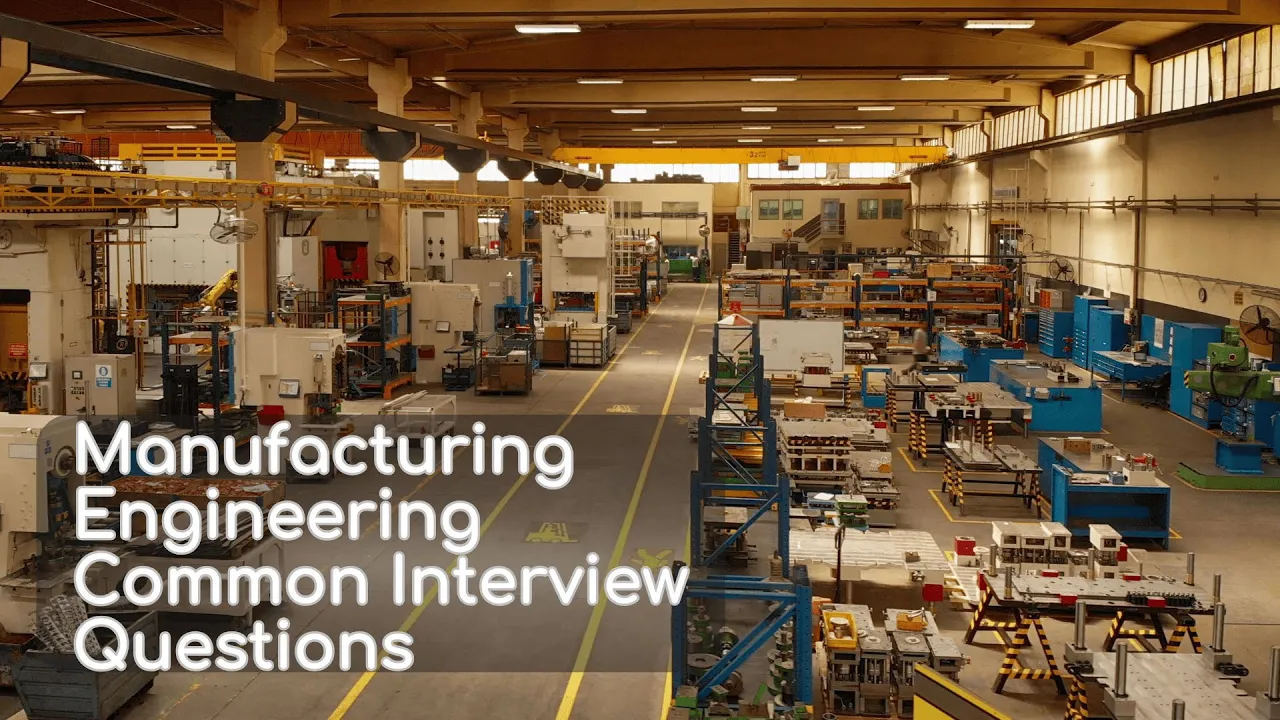
A Manufacturing Engineer interview leans into a different part of the product life cycle than a production or quality role less about running today's line, more about designing the process, tooling, and workflow that make a part manufacturable in the first place.
Interviewers want to know you can look at a design, spot what's going to be hard or expensive to produce, and fix it before it ever reaches the shop floor.
1. Manufacturing Engineering Fundamentals and Role
Interviewers open here to confirm you understand what the role actually involves before diving into DFM and process design specifics.
1. What are the main responsibilities of a Manufacturing Engineer?
A Manufacturing Engineer designs and optimizes the processes, tooling, and workflows used to produce a part, working closely with product design, quality, and production teams from early development through full-rate production.
The role sits at the intersection of design and production, translating a CAD model into a repeatable, cost-effective manufacturing process.
2. What's the difference between a Manufacturing Engineer and a Production Engineer?
A Manufacturing Engineer typically focuses on designing or redesigning the process itself tooling, fixtures, workflow often before or during a new product launch.
A Production Engineer focuses more on day-to-day line performance and troubleshooting within an already-established process. In smaller companies, one person often wears both hats.
3. What is Design for Manufacturability (DFM), and why does it matter early in a project?
DFM is the practice of designing a part so it can be manufactured efficiently, reliably, and at reasonable cost, considering the actual capabilities and limitations of the intended production process. Catching a DFM issue during the design phase is dramatically cheaper than discovering it after tooling has already been built and committed.
4. What software tools have you used for manufacturing process design?
This is your chance to name specifics SolidWorks, Fusion 360, or similar CAD/CAM platforms, along with any simulation or process planning software. GaugeHow's SolidWorks 2024 course and Fusion 360 course are common reference points if either of these tools comes up in your interview conversation.
2. Design for Manufacturability and Assembly (DFM/DFA)
5. What is the difference between DFM and DFA?
DFM (Design for Manufacturability) focuses on making individual parts easier and cheaper to produce, considering things like wall thickness, draft angles, and tolerance requirements. DFA (Design for Assembly) focuses specifically on making the final product easier and faster to assemble, often by reducing part count or simplifying how components fit together.
6. What are some common DFM issues you'd look for when reviewing a new part design?
Common issues include unnecessarily tight tolerances that drive up cost without functional benefit, sharp internal corners that are hard to machine, thin walls prone to warping in molded parts, and features that would require excessive setup changes on a CNC machine.
Flagging these early, with a specific alternative suggestion, is what separates a useful DFM review from a list of complaints.
7. Why is Draft Angle important in injection molded or cast part design?
Draft angle is the slight taper added to vertical walls of a mold cavity, allowing the finished part to release cleanly from the tool without dragging or damaging the surface.
A part designed without adequate draft can stick in the mold, cause surface defects, or wear out the tooling faster than expected.
8. How do you balance a designer's functional requirements against manufacturing cost and feasibility?
The goal isn't to override the designer's intent, but to clearly explain the cost or feasibility tradeoff of a specific feature and propose an alternative that still meets the functional need.
A collaborative DFM review bringing data on cost impact or cycle time, not just an opinion usually gets much further than simply insisting a design needs to change.
9. How does over-tolerancing a drawing increase manufacturing cost?
Tighter tolerances than functionally necessary often require slower machining speeds, more frequent inspection, tighter process control, and sometimes more expensive equipment or tooling altogether.
Reviewing a drawing's tolerances against what the part actually needs to function correctly is a common and high-value DFM exercise. GaugeHow's GD&T and Engineering Graphics course covers how to apply tolerances precisely where they're functionally needed, rather than defaulting to unnecessarily tight values everywhere.
3. Process Design, Tooling, and Fixtures
10. How do you decide which manufacturing process is right for a new part?
The decision depends on production volume, material, required tolerances, part geometry, and cost targets a low-volume, complex geometry part might favor 3D printing or CNC machining, while a high-volume simple part might favor injection molding or stamping instead.
Getting this decision right upfront avoids a costly process change later once tooling investment has already been made.
11. What is a Jig, and how is it different from a Fixture?
A jig both holds the workpiece and guides the cutting tool during a machining operation, like a drill jig that positions a drill bit precisely over a hole location.
A fixture holds and locates the workpiece securely but doesn't guide the tool itself the operator or machine controls the tool path independently. Both improve repeatability, but they serve slightly different functions.
12. What factors go into designing an effective production fixture?
A good fixture locates the part accurately and repeatably using the 3-2-1 locating principle, clamps it securely without deforming it, allows easy loading and unloading for the operator, and doesn't interfere with tool access or inspection points.
Poor fixture design is a common, often overlooked source of part-to-part variation on an otherwise capable process.
13. What is the 3-2-1 Locating Principle in fixture design?
The 3-2-1 principle uses six points of contact to fully constrain a part in 3D space three points on a primary plane to control tilt, two points on a secondary plane to control rotation, and one point on a tertiary plane to control the final degree of freedom.
This ensures the part is held in a consistent, repeatable position every time it's loaded into the fixture.
14. How do you approach reducing setup or changeover time on a new process?
Look for ways to standardize fixturing across similar parts, use quick-change tooling systems, and pre-stage the next job's tools and materials while the current job is still running.
Reducing changeover time is often less about buying new equipment and more about rethinking the sequence and preparation around the changeover itself.
4. CAD/CAM and Simulation
15. What is the difference between CAD and CAM software, and how do they work together?
CAD (Computer-Aided Design) is used to create the 3D model and drawing of the part. CAM (Computer-Aided Manufacturing) takes that model and generates the actual machine toolpaths and programs needed to produce it, particularly for CNC machining.
A manufacturing engineer often moves between both, refining the design for manufacturability before generating the production program.
16. How does Simulation help catch manufacturing problems before physical production starts?
Simulation software can model mold filling, machining toolpaths, or assembly sequences virtually, catching issues like short-shot risk in molding or tool collision in machining before any physical material or tooling is committed.
Catching these problems in simulation is far cheaper than discovering them on the shop floor after tooling has already been cut.
17. What is Reverse Engineering, and when would a manufacturing engineer use it?
Reverse engineering involves scanning or measuring an existing physical part to recreate a digital CAD model, often used when original design files are missing, outdated, or when replicating a legacy or competitor part.
It's a specialized skill that bridges metrology and CAD work, useful for replacement part production or redesigning an aging tool.
18. What is the value of using CAD/CAM simulation for CNC toolpath verification specifically?
Toolpath simulation lets you catch tool collisions, excessive cutting forces, or inefficient movement patterns before the program ever runs on the actual machine, protecting expensive tooling and reducing costly downtime from a crash.
GaugeHow's CNC Programming course covers how toolpath planning and simulation fit into an efficient, safe machining process.
5. Process Validation and Capability
19. What is a Run at Rate study, and why is it performed before full production?
A Run at Rate study runs the process at its intended full production speed and volume for a sustained period, confirming it can consistently produce conforming parts under real operating conditions, not just in a slower, more controlled trial.
It often reveals problems like tooling wear rate or cycle time drift that a short, low-volume trial run would never catch.
20. What is Process Capability (Cp/Cpk), and how does a Manufacturing Engineer use it during process validation?
Cp measures whether a process's output spread fits within specification limits, while Cpk accounts for both spread and how centered the process actually is.
A manufacturing engineer uses this data during validation to confirm the new process isn't just producing good parts today, but is statistically capable of continuing to do so reliably at full production volume.
21. What would you do if a new process passes initial trials but shows declining Cpk over a longer production run?
Investigate for gradual drift causes like tool wear, fixture wear, or thermal effects that a short initial trial wouldn't have exposed, since these often only show up over a longer, more realistic production duration.
This might mean adjusting the tool change interval, tightening fixture maintenance, or revisiting the process parameters rather than assuming the original validation was flawed.
22. How does Measurement System Analysis (MSA) factor into process validation?
Before trusting any capability data from a new process, the measurement system used to collect that data needs to be confirmed accurate and consistent through a Gage R&R study. Validating a process using unreliable measurement data risks approving a process that isn't actually capable, or rejecting one that actually is.
6. Cost Estimation and Continuous Improvement
23. How do you estimate manufacturing cost for a new part during the design phase?
Cost estimation typically breaks down into material cost, cycle time and machine rate, tooling amortization, and labor, built up from a realistic process plan rather than a rough guess.
Early cost estimates directly influence design decisions, so accuracy here has ripple effects well beyond the manufacturing engineer's own workload.
24. What is Cycle Time, and what levers can a manufacturing engineer pull to reduce it?
Cycle time is the total time to complete one full production cycle of a part, and it can often be reduced through faster tool paths, reduced non-cutting movement, optimized fixture loading sequence, or process parameter adjustments like feed rate and spindle speed.
Reducing cycle time directly improves throughput without necessarily requiring new equipment investment.
25. How do you apply Kaizen or continuous improvement principles to a manufacturing process you designed?
Even after a process is validated and running, revisiting it periodically with real production data cycle time trends, scrap rate, downtime causes often reveals further improvement opportunities that weren't obvious during initial design.
Treating process design as a one-time deliverable rather than an ongoing responsibility is a common gap between average and excellent manufacturing engineers.
26. What role does Six Sigma play in a manufacturing engineer's process improvement work?
Six Sigma's DMAIC framework provides a structured way to investigate a chronic process problem using real data, rather than relying on assumptions or trial-and-error changes. GaugeHow's Basics of 6 Sigma course covers how to apply this structured approach to real manufacturing process improvement projects.
7. Automation and Advanced Manufacturing
27. When does it make sense to automate a manual production step, and when doesn't it?
Automation makes the most sense for high-volume, repetitive tasks with stable, well-defined requirements, where the investment payback period is reasonably short.
Low-volume or highly variable tasks often aren't good automation candidates, since the flexibility and problem-solving ability of a skilled operator can outweigh the cost and complexity of automating a process that changes frequently.
28. What is PLC Programming, and why is it relevant to a manufacturing engineer even if you're not the one writing the code?
A Programmable Logic Controller (PLC) is the industrial computer that controls automated equipment on the shop floor, and understanding basic PLC logic helps a manufacturing engineer troubleshoot automation issues and communicate more effectively with controls engineers during a new process design.
GaugeHow's PLC Programming and Automation course is a useful reference if this is an area you want to strengthen before an automation-heavy interview.
29. How is 3D Printing (Additive Manufacturing) used in a manufacturing engineering context beyond prototyping?
Beyond rapid prototyping, additive manufacturing is increasingly used for low-volume production tooling, jigs and fixtures, and even certain end-use parts where its design flexibility outweighs traditional manufacturing's speed advantage at scale.
GaugeHow's 3D Printing / Additive Manufacturing course covers where this technology genuinely adds value versus where traditional processes still make more sense.
30. How do you see Industry 4.0 and connected manufacturing technologies changing the manufacturing engineer's role?
Connected sensors, real-time data collection, and digital twins are shifting manufacturing engineering toward more data-driven process design and predictive troubleshooting, rather than relying purely on periodic manual checks and historical experience.
Staying current with these tools is becoming less of a specialization and more of a baseline expectation as shop floors continue digitizing.
Frequently Asked Questions
What background is typically expected for a Manufacturing Engineer role?
Most roles expect a mechanical, industrial, or manufacturing engineering degree, along with hands-on CAD/CAM experience and familiarity with at least one core manufacturing process like machining, molding, or stamping.
Practical process design experience often matters more in the interview than academic background alone.
Is CNC programming knowledge required for a Manufacturing Engineer, or just for machinists?
Deep hands-on programming skill isn't always required, but understanding how toolpath decisions affect cycle time, tool wear, and part quality is expected, especially when working closely with CNC programmers on process improvement.
The depth expected usually scales with how machining-focused the specific role is.
How should I answer DFM questions if I haven't reviewed a design from scratch before?
Focus on the general principles tolerance appropriateness, draft angles, avoiding hard-to-machine geometry and walk through how you'd apply them to a hypothetical example, even without direct prior experience. Interviewers care about your reasoning process as much as a specific past example.
What's the most common mistake candidates make in manufacturing engineer interviews?
Talking about process design in purely theoretical terms without connecting it to real cost, cycle time, or quality outcomes. Interviewers want to hear specific numbers or concrete examples a design change that saved a specific amount of cycle time, or a DFM catch that avoided a costly tooling rework.
Conclusion
Manufacturing Engineer interviews reward candidates who can connect design decisions directly to real manufacturing outcomes cost, cycle time, tooling life, and process capability rather than treating design and production as separate concerns.
Get comfortable explaining DFM and DFA principles with concrete examples, know how to reason through a fixture design or process selection decision, and be ready to walk through how you'd validate a new process from initial trial through sustained capability.
Review this list carefully before your interview, and you'll be prepared for almost any question spanning design, process, or automation.
Want to strengthen the design and process skills these interviews test for? Explore GaugeHow's SolidWorks 2024 or Fusion 360 courses for CAD fundamentals, CNC Programming and GD&T and Engineering Graphics for process and tolerancing depth, or 3D Printing and PLC Programming and Automation for the advanced manufacturing side.
Pair any of these with the Basics of 6 Sigma course for structured process improvement. If you're just getting started, GaugeHow's Free Course is a no-cost way to explore the platform, or browse the full course catalog to find the right fit for your next role.