MATLAB Interview Questions and Answers for Mechanical Engineers

Deepak S Choudhary
Learn More in This Video
Subscribe to GaugeHow for More
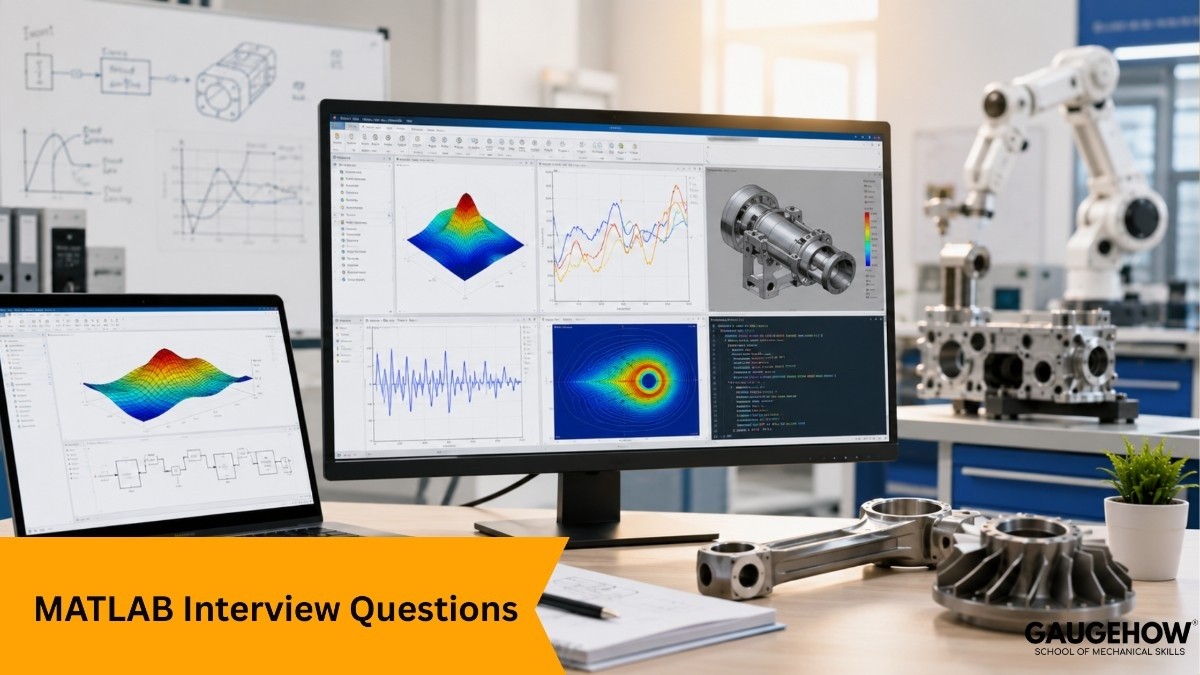
MATLAB is a programming and numerical computing platform widely used by mechanical engineers for calculations, simulations, data analysis, and automating repetitive engineering tasks. It's especially popular for matrix-based math, plotting results, and scripting custom tools that other engineering software doesn't handle natively.
Basic MATLAB Concepts
1. What is MATLAB, and why do mechanical engineers use it?
MATLAB is a numerical computing and programming platform. Mechanical engineers use it for calculations and data analysis. It's especially strong for matrix and vector-based math. It's also widely used for plotting and visualizing results.
2. What is a script in MATLAB?
It's a file containing a sequence of MATLAB commands. Scripts run from top to bottom when executed. They're commonly used for calculations and automation. Most beginner MATLAB work starts with simple scripts.
3. What is a function in MATLAB, and how is it different from a script?
A function takes inputs and returns outputs. A script doesn't require inputs or outputs. Functions are reusable across different projects. Functions help keep larger MATLAB code organized.
4. What is a matrix in MATLAB, and why is it important?
A matrix is a grid of numbers arranged in rows and columns. MATLAB is built specifically around matrix operations. Many engineering calculations are naturally matrix-based. This is part of why MATLAB suits engineering work so well.
5. What is the difference between a vector and a matrix in MATLAB?
A vector is a single row or column of numbers. A matrix has multiple rows and columns. Both are handled using the same basic operations. Vectors are essentially a simplified type of matrix.
6. How do you create a variable in MATLAB?
You assign a value directly to a variable name. MATLAB doesn't require declaring variable types first. Variables can hold numbers, text, or matrices. This makes MATLAB quick to use for fast calculations.
7. What is the MATLAB workspace? It's where all current variables are stored. You can view and edit variables there during a session. It helps track what data is currently available. Clearing the workspace resets your current variables.
8. What is the difference between MATLAB and Simulink?
MATLAB is used for coding and numerical calculations. Simulink is used for graphical, block-based system modeling. Simulink is often used for dynamic system simulation. Many engineers use both together on the same project.
Programming Logic and Data Handling
9. What is a for loop in MATLAB, and when is it used?
It repeats a block of code a set number of times. It's commonly used to process data step by step. It's useful when the number of repetitions is known in advance. Loops are a basic building block of MATLAB scripts.
10. What is a while loop, and how is it different from a for loop?
A while loop repeats until a condition becomes false. A for loop repeats a known, fixed number of times. While loops suit situations with an unknown number of steps. Both are common tools for repetitive calculations.
11. What is an if-else statement used for in MATLAB?
It runs different code based on a condition. It's used to handle multiple possible outcomes. This logic is common in engineering decision calculations. It's one of the first programming concepts engineers learn.
12. What is the difference between a cell array and a regular array?
A regular array holds only one data type. A cell array can hold mixed data types together. Cell arrays are useful for more complex, varied data. Regular arrays are simpler and faster for numeric work.
13. What is a struct in MATLAB, and why is it useful?
A struct groups related data under one variable name. Each piece of data is accessed by a named field. It's useful for organizing complex engineering data sets. Structs make code easier to read and manage.
14. How do you import data from Excel into MATLAB?
The readtable or xlsread functions are commonly used. They pull spreadsheet data directly into MATLAB. This is useful for analyzing test or experimental data. It avoids manually retyping large data sets.
15. What is vectorization in MATLAB, and why is it preferred?
It means performing operations on whole arrays at once. This avoids writing slower, manual loop-based code. Vectorized code runs faster in MATLAB. It's considered a best practice for efficient scripting.
Plotting and Engineering Calculations
16. How do you create a basic plot in MATLAB?
The plot function is used for simple line graphs. You provide x and y data as inputs. Labels and titles can be added for clarity. Plotting is essential for reviewing engineering results visually.
17. What is the difference between plot and subplot in MATLAB?
Plot creates a single standalone graph. Subplot arranges multiple graphs in one figure window. Subplot is useful for comparing related results together. Both are commonly used when reviewing simulation output.
18. How would you solve a system of linear equations in MATLAB?
MATLAB can solve them directly using matrix operations. The backslash operator is commonly used for this. This avoids manually solving equations by hand. It's a common task in structural and mechanical calculations.
19. How is MATLAB used for numerical differentiation or integration?
Built-in functions handle these calculations directly. This is useful when no exact formula is available. It's common in motion, force, or signal analysis. These tools save significant manual calculation time.
20. How can MATLAB be used to solve differential equations?
Built-in solvers like ode45 handle this directly. They're commonly used for dynamic system behavior. This avoids manually solving complex equations by hand. It's widely used in vibration and control system analysis.
MATLAB in Engineering Workflows
21. How is MATLAB used alongside FEA software like ANSYS?
MATLAB often post-processes exported simulation data. It can automate repetitive calculations across many results. A course like FEA with ANSYS builds the simulation side of this skill. Many engineers pair both tools in their daily workflow.
22. How is MATLAB used for processing test or sensor data?
It can import, clean, and analyze raw data quickly. Built-in tools help filter noise and extract trends. This is common in vibration, fatigue, or thermal testing. It saves significant manual data processing time.
23. What is a parametric study, and how does MATLAB help with it?
It involves running the same calculation with varying inputs. MATLAB can automate looping through many input values. This helps engineers compare design options quickly. It's a common, practical use of MATLAB scripting.
24. How does MATLAB compare to Python for mechanical engineering tasks?
MATLAB is built specifically for numerical and matrix work. Python is more general-purpose and widely used too. Many engineers learn both for different project needs. A course like Python for Mechanical Engineers & Robotics covers this alternative path.
25. Why is MATLAB still widely used despite free alternatives existing?
It has strong, reliable built-in engineering toolboxes. Many companies already have established MATLAB workflows. Its documentation and support are considered very strong. This makes it a safe, dependable choice for many teams.
Troubleshooting and Practical Scenarios
26. A MATLAB script runs very slowly. What would you check first?
Look for loops that could be vectorized instead. Check if large data is being reloaded repeatedly. Preallocating arrays often improves speed significantly. Most slow scripts trace back to inefficient looping.
27. A calculation gives unexpected or incorrect results. What would you investigate?
Check variable units for consistency throughout the script. Review matrix dimensions for mismatched operations. Print intermediate values to trace where it goes wrong. Most errors come from a small overlooked detail.
28. You need to process the same calculation for hundreds of test files. How would you approach it?
Write a function to handle one file at a time. Use a loop to apply it across all files automatically. Store results in a structured array or table. This avoids manually repeating the process by hand.
29. A colleague's MATLAB code is hard to understand and reuse. What would you suggest?
Recommend breaking it into smaller, named functions. Suggest adding clear comments explaining each step. Consistent variable naming also improves readability. Clean, modular code is easier to debug and reuse later.
30. What's the most common mistake beginners make in MATLAB?
Writing slow, unnecessary loops instead of vectorized code. Not checking variable types or matrix dimensions carefully. Both come from rushing past MATLAB's basic best practices. Slowing down early builds much stronger coding habits.
Frequently Asked Questions
Q: Is MATLAB a good skill for mechanical engineering students to learn?
A: Yes, it's widely used across analysis, simulation, and data processing tasks. Strong MATLAB skills are valued in research, automotive, and aerospace roles especially.
Q: Do I need a programming background before learning MATLAB?
A: No, MATLAB is considered relatively beginner-friendly to start with. Its syntax is more approachable than many general-purpose languages.
Q: Should I learn MATLAB or Python first as a mechanical engineering student?
A: Either is a reasonable starting point depending on your goals. Many engineers eventually learn both for different types of projects.
Q: How much MATLAB knowledge is expected for an entry-level interview?
A: Usually just the basics, like loops, functions, and simple plotting. Interviewers mainly want to see logical thinking and problem-solving ability.
Q: How should freshers structure their answers?
A: Keep answers short and clearly reasoned. Interviewers respond better to applied thinking than memorized syntax.
Conclusion
MATLAB interviews for mechanical engineers come back to a few core ideas: understanding basic programming logic, knowing how to handle and visualize engineering data, and using MATLAB to automate repetitive calculations. If you understand these clearly, you'll be ready for most interview questions.
To build job-ready skills, explore GaugeHow's MATLAB course and Python for Mechanical Engineers course, or browse all engineering courses. You can even start free today. Good luck you've got this.