OpenFOAM Interview Questions and Answers for CFD Roles

Deepak S Choudhary
Learn More in This Video
Subscribe to GaugeHow for More
OpenFOAM is a free, open-source CFD software widely used to simulate fluid flow, heat transfer, and other physics problems through customizable solvers. Unlike commercial CFD tools, it relies heavily on file-based setup and command-line operation, which gives engineers more flexibility but also requires a different skill set.
Basic OpenFOAM Concepts
1. What is OpenFOAM?
It's a free, open-source CFD software package. It's used to simulate fluid flow and related physics. It's widely used in both research and industry. Unlike commercial tools, its source code is fully open.
2. How is OpenFOAM different from commercial CFD tools like ANSYS Fluent?
OpenFOAM is free and fully customizable. It uses file-based, command-line setup instead of a GUI. Commercial tools usually offer easier graphical setup. Many engineers learn both to cover different project needs.
3. What is a case directory in OpenFOAM?
It's the main folder holding a simulation setup. It contains all files needed to define the problem. Every OpenFOAM simulation starts from this structure. Understanding it is the first step to learning OpenFOAM.
4. What are the three main folders in an OpenFOAM case?
These are the 0, constant, and system folders. The 0 folder holds initial and boundary conditions. The constant folder holds mesh and physical properties. The system folder holds solver and control settings.
5. What is a solver in OpenFOAM?
It's the program that actually solves the physics. Different solvers handle different flow types. Choosing the right solver depends on the problem. OpenFOAM includes many solvers built for specific cases.
6. What is the difference between incompressible and compressible solvers in OpenFOAM? Incompressible solvers assume constant fluid density. Compressible solvers allow density to change with pressure. The choice depends on flow speed and conditions. Using the wrong solver type leads to inaccurate results.
7. What is blockMesh in OpenFOAM?
It's a built-in tool for creating simple structured meshes. It's defined through a text-based dictionary file. It works well for basic or simplified geometry. Complex geometry usually needs a different meshing tool.
8. What is snappyHexMesh, and when is it used?
It's OpenFOAM's tool for meshing complex geometry. It generates an unstructured mesh from imported CAD surfaces. It's commonly used for real-world, detailed models. It requires more setup effort than blockMesh.
Case Setup and Boundary Conditions
9. What is the dictionary file structure in OpenFOAM?
OpenFOAM uses structured text files called dictionaries. Each one defines specific settings for the simulation. This includes solver controls, properties, and conditions. Understanding this structure is essential for setup.
10. How are boundary conditions defined in OpenFOAM?
They're set in files within the 0 folder. Each boundary patch gets its own defined condition. Common types include fixed value and zero gradient. Incorrect boundary conditions are a common setup mistake.
11. What is the controlDict file used for?
It controls overall simulation settings. This includes start time, end time, and time step. It also defines how often results are written. It's one of the first files engineers check or edit.
12. What is the fvSchemes file, and why does it matter?
It defines the numerical schemes used for solving. This affects accuracy and solution stability. Different schemes suit different flow types. Choosing poor schemes can cause convergence problems.
13. What is the fvSolution file used for?
It defines solver settings and convergence criteria. This includes residual tolerances and relaxation factors. It directly affects how the simulation converges. Engineers often adjust this file during troubleshooting.
14. What is a turbulence model in OpenFOAM, and how is it selected?
It approximates the effect of turbulent flow. Common options include k-epsilon and k-omega SST. The right model depends on the specific flow scenario. It's set within the constant folder's turbulence properties.
15. What is the difference between RAS and LES turbulence approaches in OpenFOAM?
RAS models the time-averaged effect of turbulence. LES resolves larger turbulent structures directly. RAS is faster and more common for everyday use. LES is reserved for cases needing more turbulence detail.
Meshing and Solver Workflow
16. How do you check mesh quality in OpenFOAM?
The checkMesh utility reviews mesh quality automatically. It flags issues like poor cell shape or non-orthogonality. Running this before solving is a standard practice. Skipping it often leads to convergence problems later.
17. What is non-orthogonality in an OpenFOAM mesh?
It measures how skewed mesh cells are. High non-orthogonality can reduce solver accuracy. It's a key metric checked during mesh validation. Refining problem areas usually improves this value.
18. How do you run a simulation in OpenFOAM?
The chosen solver is run from the case directory. This is typically done through the command line. Progress and residuals are shown during the run. Results are saved at the intervals set in controlDict.
19. What is parallel processing in OpenFOAM, and why is it used?
It splits a simulation across multiple processor cores. This significantly speeds up large or complex simulations. The decomposePar utility prepares the case for this. Results are later reassembled using reconstructPar.
20. What is residual convergence in OpenFOAM?
It shows how much the solution changes each iteration. Lower residuals indicate a more stable solution. Engineers typically set target residual thresholds. A simulation shouldn't be trusted until residuals drop sufficiently.
Post-Processing and Practical Tools
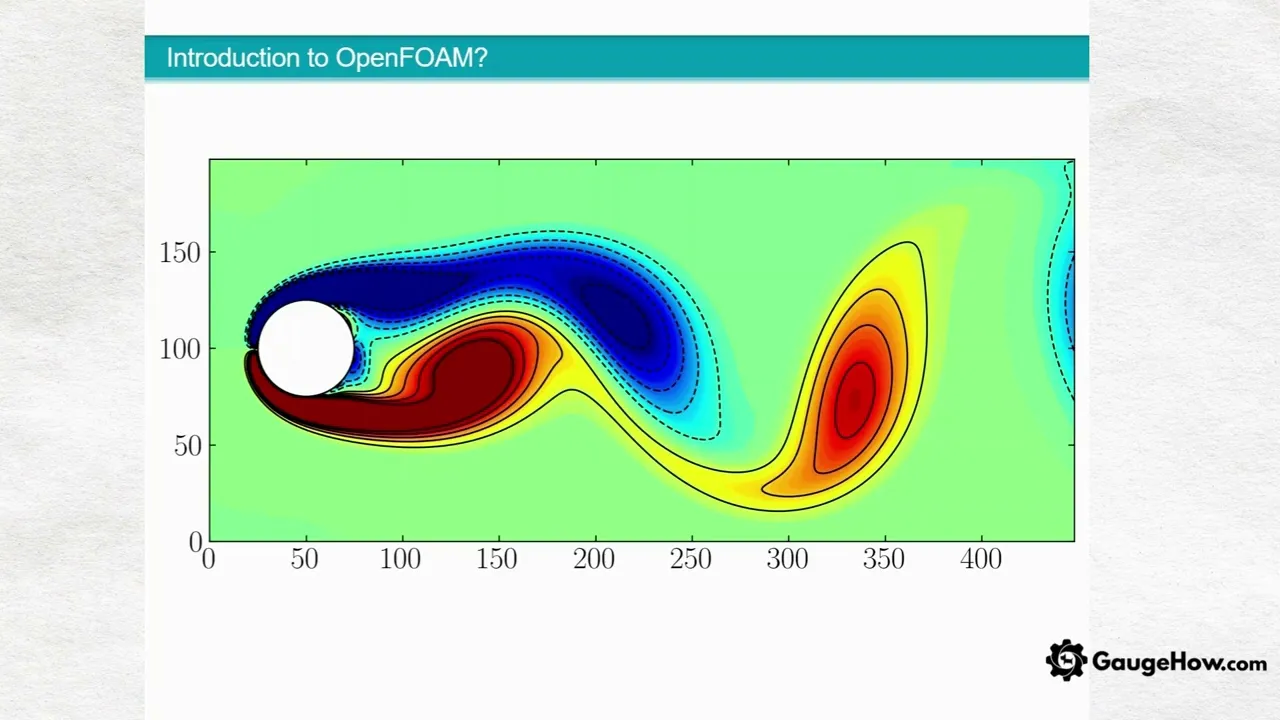
21. What is ParaView, and how is it used with OpenFOAM?
ParaView is the standard tool for OpenFOAM post-processing. It visualizes contour plots, streamlines, and other results. It reads OpenFOAM result files directly. It's typically used after a simulation finishes running.
22. What is the difference between OpenFOAM and ANSYS Fluent in terms of workflow?
OpenFOAM relies on file editing and command-line use. ANSYS Fluent offers a fully graphical setup experience. Many companies use both depending on project needs. Learning both broadens a CFD engineer's flexibility.
23. What role does MATLAB play in OpenFOAM-based CFD work?
It's used to post-process exported result data. It helps automate repetitive calculations or comparisons. MATLAB skills pair well with OpenFOAM workflows. Many engineers script custom analysis tools in it.
24. How would someone build practical OpenFOAM skills as a beginner?
Start with simple, well-documented tutorial cases. Practice editing dictionary files by hand. A structured course like the OpenFOAM CFD Course helps build this foundation. Hands-on practice matters more than memorizing commands.
25. Why is scripting knowledge valuable for OpenFOAM users?
OpenFOAM workflows are heavily file and script based. Basic shell scripting helps automate repetitive tasks. It's especially useful for running multiple case variations. This is a key difference from GUI-based CFD tools.
Troubleshooting and Practical Scenarios
26. An OpenFOAM simulation diverges shortly after starting. What would you check first?
Review the boundary conditions for inconsistencies. Check mesh quality using the checkMesh utility. Reduce the time step if instability persists. Most early divergence issues trace back to setup errors.
27. The simulation runs but residuals won't drop below the target value. What's the likely cause?
Check numerical schemes set in fvSchemes. Review relaxation factors in fvSolution. Poor mesh quality can also prevent convergence. Adjusting one of these usually resolves the issue.
28. Two different mesh resolutions give very different results. What does this indicate?
It indicates the coarser mesh hasn't reached independence. Results are still sensitive to mesh density. Continue refining until results stabilize. This is a standard mesh sensitivity check in CFD.
29. A colleague needs to repeat the same simulation with different inlet velocities. How would you approach this efficiently?
Set up a base case with editable boundary files. Use scripting to automate changing the inlet value. Run each case and collect results systematically. This avoids manually repeating the full setup each time.
30. What's the most common mistake beginners make with OpenFOAM?
Editing dictionary files without understanding their structure. Skipping mesh quality checks before solving. Both come from rushing past OpenFOAM's file-based learning curve. Slowing down early actually saves time later.
Frequently Asked Questions
Q: Is OpenFOAM a good tool to learn for a CFD career?
A: Yes, it's a widely respected, free CFD tool used across industries. Learning it alongside commercial software makes you more flexible as a candidate.
Q: Is OpenFOAM harder to learn than commercial CFD software?
A: It has a steeper initial learning curve due to its file-based setup. Once the structure is understood, it becomes much easier to use confidently.
Q: Do I need programming knowledge to use OpenFOAM effectively?
A: Basic scripting knowledge helps a lot, though it's not strictly required at first. It becomes more valuable as you automate larger or more complex workflows.
Q: Should I learn OpenFOAM, ANSYS Fluent, or both?
A: Learning both is ideal if possible, since many employers use different tools. Understanding core CFD concepts matters more than any single software.
Q: How should freshers structure their answers?
A: Keep answers short and clearly reasoned. Interviewers respond better to applied thinking than memorized command lists.
Conclusion
OpenFOAM interviews come back to a few core ideas: understanding the case directory structure, knowing how meshing and boundary conditions are set up through files, and being comfortable troubleshooting convergence issues. If you understand these clearly, you'll be ready for most interview questions.
To build job-ready skills, explore GaugeHow's OpenFOAM CFD course and ANSYS Fluent course, or browse all engineering courses. You can even start free today. Good luck you've got this.