Robotics Engineer Interview Questions and Answers

Deepak S Choudhary
Learn More in This Video
Subscribe to GaugeHow for More
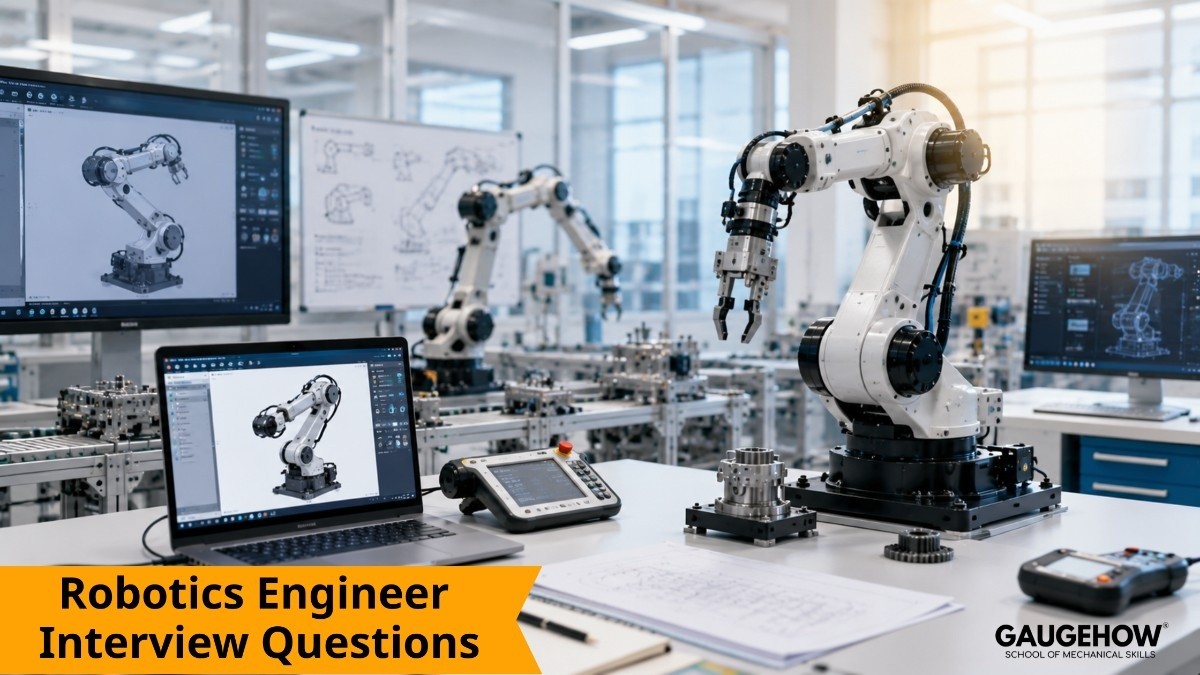
Robotics engineer interviews move fast between mechanical design, control theory, programming, and safety. Interviewers want to know whether you can actually get a robot arm to do something reliably, not just describe how robots work in general.
General Robotics Questions
Q1. What is the difference between a robot and an automated machine?
A robot is typically programmable and capable of adapting its motion path based on input. A fixed automated machine repeats one exact motion regardless of changing conditions.
That flexibility is what separates a robot from a simple mechanized tool. Robots also usually include sensors that let them react to their environment in real time.
Q2. What are the main types of industrial robots?
Articulated robots use rotary joints and mimic a human arm's range of motion. SCARA robots move in a more constrained, faster pattern suited to pick-and-place tasks. Delta robots handle very fast, lightweight sorting work using a parallel-link design. Each type fits a different balance of speed, reach, and payload.
Q3. What does degrees of freedom mean in robotics?
Degrees of freedom describe the number of independent ways a robot can move, usually tied to its joint count. A typical six-axis arm has six degrees of freedom, enough to reach most positions and orientations in its workspace. More degrees of freedom generally mean more flexibility but also more complex control.
Q4. What is a robot's workspace or work envelope?
The workspace is the full three-dimensional space a robot's end effector can physically reach. It's shaped by the robot's joint limits and link lengths, not a simple sphere or cube. Understanding the actual workspace matters for layout planning, since a robot placed wrong can leave dead zones it can't reach.
Kinematics and Motion Control Questions
Q5. What is the difference between forward and inverse kinematics?
Forward kinematics calculates the end effector's position given known joint angles. Inverse kinematics works backward, calculating the joint angles needed to reach a desired end position.
Inverse kinematics is generally the harder, more computation-heavy problem of the two. Most robot controllers handle this automatically, but understanding it helps when troubleshooting unexpected motion.
Q6. What is a Jacobian matrix used for in robotics?
The Jacobian matrix relates joint velocities to end effector velocity, which is essential for smooth, coordinated motion control. It's also used to identify singularities, points where the robot loses a degree of freedom.
Understanding Jacobians matters most for custom motion planning, less so for standard pick-and-place programming.
Q7. What is a singularity in robot motion, and why does it matter?
A singularity is a configuration where the robot temporarily loses a degree of freedom, causing unpredictable or excessive joint speed near that point.
Programming a path that passes too close to a singularity can cause a fault or jerky motion. Avoiding singularities usually means adjusting the path or robot orientation during programming.
Q8. What's the difference between joint space and Cartesian space programming?
Joint space programming specifies target angles for each individual joint directly. Cartesian space programming specifies a target position and orientation in real-world coordinates, letting the controller calculate joint angles automatically.
Cartesian programming is more intuitive for path planning, while joint space gives more direct control over individual axis behavior.
Control Systems Questions
Q9. What is a PID controller, and how is it used in robotics?
A PID controller minimizes error between a desired and actual position using proportional, integral, and derivative terms. In robotics, it's commonly used to control individual joint motors for smooth, accurate positioning.
Poor tuning causes overshoot or sluggish response, both of which hurt precision. Most modern robot controllers handle PID tuning internally, but understanding the concept helps with troubleshooting.
Q10. What's the difference between open-loop and closed-loop robot control?
Open-loop control sends a command without verifying the actual result, relying purely on calibration. Closed-loop control uses feedback, usually from an encoder, to continuously correct position in real time.
Closed-loop systems are more accurate but require more sensors and processing. Most industrial robots use closed-loop control for reliable repeatability.
Q11. How do you tune a robot's motion parameters for smoother movement?
I'd start by adjusting acceleration and deceleration profiles rather than just top speed, since abrupt starts and stops cause more wear and vibration than steady motion.
Testing at production payload, not empty, matters since dynamics change significantly under load. Small adjustments tested incrementally avoid introducing a new instability while fixing the original issue.
Sensors and Perception Questions
Q12. What sensors are commonly used for robot perception?
Vision systems using cameras handle object recognition and positioning for pick tasks. Proximity and force sensors detect contact or nearby obstacles for safety and precision.
Encoders track joint position for accurate motion feedback. Choosing the right sensor combination depends entirely on what the robot actually needs to sense for its task.
Q13. How does machine vision integrate with a robot's control system?
A vision system identifies an object's position and orientation, then passes that data to the robot controller, which adjusts its target coordinates accordingly.
Calibration between the camera's coordinate frame and the robot's frame is critical, since a small calibration error causes consistent, hard-to-diagnose pick failures. Lighting consistency also significantly affects vision system reliability in production.
Q14. What is force or torque sensing used for in robotic applications?
Force sensing lets a robot detect contact and adjust pressure during tasks like assembly or polishing, where too much force could damage a part.
It's especially important for delicate insertion tasks where visual feedback alone can't confirm proper seating. Without it, a robot would need overly conservative, slower motion to avoid damage.
Q15. How do you handle a vision system that's giving inconsistent readings?
I'd check lighting conditions first, since inconsistent ambient light is one of the most common causes of unreliable vision results. Camera calibration drift and dirty or obstructed lenses are the next likely culprits.
Isolating whether the issue is the camera itself or the part's presentation to the camera usually narrows it down quickly.
Programming Questions
Q16. What programming languages are commonly used in robotics?
Python is widely used for prototyping, vision processing, and higher-level task logic, often through frameworks like ROS. C and C++ remain common for performance-critical, real-time control code closer to the hardware. GaugeHow's Python for Mechanical Engineers & Robotics course covers how Python fits into this kind of robotics workflow.
Q17. What is ROS, and why is it widely used in robotics development?
ROS, the Robot Operating System, is a flexible framework providing tools and libraries for building robot software without starting from scratch each time.
It handles communication between different software components through a publish-subscribe messaging system. Its widespread adoption means a large ecosystem of existing packages for common robotics tasks.
Q18. How do you debug robot control code running on physical hardware?
I rely heavily on logging key variables during operation, since traditional debuggers aren't always practical on real-time embedded systems. Testing subsystems independently before full integration isolates problems faster than debugging the whole system at once. GaugeHow's C and C++ for Mechanical Engineering course covers embedded debugging fundamentals relevant here.
Q19. What's the difference between teach pendant programming and offline programming?
Teach pendant programming involves physically guiding the robot through positions in real time using a handheld controller.
Offline programming creates the motion path in simulation software before deploying it to the actual robot. Offline programming reduces production downtime during setup but needs careful validation against the real environment before running live.
Mechanical Design Questions
Q20. What factors matter when designing an end effector for a specific task?
Payload capacity, grip type, and precision requirements all shape end effector design, along with how quickly it needs to cycle between picks. A design that's technically capable but too slow for the required cycle time still fails the application.
GaugeHow's Fusion 360 course covers modeling and simulating end effector designs before physical prototyping.
Q21. How do you select the right robot payload capacity for an application?
I calculate the actual weight the robot needs to carry, including the end effector itself, not just the part being handled. I also add margin for dynamic loads during acceleration, since a robot moving quickly experiences forces beyond the object's static weight. Underestimating payload is a common and costly mistake in robot selection.
Q22. What is repeatability, and how is it different from accuracy in robotics?
Repeatability measures how consistently a robot returns to the same programmed position across repeated cycles. Accuracy measures how close that position is to the intended target in absolute terms. A robot can have excellent repeatability but poor accuracy if it consistently misses the true target by the same offset.
Safety Questions
Q23. What safety measures are required around industrial robots?
Physical guarding and light curtains typically separate humans from traditional industrial robots during operation.
Safety-rated stop circuits ensure the robot halts immediately if a barrier is breached. Risk assessments specific to each application determine exact safety requirements, since a fast, heavy robot needs different protection than a small, light one.
Q24. How do collaborative robots differ from traditional industrial robots in terms of safety?
Collaborative robots, or cobots, are designed to work safely near humans without full physical guarding, using force limiting and sensors to detect contact.
Traditional industrial robots typically require guarding because they lack this built-in force limitation. Choosing between them depends heavily on whether the application genuinely needs close human interaction.
Q25. What is lockout-tagout, and how does it apply to robot maintenance?
Lockout-tagout physically isolates a robot from its power source before maintenance begins, preventing unexpected motion that could injure a technician.
It applies directly to robotics because stored energy in servo systems or pneumatics can cause movement even when the controller appears off. Skipping this step is one of the most serious safety violations in robotics maintenance.
Integration and Automation Questions
Q26. How does a robot typically communicate with the rest of an automation system?
Robots commonly connect through industrial protocols like Ethernet/IP or Profinet to exchange I/O signals with a PLC controlling the surrounding line.
GaugeHow's PLC Programming and Automation course covers this integration layer, which is often where real-world troubleshooting time goes. Synchronizing timing between robot cycles and line speed matters as much as the communication itself.
Q27. How does IIoT connectivity change how robots are monitored in production?
Connected sensors let a robot report performance and health data continuously, supporting predictive maintenance beyond what basic error codes show.
GaugeHow's IIoT course covers how this kind of connected monitoring architecture is built around existing robotic systems. It shifts maintenance from reactive to data-driven over time.
Scenario and Behavioral Questions
Q28. A robot's pick success rate dropped suddenly. How would you investigate it?
I'd check for recent changes first, like a part supplier switch or lighting adjustment near the vision system. Comparing current vision and position data against a known-good baseline usually narrows the cause quickly. A sudden drop almost always points to something that changed recently, not a gradual mechanical issue.
Q29. Describe a time you had to debug unexpected robot motion.
A strong answer names a specific case, like a near-singularity causing erratic joint speed, and explains how it was diagnosed and corrected. Interviewers want the diagnostic process explained clearly, not just the final fix. Specific detail is what separates a credible answer from a generic one.
Q30. How do you approach a robotics project where requirements change mid-development?
I'd assess how the change affects payload, reach, and cycle time assumptions already built into the design. Flagging cost and schedule impact early prevents surprises later in the project. Flexibility in early design decisions, like leaving margin in payload capacity, makes handling changes like this much less painful.
FAQ
Do robotics engineers need both mechanical and programming skills?
Most roles expect at least working knowledge of both. Some engineers specialize more heavily in one side, but understanding how mechanical and software decisions affect each other is core to the field.
What's the most commonly asked robotics interview question?
Explaining the difference between forward and inverse kinematics comes up frequently, since it tests both theoretical understanding and practical application experience.
Is ROS experience required for robotics interviews?
Not always required, but it's increasingly expected, especially for roles involving research, mobile robotics, or custom automation beyond standard industrial pick-and-place tasks.
How important is safety knowledge in a robotics interview?
Very important. Interviewers often ask directly about guarding, lockout-tagout, or cobot safety limits to confirm safety isn't an afterthought in your design process.
What's the difference between industrial and collaborative robots in interview terms?
Industrial robots need physical guarding and move faster with higher payloads. Collaborative robots use force limiting to work safely near humans. Interviewers expect you to know which fits a given application.
Conclusion
Robotics engineer interviews reward candidates who can connect mechanical design, control theory, and programming into one coherent answer, backed by a real troubleshooting example. Prepare a specific case involving motion control, vision system debugging, and a safety decision you made in a real project.
To build the technical foundation behind these interview topics, GaugeHow's Python for Mechanical Engineers & Robotics course covers programming fundamentals for robotics work, while PLC Programming and Automation and Fusion 360 build the integration and design skills these interviews test for.