Sheet Metal Design Interview Questions and Answers


Deepak S Choudhary
Learn More in This Video
Subscribe to GaugeHow for More
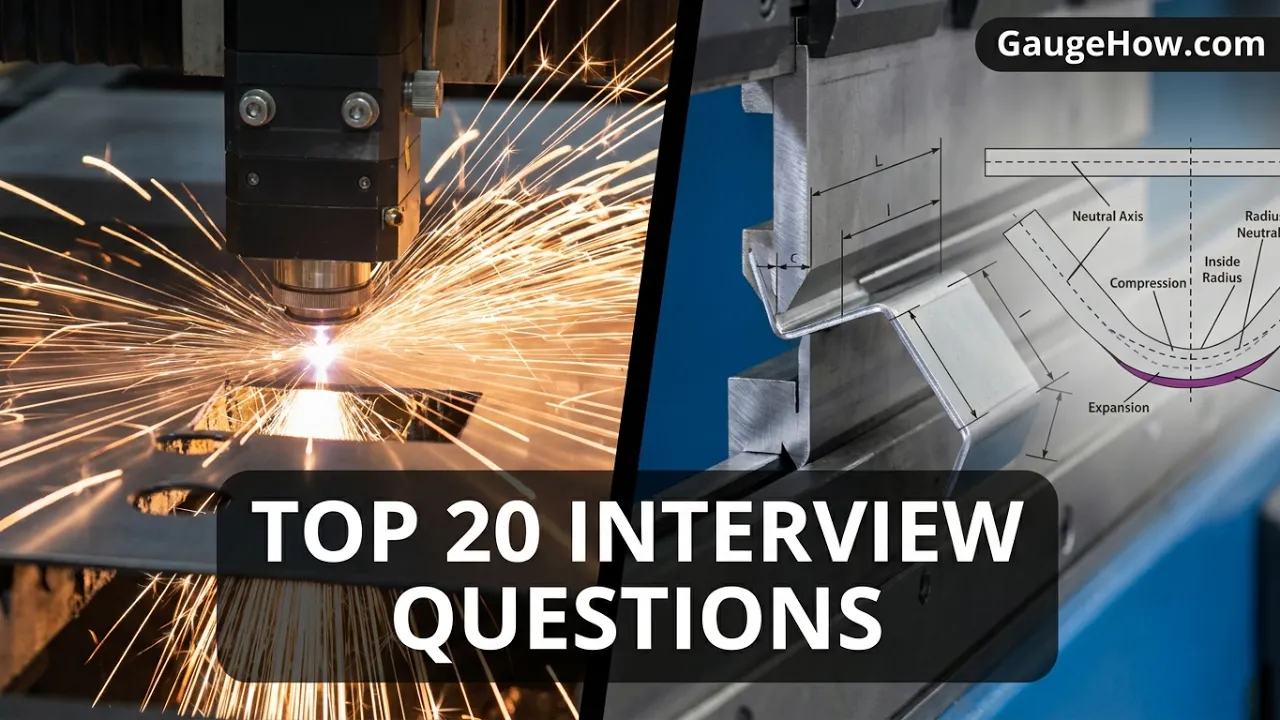
Sheet metal design sits at the crossroads of CAD and real manufacturing, which is exactly why interviews dig deep. It's not enough to model a bent part you need to explain bend allowance, K-factor, forming operations, and the design rules that keep a part from cracking or failing to flatten.
Recruiters want engineers who design parts that can actually be made on a press brake or stamping die.
This guide collects the questions you're most likely to face, sorted by topic so you can prepare the way real interviews flow. Each answer is short, in plain language, and uses simple examples so the idea sticks.
Sheet Metal Fundamentals
Interviews usually open here to confirm your foundations before testing bend math and operations.
1. What is sheet metal design?
Sheet metal design is the process of designing parts made from thin, flat metal that is cut, bent, and formed into a final shape like brackets, enclosures, and panels. It focuses on making parts that can be manufactured economically. For example, a control box housing is designed as a flat blank that folds into a 3D shape.
2. What is sheet metal gauge?
Gauge is a standard way of expressing sheet metal thickness, where a higher gauge number means thinner material. Different metals have different gauge charts. For example, 16-gauge steel is thicker than 22-gauge steel, and designers pick gauge based on strength and weight needs.
3. What are the advantages of sheet metal parts?
They're lightweight, strong, cost-effective in volume, and easy to form, cut, and join. They also use material efficiently. For example, a car body or an electrical enclosure uses sheet metal because it's strong yet light and quick to mass-produce.
4. What is the neutral axis in sheet metal bending?
The neutral axis is the line within the material thickness that neither stretches nor compresses during bending. Material outside it stretches and inside it compresses. Its position determines the bent part's flat length, which is why it's central to bend calculations.
Bending and Bend Calculations
Bend math is the core of sheet metal design, so freshers get tested heavily here.
5. What is bend allowance?
Bend allowance is the length of the neutral axis through the bend, added to the flat lengths to find the total flat blank size. It accounts for material behavior in the bend. For example, you add bend allowance to two flange lengths to get the correct flat pattern size before bending.
6. What is bend deduction?
Bend deduction is the amount subtracted from the sum of the outside flange lengths to get the flat length. It's an alternative to bend allowance for the same calculation. For example, subtract the bend deduction from the two outside dimensions to find the flat blank length.
7. What is the K-factor, and what is a typical value?
The K-factor is the ratio of the neutral axis position to the material thickness, used to calculate bend allowance. It typically ranges from about 0.3 to 0.5, often around 0.4 for many materials. A correct K-factor ensures the flat pattern flattens to the right size.
8. What is bend radius, and what is the minimum bend radius?
Bend radius is the inside radius of a bend. The minimum bend radius is the smallest you can bend without cracking the material, usually at least equal to the material thickness. For example, bending too sharply on thick steel can cause cracks on the outer surface.
9. What is springback, and how do you compensate for it?
Springback is the slight return of bent metal toward its original shape after the force is removed, due to elastic recovery. It makes bends open up a little. You compensate by over-bending or adjusting tooling, so the part reaches the intended angle. Harder materials spring back more.
Forming and Manufacturing Operations
Knowing how parts are actually made shows real manufacturing awareness.
10. What's the difference between blanking and piercing?
In blanking, the punched-out piece is the useful part and the surrounding sheet is scrap. In piercing (punching), the hole is the goal and the punched-out slug is scrap. For example, blanking cuts out a flat part outline, while piercing makes holes in it.
11. What is deep drawing?
Deep drawing is a forming process where a flat blank is pushed into a die to create a deep, cup-like shape without cutting. It's used for hollow parts. For example, a metal cup, a sink, or a fuel tank shell is made by deep drawing.
12. What's the difference between embossing and coining?
Embossing creates a raised or recessed shape with little thickness change, often for stiffening or branding. Coining applies high pressure to precisely shape the metal, changing thickness for sharp detail. For example, a logo might be embossed, while a precise coin face is coined.
13. What are notching and lancing?
Notching removes material from the edge of a sheet, often to allow bends or fit. Lancing cuts and bends the sheet partly without removing material, creating features like tabs or louvers. For example, lancing forms a vent louver from the panel itself without a separate part.
14. What is a press brake, and what is it used for?
A press brake is a machine that bends sheet metal by pressing it between a punch and a die. It's the main tool for forming bends and flanges. For example, you'd use a press brake to fold the sides of a flat blank up into an enclosure.
Sheet Metal Features
Interviewers check that you know the common features that make sheet metal parts work.
15. What is a flange in sheet metal?
A flange is a bent edge used for joining, stiffening, or mounting. It adds rigidity and gives a surface to fasten or weld. For example, a bracket's flange provides bolt holes to attach it to another part.
16. What is a hem, and what types are there?
A hem is a folded-over edge that removes sharp edges and adds strength. Common types are closed, open, and teardrop hems. For example, a closed hem folds the edge flat against itself to create a safe, smooth, and stiffer edge.
17. What is a jog (offset) in sheet metal?
A jog is a small Z-shaped offset made by two close bends, used to step the material up or down. It helps parts overlap or clear each other. For example, a jog lets one panel sit flush over another at a joint.
18. What are ribs, beads, and embosses used for?
They are formed features that add stiffness to a flat panel without adding material or thickness. They prevent flexing and vibration. For example, a long rib pressed into a thin cover stops it from oil-canning or flexing under load.
19. What is a louver?
A louver is a vented, scoop-like opening formed by partially cutting and bending the sheet, used for airflow. It provides ventilation without a separate part. For example, louvers on an electrical cabinet let heat escape while keeping the panel one piece.
Design Rules and DFM
Following design rules keeps parts manufacturable, so this is a favorite topic.
20. What is the minimum flange length rule?
A flange must be long enough to form properly on the press brake, usually at least about four times the material thickness (plus the bend radius). Too-short flanges can't be bent reliably. For example, a very short flange may slip off the die and bend inaccurately.
21. What is the minimum hole-to-bend distance, and why does it matter?
Holes must sit far enough from a bend typically at least around 2.5 times the thickness plus the bend radius so they don't distort during bending. Too close, and the hole stretches into an oval. For example, a hole placed right at a bend line will deform when the part is folded.
22. What is bend relief, and why is it needed?
Bend relief is a small notch or cut added at the end of a bend near an edge to prevent tearing or distortion. It lets the metal bend cleanly. For example, adding relief cuts at the corners of a flange stops the material from ripping where the bend meets the edge.
23. Why should bends be in the same direction when possible?
Keeping bends in one direction reduces the need to reposition the part on the press brake, saving time and improving accuracy. It simplifies tooling and setup. For example, a part bent all from one side is faster and cheaper to produce than one needing flips.
Materials, Tolerances and Joining
Material and joining knowledge shows you can make practical, real-world choices.
24. What materials are commonly used for sheet metal?
Common ones are mild steel, stainless steel, aluminum, and copper or brass for specific uses. Each is chosen for strength, weight, corrosion resistance, or cost. For example, aluminum is used where light weight matters, while stainless steel suits corrosion-prone environments.
25. What are common joining methods for sheet metal?
Methods include welding, riveting, self-clinching (PEM) fasteners, screws, spot welding, clinching, and adhesives. The choice depends on strength, material, and whether the joint must be removable. For example, self-clinching nuts add threads to thin sheet where tapping isn't possible.
26. What tolerances apply to sheet metal parts?
Sheet metal tolerances are generally looser than machining because of forming variation and springback. Bends and hole positions need realistic tolerances. For example, you allow more tolerance across a bend than on a single flat feature, since bending adds variation.
CAD and Flat Pattern
Turning a 3D part back into a flat blank is a key sheet metal skill.
27. What is a flat pattern in sheet metal CAD?
A flat pattern is the unfolded, flat shape of a sheet metal part before bending, showing the exact blank to cut. It's what manufacturing uses to cut the material. For example, CAD flattens a folded enclosure into a flat outline ready for laser cutting.
28. How does CAD software calculate the flat pattern?
It uses the K-factor, bend allowance, or bend tables to account for material stretch during bending and compute the correct flat length. Accurate values give an accurate blank. For example, entering the right K-factor ensures the flattened part bends back to the intended dimensions.
HR and Behavioral Questions
Skills get you in the room, but these questions often decide the offer. Answer like a real person.
29. How would you rate your sheet metal design skills, and how did you learn?
Be honest and specific state your level and back it with what you've designed. For example: "I'm comfortable with bends, flanges, flat patterns, and basic DFM, learned through coursework and projects." Concrete examples beat vague claims of being an expert.
30. Tell me about a sheet metal project you worked on.
Pick a real example and explain it simply: what you designed, the challenges, and the result. Mention bends, features, or manufacturability if relevant. Even a college project like designing an enclosure works, as long as you explain your thinking and what you learned.
Frequently Asked Questions
What should freshers focus on most for a sheet metal interview?
Master bend allowance, K-factor, bend radius, common features like flanges and hems, and key design rules. Be ready to explain manufacturability simply. Understanding why holes must sit away from bends and why bend relief is needed gives you a real edge.
Why is the K-factor so important in sheet metal design?
Because it determines the flat pattern size by accounting for how the material stretches in a bend. A wrong K-factor gives a wrong blank, so bent parts come out the wrong size. Getting it right is essential for accurate, manufacturable parts.
Is sheet metal design only about CAD modeling?
No. The real skill is designing parts that can actually be cut, bent, and assembled within tolerance and cost. CAD is the tool, but manufacturability bends, reliefs, materials, and forming limits is what matters most. That mindset is what interviewers look for.
Which CAD tools are best for sheet metal design?
SolidWorks, Siemens NX, and Creo all have strong dedicated sheet metal tools for flanges, bends, and flat patterns. Learning one well makes the others easier. Strong CAD sheet metal skills make you much more employable.
How many questions should I prepare for a sheet metal interview?
Around 30 covering fundamentals, bending, operations, features, and design rules is a solid target exactly what this guide provides. The real key is practicing your explanations out loud and understanding the reasoning behind each rule.
Conclusion
Cracking a sheet metal design interview is about proving you can design parts that are actually manufacturable understanding bend math, forming operations, features, and the design rules that prevent cracking or distortion.
If you can explain the "why" with simple examples, you'll stand out from candidates who only know how to model. Study these questions, practice out loud, and focus on manufacturability.
To turn this preparation into job-ready skills, explore GaugeHow's SolidWorks course and the broader CAD learning path, or browse all engineering courses. You can even start free today. Good luck you've got this.