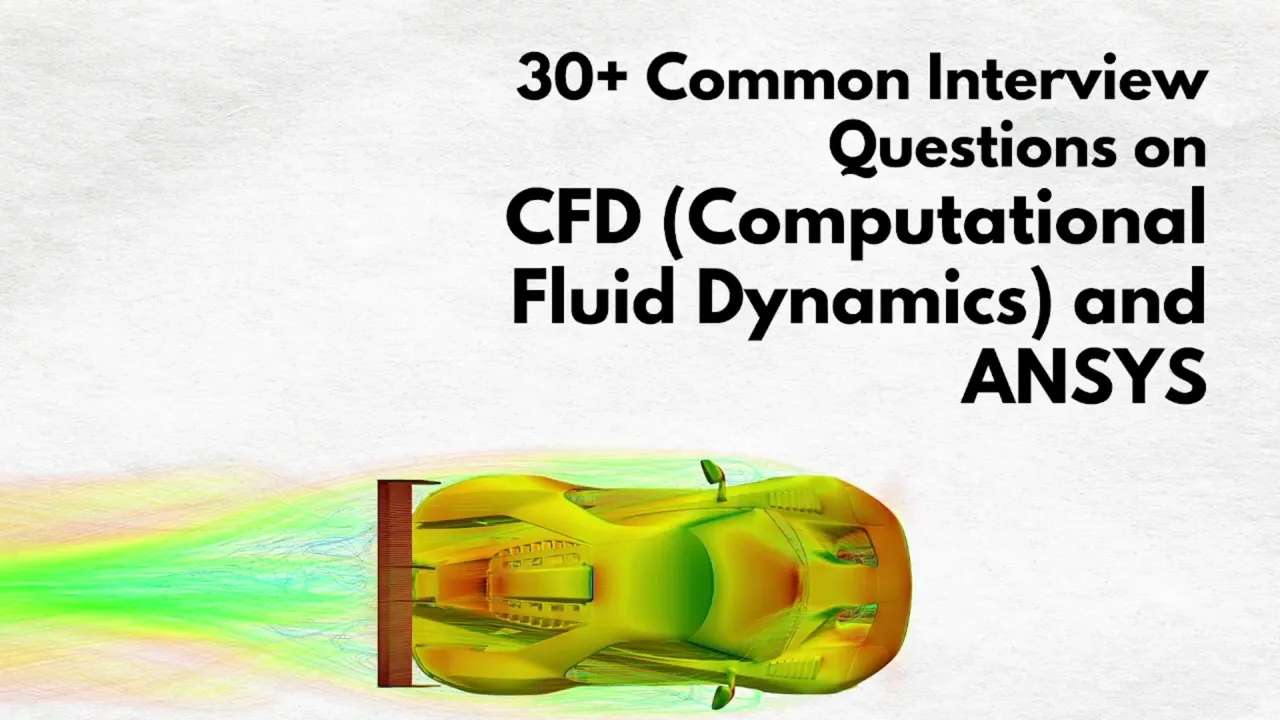
Top 30 CAE Engineer Interview Questions and Answers (FEA & CFD).


Deepak S Choudhary
Learn More in This Video
Subscribe to GaugeHow for More
CAE interviews tend to separate candidates quickly, since interviewers can usually tell within a few questions whether you actually understand what's happening behind the solver, or whether you've just learned which buttons to click in the software.
Basic Simulation Concepts
1. What is CAE, and how does it fit into the product development process?
CAE, or Computer-Aided Engineering, refers to using simulation software to predict how a product will perform under real-world conditions before it's physically built.
It's used throughout product development to validate designs, reduce physical prototyping, and catch failures early. CAE typically works alongside CAD, taking the geometry created in design software and analyzing its behavior under load, flow, or other conditions.
2. What is the difference between FEA and CFD?
FEA, or Finite Element Analysis, is used to study structural behavior like stress, deflection, and vibration in solid parts. CFD, or Computational Fluid Dynamics, is used to study the behavior of fluids and gases, like airflow or coolant flow, around or through a system.
Both use similar underlying mathematical approaches but are applied to very different physical problems.
3. What is meshing, and why is it a critical step in simulation?
Meshing divides a continuous geometry into a finite number of small elements or cells, which the solver uses to approximate the physical behavior across the part.
The quality and density of the mesh directly affects both accuracy and solve time. A poor mesh is one of the most common reasons simulation results don't match real-world behavior.
4. What is the difference between a structured and unstructured mesh?
A structured mesh uses a regular, grid-like pattern of elements, typically offering better accuracy and faster solving for simple geometries. An unstructured mesh uses irregularly arranged elements, like tetrahedra, which can conform to complex geometry much more easily.
Most real-world CAD geometry is complex enough that unstructured meshing is the practical default.
5. What are boundary conditions, and why are they important in simulation?
Boundary conditions define how a model interacts with its surroundings, such as applied loads, fixed supports, or fluid inlet velocities. Getting boundary conditions wrong is one of the most common causes of inaccurate simulation results, even when the mesh and solver settings are correct.
They essentially translate the real-world scenario into something the solver can actually compute.
6. What is the difference between linear and nonlinear analysis in FEA?
Linear analysis assumes a proportional relationship between load and response, which is computationally fast but only valid for small deformations and simple material behavior.
Nonlinear analysis accounts for large deformations, material plasticity, or contact, and is required when those effects matter to the real-world result. Nonlinear problems take significantly longer to solve and require more careful setup.
7. What is convergence in the context of a simulation?
Convergence refers to a simulation reaching a stable, consistent solution where further iterations or mesh refinement no longer significantly change the result.
A simulation that hasn't converged shouldn't be trusted, even if it technically produced an output. Checking convergence is a standard, non-negotiable step before accepting any simulation result.
8. What is the difference between explicit and implicit solvers?
Implicit solvers calculate a solution by solving the full system of equations simultaneously at each step, offering stability for slower or static problems.
Explicit solvers march forward in very small time steps without solving the full system at once, making them better suited for fast, dynamic events like impact or crash simulations. The choice between them depends heavily on the type of physical event being studied.
FEA Concepts and Structural Analysis
9. What is stress concentration, and where does it typically occur?
Stress concentration is a localized increase in stress around geometric features like sharp corners, holes, or sudden cross-section changes. It occurs because load lines have to redirect around the feature, bunching up stress in a small area.
Identifying and addressing stress concentrations, often with fillets, is a routine part of structural design review.
10. What is the difference between von Mises stress and principal stress?
Von Mises stress is a single combined value used to predict yielding in ductile materials, summarizing the overall stress state into one comparable number.
Principal stresses are the actual maximum and minimum normal stresses acting on a particular orientation, with no shear component. Von Mises is more commonly used for quick pass/fail checks, while principal stresses give more detailed directional insight.
11. What is a factor of safety, and how is it determined?
A factor of safety is the ratio between a material's actual strength and the maximum stress expected in service, providing a margin against uncertainty in loads, materials, and manufacturing.
It's typically set based on industry standards, application criticality, and consequences of failure. A higher factor of safety adds confidence but can also mean unnecessary material and cost.
12. What is modal analysis, and why is it performed?
Modal analysis identifies a structure's natural frequencies and mode shapes, showing how it tends to vibrate without external excitation. It's critical for avoiding resonance, where an external excitation frequency matches a natural frequency and causes dangerous amplification.
Engineers commonly run modal analysis early in design to steer clear of problematic frequency ranges.
13. What is the difference between static and dynamic structural analysis?
Static analysis assumes loads are applied slowly and remain constant, ignoring inertia and time-dependent effects. Dynamic analysis accounts for how loads change over time and includes inertial effects, which matters for impacts, vibrations, or rapidly applied forces.
Choosing the wrong type for a given problem is a common source of misleading results.
14. What is contact modeling in FEA, and why is it considered complex?
Contact modeling simulates how two or more separate parts interact when they touch, push against, or slide relative to each other. It's considered complex because contact behavior is inherently nonlinear, and the solver has to determine where and when surfaces are actually touching during the simulation.
Poorly defined contact settings are a frequent cause of convergence failures.
15. What software is commonly used for structural FEA work?
Common tools include ANSYS and ABAQUS, both widely used across industries for structural, thermal, and multiphysics simulation work.
Building hands-on experience through a course like FEA with ANSYS or ABAQUS CAE gives a strong practical foundation for entry-level CAE roles. Most companies expect at least working familiarity with one major solver platform.
16. What is mesh sensitivity analysis, and why is it important?
Mesh sensitivity analysis involves running the same simulation at progressively finer mesh densities to check whether results stabilize rather than continuing to change.
If results keep shifting significantly as the mesh gets finer, the original mesh was too coarse to trust. It's one of the most important validation steps a CAE engineer performs before reporting results.
CFD Concepts and Fluid Flow Analysis
17. What is the difference between laminar and turbulent flow?
Laminar flow moves in smooth, predictable layers with minimal mixing between them. Turbulent flow is chaotic and irregular, with significant mixing and eddies forming throughout the fluid.
The Reynolds number is typically used to predict which flow regime a given scenario falls into, and that choice significantly affects which solver settings are appropriate.
18. What is a turbulence model, and why is one needed in CFD?
A turbulence model is a mathematical approximation used to represent the effects of turbulent flow without needing to fully resolve every tiny eddy directly, which would be computationally impractical for most real-world problems.
Common models include k-epsilon and k-omega, each with different strengths depending on the flow scenario. Choosing the right turbulence model is one of the more nuanced decisions a CFD engineer has to make.
19. What is the difference between steady-state and transient CFD analysis?
Steady-state analysis assumes flow conditions don't change over time, which is faster to solve and appropriate when the system has settled into a constant pattern.
Transient analysis captures how flow changes over time, which is necessary for scenarios like startup conditions, pulsating flow, or moving components. Transient simulations are significantly more computationally expensive than steady-state ones.
20. What is mesh y+ value, and why does it matter in CFD?
Y+ is a non-dimensional value describing how fine the mesh is near a wall surface relative to the boundary layer, which is critical for accurately capturing near-wall flow behavior and turbulence effects.
Different turbulence models require different target y+ ranges to function correctly. Getting y+ wrong is a common, often subtle cause of inaccurate CFD results near walls.
21. What is the purpose of a CFD boundary layer mesh?
A boundary layer mesh uses thin, stacked layers of elements near a wall to accurately capture the steep velocity and pressure gradients that occur close to a surface.
Without it, near-wall flow behavior, including drag and heat transfer, would be poorly resolved. It's standard practice in nearly every external or internal flow CFD simulation.
22. What software is commonly used for CFD analysis?
Common tools include ANSYS Fluent, Autodesk CFD, and OpenFOAM, each used across industries for flow, thermal, and multiphysics analysis. Hands-on practice with a course like ANSYS Fluent or OpenFOAM builds practical experience that translates well across different CFD platforms. Familiarity with at least one solver is typically expected even for entry-level CFD roles.
23. What is conjugate heat transfer, and when is it used in CFD?
Conjugate heat transfer simulates heat transfer simultaneously between a solid and a surrounding or contacting fluid, rather than treating either domain in isolation.
It's used whenever heat exchange between solid components and fluid flow, like electronics cooling or heat exchangers, is critical to the result. Solving the solid and fluid domains together gives a far more realistic picture than approximating one side separately.
Tools, Validation, and Practical Scenarios
24. How do you validate a simulation result before trusting it?
Validation typically involves comparing results against physical test data, hand calculations, or published reference values where available. A mesh sensitivity check and confirmation of solver convergence are also essential before accepting a result.
Skipping validation is one of the riskiest habits a CAE engineer can develop, since a confident-looking result can still be wrong.
25. What role does MATLAB play in CAE and simulation work?
MATLAB is commonly used for pre- and post-processing simulation data, automating repetitive analysis tasks, and performing custom calculations that solver software doesn't handle natively.
Many CAE engineers also use it for scripting parametric studies across multiple simulation runs. Comfort with a tool like MATLAB is a valuable complement to solver-specific skills.
26. What is multiphysics simulation, and when is it needed?
Multiphysics simulation couples two or more physical phenomena, like structural and thermal, or fluid and electromagnetic, into a single analysis rather than treating them independently.
It's needed whenever the interaction between physics genuinely changes the outcome, such as thermal expansion affecting structural stress. Tools like COMSOL Multiphysics are built specifically around this kind of coupled analysis.
27. A structural simulation shows unrealistically high stress at a single mesh node. What's the likely cause?
This is a classic sign of a stress singularity, often occurring at a sharp re-entrant corner or a point load where the mathematical model predicts theoretically infinite stress.
It's typically a meshing or geometry idealization artifact rather than a real physical concern. Checking stress at a slightly refined mesh or using a fillet in the geometry usually clarifies whether it's a genuine concern.
28. A CFD simulation isn't converging no matter how many iterations you run. What would you check?
Start by reviewing the boundary conditions for inconsistencies, like conflicting inlet and outlet definitions. Then check the mesh quality near critical regions, since poor mesh quality is a common convergence killer.
Reducing the solver's under-relaxation factors or switching to a more robust turbulence model are also common troubleshooting steps.
29. A client wants faster turnaround on a complex simulation, but mesh refinement is needed for accuracy. How would you balance this?
Consider using a graded mesh that's finer only in critical regions of interest and coarser elsewhere, rather than refining the entire model uniformly.
Simplifying non-critical geometry features that don't meaningfully affect the result of interest can also save significant solve time. Communicating the accuracy tradeoff clearly to the client is just as important as the technical solution itself.
30. What's the most common mistake students or new CAE engineers make?
The most common mistake is trusting a simulation result simply because it ran successfully, without performing mesh sensitivity checks or sanity-checking the result against expectations.
A close second is applying boundary conditions that don't actually represent the real physical scenario being studied. Both come from treating the software as a black box rather than understanding the physics behind it.
Frequently Asked Questions
Q: Is CAE a good career path for mechanical engineering students?
A: Yes — CAE is a specialized, consistently in-demand skill across automotive, aerospace, and industrial design, and engineers who combine strong simulation skills with physical intuition are highly valued.
Q: Do I need to know both FEA and CFD for a CAE interview?
A: Not always. Many roles focus specifically on one or the other, but understanding the basic concepts of both is useful, especially for multiphysics-related questions that come up increasingly often.
Q: What software should I focus on before a CAE interview?
A: ANSYS is one of the most widely used platforms across both FEA and CFD, making it a strong starting point, though familiarity with ABAQUS, OpenFOAM, or COMSOL is valuable depending on the industry.
Q: How important is meshing knowledge compared to solver settings?
A: Meshing is arguably more important, since even perfect solver settings can't fix a poor-quality mesh, and interviewers frequently probe meshing fundamentals to gauge real understanding.
Q: How should I structure my answers as a fresher candidate?
A: Keep answers short, specific, and grounded in practical reasoning rather than memorized definitions. Interviewers respond better to clear, applied thinking than to long, recited answers.
Conclusion
CAE engineer interviews consistently come back to a few core ideas: understanding the physics behind the solver, knowing how to set up a model with realistic boundary conditions, and validating results through mesh sensitivity and convergence checks rather than blind trust.
If you can explain those fundamentals clearly and reason through a troubleshooting scenario, you'll be well prepared for almost any question an interviewer asks, whether the focus is FEA, CFD, or both.
To turn this preparation into job-ready skills, explore GaugeHow's FEA with ANSYS course and OpenFOAM CFD course, or browse all engineering courses. You can even start free today. Good luck — you've got this.