AWS IoT SiteWise
What is aws iot sitewise

What Is AWS IoT SiteWise? A Student's Guide to Industrial IoT on AWS
You have learned how to program PLCs with tools like TIA Portal, Studio 5000, or CODESYS.
Now imagine sending that machine data — temperatures, cycle counts, fault codes — up to the cloud, building a live dashboard anyone can see from a browser, and setting alerts that fire when something goes wrong. That is what AWS IoT SiteWise does.
What makes it different from other IIoT platforms is how you pay for it: no enterprise quote, no sales call. You create an AWS account, use the free tier for twelve months, and start building.
For a student, that is a real advantage you can learn industrial IoT on the same platform that runs some of the biggest factories in the world, at zero cost. This guide breaks down how it works, what it costs, and how it compares to Azure IoT.
How does AWS IoT SiteWise work?
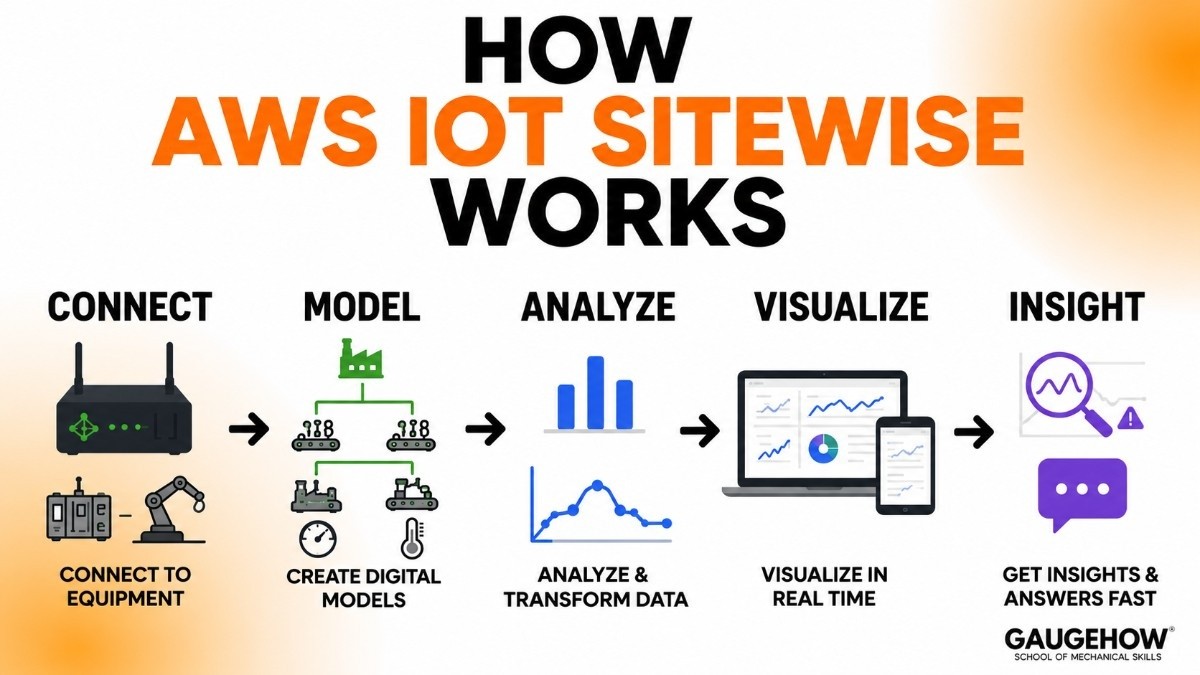
AWS IoT SiteWise is a managed service from Amazon Web Services that collects, organizes, and analyzes data from industrial equipment at scale.
It is part of the broader AWS IoT ecosystem, which includes several services that each handle a different piece of the puzzle. SiteWise focuses specifically on the industrial side — connecting to PLCs and sensors, modeling your equipment digitally, and providing dashboards and analytics.
Here is how the pieces fit together:
SiteWise Edge: Software that runs on a local gateway at the factory. It connects to your equipment using protocols like OPC-UA and MQTT — the same ones your PLCs speak — and sends the data to the cloud.
Asset models: You create digital representations of your physical equipment. A "pump" asset might have properties like temperature, pressure, and flow rate. You organize these into hierarchies — a factory contains lines, lines contain machines, machines contain sensors.
Metrics and transforms: SiteWise automatically computes aggregates (averages, sums, counts) over time, and you can define custom calculations like OEE (Overall Equipment Effectiveness).
SiteWise Monitor: A built-in web dashboard tool that lets you create portals for engineers and operators to view live data, without writing front-end code.
Anomaly detection: Machine learning models that flag when equipment behavior deviates from normal patterns.
SiteWise Assistant: A newer feature (introduced in 2025) that lets you query your operational data in plain English — for example, "Why is Pump A vibrating?" — and get an answer drawn from your live data.
For a student, the mental model is straightforward: sensors and PLCs produce data → SiteWise Edge collects it locally → the cloud stores and organizes it → dashboards and analytics make it useful.
What is AWS IoT TwinMaker?
TwinMaker is the companion service to SiteWise, and it is worth knowing because they often work together.
AWS IoT TwinMaker creates digital twins — 3D virtual representations of real-world systems like factories, buildings, or production lines.
It pulls data from IoT sensors (often via SiteWise), cameras, and enterprise applications and overlays it onto a visual scene, so you can "walk through" a virtual factory and see live data on each machine.
The difference between the two is simple: SiteWise organizes and monitors your equipment data. TwinMaker visualizes it in 3D. SiteWise gives you dashboards and metrics; TwinMaker gives you an interactive, spatial view of an entire facility.
For a student project, a practical combination would be: use SiteWise to collect and model data from simulated equipment, then use TwinMaker to build a 3D view of the setup. It teaches both data engineering and spatial visualization.
AWS IoT SiteWise pricing
This is where SiteWise stands apart from most IIoT platforms, and it matters for students.
Pay-as-you-go
SiteWise uses consumption-based pricing — you pay only for what you use, with no upfront commitment. The main cost components are:
Messages ingested (data flowing from your devices into SiteWise)
Asset model and metrics (the models you create and the computations they run)
Data queries (retrieving stored data for dashboards or analysis)
Rates vary by region, but the amounts are small at learning scale. Running a few simulated assets for practice costs pennies.
AWS Free Tier
This is the student-friendly part. AWS offers a 12-month free tier for IoT SiteWise that includes a set number of messages, asset metrics, and queries per month at no cost.
That is more than enough to learn the platform, build projects, and populate a portfolio.
Compared to ThingWorx (enterprise subscription) or Insights Hub (tiered capability packages), SiteWise's pricing model is the most accessible for an individual learner.
You sign up, you use it, you pay only if you exceed the free tier — and at learning scale, you probably will not.
Pros and cons of AWS IoT SiteWise
A balanced view.
Pros
Pay-as-you-go pricing with a 12-month free tier — genuinely accessible for students.
Fully managed — AWS handles the infrastructure, so you focus on the application.
OPC-UA and MQTT support through SiteWise Edge connects to real industrial equipment.
Asset modeling brings structure to messy industrial data.
Part of the massive AWS ecosystem, so it integrates with hundreds of other services.
SiteWise Assistant (natural language queries) is a forward-looking, AI-powered feature.
Cons
More developer-oriented — you need comfort with AWS concepts (IAM, regions, services) to get started.
No drag-and-drop app builder like ThingWorx's Mashup Builder; dashboards are functional but basic.
The AWS IoT ecosystem is modular, which means flexibility but also complexity — knowing which service to use for what takes time.
Less industrial domain knowledge built in compared to purpose-built platforms like ThingWorx or Insights Hub.
Documentation is thorough but AWS-style — dense and aimed at developers, not beginners.
Who is AWS IoT SiteWise best for?
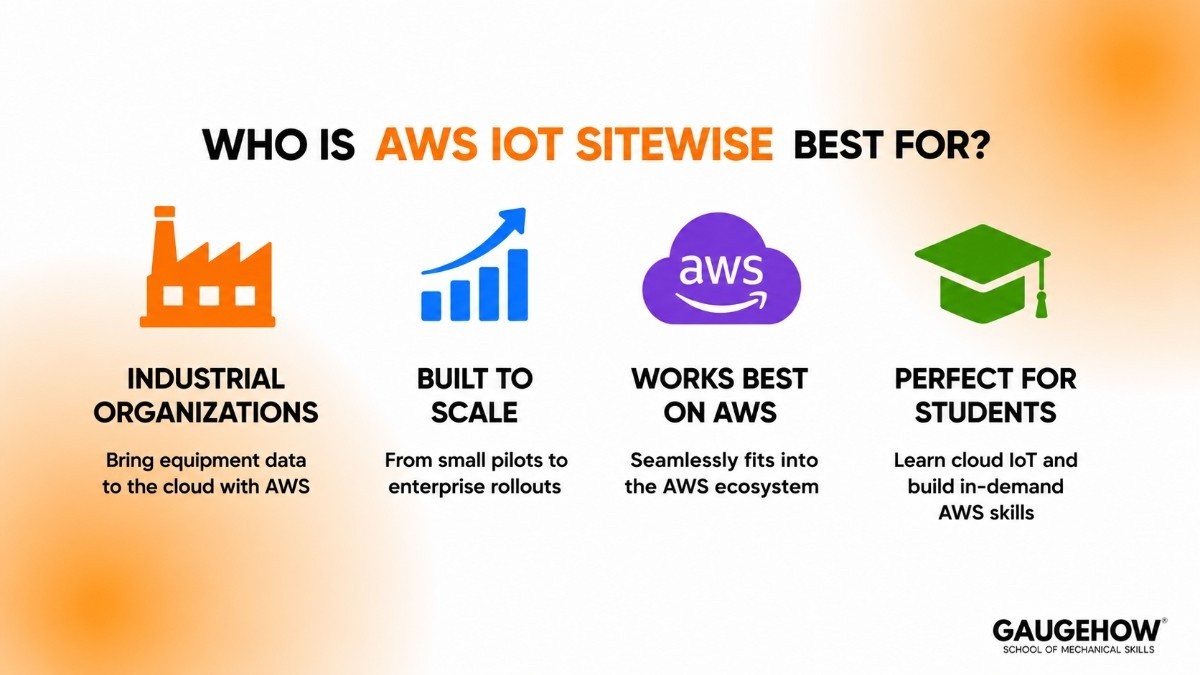
SiteWise fits manufacturers, OEMs, and industrial organizations that want to bring equipment data to the cloud using AWS infrastructure.
It scales from a small pilot (a few sensors) to an enterprise rollout across multiple plants, and it works well when the broader technology stack already runs on AWS.
For students, it is an excellent way to learn cloud-based industrial IoT while building real AWS skills.
Cloud and IoT together are among the fastest-growing areas in the engineering job market, and having AWS IoT experience on a resume carries weight — especially in India and other markets where AWS adoption is strong.
Integrations: what SiteWise connects to
SiteWise is designed to be the industrial data layer within the AWS cloud:
Industrial equipment: Through SiteWise Edge, connecting to PLCs, historians, and data servers via OPC-UA and MQTT.
AWS IoT Core: For broader device messaging and rule-based routing.
AWS IoT Greengrass: For running compute and ML models at the edge.
AWS IoT TwinMaker: For 3D digital twin visualization.
Storage and analytics: Amazon S3, Amazon Timestream (time-series database), Amazon QuickSight (BI dashboards), and Amazon SageMaker (machine learning).
Serverless logic: AWS Lambda for event-driven processing.
The strength is the AWS ecosystem itself — once your data is in SiteWise, you can route it to almost any AWS service for storage, analysis, visualization, or machine learning.
Deployment: cloud, edge, and hybrid
SiteWise is cloud-native on AWS, but it includes an edge component:
Cloud: The primary model — asset models, metrics, dashboards, and storage live in the AWS cloud.
Edge: SiteWise Edge runs on local hardware at the factory, collecting and processing data before sending it to the cloud. This handles latency-sensitive operations and environments with limited connectivity.
Hybrid: A common pattern where edge devices handle real-time local tasks while the cloud stores historical data and runs analytics.
For brownfield work (existing equipment), SiteWise Edge connects to legacy PLCs and industrial systems already on the floor via OPC-UA you do not need to replace anything to start collecting data, which is the same "connect what exists" approach as ThingWorx's Kepware.
AWS IoT vs Azure IoT and other alternatives
This is the comparison students ask about most, and it is worth understanding because choosing a cloud for industrial IoT is a real career decision.
AWS IoT vs Azure IoT
Both are major cloud IoT platforms, but they take different approaches:
AWS IoT is modular: you pick individual services (IoT Core, SiteWise, Greengrass, TwinMaker) and assemble them. More flexibility, more decisions.
Azure IoT offers IoT Central, a more opinionated, out-of-the-box experience that gets you running faster with less configuration. Azure also has IoT Hub (the messaging layer) and Digital Twins (similar to TwinMaker).
The honest difference: AWS gives you more control and more services to combine. Azure gives you a faster, more guided start. If your target industry or employer runs on AWS, learn SiteWise.
If they run on Azure (or use Siemens, which historically built Insights Hub on Azure), learn Azure IoT. Both are strong choices.
Other tools worth knowing
PTC ThingWorx — a purpose-built IIoT platform with strong Kepware connectivity, now part of Velotic.
Siemens Insights Hub — Siemens' cloud IIoT platform (formerly MindSphere), tightest with Siemens hardware.
Schneider EcoStruxure — Schneider's IoT architecture spanning machines, buildings, and power.
Ignition by Inductive Automation — a flexible SCADA and IoT platform with a strong community and free trial.
Frequently asked questions
Is AWS IoT SiteWise free?
There is a 12-month free tier that includes a set number of messages, metrics, and queries per month. Beyond that, you pay only for what you use.
Do I need AWS experience to learn SiteWise?
Basic AWS familiarity helps — understanding accounts, regions, and IAM permissions. If you are new to AWS, start with a free-tier account and a beginner AWS tutorial before diving into SiteWise specifically.
What is the difference between AWS IoT Core and SiteWise?
IoT Core handles device connectivity and messaging (getting data from devices to the cloud). SiteWise handles data organization, asset modeling, and visualization (making that data useful once it arrives).
Can SiteWise connect to Siemens or Allen-Bradley PLCs?
Yes. SiteWise Edge connects to PLCs via OPC-UA, which is supported by Siemens, Allen-Bradley, and most other major PLC brands.
What is SiteWise Assistant?
A 2025 feature that lets you query your operational data in plain English. Instead of writing queries, you ask questions like "Why is Pump A vibrating?" and the assistant returns answers from your live data.
AWS IoT SiteWise vs ThingWorx — which should a student learn?
SiteWise if you want cloud-native AWS skills and pay-as-you-go accessibility. ThingWorx if you want a purpose-built industrial platform with rapid app development tools and stronger out-of-the-box manufacturing features.
Final thoughts
So what is AWS IoT SiteWise? It is AWS's managed service for bringing industrial equipment data to the cloud — collecting it from your PLCs and sensors, organizing it into asset models, and turning it into dashboards and analytics that drive better decisions. For a student, the combination of a 12-month free tier, pay-as-you-go pricing, and the weight of AWS on a resume makes it one of the most accessible ways to learn industrial IoT.
Create a free AWS account, set up a simulated asset, build a monitoring dashboard, and you will have a working cloud IoT project to show — built on the same infrastructure that runs real factories worldwide.
AWS IoT SiteWise is a cloud service that collects, organizes, and analyzes industrial equipment data to improve monitoring and operational efficiency.