Infor CloudSuite
Infor CloudSuite 2026

Infor CloudSuite 2026: The Complete Guide to Industry-Specific Cloud ERP
Overview: What Is Infor CloudSuite?
Infor CloudSuite is a family of industry-specific cloud ERP systems built on Amazon Web Services, designed for manufacturers, distributors, healthcare providers, and fashion companies.
Most enterprise software tries to be everything to everyone. Infor took the opposite bet:
Instead of one generic ERP configured per industry, Infor built separate, pre-packaged editions — each with its own data models, workflows, and compliance logic already built in
A food manufacturer and an aerospace contractor are not using the same software with different labels — they are running fundamentally different products, both sitting under the CloudSuite umbrella
The result: you are not starting from a blank canvas — you are starting at roughly 70–80% of done before a consultant sets foot in the door
About the company:
Founded in 2002, Infor is now owned by Koch Industries, one of the largest private companies in the world
Koch's financial backing funds heavy investment in AWS infrastructure, AI capabilities, and Infor OS — the unified technology layer connecting every CloudSuite edition
As of 2026, more than 65,000 organizations across 175 countries run some version of Infor software
What Is Infor CloudSuite ERP, Really?
If you are a student, a buyer doing early research, or someone new to enterprise software — here is the clearest way to understand what ERP actually does:
The core idea:
An ERP connects the separate parts of a business — finance, purchasing, production, inventory, HR — into one shared database
Without it: the warehouse runs one spreadsheet, finance runs another, production uses a whiteboard
With it: everyone pulls from the same live data, in real time, all the time
What makes Infor's version different:
When a hospital buys CloudSuite Healthcare, the system already understands charge capture, patient supply demand, and healthcare compliance — no custom build required
When a chemical company buys the chemicals edition, it already knows what a batch record, a formula, and a safety data sheet are
When a fashion retailer buys CloudSuite Fashion, it already handles seasons, colorways, and size curves out of the box
That head start is the entire value proposition — and it is what separates Infor from SAP, Oracle, and Microsoft, all of which start more generically.
Key Features
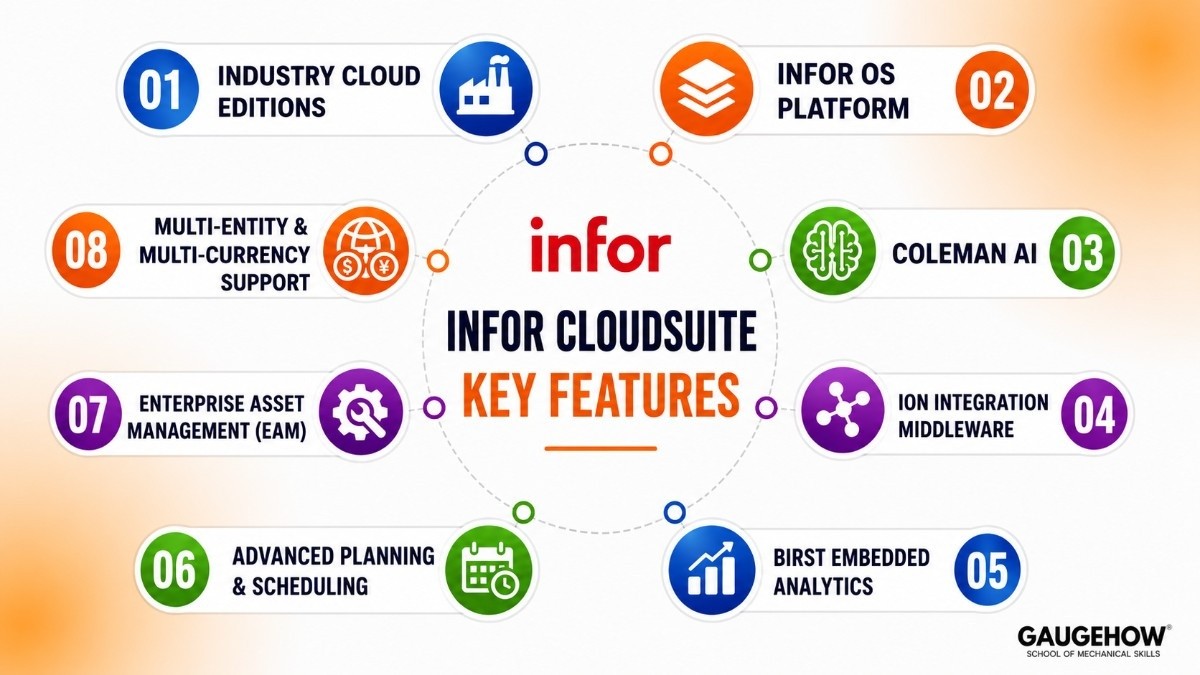
1. Industry Cloud Editions — 15+ Vertical Products
Each edition is purpose-built, not re-skinned — different engines under the hood, not just different color schemes
CloudSuite Industrial runs on the SyteLine codebase
CloudSuite Food & Beverage is built on M3
CloudSuite Aerospace & Defense runs on Infor LN
CloudSuite Healthcare is built on the Lawson platform
Each ships with pre-configured data models, industry workflows, compliance rules, and reports specific to that vertical
2. Infor OS — The Unified Platform Layer
Every CloudSuite edition runs on top of Infor OS — a shared technology stack available to all editions
Provides analytics, AI, integration, and document management as built-in services, not add-on purchases
Means an industrial manufacturer and a healthcare network can use the same reporting dashboard and the same AI tools, even though the ERP underneath is different
Acts as the connective tissue that makes the multi-edition architecture feel coherent
3. Coleman AI
Infor's AI layer embedded directly in the platform — not a bolt-on, not a third-party tool
In 2026, key capabilities include:
Conversational queries in natural language ("What is our on-time delivery rate this quarter?")
Predictive demand forecasting — anticipates inventory needs before stockouts occur
Anomaly detection in financial and operational data
AI-assisted scheduling for production planning
Critical distinction: Coleman queries your live ERP data — it does not pull from the internet or give generic answers
4. ION Integration Middleware
ION handles connections between CloudSuite and all external systems — EDI partners, CRM platforms, warehouse automation, analytics tools
Works through event-driven messaging: when something changes in one system (say, an order ships), ION automatically notifies all connected systems — no manual intervention
Eliminates the need for custom point-to-point integrations between every tool in your stack
Student-friendly analogy: Think of ION as the translator that lets all your software tools speak the same language
5. Birst Embedded Analytics
Birst is Infor's business intelligence tool, included with CloudSuite — not sold separately
Pre-built dashboards cover:
Financial performance and variance analysis
Supply chain metrics and supplier scorecards
Production output and shop floor efficiency
Workforce analytics and headcount trends
Users build custom reports without writing SQL — genuinely useful for operations teams who are not data analysts
6. Advanced Planning and Scheduling (APS)
The planning engine handles finite capacity scheduling — it understands that a production line cannot run three jobs simultaneously, and plans accordingly
Far more useful than basic MRP, which ignores capacity constraints entirely and produces plans that work on paper but fail on the shop floor
Handles dynamic rescheduling — when a job is delayed or a machine goes down, the system recalculates the entire schedule automatically
Supports make-to-order, make-to-stock, engineer-to-order, and mixed-mode production environments
7. Enterprise Asset Management (EAM)
Manages the full lifecycle of physical assets — production equipment, facility infrastructure, vehicles, tooling
Predictive maintenance capabilities use sensor data to flag equipment likely to fail before it actually does
Reduces unplanned downtime, which in manufacturing environments is one of the most expensive problems a business can have
Connects directly to production scheduling so maintenance windows are planned without disrupting output
8. Multi-Entity and Multi-Currency Support
For organizations operating across multiple countries:
Intercompany transactions handled automatically
Multi-currency accounting with real-time exchange rate management
Local statutory reporting for each jurisdiction
Multiple charts of accounts from one system
Configured through standard setup — not custom code — which matters for long-term maintainability as tax laws and reporting requirements change
Pricing
Infor does not publish pricing publicly — standard practice among enterprise ERP vendors. The ranges below are based on third-party research, partner market data, and publicly available customer information from 2025–2026.
Licensing Model
CloudSuite is sold exclusively as a cloud subscription (SaaS) — no perpetual license options exist for current editions
Annual subscription cost is driven by:
Number of named users (not concurrent — every person with a login counts)
Which modules your edition includes
Which CloudSuite edition you are buying (Industrial, Healthcare, Fashion, etc.)
Negotiation leverage — enterprise deals are always negotiated, not listed
Estimated Annual Subscription Ranges
Tier | Profile | Estimated Annual Cost |
|---|---|---|
Mid-Market Entry | 50–150 users, single edition, core modules | $150,000–$400,000/year |
Mid-Market Full Suite | 150–500 users, full module set | $400,000–$900,000/year |
Enterprise | 500+ users, multi-site, global | $1,000,000+/year |
Important: Implementation costs are separate and typically run 1x–2.5x the first-year subscription. A realistic mid-market CloudSuite Industrial deployment costs $300,000–$800,000 all-in for year one, covering software, implementation, training, and data migration.
Is There a Free Trial?
No self-serve trial exists
Infor offers guided demos through its website and certified partners
Some partners provide sandbox access during an active scoping engagement
You need to be in a real evaluation conversation to access a sandbox — which is intentional on Infor's part
Pros and Cons
What It Does Well
Industry depth without years of configuration
Pre-configured editions genuinely save implementation time and consulting cost
A food manufacturer does not spend 18 months explaining recipe management, allergen tracking, and shelf-life logic to a consultant — it is already there
This is Infor's most defensible advantage over SAP and Oracle, both of which require more customization to reach the same vertical depth
AWS-native infrastructure
Runs natively on Amazon Web Services — not a third-party data center or converted on-premise environment
Elastic scalability, strong uptime track records, and access to AWS security and compliance certifications
For regulated industries (healthcare, aerospace, pharmaceuticals), AWS compliance posture matters in vendor evaluation
Infor OS bundles real value
Analytics (Birst), AI (Coleman), and integration middleware (ION) are included in the subscription
Competitors like SAP and Oracle commonly charge separately for equivalent tools
One platform to manage, one vendor to call, one support contract to maintain
Strongest platform in specific verticals
Healthcare supply chain, food and beverage, fashion and apparel, and aerospace and defense are areas where Infor leads or matches any competitor in the world
For buyers in these industries, the depth justifies the complexity
Where It Falls Short
Multiple codebases create inconsistency
CloudSuite Industrial (SyteLine), CloudSuite LN, and CloudSuite M3 came from different acquisitions and have different underlying architectures
Moving between editions or integrating across them is more complex than it looks on a product slide
A company that spans discrete manufacturing and process manufacturing may need two CloudSuite editions — and integration work between them
Smaller partner ecosystem
Infor's partner network is capable but smaller than SAP's or Microsoft's
In some geographies and niche industries, finding an experienced Infor implementation partner requires genuine research
A bad implementation partner is one of the most common reasons ERP projects fail — partner quality matters as much as product quality
Pricing transparency is low
Going three months into an evaluation before discovering the total cost of ownership exceeds your budget is a real and common frustration
Push for all-in cost estimates — software, implementation, training, migration, year-two support — very early in the conversation
UI modernization is still uneven
Some modules feel genuinely modern and intuitive
Others still carry the visual DNA of older acquired software from the 1990s and 2000s
Infor has been improving this consistently, but it is not yet uniform across all editions
Implementation timelines are long
Mid-market deployments: nine to fifteen months
Enterprise or multi-site projects: eighteen to twenty-four months
The most common cause of overruns is data migration from legacy systems and organizational change management — both require far more planning than most companies budget for
Best For
Infor CloudSuite is a strong fit when:
You are a mid-size to large organization (200+ employees) in a specialized, regulated, or operationally complex industry
Your business is in discrete manufacturing, process manufacturing, healthcare, distribution, or fashion — verticals where Infor's functional depth is genuinely hard to match
You want industry-specific logic out of the box rather than spending months configuring a generic platform to understand your operations
Your organization has experienced IT leadership and can run a structured implementation project with a qualified partner
You are already invested in the AWS ecosystem and want an ERP that fits your cloud strategy natively
It is probably not the right fit if:
Your business has fewer than 100 employees — the subscription and implementation costs are calibrated for larger organizations
Your primary need is CRM or HR — Infor has these modules but they are not the strongest reason to choose it
You need to be live in under 12 months — the implementation timeline rarely supports this
You are in a non-industrial vertical with no complex manufacturing or distribution component
Infor CloudSuite Aerospace Defense: What Makes It Different?
Of all the CloudSuite editions, Aerospace & Defense best illustrates why the vertical-specific approach matters — because the compliance requirements here are genuinely unlike any other industry.
What it is built on:
Runs on Infor LN, which originated from Baan — one of the original enterprise manufacturing ERP systems
Baan was specifically designed for complex, project-based manufacturing, which is exactly what defense contracting requires
What it handles that generic ERP cannot:
Project-based manufacturing — every component is tracked to a specific contract, deliverable, and funding line
Government compliance — AS9100 quality management, ITAR (International Traffic in Arms Regulations), DFARS (Defense Federal Acquisition Regulation Supplement)
Complex supply chain traceability — full chain of custody from raw material to delivered assembly
Earned value management (EVM) — the government billing methodology that requires progress to be measured in standardized financial terms
Multi-level program management — managing hundreds of sub-contractors and parts families across a single program
Why it matters for buyers:
An aerospace contractor running a generic ERP typically spends enormous resources on custom development to reach this compliance level
CloudSuite Aerospace & Defense ships with most of it already configured — tested against real defense program requirements, not built fresh for each customer
For students: Understanding how ERP systems handle program management, ITAR compliance, and multi-level BOM traceability is increasingly valuable for careers in aerospace supply chain, defense procurement, and program management.
Infor CloudSuite vs Epicor Kinetic: Which One Is Right for You?
This is one of the most searched manufacturing ERP comparisons in 2026 — and for good reason. Both platforms target similar buyers: mid-market manufacturers who need genuine manufacturing depth.
Dimension
Infor CloudSuite
Epicor Kinetic
Architecture
Multiple vertical codebases (SyteLine, LN, M3)
Single unified platform
Ideal company size
200–5,000+ employees
50–2,000 employees
Industry breadth
15+ editions across many verticals
Primarily discrete manufacturing
Healthcare
Strong (Lawson-based)
Not a focus
Fashion and apparel
Strong (M3-based)
Not offered
Chemical / process mfg
Strong (M3-based)
Limited
Aerospace and defense
Strong (LN-based)
Moderate
Discrete manufacturing
Strong (SyteLine / CSI)
Very strong — core focus
Implementation complexity
Higher — multiple codebases
More standardized
Total cost of ownership
Higher
Lower for mid-market
AI capabilities
Coleman (mature, embedded)
Epicor Prism (growing)
Partner ecosystem
Smaller, more specialized
Growing, manufacturing-focused
The honest recommendation:
Choose Epicor Kinetic if you are a mid-size discrete manufacturer making machines, metal parts, electronics, or custom assemblies — it is likely simpler to implement, less expensive, and equally deep in pure manufacturing functionality
Choose Infor CloudSuite if your business spans multiple industries, includes process manufacturing, healthcare, or fashion, or is large enough that the broader Infor OS ecosystem genuinely adds value across your organization
Neither is universally better — the right answer depends on your specific industry, company size, and how many of Infor's 15+ editions are actually relevant to your operations
CloudSuite Industrial SyteLine: The Manufacturing Workhorse
CloudSuite Industrial is the most widely deployed CloudSuite edition globally — and the one most people encounter first when researching Infor for manufacturing.
Background:
SyteLine's origins go back to the 1980s as one of the earliest dedicated manufacturing ERP systems
Decades of development built deep production planning, shop floor execution, and supply chain logic into the core
Acquired by Infor, it became the foundation of CloudSuite Industrial — with the Infor OS interface, Coleman AI, and Birst analytics layered on top
Who it is built for:
Small to mid-size discrete manufacturers — companies making defined, countable products
Industries it serves well include: industrial machinery, metal fabrications, medical devices, electronics, windows and doors, furniture, plastics, and custom equipment
The sweet spot is make-to-order, engineer-to-order, and mixed-mode environments — where no two jobs are identical
Key capabilities manufacturers use most:
Finite capacity scheduling — plans production around real machine and labor constraints, not theoretical unlimited capacity
Multi-site inventory management — real-time stock visibility across multiple locations and warehouses
Shop floor data collection — labor tracking, job status, and machine utilization captured in real time via barcode, RFID, or touchscreen
Quality management with inspection workflows — embedded, not a separate module to purchase
Customer portal access — lets customers check order status and track shipments without calling your customer service team
Engineer-to-order support — full quoting, BOM generation, and routing for custom manufactured products
Infor CloudSuite Corporate: The Financial Backbone
While the manufacturing editions get most attention, CloudSuite Corporate serves a different, equally important audience.
What it is:
An enterprise-level financial and supply management platform for organizations that do not necessarily need the full manufacturing suite
Built for multi-entity consolidation — rolling up financials from dozens or hundreds of subsidiaries into one consolidated view
Includes human capital management (HCM) for HR, payroll, and workforce administration
Who uses it:
Holding companies managing portfolios of subsidiary businesses
Financial services firms with complex multi-entity reporting requirements
Large diversified enterprises where different divisions run different ERP systems but corporate finance needs one consolidated picture
How it connects to the rest of CloudSuite:
A subsidiary running CloudSuite Industrial can roll up financials into a parent organization running CloudSuite Corporate
This happens through Infor ION — the same integration middleware that connects all CloudSuite editions
No manual consolidation spreadsheets, no month-end data export marathons — the consolidation runs continuously on live data
ERP for Chemical Manufacturers: Why Industry Fit Matters
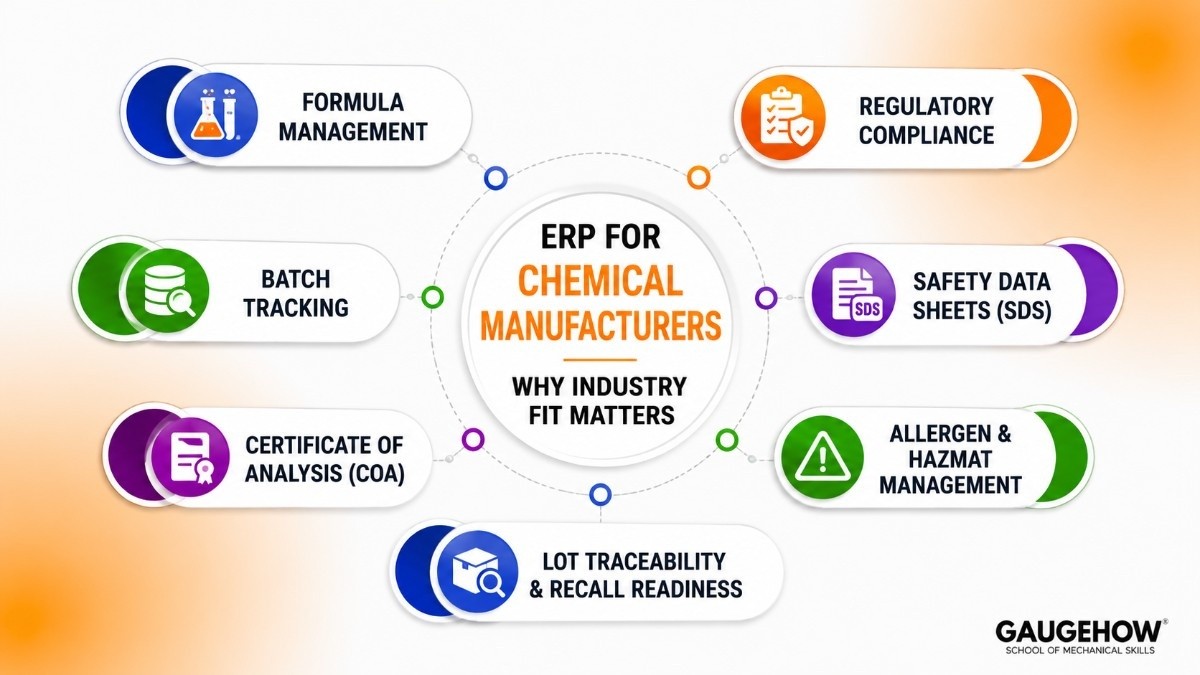
Chemical manufacturing is one of the clearest examples of why generic ERP systems create real operational and compliance problems.
What makes chemicals different from standard manufacturing:
You work with formulas, not bills of materials
You produce batches, not discrete work orders
You submit regulatory filings, not standard shipping documents
You manage safety data sheets (SDS), not product catalogs
Every batch must be traced from raw material lot to shipped container — not just for quality, but for legal liability
Compliance requirements that generic ERP struggles with:
REACH (Registration, Evaluation, Authorisation and Restriction of Chemicals) — EU regulatory framework
GHS/SDS documentation — globally harmonized hazard communication standards
FDA regulations for food-grade and pharmaceutical-grade chemicals
Hazardous materials handling rules for shipping and storage
Lot traceability and recall readiness — ability to identify every product affected by a single bad raw material lot within hours, not days
What Infor's CloudSuite Chemicals (built on M3) ships with:
Formula management — version-controlled recipes with ingredient substitution rules
Batch tracking — full forward and backward traceability for every production run
Certificate of Analysis (CoA) generation — automatic quality documents for customers
Regulatory compliance frameworks — pre-built for REACH, GHS, and industry-specific regulations
Allergen and hazmat management — controls and warnings built into the production workflow
The cost of retrofitting a generic platform to handle chemical-specific compliance consistently exceeds the premium of buying a purpose-built solution. The same principle applies to food and beverage, pharmaceuticals, coatings, and specialty materials.
Integrations
CloudSuite connects to external systems through native connectors, Infor ION middleware, and an open REST API.
One Infor-specific integration asset worth noting:
Infor Nexus is a supply chain collaboration network — a separate product that connects buyers and suppliers on a shared platform
It enables real-time shipment visibility, supply chain financing, and supplier performance tracking
It integrates natively with CloudSuite and is particularly valuable for distribution-heavy industries and global manufacturing operations
Deployment
Cloud (Multi-Tenant SaaS on AWS)
The standard path for all new CloudSuite customers
Infor manages the infrastructure, security patching, and performance
Quarterly updates deliver new features automatically — you do not need an IT project to upgrade
All new Infor feature development is cloud-first, meaning cloud customers get new capabilities before anyone else
Hybrid
Used by organizations migrating from older on-premise Infor products (M3 on-prem, LN on-prem, SyteLine on-prem)
Some data and processes run in the cloud while legacy infrastructure winds down
This is a bridge state during migration, not a permanent architecture Infor recommends long-term
On-Premise
Current CloudSuite editions are cloud-only
Any reference to on-premise Infor refers to older product versions predating the CloudSuite architecture
Infor still supports these legacy products but actively steers customers toward CloudSuite migration
Brownfield Migration Reality
Moving from an older on-premise Infor product to CloudSuite is the most common migration scenario — and the most frequently misunderstood one.
The honest picture:
It is not a simple upgrade — CloudSuite represents a different product architecture, not just a newer version of the same software
Data migration requires mapping old data structures to new ones — messy data in legacy systems causes the most project delays
Process re-mapping is required — your old workflows may not translate directly and often need redesign
User retraining is essential — the interface and interaction model are different enough to require formal training, not just a brief orientation.
Budget guidance:
Plan for 12–24 months from project kickoff to go-live
Expect process redesign, not a lift-and-shift
Allocate budget for change management — user adoption is consistently underinvested in ERP projects and consistently responsible for post-go-live problems.
Alternatives Worth Evaluating
SAP S/4HANA
The biggest name in enterprise ERP with the largest global partner network
Strengths: most mature AI capabilities, deepest customization options, broadest product footprint
Weaknesses: significantly higher cost, longer implementation timelines, heavier consulting requirements
Best for: Very large global enterprises that need the most comprehensive platform available and have the budget and internal resources to match
Oracle ERP Cloud (Fusion)
Strong in financials, HR, and supply chain for large enterprises
Less manufacturing-specific depth than Infor in discrete and process manufacturing
Pricing is similarly opaque and typically comparable to SAP at the high end
Best for: Finance-first organizations and large enterprises already invested in the Oracle ecosystem.
Microsoft Dynamics 365 Supply Chain Management
The Microsoft ecosystem play — integrates tightly with Azure, Teams, Power BI, and Microsoft 365
Growing manufacturing depth, but still lighter on shop floor execution than Infor or Epicor for complex discrete manufacturing
Best for: Organizations already Azure-heavy who prioritize the Microsoft integration story over pure manufacturing depth.
Epicor Kinetic
The most direct competitor for mid-market discrete manufacturers
Simpler to implement, lower total cost of ownership, equally deep in pure discrete manufacturing
See the full comparison section below.
Acumatica Manufacturing Edition
Strong alternative for smaller manufacturers (under 200 employees)
Known for unlimited-user licensing — you pay for compute, not per seat
Modern cloud-native architecture with faster implementation timelines than Infor
Best for: Growing manufacturers who want enterprise-grade cloud ERP without the enterprise price tag.
FAQ
Is Infor CloudSuite cloud-based?
Yes. All current Infor CloudSuite editions are cloud-only and run on AWS. Older on-premise products like SyteLine, LN, and M3 are still supported but are separate from the modern CloudSuite platform.
What is the difference between Infor CloudSuite and SyteLine?
SyteLine is the manufacturing ERP engine behind CloudSuite Industrial. CloudSuite Industrial adds Infor OS, Coleman AI, analytics, and cloud services on top of the SyteLine foundation.
How long does a CloudSuite implementation take?
Most mid-market projects take 9–15 months, while larger multi-site deployments can take 18–24 months. Data migration, user adoption, and changing project requirements are the biggest causes of delays.
Can small businesses use Infor CloudSuite?
They can, but it is generally designed for mid-sized and large organizations. Smaller businesses often find solutions like Epicor Kinetic, Acumatica, or SYSPRO more affordable and easier to implement.
Which industries are the best fit for Infor CloudSuite?
Infor CloudSuite is strongest in manufacturing, aerospace & defense, food & beverage, healthcare, fashion, distribution, and chemicals. These industries benefit from its industry-specific workflows and compliance features.
How does Infor CloudSuite use AI?
Infor uses Coleman AI, which works directly with ERP data. It supports demand forecasting, anomaly detection, natural language queries, and AI-assisted production scheduling to improve decision-making and efficiency.
Everything you need to know about Infor CloudSuite in 2026 — what it is, how it works, pricing, industry editions, and how it compares to Epicor Kinetic.