Instrumental
instrumental ai

Instrumental AI: A Simple Guide to Manufacturing's Smart Inspection Platform
If you're studying engineering, manufacturing, or AI, you've probably wondered how modern factories catch tiny defects that humans miss. One of the companies leading that shift is Instrumental, and its AI is changing how electronics get built.
This guide explains what Instrumental AI is, how it works, what it costs, and how it stacks up against the competition. It's written in plain language, so you don't need a factory background to follow along.
Overview: What Is Instrumental AI?
Instrumental AI is a manufacturing platform that uses cameras and machine learning to spot defects on assembly lines and help engineers fix problems faster.
The company, Instrumental, Inc., was founded in 2015 by two former Apple engineers, Anna-Katrina Shedletsky and Samuel Weiss.
While working on products like the iPod and Apple Watch, they grew frustrated with how much travel and guesswork went into checking product quality in overseas factories.
So they built software that lets engineers monitor production remotely, using data instead of plane tickets. Today their platform is used by brands like Bose, Cisco, Meta, and Honeywell to build better electronics with less waste.
Key Features
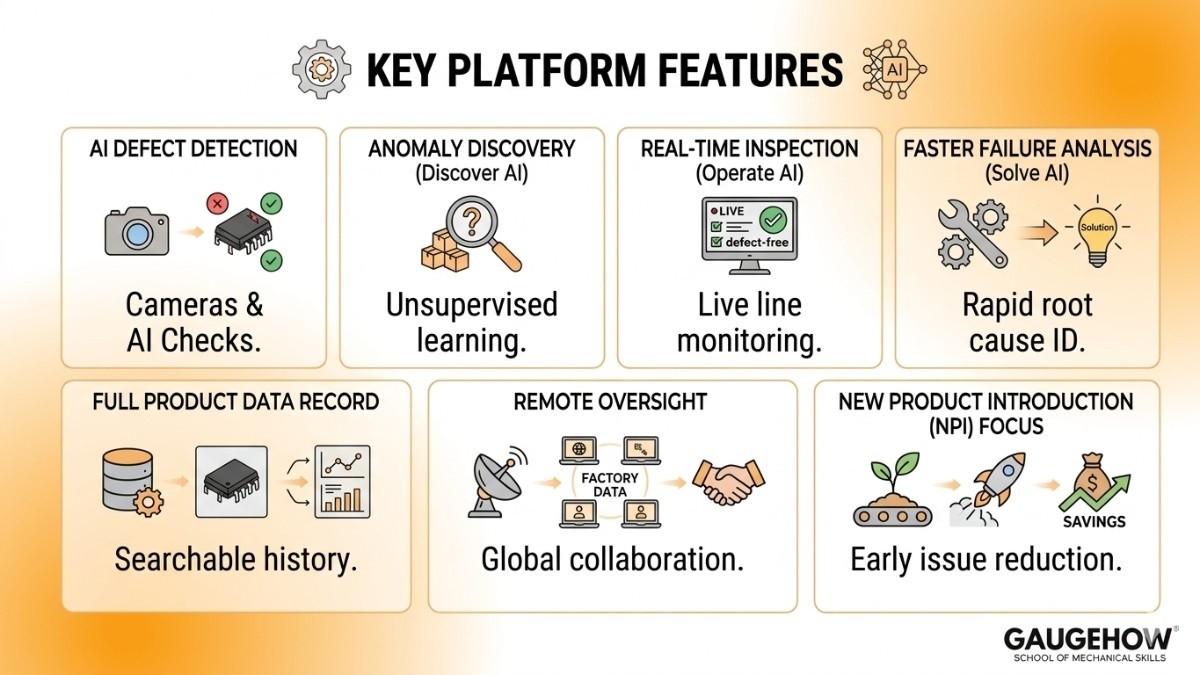
Here's what the platform actually does, in concrete terms:
AI defect detection. Cameras photograph every unit at key assembly steps, and the AI flags problems like bent pins, missing parts, or misalignment.
Anomaly discovery ("Discover AI"). It can find brand-new defects it was never trained on, sometimes using as few as five sample units. This is rare and valuable.
Real-time inspection ("Operate AI"). It runs hundreds of automated visual checks at once on the live production line, catching known defects as they happen.
Faster failure analysis ("Solve AI"). When something goes wrong, it helps engineers find the root cause in minutes instead of days.
A full product data record. Every unit's photos, measurements, and test results are stored together, so engineers can search history and compare builds.
Remote oversight. Teams anywhere in the world can review the same factory data, which matters when production happens overseas.
NPI focus. It's built for New Product Introduction (the tricky early stage of making a new product), where catching issues early saves huge amounts of time and money.
What Is AI Visual Inspection?
AI visual inspection means using artificial intelligence to "look at" products and decide whether they're good or defective, the way a human inspector would, but faster and without getting tired.
Here's the basic idea. Cameras capture images of a product. An AI model, trained on examples of good and bad units, examines each image.
It then flags anything that looks wrong. Because software never fatigues or gets distracted, it can check thousands of units consistently. Studies have long shown human inspectors catch only around 80% of defects, so even two people in a row still miss some. AI inspection aims to close that gap.
AI Visual Inspection: Why Factories Are Switching
Traditional inspection has real limits. It depends on the operator's focus, leaves no clear record of what was seen, and slows down as products get more complex.
Modern electronics, like the dense connectors in AI servers, can have thousands of tiny pins where one bent contact ruins the whole board.
AI visual inspection solves several of these problems at once. It works around the clock, keeps a photo record of every unit, and catches microscopic issues a person would struggle to see.
That's why many electronics manufacturers now treat it as a core part of quality control rather than a nice-to-have.
Best Automated Optical Inspection Software
Automated Optical Inspection (AOI) is the broad category Instrumental belongs to.
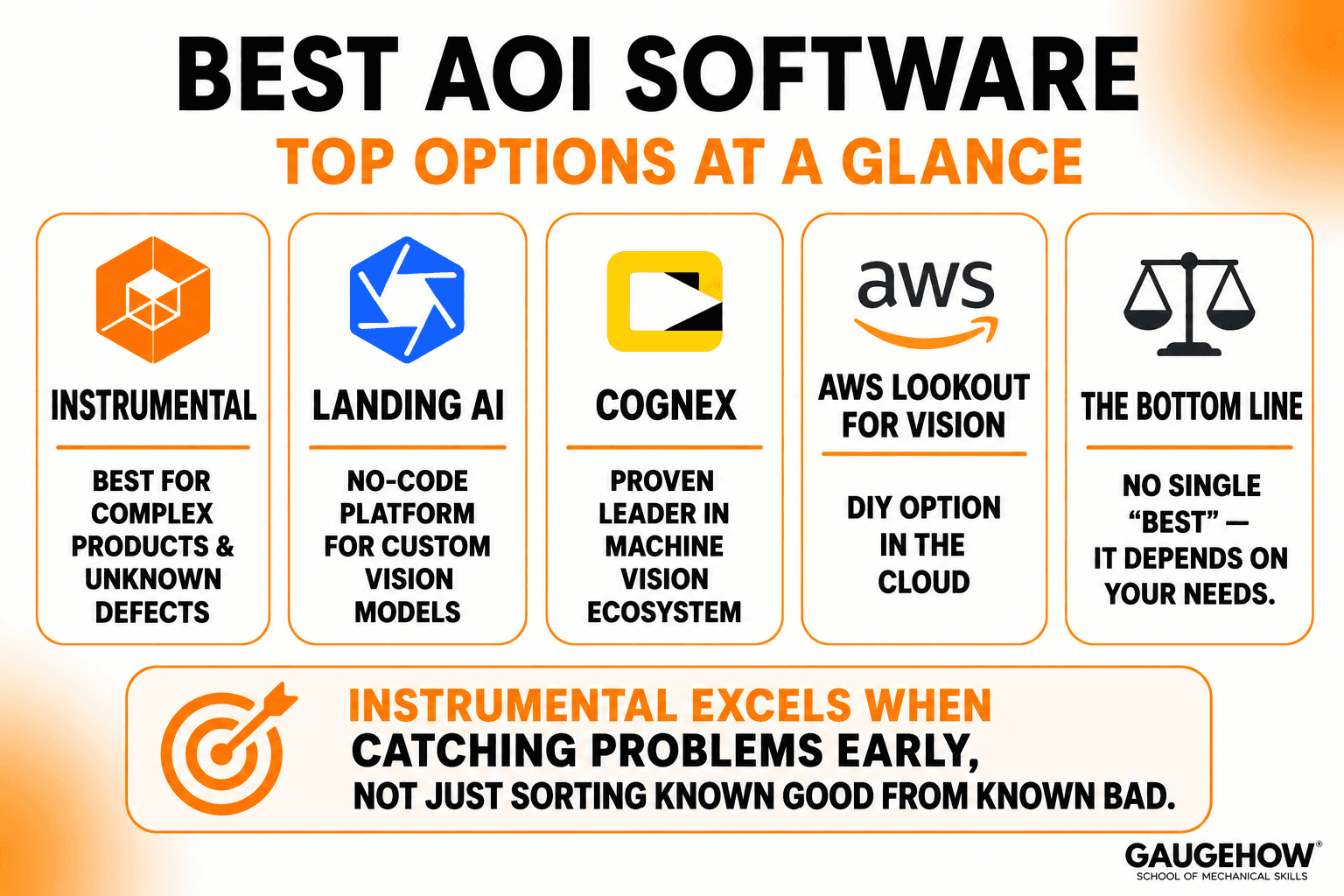
It refers to systems that use cameras and software to inspect products automatically. When people search for the "best" AOI software, they're usually weighing a few options:
Instrumental — strongest for complex electronics, NPI, and finding unknown defects.
Landing AI (LandingLens) — a flexible, no-code platform for building your own vision models.
Cognex — a long-established machine vision leader, great inside its own camera ecosystem.
AWS Lookout for Vision — a do-it-yourself option if your data already lives in Amazon's cloud.
There's no single "best", it depends on your product, team, and budget. Instrumental tends to win when the product is complex and the goal is catching problems early in development, not just sorting known good from known bad.
Instrumental Pricing
Pricing is what most buyers really want to know, so let's be honest about it.
Instrumental uses a SaaS subscription model, and it does not publish public prices. There's no self-serve plan or instant sign-up button. Instead, you book a demo and get a custom quote based on your needs.
Here's the general shape of how it works:
No free tier. Unlike some no-code tools, there isn't a free version you can just try on your own.
Demo-first. You talk to their team, show your use case, and they scope a solution.
Custom enterprise pricing. Cost depends on factors like the number of production lines, sites, and units you're inspecting.
The honest takeaway: this is enterprise software priced for serious manufacturers, not hobbyists or students experimenting at home.
The upside is that Instrumental sets up and maintains your secure cloud instance for you, so you don't need a big IT team.
The downside is that the lack of transparent pricing makes quick comparisons hard, which is a common complaint about platforms in this space.
Pros and Cons
A fair look at both sides.
Pros
Finds unknown defects, not just ones it was trained on, which most competitors can't do.
Built by manufacturing engineers, so it speaks the language of real factory problems.
Strong for the hard early stage of making a new product (NPI).
Stores a complete data record of every unit, useful for tracing problems later.
Fully managed setup, so small teams don't need heavy IT support.
Cons
No public pricing and no free tier, so you can't just try it yourself.
Built for complex, higher-value electronics, likely overkill for simple products.
Enterprise-focused, so it's a poor fit for very small manufacturers or students.
As a subscription, costs are ongoing rather than a one-time purchase.
Listing the downsides isn't criticism. It's what separates an honest guide from a sales pitch.
Best For
Instrumental fits a specific profile. By company size, it suits mid-size to large manufacturers and established brands, the kind already shipping products in real volume.
By industry, the sweet spot is electronics, including consumer devices, medical devices, automotive electronics, and aerospace or defense (it offers an ITAR-compliant environment for sensitive work).
By use case, it's ideal when products are complex, quality really matters, and teams want to catch issues early during development and scale-up, rather than discovering them after products reach customers.
Integrations
Instrumental is designed to fit into a modern factory's existing setup. It works with off-the-shelf cameras placed along the assembly line, so you don't always need specialized hardware.
On the software side, it runs on AWS and is an Amazon industrial software partner, which provides the cloud backbone.
It also connects into the broader manufacturing ecosystem, for example, it has partnered with Siemens to complement Teamcenter Quality with AI, and joined NVIDIA's Metropolis program for automated inspection.
One honest note: linking a platform like this to your ERP or MES (the systems that run scheduling and execution) usually happens through APIs and data exports, and often involves some setup work with their team rather than a single click.
Deployment: Cloud, On-Prem, and Edge
Instrumental is primarily a cloud platform. The company deploys and maintains a secure cloud instance for you, which is why teams can get started in days without building their own infrastructure.
It also uses edge processing, meaning some AI runs on or near the cameras on the factory floor for fast, real-time results, while heavier analysis happens in the cloud.
For sensitive work, like defense electronics, it offers that ITAR-compliant, controlled environment.
On brownfield readiness (a term for working with the older equipment a factory already has), Instrumental does reasonably well because it can use standard cameras and slots into existing lines.
Still, because it's a managed cloud service, it suits teams comfortable sending production data to the cloud.
Alternatives to Instrumental
Instrumental isn't the only option. Depending on your goals, these are worth comparing:
Landing AI / LandingLens — a no-code computer vision platform, more flexible and beginner-friendly for building custom models.
Cognex — an industrial machine vision heavyweight, strong inside its own hardware ecosystem.
AWS Lookout for Vision — a do-it-yourself defect-detection service for teams already on Amazon's cloud.
Sight Machine — focused on broader manufacturing data and analytics rather than just visual inspection.
Elementary — another AI visual inspection startup targeting manufacturers.
Instrumental vs Landing AI
This is the comparison people search most, because both bring AI to factory inspection but take different approaches.
Feature | Landing AI | Instrumental |
|---|---|---|
Best For | General manufacturing inspection | Electronics manufacturing |
How It Works | Build and train your own AI vision models | Managed platform with built-in defect detection |
Defect Detection | Finds defects it has been trained to recognize | Can find both known and unknown defects |
Flexibility | Highly customizable | More structured and automated |
Root Cause Analysis | Basic | Advanced |
Data Tracking | Inspection-focused | Tracks every product and production step |
Ease of Use | More hands-on | More automated |
Pricing | Usually lower cost | Enterprise pricing |
Quick Summary
Choose Landing AI if you want a flexible, do-it-yourself AI inspection platform.
Choose Instrumental if you need advanced defect detection, traceability, and analytics for electronics manufacturing.
Frequently Asked Questions
What is Instrumental AI used for? It's used to inspect products on electronics assembly lines, detect defects (including new, unexpected ones), monitor quality remotely, and speed up failure analysis during product development and mass production.
Who founded Instrumental? Anna-Katrina Shedletsky and Samuel Weiss, two former Apple product design engineers, founded the company in 2015.
Is Instrumental cloud-based? Yes. It's primarily a managed cloud platform running on AWS, and it also uses edge processing near the cameras for real-time inspection.
How much does Instrumental cost? There's no public pricing. It uses a custom SaaS subscription based on your production needs, so you request a demo and quote rather than signing up online.
Instrumental vs Landing AI, which is better? Landing AI is more flexible and do-it-yourself; Instrumental is a managed, enterprise platform that excels at finding unknown defects in complex electronics. The best choice depends on your product and budget.
Can Instrumental find defects it wasn't trained on? Yes. Its anomaly-detection feature can flag new, never-before-seen issues using only a small number of sample units, which is one of its biggest advantages.
Instrumental is the AI manufacturing platform that Detect defects, boost yield, and speed up NPI for electronics brands.