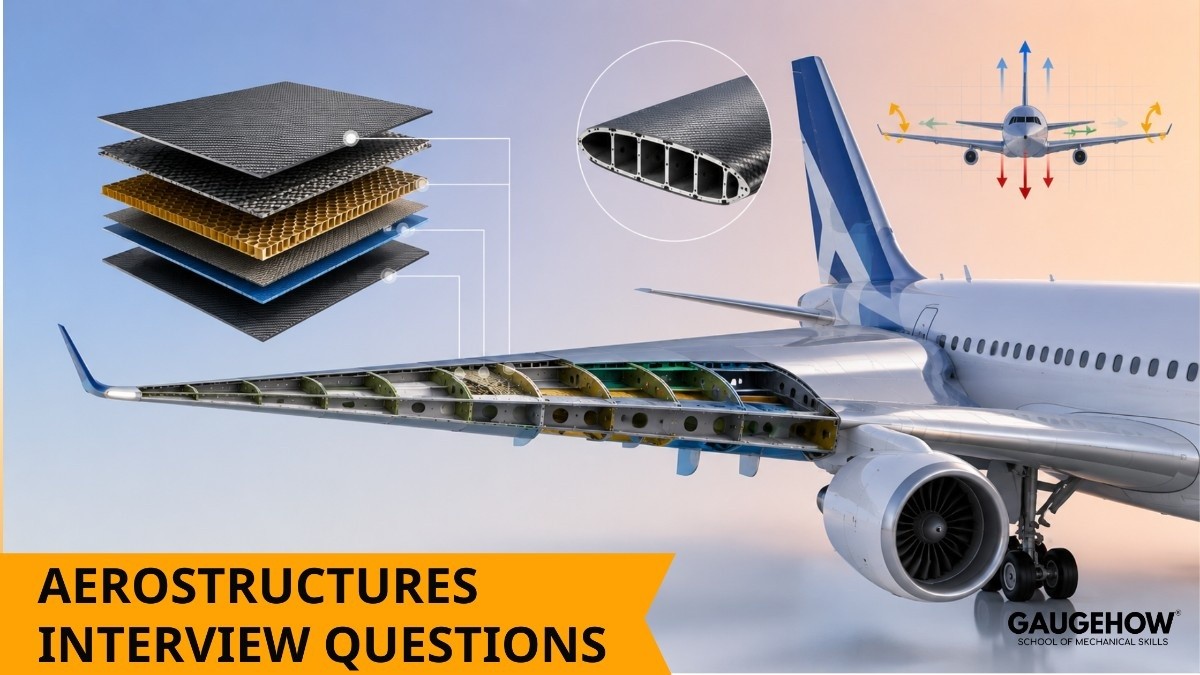
Aerostructures Interview Questions and Answers (Composites & Loads)

Deepak S Choudhary
Learn More in This Video
Subscribe to GaugeHow for More
Aerostructures interviews sit at a tricky intersection you're expected to know composite material behavior, structural loads, and certification requirements all at once, and interviewers move between them without warning. If you've worked on metallic structures before but are now interviewing for a composites-heavy role, or vice versa, the gaps show up fast.
Composite Materials Fundamentals Questions
1. What makes composite materials different from metals in aerostructure design?
Composites are anisotropic, meaning their strength and stiffness change depending on the direction of load relative to the fiber orientation. Metals are largely isotropic, so their properties are the same in every direction, which makes analysis simpler but limits weight savings.
Composites also don't yield like metals they tend to fail more abruptly once damage initiates. This changes how engineers approach both design margins and inspection strategy.
2. What is the difference between a fiber and a matrix in a composite laminate?
The fiber, usually carbon or glass, carries the primary structural load and provides stiffness and strength along its length. The matrix, typically an epoxy resin, holds the fibers in position, transfers load between them, and protects against environmental damage.
Neither material alone would perform well structurally the fiber is strong but brittle, and the resin alone is weak. Their combined, engineered interaction is what gives composites their performance advantage.
3. What does "quasi-isotropic" mean in a composite layup?
A quasi-isotropic layup uses plies oriented at multiple angles, commonly 0°, +45°, -45°, and 90°, in a balanced and symmetric stacking sequence. This spreads strength and stiffness more evenly across directions, behaving somewhat like an isotropic metal even though it's still fundamentally directional.
It's a common starting layup for structures with multi-directional or unpredictable loading. True isotropy is never fully achieved, but this gets close enough for many design cases.
4. Why must composite layups be both balanced and symmetric?
A balanced layup has equal numbers of plies at +θ and -θ angles to prevent unwanted shear-extension coupling under load. A symmetric layup mirrors ply orientations about the laminate's mid-plane to prevent warping from thermal or mechanical loading.
Skipping either rule can cause a panel to twist or bow during curing or in service, even if the overall ply count looks correct. This is one of the first things reviewers check on a layup drawing.
5. What is the difference between carbon fiber and glass fiber composites in aerostructure applications?
Carbon fiber offers a much higher stiffness-to-weight ratio and is the dominant choice for primary structure like wing skins and fuselage panels. Glass fiber is less stiff and heavier per unit strength but is cheaper and more impact tolerant in some cases.
Carbon fiber is also electrically conductive, which matters for lightning strike protection design, while glass fiber is not. The choice often comes down to whether the part is primary structure or a secondary, cost-sensitive component.
6. What is a honeycomb sandwich structure and where is it used?
A honeycomb sandwich structure has two thin composite or metal face sheets bonded to a lightweight honeycomb core, usually aluminum or Nomex. It provides high bending stiffness for very low weight, since the core resists shear while the face sheets carry bending loads.
It's commonly used in control surfaces, fairings, and interior panels where stiffness matters more than raw strength. A known weakness is core crushing or face sheet disbond from impact damage, which isn't always visible from the outside.
Layup, Manufacturing, and Design Questions
7. What is the difference between autoclave curing and out-of-autoclave (OOA) curing?
Autoclave curing applies both heat and high pressure in a sealed vessel, producing very low void content and high-quality parts, which is why it's the aerospace standard for primary structure.
OOA curing uses vacuum bag pressure alone with specially formulated prepregs, avoiding the cost and size limits of an autoclave. OOA parts can have slightly higher void content if not carefully controlled. OOA is gaining ground for larger structures where autoclave size or cost becomes a limiting factor.
8. What is a prepreg and why is it used over wet layup in aerospace manufacturing?
Prepreg is fiber material pre-impregnated with a precise, controlled amount of resin, then stored refrigerated until it's laid up and cured. It gives much tighter control over fiber-to-resin ratio compared to wet layup, which directly affects final part strength and consistency.
Prepreg also has a limited out-time and shelf life, so tracking and logging exposure to room temperature is a real production concern. Aerospace primary structures almost always use prepreg for this repeatability.
9. What causes voids in a composite laminate, and why do they matter?
Voids form from trapped air, moisture in the material, or insufficient consolidation pressure during cure. Even small void content, often above 2%, measurably reduces interlaminar shear strength and can become a starting point for delamination under load.
Autoclave pressure is specifically used to minimize void content compared to vacuum-bag-only processes. Void content limits are typically defined in the material and process specification and verified through ultrasonic inspection.
10. What is fiber placement or automated tape laying (ATL/AFP), and why has it replaced hand layup for large structures?
ATL and AFP are automated processes that lay composite tape or tows onto a tool using a robotic head, following a programmed path. They dramatically improve repeatability, reduce labor hours, and allow more complex ply drop-off patterns than hand layup can reliably achieve.
Large structures like wing skins and fuselage barrels rely on these processes to meet both cost and quality targets at production rates. The tradeoff is high upfront tooling and programming cost, which only pays off at sufficient volume.
11. What is a ply drop-off and why does it need careful design?
A ply drop-off is where one or more plies terminate within a laminate to taper thickness, rather than running the full length of the part. Poorly designed drop-offs create local stress concentrations and can become delamination initiation points under load.
Design rules typically stagger drop-off locations and limit how many plies can end at the same location. This is a common area reviewers focus on during structural design reviews.
12. How does tooling design differ for composite parts versus metallic parts?
Composite tooling must account for cure shrinkage and the mismatch in thermal expansion between the tool material and the composite part, especially with metallic tools and carbon fiber parts. Invar tooling is often used for tight tolerance parts because its thermal expansion closely matches carbon fiber.
Tool surface finish directly transfers to the part's outer mold line, so surface quality control matters more than in typical metal fabrication. Spring-in and warpage prediction is a routine part of composite tool design.
Structural Loads Questions
13. What is the difference between limit load and ultimate load in aircraft structural design?
Limit load is the maximum load a structure is expected to experience during normal service, and the structure must return to its original shape without permanent deformation at this load.
Ultimate load is typically 1.5 times limit load, and the structure must be able to withstand it without complete failure, though permanent deformation is acceptable.
This 1.5 safety factor is a standard requirement across most civil aviation certification. Every structural analysis report references both values explicitly.
14. What are the main aircraft load cases engineers must design for?
Key load cases include maneuver loads from pilot control inputs, gust loads from atmospheric turbulence, landing loads including hard landing scenarios, and pressurization loads for the fuselage.
Ground handling loads, like jacking and towing, and fatigue loads from repeated cyclic loading over the aircraft's life are also critical. Each load case can drive design in different areas of the structure gust loads often size the wing, while pressurization sizes the fuselage skin. A complete structural substantiation has to address all applicable cases, not just the most obvious one.
15. What is the V-n diagram and why is it important in aircraft structural design?
A V-n diagram plots load factor (n) against airspeed (V), defining the structural flight envelope an aircraft must be designed to withstand. It shows both maneuver limits and gust limits across the speed range, with the most critical combination typically occurring at maneuvering speed.
Engineers use it to identify the worst-case load factor the structure must be sized for. It's one of the first things referenced when starting a new structural loads analysis.
16. What is the difference between static strength analysis and fatigue analysis?
Static strength analysis checks whether a structure can survive a single application of the worst-case load without failure. Fatigue analysis evaluates how repeated, often much lower, cyclic loading over the aircraft's operational life can initiate and grow cracks over time.
A structure can easily pass static analysis but fail prematurely in service if fatigue wasn't properly accounted for. Composite structures behave differently under fatigue than metals, generally showing better fatigue resistance but different damage mechanisms.
17. What is a load path and why does understanding it matter in aerostructure design?
A load path describes how force travels through a structure from its point of application to where it's ultimately reacted, such as landing gear loads traveling into the wing spar.
Misunderstanding the load path can lead to underestimating stress in a critical member or missing a load transfer joint that needs reinforcement. Engineers trace load paths using free body diagrams and finite element models before finalizing structural sizing.
A clear load path also simplifies inspection planning, since it highlights which areas see the highest stress in service.
18. How do finite element models (FEM) support structural loads analysis in aerostructures?
FEM breaks a complex structure into small elements to predict stress, strain, and deflection under applied loads that would be impractical to calculate by hand. For composites, this often includes ply-by-ply stress analysis to check each layer against its allowable strength.
Tools like ABAQUS and ANSYS are widely used for both linear static and more complex nonlinear or progressive failure analysis. Model correlation against physical test data is required before an FEM is trusted for certification, since a good-looking mesh can still hide bad assumptions.
Failure Modes, Damage Tolerance, and Certification Questions
19. What is delamination and why is it a critical failure mode in composites?
Delamination is the separation between adjacent plies in a laminate, usually caused by impact, manufacturing defects, or high interlaminar shear stress. It's especially dangerous because it often isn't visible from the surface, unlike a crack in a metal structure.
Barely Visible Impact Damage, or BVID, can hide significant internal delamination that reduces compression strength substantially. This is why composite structures require damage tolerance analysis, not just static strength analysis.
20. What is Barely Visible Impact Damage (BVID) and how does it affect design?
BVID is impact damage, often from tool drops or hail, that leaves minimal surface indication but can cause meaningful internal delamination and strength reduction.
Because it's easy to miss during visual inspection, designers must assume BVID could exist anywhere on the structure and still size for adequate residual strength. This drives the "no-growth" or "slow-growth" damage tolerance philosophy required by certification authorities.
It's a major reason composite structures carry more conservative design allowables than an equivalent metal structure might.
21. What is the difference between damage tolerance and fail-safe design philosophies?
Damage tolerance design assumes damage or defects exist and requires the structure to safely carry limit loads until the damage is detected through scheduled inspection.
Fail-safe design relies on redundant load paths, so if one member fails, others can carry the load until repair. Modern composite aerostructures typically use a combination of both approaches depending on the structure type and inspection accessibility.
Certification requirements specify which philosophy applies and what inspection intervals are acceptable for each.
22. What certification standards govern composite aerostructure design?
Key references include FAA Advisory Circular AC 20-107B for composite aircraft structure, and the corresponding EASA CS-25 requirements for large aircraft.
These require substantiation through a building block testing approach, starting from coupon-level tests up through full-scale component testing. Environmental effects like moisture absorption and temperature extremes must also be accounted for in allowables.
Compliance documentation ties every design allowable back to a specific test or analysis method approved by the certifying authority.
23. What is the "building block approach" in composite structural certification?
It's a staged testing strategy that starts with small material coupon tests, moves up to element and sub-component tests, and finishes with full-scale structural tests.
Each level validates assumptions from the level below before moving to more expensive, larger-scale testing. This reduces risk and cost compared to jumping straight to full-scale testing without confidence in the underlying material data. Regulatory authorities expect to see this approach documented in the certification plan.
24. How is moisture absorption accounted for in composite structural allowables?
Composite resins can absorb moisture over time, which reduces matrix-dominated properties like compression strength and interlaminar shear strength, especially at elevated temperature. Design allowables are typically derived from "hot-wet" test conditions to represent worst-case in-service environmental exposure.
This is why composite allowables are often noticeably lower than the material's dry, room-temperature test values. Engineers must always confirm which environmental condition an allowable value corresponds to before using it in analysis.
Advanced and Scenario-Based Questions
25. A wing skin panel shows a small dent from a tool drop during assembly. How would you assess whether it's acceptable to fly?
I'd first compare the dent depth and diameter against the structure's approved BVID and damage tolerance limits defined in the structural repair manual.
If it's within allowable limits, no repair may be needed, but it would still get logged and tracked per the inspection program. If it exceeds the threshold, I'd escalate for engineering disposition, which might involve NDI, like ultrasonic inspection, to check for underlying delamination. The decision always ties back to documented allowables, not visual judgment alone.
26. How would you approach sizing a composite wing spar cap under combined bending and shear loading?
I'd start by extracting internal loads from the global FEM at the critical load case, typically maximum gust or maneuver condition. Then I'd perform ply-by-ply stress analysis to check each lamina against its allowable using an appropriate failure criterion, like Tsai-Wu or maximum strain.
I'd also verify buckling stability separately, since thin composite laminates can buckle well before reaching material failure strength. Finally, I'd cross-check margins against both limit and ultimate load requirements before finalizing the layup.
27. How do you decide when a composite repair is structurally acceptable versus requiring a full panel replacement?
The decision depends on damage size, location relative to critical load paths, and whether the damage falls within pre-approved repair limits in the structural repair manual. Repairable damage typically uses a scarf or bonded patch repair sized to restore the original strength margin.
If damage exceeds repair limits or falls in a highly loaded, hard-to-access area, replacement becomes the safer and often more cost-effective option. Engineering disposition always documents the reasoning, since it affects both airworthiness and long-term maintenance cost.
28. How does reverse engineering come into play when analyzing legacy composite aerostructures without full original design data?
When original layup or material specifications are missing, engineers may need to physically inspect and measure an existing part to reconstruct ply count, orientation, and thickness.
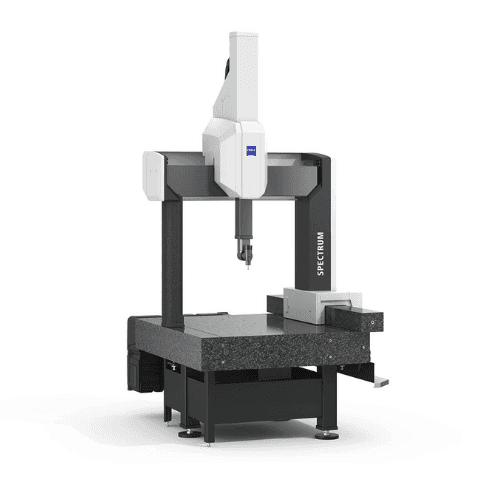
This often involves careful sectioning, microscopy, or CT scanning combined with dimensional measurement to rebuild an accurate model. It's a slower, more conservative process since assumptions have to be validated rather than taken from an original spec.
Skills in reverse engineering and precise measurement, like those covered in a Computer-Aided Reverse Engineering course, become essential in these legacy analysis situations.
29. What role does GD&T play in composite aerostructure manufacturing and inspection?
Geometric Dimensioning and Tolerancing defines allowable variation in part geometry, which is critical for composite parts since tooling shrinkage and spring-back can shift final dimensions from nominal.
Datum structures and tolerance zones ensure mating parts, like a skin panel and its substructure, fit correctly during assembly. Poor GD&T definition is a common root cause of fit-up issues discovered late in assembly.
A strong grounding in this area, such as through a GD&T and Engineering Graphics course, pays off directly in reducing rework on the shop floor.
30. Where do you see composite aerostructure analysis and manufacturing heading in the next few years?
Expect wider adoption of out-of-autoclave processes and thermoplastic composites, which offer faster cycle times and easier repairability than traditional thermoset systems. Simulation is moving toward more accurate progressive failure and multiscale modeling to reduce the physical testing burden in certification.
Automation in layup and inspection, including AI-assisted defect detection, is also expanding to improve consistency at higher production rates. Engineers who combine strong FEA skills, using tools like ABAQUS CAE or FEA with ANSYS, with real manufacturing process knowledge will be best positioned for where the field is heading.
FAQ
Do aerostructures engineers need to know both composites and metals?
Yes, most modern aircraft use a hybrid of composite and metallic structure, so understanding load transfer and compatibility between the two is essential. Even composite-focused roles regularly involve metallic fittings, fasteners, and joints.
Is coding or scripting experience important for a structural loads role?
It's increasingly valuable, since many loads and analysis workflows use scripting, often through MATLAB or Python, to automate load case processing and post-process FEM results. A course like MATLAB or a broader C and C++ for Mechanical Engineering background can make you noticeably faster on the job.
What's the biggest mistake candidates make in aerostructures interviews?
Treating composites like metals and assuming the same failure logic applies. Interviewers specifically probe for this because it's a common and costly misunderstanding in real design work.
How much detail should I give on certification standards if I'm interviewing for a design role, not a certification role?
Enough to show you understand how your design decisions tie back to substantiation requirements, without needing to quote every advisory circular from memory.
Showing awareness that "this needs to be tested and documented" is usually more valuable than reciting standard numbers.
Should I mention specific FEA or CAD tools I've used, even if the job posting doesn't list them?
Yes, naming specific tools and describing what you did with them gives interviewers something concrete to ask follow-up questions about. It's far more convincing than describing skills in general terms.
Conclusion
Aerostructures interviews reward candidates who can move fluidly between material science, structural loads, and certification logic not just recite definitions.
Use these 30 questions to build connections between concepts, like how BVID drives damage tolerance philosophy, or how a ply drop-off decision affects both manufacturing and structural margins, so you can speak to the "why" behind each answer.
If you want to strengthen your practical FEA skills before your next interview, the FEA with ANSYS course is a solid next step to turn this theory into hands-on, interview-ready experience.