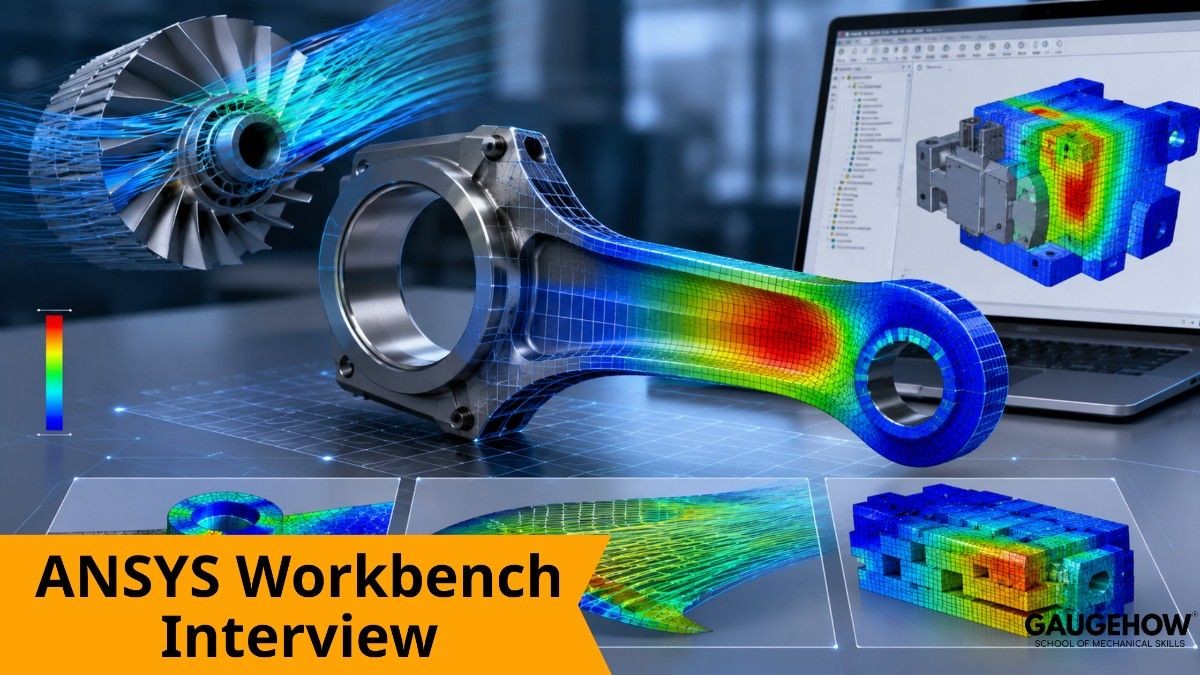
ANSYS Workbench Interview Questions and Answers (Static & Modal)

Deepak S Choudhary
Learn More in This Video
Subscribe to GaugeHow for More
Walking into an ANSYS interview and freezing up on a basic meshing question is more common than most students admit. Recruiters for CAE and design roles almost always test two areas first: Static Structural analysis and Modal analysis, since together they cover the fundamentals every FEA engineer uses daily.
What Static Structural and Modal Analysis Mean in ANSYS Workbench
Static Structural analysis calculates how a part deforms, stresses, and strains under loads that don't change with time, like a bracket holding a fixed weight. Modal analysis, on the other hand, finds a structure's natural frequencies and mode shapes, telling you how it wants to vibrate on its own with no external load applied.
Interviewers pair these two topics because together they cover both "how strong is it" and "how does it move," which is the core of most mechanical simulation work.
Static Structural Analysis Interview Questions and Answers
1. What is Static Structural analysis in ANSYS?
It's a solution type used to calculate displacement, stress, and strain in a structure under loads that stay constant over time. Inertia and damping effects are ignored because nothing is changing with time. It's the most commonly used analysis type for checking whether a part will survive a steady load, like a shelf bracket or a pressure vessel wall.
2. What assumptions does linear static analysis make?
Linear static analysis assumes small deformations, a linear elastic material where stress is proportional to strain, and constant boundary conditions throughout the solve. It also assumes contacts don't change status during loading. If any of these break down, whether from large deflection, plasticity, or contact separation, the analysis needs to be treated as nonlinear.
3. What is meshing, and why does it matter?
Meshing divides a continuous geometry into small elements, like tetrahedra, hexahedra, or shells, so ANSYS can solve the governing equations numerically at each node. Mesh quality directly affects accuracy, since a coarse or skewed mesh can under- or over-predict stress, especially near fillets and holes where stress concentrates.
4. What's the difference between a node and an element?
A node is a single point in space where ANSYS calculates results like displacement. An element is the small volume, area, or line formed by connecting several nodes together. The full mesh is just a collection of elements sharing nodes, which lets ANSYS build the overall stiffness matrix for the model.
5. What are the common element types used in structural analysis?
1D elements, like beam and link, model slender members like trusses. 2D elements, like shell and plane, suit thin-walled parts like sheet metal. 3D solid elements handle bulky or complex geometry where thickness matters in every direction, and the choice depends on geometry proportions and the accuracy needed.
6. What is a boundary condition?
A boundary condition defines how the model interacts with the outside world, including fixed supports, applied forces, pressures, moments, or prescribed displacements. Without correct boundary conditions, the solver either can't find a unique solution or produces results that don't reflect real-world behavior.
7. What's the difference between deformation and stress?
Deformation is how much a point on the structure physically moves from its original position under load. Stress is the internal force per unit area the material experiences as a result of that deformation. ANSYS calculates deformation first, then derives strain, and finally stress from the material's stiffness.
8. What is von Mises stress, and why is it used so often?
Von Mises stress is a single equivalent stress value calculated from the full 3D stress state at a point. It's popular because it lets engineers compare a complex, multi-directional stress condition against a material's single yield strength value from a tensile test. If von Mises stress exceeds yield strength, the material is expected to deform permanently.
9. What is a Factor of Safety (FOS)?
FOS is the ratio of a material's allowable strength, either yield or ultimate, to the maximum stress predicted in the analysis. An FOS greater than 1 generally means the design should survive the load, while values below 1 indicate likely failure. Most industries specify a minimum acceptable FOS depending on how critical the part is.
10. What's the difference between linear and nonlinear static analysis?
Linear analysis assumes proportional load-deflection behavior and small deformations, solving in a single step. Nonlinear analysis accounts for large deflections, plasticity, or changing contact conditions, and solves iteratively in multiple sub-steps. Nonlinear runs take longer but are necessary whenever the linear assumptions don't hold.
11. What does mesh convergence mean?
Mesh convergence is the process of refining a mesh repeatedly and checking whether key results, like peak stress, stop changing significantly. Once further refinement barely changes the answer, the mesh is considered converged and trustworthy. It's a standard way to prove a result isn't an artifact of a bad mesh.
12. What causes stress singularities, and how do you handle them?
Stress singularities appear at sharp re-entrant corners, point loads, or point supports, where theoretical stress rises without limit as the mesh is refined. Instead of chasing infinite stress, engineers typically add realistic fillets, use averaged stress over a small area, or rely on displacement results, which stay well-behaved even near singularities.
13. What is the difference between a fixed support and a frictionless support?
A fixed support locks all translational and rotational degrees of freedom at that location, so nothing moves or rotates there. A frictionless support only restrains motion normal to the surface, letting the part slide freely along the surface plane. Choosing the wrong one is a common cause of unrealistic stress results.
14. What is contact, and what types are available in ANSYS?
Contact defines how two separate bodies interact when they touch, such as two bolted plates. Common types include Bonded, No Separation, Frictionless, Rough, and Frictional, each allowing different amounts of relative motion.
Bonded contact is linear and fast, while frictional contact is nonlinear and needs more solver iterations.
15. What's the difference between pressure and force loads?
Force is a single resultant load value applied to a face, edge, or point, and ANSYS distributes it internally. Pressure is a load defined per unit area, applied normal to a surface, so the total force depends on the surface area selected.
Using the wrong one on the wrong geometry is a frequent source of incorrect results in interviews and real projects alike.
16. Why do we use symmetry in FEA models?
If both geometry and loading are symmetric, modeling only half or a quarter of the part with symmetry boundary conditions gives identical results at a fraction of the computational cost. It reduces mesh size, solve time, and memory usage significantly.
Symmetry must be applied carefully, since asymmetric loads or supports break the assumption.
17. What is the difference between explicit and implicit solvers?
Implicit solvers, used in standard Static Structural analysis, solve the full system of equations simultaneously and are efficient for slow, static, or mildly nonlinear problems. Explicit solvers calculate results step-by-step forward in time and suit fast, highly nonlinear events like impact or crash simulation. Static Structural in Workbench always uses the implicit approach.
18. What is buckling, and how is it analyzed?
Buckling is a sudden loss of structural stability under compressive load, where a slender member deflects sideways well before the material actually yields.
It's studied using Eigenvalue, or linear, buckling analysis, which gives a load multiplier, or nonlinear buckling for a more realistic post-buckling response. Thin columns, panels, and shells are the usual candidates.
19. What is the difference between total deformation and directional deformation?
Total deformation is the resultant magnitude of movement at a node, combining X, Y, and Z components into one positive value. Directional deformation reports movement along a single chosen axis and can be positive or negative depending on direction.
Engineers use directional results when checking clearance or alignment in a specific direction.
20. How do you validate FEA results?
Validation typically combines a mesh convergence study, a hand-calculation or simplified theoretical check for a basic case, and comparison against physical test data if available.
Checking that reaction forces balance the applied loads is also a quick sanity check every engineer should run before trusting any result.
Modal Analysis Interview Questions and Answers
21. What is Modal analysis used for?
Modal analysis calculates a structure's natural frequencies and corresponding mode shapes, the specific frequencies at which it tends to vibrate freely.
No external load is applied, since it's purely a property of the structure's mass and stiffness distribution.
It's the starting point for any vibration, resonance, or dynamic response study.
22. What is a natural frequency?
A natural frequency is a frequency at which a structure vibrates freely once disturbed, without any continuous external force driving it. Every structure has multiple natural frequencies, ranked from lowest, or first mode, upward.
If an operating load matches a natural frequency closely, resonance can cause dangerously large vibrations.
23. What is a mode shape?
A mode shape is the deformed pattern a structure takes on when vibrating at one of its natural frequencies. It shows relative motion, not absolute magnitude, since ANSYS normalizes mode shapes because modal analysis doesn't calculate real stress or displacement values in physical units. Each natural frequency has its own unique mode shape.
24. Why doesn't Modal analysis need a load?
Because natural frequencies and mode shapes depend only on the structure's mass and stiffness, not on any applied force. Loads affect how much a structure responds at a given frequency, which is studied separately in harmonic or transient analysis, but they don't change the frequencies themselves.
25. What is resonance, and why is it dangerous?
Resonance happens when an external excitation frequency matches a structure's natural frequency, causing vibration amplitude to grow rapidly, sometimes to failure.
It's dangerous because even small forces can produce very large deflections and stresses if the timing lines up. Engineers try to keep operating frequencies well away from natural frequencies during design.
26. How do boundary conditions affect Modal analysis results?
Adding supports increases a structure's stiffness, which raises its natural frequencies compared to a free, unsupported structure. A cantilevered beam and the same beam simply supported at both ends will produce very different mode shapes and frequency values.
Getting boundary conditions right is just as critical in Modal analysis as it is in Static Structural.
27. What is the difference between free-free and constrained Modal analysis?
Free-free modal analysis has no supports at all, so the first six modes are rigid-body modes at or near zero Hz, representing free translation and rotation.
Constrained modal analysis applies real supports, producing genuine elastic mode shapes from the very first mode. Free-free runs are often used to check mesh quality and model integrity before adding boundary conditions.
28. How many modes should you extract in an analysis?
It depends on the frequency range of interest for the application, usually enough modes to cover the operating frequency range plus a safety margin, often the first 6 to 20 modes for typical mechanical components. Extracting far more modes than needed just increases solve time without adding useful insight for most design checks.
29. What is participation factor and effective mass in Modal analysis?
Participation factor indicates how strongly a given mode responds to excitation in a particular direction, while effective mass shows how much of the structure's total mass that mode actually represents. Modes with high effective mass in the direction of loading matter far more for real-world response than modes with tiny participation.
30. How is Modal analysis different from Harmonic analysis?
Modal analysis only finds natural frequencies and mode shapes with no applied load, treating the structure in isolation.
Harmonic analysis goes a step further, applying a cyclic force at a range of frequencies to calculate actual displacement, stress, and phase response at each frequency. In practice, engineers run Modal first, then use those results to guide a Harmonic study.
FAQ
Is ANSYS Workbench free to learn?
ANSYS offers a free Student version with limited model size, which is enough to practice the concepts covered here and build interview-ready project examples.
Do freshers need to know APDL commands for interviews?
Most entry-level interviews focus on Workbench GUI concepts like meshing, boundary conditions, and result interpretation. APDL scripting is usually asked about only for more experienced or automation-focused roles.
What's asked more often, Static or Modal analysis?
Static Structural questions come up more frequently since it's the most commonly used analysis type in industry, but almost every CAE interview touches on basic Modal analysis concepts too.
How do I explain a project in an ANSYS interview?
Structure it around the analysis type used, key boundary conditions and loads, mesh strategy, and the final result with a factor of safety or frequency value. That mirrors exactly how interviewers expect you to think through a real problem.
Final Tips Before Your Interview
Don't just memorize definitions, be ready to explain why each concept matters with a one-line real-world example, since that's usually what separates a strong answer from a textbook one.
Practicing simple models in Workbench yourself, rather than only reading theory, makes these answers far easier to recall under interview pressure.
If you want structured, hands-on practice with these exact concepts, GaugeHow's FEA with ANSYS course walks through Static Structural and Modal analysis setup, meshing, and result interpretation step by step, good preparation for both interviews and real project work.
If you're newer to simulation and want to build up from the fundamentals first, GaugeHow's free course is a good starting point before diving into the full ANSYS training.