Digital Twin Interview Questions and Answers (Architecture & Use Cases)

Deepak S Choudhary
Learn More in This Video
Subscribe to GaugeHow for More
Digital twin interviews test whether you understand the actual architecture behind the buzzword how real data flows into a virtual model and back out as a usable decision. Interviewers want specifics on layers and use cases, not just a one-line definition.
General Digital Twin Questions
Q1. What is a digital twin?
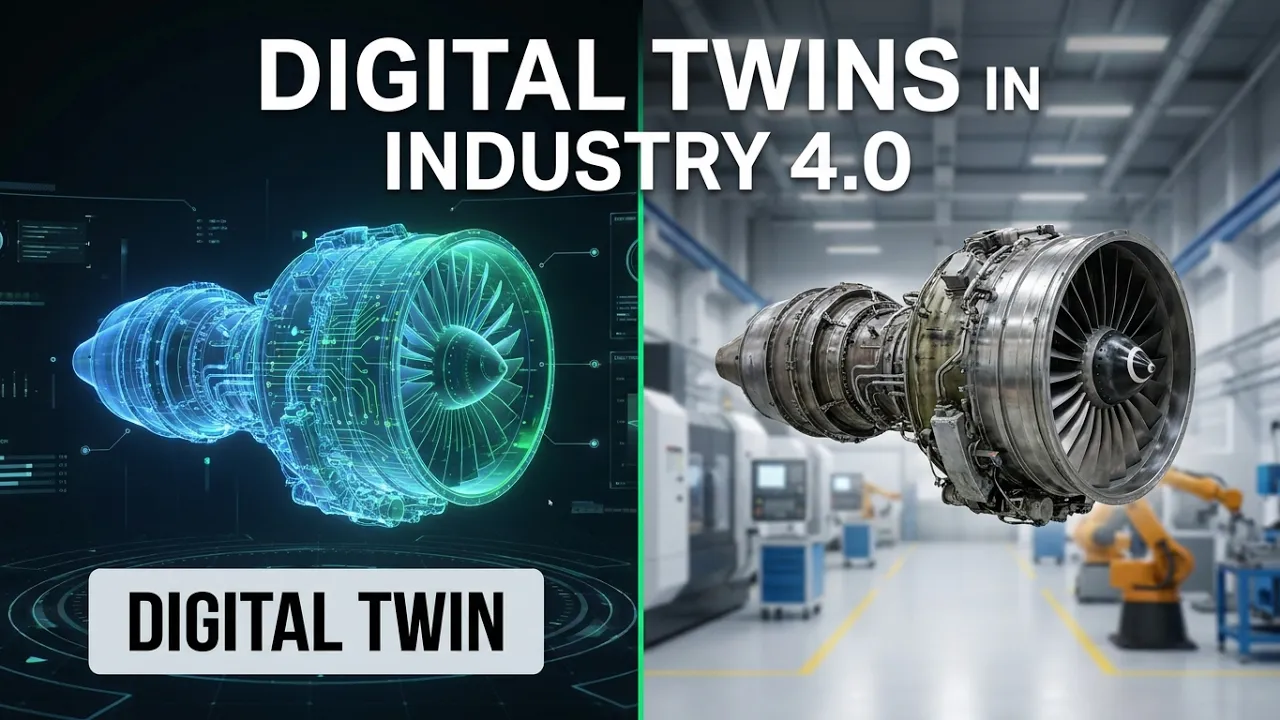
A digital twin is a virtual model of a physical asset or process, kept continuously updated with real-time data. It mirrors the actual object's behavior, not just its appearance. GaugeHow's Digital Twins course covers building and maintaining this kind of model.
Q2. How is a digital twin different from a regular simulation?
A traditional simulation is typically static, built once and used before deployment. A digital twin stays connected to live data throughout the asset's life, evolving alongside it. That ongoing sync is what makes it useful for real-time decisions, not just upfront design.
Q3. What are the three main types of digital twins?
Asset twins model a single piece of equipment, like a motor. Process twins model an entire production process or line. System twins model an interconnected network of assets and processes together, giving the broadest view.
Q4. What is the digital thread, and how does it relate to a digital twin?
The digital thread is the continuous data connection linking a product's design, production, and field performance. A digital twin is often one expression of that thread, applied to a specific asset or process. Together they support full lifecycle traceability.
Architecture Questions
Q5. What are the main layers in a digital twin architecture?
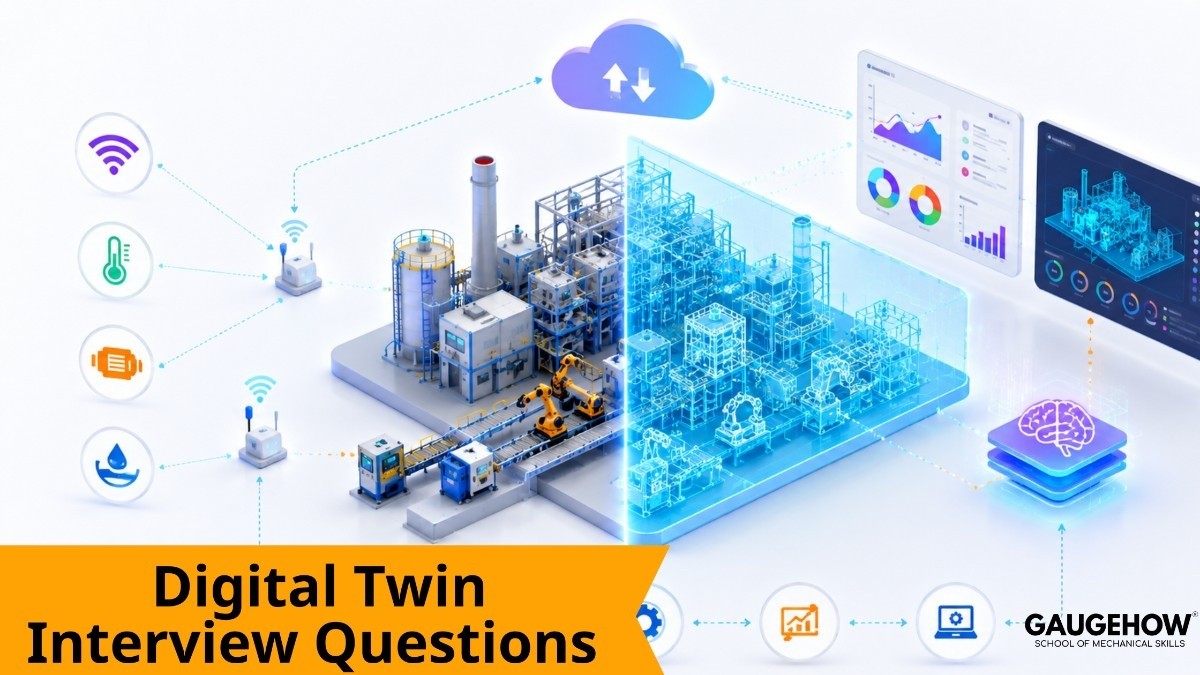
The layers are data acquisition, connectivity, data processing, the modeling layer, and a visualization or analytics layer on top. Data flows up from physical sensors through each layer before reaching a usable dashboard or model. Weakness in any layer limits the whole system's usefulness.
Q6. What is the data acquisition layer, and why does it matter?
This layer covers the sensors and devices physically collecting data from the real asset, like temperature or vibration readings. Its accuracy directly determines how trustworthy the resulting digital twin is. A twin built on poor sensor data will mislead more than help.
Q7. What role does connectivity play in digital twin architecture?
Connectivity moves data from sensors to processing systems, using protocols like MQTT or OPC UA. GaugeHow's IIoT course covers this connectivity layer in depth. Reliable, low-latency connectivity matters most for twins supporting real-time decisions.
Q8. What is the modeling layer, and what does it actually do?
The modeling layer contains the mathematical or physics-based representation of the asset's behavior. It uses incoming data to simulate expected performance and compare it against actual conditions. This comparison is what surfaces anomalies or predicts future behavior.
Q9. What is the role of the analytics layer in a digital twin system?
Analytics processes the model's output alongside real data to generate actionable insight, like a maintenance recommendation. Without this layer, a digital twin is just a passive visualization. Analytics is what turns the twin into a decision-support tool.
Q10. How does data storage factor into digital twin architecture?
Historical data storage lets the twin compare current behavior against past performance trends, not just a single snapshot. It also supports training predictive models that improve over time. Poor storage design can bottleneck performance as data volume grows.
Data and Integration Questions
Q11. How does a digital twin stay synchronized with its physical counterpart?
Continuous data feeds from sensors update the twin's state at a frequency matched to the application's needs. Fast-changing processes need near real-time sync; slower assets can update less frequently. Sync frequency is a deliberate design choice, not a fixed rule.
Q12. What data quality issues commonly affect digital twin accuracy?
Sensor drift, missing data from connectivity gaps, and inconsistent formats across different equipment vendors all degrade accuracy. Regular calibration and validation checks catch these issues before they corrupt the model. Data quality problems are often underestimated compared to the modeling work itself.
Q13. How does a digital twin integrate with MES or ERP systems?
Integration lets the twin pull production context, like scheduling or material data, and push insights back for planning decisions. GaugeHow's Digital Manufacturing course covers this kind of system integration. Without it, the twin operates in isolation from broader business decisions.
Q14. What communication protocols are commonly used to feed data into a digital twin?
MQTT is common for lightweight, real-time sensor data transmission. OPC UA is widely used for interoperable industrial data exchange across vendors. Protocol choice depends on the specific equipment and required data update speed.
Use Case Questions
Q15. How is predictive maintenance implemented using a digital twin?
The twin simulates expected equipment behavior and flags deviations from real sensor data as early warning signs. Maintenance teams use these flags to intervene before an actual failure occurs. Accuracy depends heavily on both model quality and sensor reliability.
Q16. What is virtual commissioning, and how does a digital twin support it?
Virtual commissioning tests a production line's control logic against a simulated model before physical installation. It catches design errors, collisions, and timing issues early, when they're cheap to fix. This significantly reduces on-site debugging during actual commissioning.
Q17. How can a digital twin support process optimization in manufacturing?
Engineers can test process changes, like speed or temperature adjustments, on the virtual model before applying them live. This avoids risking real production output on an untested change. It's a lower-risk way to explore improvement ideas.
Q18. What is a product digital twin, and how is it used during design?
A product digital twin models how a product design will perform under real-world conditions before it's physically built. It helps validate design choices against expected stress, thermal, or usage patterns. This reduces costly redesigns discovered only after physical prototyping.
Q19. How are digital twins used for operator training?
A digital twin can simulate realistic equipment behavior in a safe virtual environment, letting trainees practice without risking real machinery. It also lets trainers create rare fault scenarios that would be hard to reproduce live. This shortens ramp-up time for new operators significantly.
Q20. How does a digital twin support supply chain or logistics use cases?
A twin of a distribution network can model flow, capacity, and disruption scenarios before they happen in reality. It helps planners test contingency strategies, like a supplier delay, without real-world risk. This use case is growing alongside traditional asset-focused twins.
Value and ROI Questions
Q21. How do you measure the ROI of a digital twin implementation?
I'd tie it to specific outcomes defined upfront, like reduced downtime hours or fewer physical prototype iterations. Comparing before-and-after data over a sustained period confirms whether the value actually held. A twin project without defined success metrics is hard to evaluate honestly.
Q22. What industries benefit most from digital twin technology today?
Manufacturing, aerospace, and energy sectors have adopted digital twins most heavily, given their high equipment cost and downtime impact. Healthcare and smart city applications are growing use cases as well. The common thread is high-value assets where prediction and testing offer real payback.
Q23. What's a common mistake companies make when starting a digital twin project?
Trying to build a comprehensive twin covering an entire facility at once, rather than starting with a focused, high-value asset or process. That broad scope often stalls before delivering any real result. A narrow, successful pilot builds the case for wider investment.
Cybersecurity and Governance Questions
Q24. What security risks are specific to digital twin systems?
A digital twin depends on continuous data flow from physical assets, which expands the network's attack surface if not properly secured. A compromised twin could also feed false data back into real decisions. Security needs to be built into the connectivity architecture from the start.
Q25. How do you protect sensitive process data used in a digital twin?
Role-based access control limits who can view or modify twin data based on actual need. Network segmentation between the twin's data sources and broader corporate systems reduces exposure. These protections matter as much for twins as for any other connected industrial system.
Implementation Questions
Q26. How would you approach building a digital twin for a piece of equipment from scratch?
I'd start by defining what decisions the twin needs to support, since that shapes which data and model fidelity actually matter. Gathering baseline equipment specs and historical performance data comes next. Building incrementally, validating against real behavior at each step, avoids over-investing in an inaccurate model.
Q27. How do you decide the right level of model fidelity for a digital twin?
Fidelity should match the decision the twin supports, not maximize realism for its own sake. A twin used for basic status monitoring needs less detail than one used for precise predictive maintenance. Over-engineering fidelity wastes effort without adding real decision value.
Scenario and Behavioral Questions
Q28. A digital twin's predictions stopped matching actual equipment behavior. How would you investigate it?
I'd check sensor data quality first, since drift or a connectivity gap is a common and often-overlooked cause. If data looks clean, I'd review whether the physical equipment changed, like a repair or part replacement, that the model doesn't account for. Retraining or recalibrating the model usually follows.
Q29. Describe a time you used a digital twin to solve a real problem.
A strong answer names the specific asset or process, the insight the twin revealed, and the measured outcome, like reduced downtime. Vague claims without a specific result raise more questions than they answer. Interviewers want a concrete story, not a general description.
Q30. How do you stay current with digital twin tools and best practices?
I follow industry publications and vendor documentation for platforms I use, and try to apply new modeling techniques to real projects rather than only reading about them. GaugeHow's Introduction to Industry 4.0 course covers how digital twins fit within the broader technology landscape. Hands-on exposure sticks better than theory alone.
FAQ
Is a digital twin the same as a 3D model? No. A 3D model is a static visual representation. A digital twin is continuously updated with real data and simulates actual behavior, not just appearance.
Do digital twins require IIoT sensors? Yes, in almost all real applications. Without connected sensors feeding real-time data, the model can't stay synchronized with its physical counterpart.
What's the most commonly asked digital twin interview question? Explaining the difference between a digital twin and a traditional simulation comes up in nearly every interview on this topic.
How much data history does a digital twin need? It depends on the use case. Predictive maintenance typically needs enough historical failure data to train an accurate model, often months or years.
Are digital twins only for large enterprises? No. Smaller manufacturers increasingly build focused twins for a single critical asset, without needing a facility-wide implementation.
Conclusion
Digital twin interviews reward candidates who understand the architecture layers and can explain a real use case, not just define the concept. Prepare a specific example involving predictive maintenance, virtual commissioning, or a project where a twin's prediction actually changed a decision.
To build the technical foundation behind these interview topics, GaugeHow's Digital Twins course covers architecture and use cases in practical depth, while IIoT and Digital Manufacturing build the connected-data skills these interviews test for.