Industrial IoT (IIoT) Interview Questions and Answers

Deepak S Choudhary
Learn More in This Video
Subscribe to GaugeHow for More
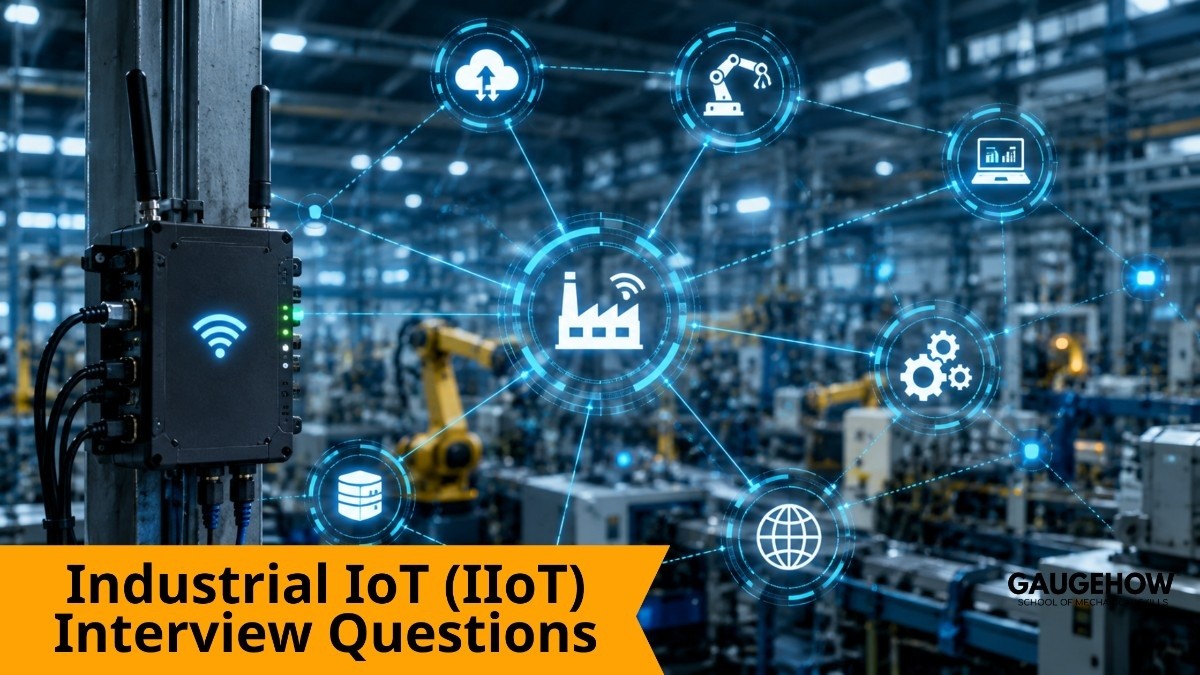
IIoT interviews test whether you understand how sensor data actually gets from a machine on the floor to a decision someone acts on. Interviewers want specifics on protocols, architecture, and security, not just a definition of connected devices.
General IIoT Questions
Q1. What is IIoT, and how is it different from consumer IoT?
IIoT refers to connected sensors and devices used specifically in industrial settings like manufacturing and energy. Consumer IoT covers everyday devices like smart speakers or thermostats. GaugeHow's IIoT course covers the added reliability and security requirements industrial applications demand.
Q2. What business problems does IIoT typically solve?
IIoT reduces unplanned downtime through predictive maintenance and improves quality through real-time process monitoring. It also gives visibility into equipment performance that periodic manual checks simply can't match. The core value is faster, data-backed decisions instead of guesswork.
Q3. What are the main components of a typical IIoT system?
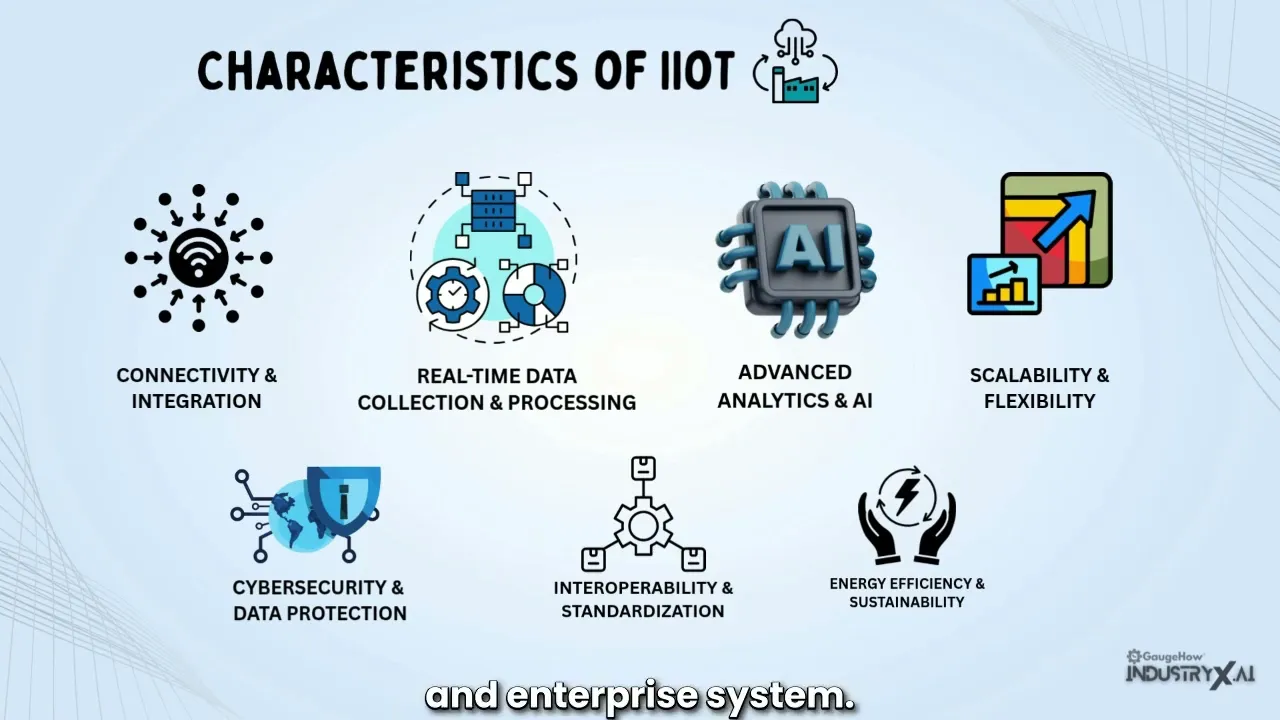
The main components are sensors collecting data, a connectivity layer transmitting it, a processing layer analyzing it, and a visualization or application layer presenting insights. Each layer depends on the others functioning correctly. A weak link in any layer limits the whole system's value.
Q4. How does IIoT support Industry 4.0 more broadly?
IIoT provides the real-time data foundation that other Industry 4.0 pillars, like digital twins and predictive analytics, depend on. GaugeHow's Introduction to Industry 4.0 course covers how IIoT fits into that larger framework. Without reliable sensor data, most other pillars have little to actually work with.
Sensors and Devices Questions
Q5. What types of sensors are commonly used in IIoT applications?
Temperature, vibration, pressure, and flow sensors are common for equipment monitoring. Proximity and position sensors support tracking and automation tasks. The right sensor choice depends entirely on what specific condition needs monitoring.
Q6. How do you choose the right sensor for a specific IIoT application?
I match sensor type and range to the actual measurement need, not just what's readily available. Environmental conditions, like temperature extremes or vibration, also affect sensor selection and durability. Getting this wrong leads to unreliable data feeding the whole system.
Q7. What is sensor calibration, and why does it matter for IIoT data quality?
Calibration verifies a sensor's output accurately reflects the real physical value it measures. Drift over time can silently corrupt data without any obvious failure signal. Regular calibration checks are essential for trustworthy long-term IIoT data.
Q8. How do you handle sensor data noise in an IIoT system?
I apply filtering, like a moving average, to smooth out random fluctuations before the data reaches analytics. Hardware-level filtering can also reduce noise before it even reaches the sensor's output signal. Over-filtering introduces lag, so balance matters.
Connectivity and Protocols Questions
Q9. What communication protocols are commonly used in IIoT systems?
MQTT is popular for lightweight, real-time data transmission from sensors. OPC UA is widely used for interoperable data exchange across different vendor equipment. Modbus remains common for connecting to older, simpler industrial devices.
Q10. What is MQTT, and why is it well suited to IIoT applications?
MQTT is a lightweight publish-subscribe messaging protocol designed for low-bandwidth, unreliable network conditions. It's well suited to IIoT because many industrial sensors need to transmit small amounts of data efficiently and reliably. Its simplicity also makes it easy to implement across many device types.
Q11. What is OPC UA, and why has it become an industry standard?
OPC UA is a platform-independent protocol designed to let equipment and software from different vendors exchange data securely. It became a standard because it solved the interoperability problems that plagued earlier, more proprietary protocols. It also includes built-in security features many older protocols lack.
Q12. How do you troubleshoot a connectivity failure between an IIoT sensor and the central platform?
I check physical power and network connections first, since these simple issues are common causes. Then I verify protocol configuration, like addressing or credentials, matches on both ends. Diagnostic logs on the platform side usually confirm exactly where the failure occurred.
Q13. What is network latency, and why does it matter for real-time IIoT applications?
Latency is the delay between data being generated and actually reaching its destination for processing. High latency can make time-sensitive applications, like predictive control, unreliable or unsafe. Applications requiring fast response typically rely on edge processing to minimize this delay.
Edge and Cloud Architecture Questions
Q14. What is edge computing, and why is it used in IIoT architecture?
Edge computing processes data locally, near the sensor generating it, rather than sending everything to a distant server first. It reduces latency for time-sensitive decisions and lowers network bandwidth needs. GaugeHow's Digital Manufacturing course covers how edge fits alongside cloud processing.
Q15. What's the difference between edge and cloud processing in an IIoT system?
Edge processing happens locally and fast, suited for immediate, time-critical decisions. Cloud processing happens centrally and handles larger-scale analytics that don't need instant response. Most real systems combine both rather than relying on just one.
Q16. How do you decide what data should be processed at the edge versus sent to the cloud?
Time-critical decisions, like an immediate safety response, belong at the edge for speed. Broader trend analysis or long-term storage fits better in the cloud, where processing power and storage scale more easily. That split is a deliberate architecture decision, not a default rule.
Q17. What role does a gateway device play in an IIoT architecture?
A gateway aggregates data from multiple sensors, often converting protocols or formats, before sending it onward to edge or cloud systems. It reduces the number of direct connections needed to a central platform. Gateways also often handle basic local processing or filtering before transmission.
Data and Analytics Questions
Q18. How is IIoT data typically used for predictive maintenance?
Sensor data on vibration, temperature, or current feeds into models trained to recognize early failure patterns. Deviations from normal patterns trigger maintenance alerts before an actual breakdown occurs. Accuracy depends heavily on both data quality and enough historical failure data.
Q19. What is a digital twin, and how does IIoT data support it?
A digital twin is a virtual model of a physical asset, kept synchronized with real-time IIoT sensor data. GaugeHow's Digital Twins course covers building this kind of model from live data. Without reliable IIoT data, a digital twin quickly becomes inaccurate.
Q20. How do you ensure IIoT data is actually usable for analytics, not just collected?
Consistent data formats and timestamps across different sensors are essential for meaningful analysis. Establishing clear data quality standards early prevents accumulated inconsistency as more sensors get added over time. Data collected without a plan for how it'll be analyzed often goes unused.
Q21. What is anomaly detection, and how is it applied in IIoT systems?
Anomaly detection identifies data patterns that deviate significantly from expected normal behavior, flagging them for review. It's commonly applied to catch early signs of equipment failure or process drift. Machine learning models increasingly automate this detection beyond simple threshold-based alerts.
Security Questions
Q22. What are the main security risks specific to IIoT deployments?
Many IIoT sensors have limited built-in security, making them vulnerable entry points into a broader industrial network. Legacy equipment connected for the first time often lacks modern security capabilities entirely. A compromised sensor network can lead to data manipulation or physical process disruption.
Q23. How do you secure an IIoT network from unauthorized access?
Network segmentation isolates IIoT devices from broader corporate or external networks, limiting exposure. Strong authentication and regular firmware updates where feasible add further protection. Continuous monitoring for unusual device behavior helps catch a breach attempt early.
Q24. What is device authentication, and why does it matter in IIoT?
Device authentication verifies that a sensor or device connecting to the network is legitimate, not a spoofed or malicious device. Without it, an attacker could inject false data or gain unauthorized network access. Strong authentication is especially critical given how many IIoT devices operate unattended.
Implementation and Scalability Questions
Q25. What challenges commonly arise when scaling an IIoT deployment from a pilot to a full plant?
Network infrastructure often needs upgrading to handle significantly more devices and data traffic reliably. Data management complexity grows quickly as more sensor types and formats get added. A pilot's simple architecture rarely scales cleanly without deliberate redesign.
Q26. How do you approach retrofitting IIoT sensors onto older, non-connected equipment?
I assess what data is actually valuable to collect before adding sensors indiscriminately. Retrofitting often requires creative mounting or external sensors, since the equipment wasn't designed for connectivity. Testing reliability under real operating conditions matters more than lab testing alone.
Q27. What factors matter when selecting an IIoT platform for a manufacturing deployment?
Compatibility with existing equipment and protocols matters most, since a mismatch creates costly integration work. Scalability for future sensor growth and security features are close behind. Vendor support and long-term platform stability also factor into a sound long-term decision.
Scenario and Behavioral Questions
Q28. An IIoT sensor is sending inconsistent data. How would you investigate it?
I'd check power stability and physical connections first, since these are common and easy-to-miss causes. Calibration drift is the next likely culprit if wiring checks out fine. Comparing the sensor's readings against a known reference confirms whether it's actually the sensor itself.
Q29. Describe a time you used IIoT data to solve a real production problem.
A strong answer names the specific sensor data used, the insight it revealed, and the measurable outcome, like reduced downtime. Vague claims without real numbers raise more questions than they answer. Interviewers want a concrete story, not a general description.
Q30. How do you stay current with IIoT technology and standards?
I follow industry publications and vendor documentation for platforms and protocols I use regularly. Hands-on experimentation with new sensors or gateways teaches more than reading specifications alone. IIoT technology evolves quickly, so practical exposure matters.
FAQ
What's the difference between IoT and IIoT?
IoT broadly covers connected consumer and industrial devices. IIoT specifically applies to industrial settings with stricter reliability and security requirements than typical consumer devices.
Do I need networking knowledge for IIoT interviews?
Yes, basic familiarity with protocols like MQTT and OPC UA, along with network security concepts, comes up frequently in these interviews.
What's the most commonly asked IIoT interview question?
Explaining the difference between edge and cloud processing, and describing how you'd secure an IIoT network, come up in nearly every interview on this topic.
Is a digital twin the same thing as IIoT?
No. IIoT is the sensor and connectivity layer providing data. A digital twin is a separate model that uses that data to simulate and predict behavior.
How important is cybersecurity knowledge for an IIoT role?
Very important. Interviewers often ask directly about securing sensor networks, since IIoT security gaps carry real physical safety and production risk.
Conclusion
IIoT interviews reward candidates who understand the full data path from sensor to decision, not just the concept of connected devices. Prepare a specific example involving a connectivity issue you diagnosed, a predictive maintenance use case, and a security consideration you factored into a real deployment.
To build the technical foundation behind these interview topics, GaugeHow's IIoT course covers sensors, protocols, and architecture in practical depth, while Digital Twins and Digital Manufacturing build the connected-systems skills these interviews increasingly test for.