Industry 4.0 Interview Questions and Answers (9 Pillars Explained)

Deepak S Choudhary
Learn More in This Video
Subscribe to GaugeHow for More
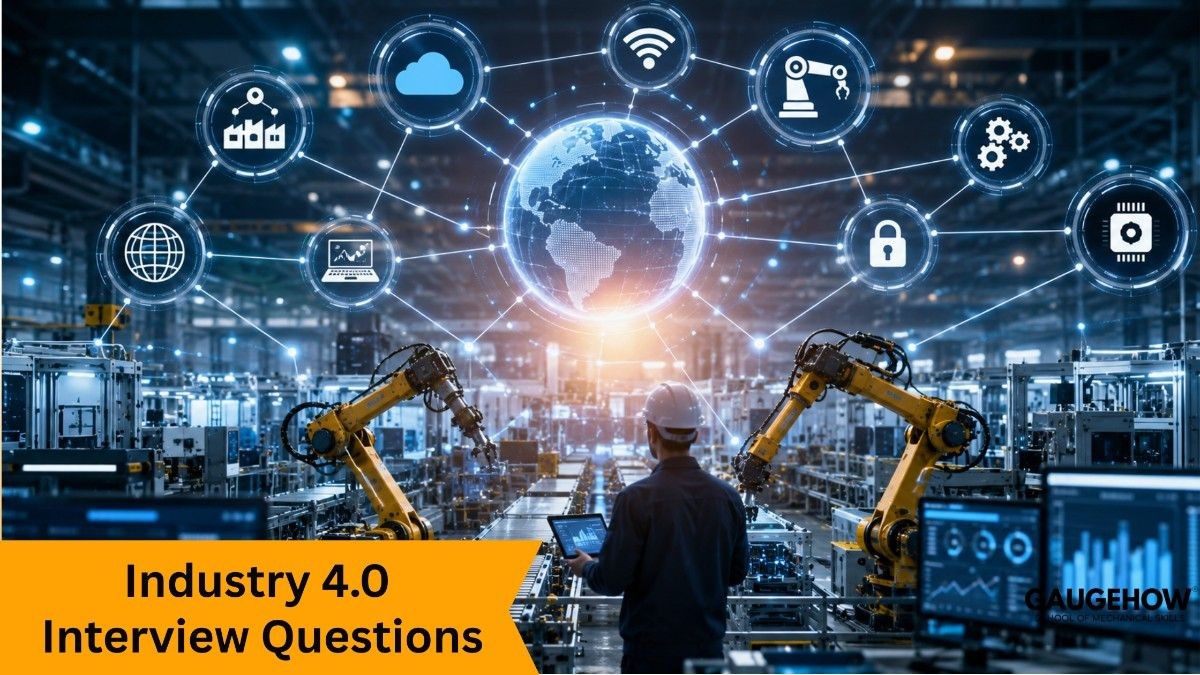
Industry 4.0 interviews test whether you understand how the individual pillars IIoT, big data, robotics, simulation actually connect into one smart manufacturing system, not just whether you can define each one separately. Interviewers want to see you understand the "why," not just the buzzwords.
General Industry 4.0 Questions
Q1. What is Industry 4.0, and how is it different from previous industrial revolutions?
Industry 4.0 refers to the current wave of manufacturing transformation built around connected, data-driven, and intelligent systems. The first three revolutions were mechanization, mass production, and automation, while this one adds real-time data, connectivity, and autonomous decision-making on top of existing automation.
GaugeHow's Introduction to Industry 4.0 course covers this evolution in detail. The core shift is machines and systems that communicate and adapt, not just execute fixed programs.
Q2. What are the nine pillars of Industry 4.0?
The nine pillars are Big Data and Analytics, Autonomous Robots, Simulation, Horizontal and Vertical System Integration, the Industrial Internet of Things, Cybersecurity, the Cloud, Additive Manufacturing, and Augmented Reality.
Each pillar represents a specific technology area, but they're most powerful when combined rather than implemented in isolation. Interviewers often ask you to name all nine, so having them memorized clearly helps.
Q3. What is a smart factory, and how does it relate to Industry 4.0?
A smart factory uses connected sensors, real-time data, and automated decision-making to optimize production continuously, rather than relying purely on fixed processes and periodic manual review.
It's essentially the practical application of Industry 4.0 pillars working together in a real production environment. Not every factory needs to implement all nine pillars to be considered "smart" the right combination depends on the specific operation.
Q4. What business problems does Industry 4.0 actually solve?
It addresses problems like unplanned downtime through predictive maintenance, quality issues through real-time monitoring, and slow decision-making through instant data visibility.
It also supports mass customization, letting manufacturers produce smaller batches efficiently without the setup penalty traditional processes carry. The value proposition is fundamentally about turning data into faster, better decisions.
Big Data and Analytics Questions
Q5. What role does Big Data play in Industry 4.0?
Big Data refers to the massive volume of data generated by connected sensors and systems across a modern plant, far more than traditional analysis methods can handle manually.
Analyzing this data reveals patterns, like early signs of equipment failure, that wouldn't be visible from periodic manual checks. The value isn't in collecting data alone but in turning it into actionable decisions.
Q6. What's the difference between descriptive, predictive, and prescriptive analytics in a manufacturing context?
Descriptive analytics summarizes what already happened, like a report on last month's downtime. Predictive analytics forecasts what's likely to happen next, like predicting a machine failure before it occurs.
Prescriptive analytics goes further, recommending specific actions to take based on that prediction, closing the loop from insight to action.
Q7. How do manufacturers use Big Data for predictive maintenance?
Sensor data on vibration, temperature, or current draw feeds into analytics models trained to recognize early failure patterns before a breakdown occurs.
This lets maintenance teams schedule repairs proactively instead of reacting to unplanned downtime. The accuracy of this prediction depends heavily on both good sensor data and enough historical failure data to train the model effectively.
Autonomous Robots Questions
Q8. How do Industry 4.0 robots differ from traditional industrial robots?
Traditional industrial robots typically execute fixed, pre-programmed paths with limited adaptability. Industry 4.0 robots increasingly incorporate sensors, connectivity, and sometimes AI to adapt to changing conditions, communicate with other systems, and work more safely alongside humans. This shift makes them more flexible for mixed-product lines than older, rigidly programmed equipment.
Q9. What is a collaborative robot, and how does it fit into Industry 4.0?
A collaborative robot, or cobot, is designed to work safely near humans without full physical guarding, using force limiting and sensors to detect contact.
It fits Industry 4.0's emphasis on flexible, human-machine collaboration rather than fully isolated automation. Cobots are especially useful for smaller manufacturers who need automation without a complete, isolated robotic cell.
Q10. How does connectivity change what autonomous robots can do in a smart factory?
Connected robots can share status and performance data with a central system, enabling coordinated scheduling across multiple machines rather than operating in isolation. They can also receive updated instructions dynamically based on real-time production needs, instead of requiring a manual reprogram for every change. That connectivity is what separates a simple automated robot from a true Industry 4.0 asset.
Simulation and Digital Twin Questions
Q11. How is simulation used differently in Industry 4.0 compared to traditional engineering simulation?
Traditional simulation is typically used during design, then set aside once the physical system is built. Industry 4.0 simulation, especially through digital twins, stays connected to the live system, continuously updated with real operational data.
GaugeHow's Digital Twins course covers building and maintaining this kind of live simulation model.
Q12. What is a digital twin, and what value does it provide?
A digital twin is a virtual model of a physical asset or process, continuously synced with real-time data from its physical counterpart. It lets engineers test changes, predict failures, or optimize performance without risking the actual equipment. This "test before you touch it" capability significantly reduces the risk and cost of process changes.
Q13. How can simulation reduce commissioning time for a new production line?
Simulating the line's layout and control logic before physical installation catches design errors, collisions, or bottlenecks early, when they're cheap to fix. Validating robot paths and PLC logic in simulation reduces costly on-site debugging once the real equipment arrives. This upfront investment in simulation often pays back significantly in reduced downtime during actual commissioning.
Horizontal and Vertical Integration Questions
Q14. What is horizontal integration in the context of Industry 4.0?
Horizontal integration connects systems across a supply chain, linking suppliers, manufacturers, and distributors so data flows smoothly across organizational boundaries.
It reduces delays and miscommunication that happen when each party relies on separate, disconnected systems. A supplier that can see real-time demand data, for example, can respond to changes far faster than one relying on periodic manual orders.
Q15. What is vertical integration, and how does it differ from horizontal integration?
Vertical integration connects systems within a single organization, from the shop floor sensors up through MES and ERP systems to executive reporting.
Horizontal integration, by contrast, connects across different organizations in a supply chain. Both matter, but vertical integration is usually the starting point most manufacturers tackle first internally.
Q16. Why is system integration considered one of the harder pillars to implement in practice?
Many plants run a mix of legacy equipment and newer systems that weren't originally designed to communicate with each other. Bridging that gap often requires middleware, protocol converters, or significant custom integration work.
Unlike a purely technical challenge, it also usually requires organizational alignment across departments that haven't historically shared data closely.
IIoT and Connectivity Questions
Q17. What is the Industrial Internet of Things, and how does it support the other Industry 4.0 pillars?
IIoT refers to connected sensors and devices that continuously collect and transmit data from physical equipment. GaugeHow's IIoT course covers how this sensor and connectivity layer supports nearly every other pillar, feeding data into analytics, digital twins, and predictive maintenance systems. Without IIoT's data collection, most other pillars would have little real-time information to work with.
Q18. What's the difference between IoT and IIoT?
IoT broadly covers connected devices across consumer and industrial contexts alike, like smart home devices. IIoT specifically refers to industrial applications, typically with stricter requirements for reliability, security, and real-time performance than consumer IoT devices need.
The stakes of a failed connection are also higher in an industrial setting, where downtime has direct production cost.
Q19. What are common challenges in deploying IIoT sensors across an existing plant?
Retrofitting sensors onto older equipment not originally designed for connectivity can be technically difficult and sometimes requires creative mounting or power solutions.
Network infrastructure in older facilities often needs upgrading to handle the added data traffic reliably. Data quality and consistency across a mix of new and legacy sensors is another common practical hurdle.
Cybersecurity Questions
Q20. Why does cybersecurity matter more in Industry 4.0 than in traditional manufacturing?
Traditional manufacturing equipment was often isolated from external networks, providing some natural protection.
Industry 4.0's connectivity, while enabling major benefits, also expands the attack surface significantly, connecting previously isolated industrial systems to broader networks. A cybersecurity breach in this context can cause physical process disruption, not just data loss.
Q21. What is network segmentation, and why is it important for industrial cybersecurity?
Network segmentation separates the industrial control network from the corporate IT network, limiting how far a breach in one can spread into the other. It's important because industrial systems often run legacy software that can't be patched as easily as standard IT systems, making isolation a critical protective layer. Skipping segmentation is one of the most common and serious industrial security mistakes.
Q22. How do you balance the connectivity Industry 4.0 requires against the security risks it introduces?
I'd apply segmentation, strong authentication, and monitoring specifically at the points where industrial and external networks connect, rather than avoiding connectivity altogether.
Limiting remote access to what's actually necessary, and auditing it regularly, reduces exposure without sacrificing the benefits connectivity provides. Security should be built into the connectivity design from the start, not added afterward.
Cloud Computing Questions
Q23. What role does cloud computing play in Industry 4.0 architecture?
Cloud platforms provide scalable storage and processing power for the massive data volumes Industry 4.0 systems generate, without requiring every plant to maintain that infrastructure locally.
It also enables centralized analytics and remote access across multiple facilities. Cloud adoption in industrial settings usually happens alongside, not instead of, local edge processing for time-sensitive tasks.
Q24. What's the difference between edge computing and cloud computing in this context?
Edge computing processes data locally, close to the equipment generating it, reducing latency for time-sensitive decisions. Cloud computing processes data at a centralized, often remote location, better suited for large-scale analytics that don't need instant response.
GaugeHow's Digital Manufacturing course covers how these two approaches typically work together in a modern architecture.
Q25. What concerns do manufacturers commonly raise about moving to cloud-based industrial systems?
Data security and network reliability are the most common concerns, since production can't afford to pause if a cloud connection drops. Latency for time-critical control decisions is another reason many manufacturers keep certain functions on local edge systems rather than the cloud. Regulatory or intellectual property concerns also factor in for some industries.
Additive Manufacturing and AR Questions
Q26. Why is additive manufacturing considered one of the Industry 4.0 pillars?
Additive manufacturing supports the mass customization and rapid iteration that Industry 4.0 emphasizes, producing complex, low-volume parts without traditional tooling costs.
GaugeHow's 3D Printing / Additive Manufacturing course covers the technology fueling this shift. It also enables faster prototyping cycles that align with data-driven, iterative design approaches.
Q27. How is augmented reality used in an Industry 4.0 manufacturing environment?
Augmented reality overlays digital information, like assembly instructions or equipment diagnostics, directly onto a technician's view of the physical equipment.
It's used for training, remote expert assistance, and maintenance guidance, reducing errors and ramp-up time for new operators. Adoption is still growing, often starting with maintenance and training use cases before broader deployment.
Q28. How do additive manufacturing and simulation pillars work together?
Simulation can validate a part's design and expected performance before it's ever printed, reducing wasted material and iteration cycles. For complex additive geometries especially, simulating stress and thermal behavior catches design flaws that would be expensive to discover after printing. This combination shortens the overall design-to-production timeline significantly.
Scenario and Behavioral Questions
Q29. How would you prioritize which Industry 4.0 pillar to implement first in a plant with a limited budget?
I'd start with whichever pillar addresses the plant's most costly existing problem, often IIoT for visibility or predictive maintenance for downtime reduction, rather than trying to implement everything at once.
A focused pilot project that demonstrates clear ROI builds the case for further investment. Spreading limited budget too thin across all nine pillars usually produces weaker results than a focused start.
Q30. Describe how you'd explain the value of Industry 4.0 investment to a skeptical plant manager.
I'd focus on a specific, measurable problem they already care about, like unplanned downtime cost, rather than a broad pitch about digital transformation.
Showing a concrete example, like predictive maintenance catching a failure before it happened elsewhere, builds more trust than theoretical benefits. Skeptics respond to demonstrated results, not buzzwords.
FAQ
Do I need to memorize all nine pillars for an Industry 4.0 interview?
Yes, being able to name and briefly explain all nine Big Data, Autonomous Robots, Simulation, Integration, IIoT, Cybersecurity, Cloud, Additive Manufacturing, and Augmented Reality is one of the most commonly asked questions in these interviews.
What's the difference between Industry 4.0 and digital transformation?
Industry 4.0 specifically refers to manufacturing-focused technology adoption built around these nine pillars. Digital transformation is a broader business term that can apply to any industry, not just manufacturing.
Is Industry 4.0 only relevant for large manufacturers?
No, though large manufacturers often adopt it faster due to available budget. Smaller manufacturers increasingly adopt individual pillars, like IIoT sensors or cobots, without implementing the full architecture at once.
What skills should I highlight in an Industry 4.0 interview?
Familiarity with data analysis, IIoT concepts, and at least one specific pillar in depth, paired with a real example of implementing or working with connected manufacturing technology, makes for a strong interview answer.
How is Industry 5.0 different from Industry 4.0?
Industry 5.0 builds on 4.0's technology foundation but shifts focus toward human-centric design, sustainability, and resilience, rather than technology adoption alone. It's a newer, still-evolving concept in most industry discussions.
Conclusion
Industry 4.0 interviews reward candidates who understand how the nine pillars connect into one coherent smart manufacturing strategy, not just isolated buzzwords.
Prepare a specific example tied to one pillar, like a predictive maintenance program or a digital twin project, and be ready to explain the measurable business value it delivered.
To build the technical foundation behind these interview topics, GaugeHow's Introduction to Industry 4.0 course covers all nine pillars in practical depth, while IIoT and Digital Twins build the connected-systems skills these interviews increasingly test for.