Vehicle Dynamics Interview Questions and Answers

Deepak S Choudhary
Learn More in This Video
Subscribe to GaugeHow for More
Vehicle dynamics interviews cover a lot of ground fast tires, suspension, stability systems, and simulation, often in the same breath. Interviewers want to see you understand not just the theory, but how it actually translates to how a car feels on the road.
Vehicle Dynamics Fundamentals Questions
1. What is vehicle dynamics, and why is it its own engineering discipline?
Vehicle dynamics studies how a vehicle responds to driver inputs, road conditions, and outside forces. It blends mechanical design, control systems, and ride perception. A car can have great components and still handle poorly if the dynamics aren't tuned right.
2. What are the three main axes of vehicle motion?
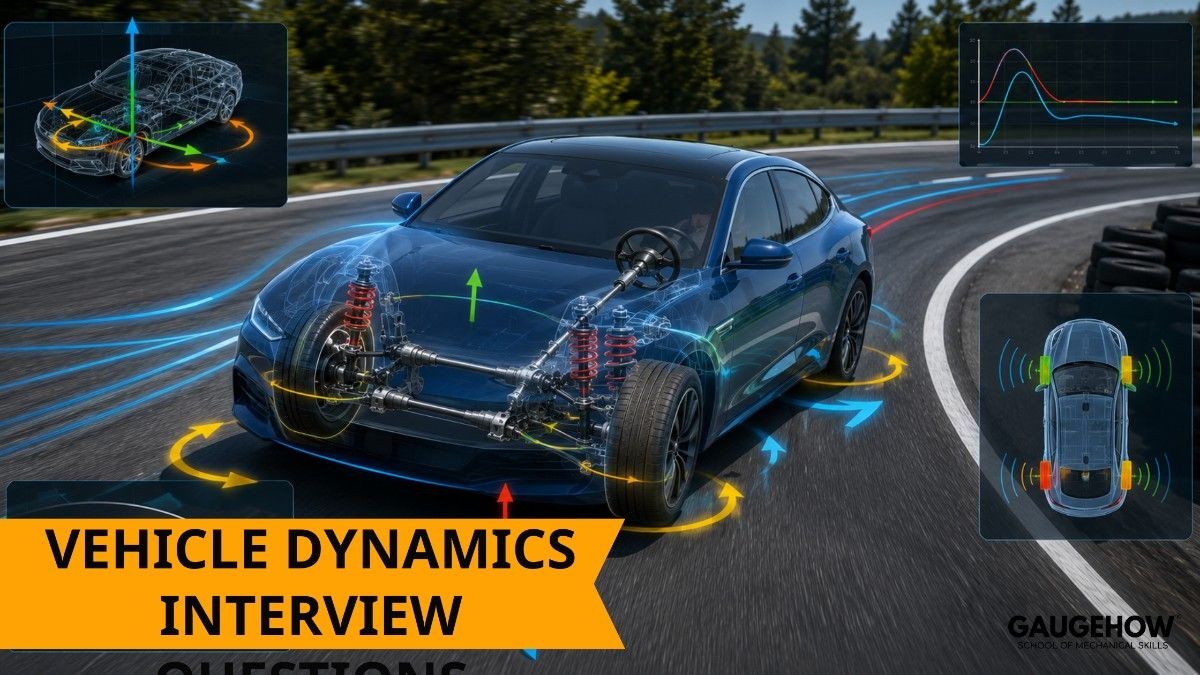
Longitudinal covers acceleration and braking, lateral covers cornering, and vertical covers ride and bump response. Most analysis looks at how these combine, like braking mid-corner. Roll, pitch, and yaw describe rotation around these same axes.
3. What is the difference between understeer and oversteer?
Understeer is when the front tires lose grip first, so the car turns less than intended. Oversteer is when the rear loses grip first, causing the back to slide out. Most production cars lean toward mild understeer because it's more predictable.
4. How does center of gravity location affect handling?
A lower center of gravity reduces weight transfer and improves stability during hard maneuvers. Its front-to-rear position also shapes the understeer/oversteer balance. This is why lowering it is a common motorsport modification.
5. What is weight transfer, and why does it matter?
Weight transfer shifts load between tires during acceleration, braking, or cornering. Braking shifts weight forward, cornering shifts it to the outside tires. This changes how much grip each tire actually has at the limit.
6. What's the difference between ride and handling?
Ride is how comfortably a vehicle absorbs bumps, driven mainly by damping and spring rates. Handling is how precisely it responds to steering, braking, and throttle. The two usually involve tradeoffs against each other.
Tires and Handling Questions
7. What is tire slip angle?
Slip angle is the gap between where a tire points and where it's actually traveling. Lateral force builds as slip angle increases, up to a peak, then drops off. This is key to predicting grip near the limit.
8. What is the tire friction circle?
It represents the total grip a tire can produce for braking, cornering, or both combined. Using more grip for braking leaves less for cornering, and vice versa. This is why braking hard mid-corner easily exceeds available grip.
9. Why does dynamic tire load matter more than static load?
Static load is simple weight distribution at rest. Dynamic load shifts constantly from acceleration, braking, and cornering forces. Since grip scales with load, this constantly changes how much traction is actually available.
10. How does tire pressure affect handling and ride?
Higher pressure increases cornering stiffness and lowers rolling resistance but can harden the ride. Lower pressure grows the contact patch but raises heat and rolling resistance if too low. Mismatched front/rear pressure also shifts handling balance.
11. What causes aquaplaning?
Water builds up between tire and road faster than the tread can clear it. Speed, tread depth, tire pressure, and water depth all play a role. Wider tires are generally more prone to it than narrower ones.
12. What is camber, and how does it affect grip?
Camber is the tire's tilt relative to vertical when viewed from the front. Negative camber keeps more tread flat during cornering as the body rolls. Too much reduces straight-line braking and acceleration grip.
Suspension and Ride Questions
13. What's the difference between spring rate and damping rate?
Spring rate controls how much force compresses the suspension a given distance. Damping rate controls how quickly that motion settles afterward. Both need to be tuned together, not separately.
14. What does an anti-roll bar do?
It connects left and right suspension on an axle to resist body roll in corners. Stiffer bars reduce roll and sharpen handling feel. Changing one axle's stiffness relative to the other also shifts understeer/oversteer balance.
15. Independent versus dependent suspension what's the difference?
Independent suspension lets each wheel move without directly affecting the other side. Dependent, or solid axle, suspension links both wheels rigidly. Independent is standard on cars; solid axles remain common on heavy trucks.
16. Why does unsprung mass matter for handling?
Unsprung mass includes wheels, tires, brakes, and part of the suspension itself. Lower unsprung mass lets the suspension react faster to bumps, keeping tires in better contact with the road. Lighter wheels are a common fix for this.
17. What is roll center?
Roll center is a theoretical point the body rolls around during cornering, set by suspension geometry. Its height relative to the center of gravity affects how much the body rolls. A poorly matched roll center creates unpredictable handling.
Vehicle Stability and Control Systems Questions
18. How does Electronic Stability Control (ESC) work?
ESC compares the driver's intended path against the car's actual path using yaw and lateral sensors. When it detects a mismatch, it brakes individual wheels to help correct the trajectory. It's now mandatory in most markets due to its safety impact.
19. What's the difference between ABS and traction control?
ABS prevents wheel lockup during braking to maintain steering and shorten stopping distance. Traction control prevents wheel spin during acceleration by cutting power or braking a spinning wheel. Both rely on similar wheel speed sensors.
20. What does a yaw rate sensor measure?
It measures how fast a vehicle is rotating around its vertical axis. This is compared against steering input to detect unintended spinning or sliding. It's a core input for stability control systems like ESC.
21. What is torque vectoring?
It actively splits engine torque differently between wheels to improve cornering. Sending more torque to the outside wheel helps rotate the car into a turn, reducing understeer. It's increasingly common in EVs with independent motor control.
Simulation, Testing, and Analysis Questions
22. What is a bicycle model in vehicle dynamics simulation?
It simplifies a four-wheeled car into a two-wheeled model for basic lateral dynamics analysis. It captures core understeer/oversteer behavior without full vehicle complexity. Engineers often start here before moving to detailed models.
23. What software tools are common in vehicle dynamics work?
MATLAB and Simulink handle control system development and simplified dynamics modeling. Multi-body dynamics software covers detailed suspension kinematics. ANSYS handles structural analysis that feeds into overall vehicle behavior.
24. What does a skid pad test measure?
It drives a vehicle in a constant circle at rising speed until tires reach their grip limit. This gives maximum steady-state lateral acceleration, usually in g-force. It doesn't capture transient handling behavior like sudden steering response.
25. What is a double lane change test?
It simulates an emergency obstacle avoidance maneuver, testing transient handling rather than steady-state grip. It's key for evaluating how well stability control prevents loss of control. Regulators often include variations of this test in safety evaluations.
26. How is Hardware-in-the-Loop (HIL) testing used here?
HIL connects real control hardware, like an ESC module, to a simulated vehicle model running in real time. This cuts cost and risk compared to testing every change on a physical car. It also allows safely testing extreme, dangerous scenarios.
Advanced and Scenario-Based Questions
27. A car feels "twitchy" on the highway but tests fine on a skid pad. How would you investigate?
Skid pad tests steady-state grip, not transient response, so I'd look elsewhere first. I'd check suspension damping, since underdamping causes excess body motion during quick inputs. I'd also review steering tuning for excess sensitivity near center.
28. How would you fix excessive understeer without hurting high-speed stability?
I'd start with the front/rear anti-roll bar balance, softening front or stiffening rear. I'd also check tire pressure and camber settings for a quick, low-cost fix. Any change gets validated at both low and high speed before finalizing.
29. How would you validate a new vehicle dynamics simulation against real test data?
I'd run the same maneuvers, like a skid pad or lane change, in both simulation and physical testing. I'd compare lateral acceleration and yaw rate between the two. Mismatches usually trace back to inaccurate tire model parameters.
30. Where is vehicle dynamics heading with EVs and driver assistance systems?
EVs with independent motor control are enabling far more advanced torque vectoring. Driver assistance systems are increasingly blending with stability control to predict loss of control earlier. Engineers who pair strong simulation skills, like MATLAB, with Digital Twins knowledge will be well positioned here.
FAQ
Do I need a motorsport background for vehicle dynamics roles?
Not necessarily, though it helps build intuition for handling limits. Many engineers build their foundation through simulation and passenger vehicle work instead.
Is coding experience important for this field?
Yes, increasingly so, since much of the work now involves building and validating simulation models. A course like C and C++ for Mechanical Engineering is a genuinely useful skill here.
What's the biggest mistake candidates make in these interviews?
Explaining concepts purely in theory without connecting them to how a car actually feels to a driver. Interviewers want practical, felt understanding, not just textbook definitions.
How important is tire knowledge compared to other topics?
Very important, since tires are the only contact point with the road. Nearly every handling trait ultimately traces back to tire behavior.
Should I mention personal driving experience in the interview?
Yes, if it's relevant and tied back to a real engineering concept. A specific, well-explained observation is far more convincing than a general impression.
Conclusion
Vehicle dynamics interviews reward candidates who connect tires, suspension, and control systems into one clear picture of how a car actually behaves. Use these 30 questions to build intuition around weight transfer, handling balance, and how modern stability systems work in real time.
If you want to sharpen your simulation skills before your next interview, the MATLAB course is a solid, practical starting point.