DELMIA Apriso
DELMIA Apriso

DELMIA Apriso: Features, Pricing, Comparisons and Honest Review (2026)
If DELMIA Apriso is on your manufacturing software shortlist, this guide gives you everything you need to make a confident decision.
No marketing language — just a clear breakdown of what it does, what it costs, and whether it is the right fit for your operation.
What Is DELMIA Apriso?
One-line definition: DELMIA Apriso is a Manufacturing Operations Management (MOM) and MES platform that helps large manufacturers synchronize and control production across multiple plants globally.
Apriso is made by Dassault Systèmes — the French software company behind CATIA, SolidWorks, SIMULIA, and ENOVIA. It sits inside Dassault's 3DEXPERIENCE platform, which connects product design, simulation, PLM, and shop floor execution in one ecosystem.
What separates Apriso from most MES tools is its focus on multi-site process standardization.
A manufacturer running 12 plants across 6 countries can define one production process, one quality workflow, and one set of operating standards — and deploy them identically to every location from a single platform. When a process is updated, every site gets the change simultaneously.
That capability is what makes Apriso a serious contender in aerospace, automotive, and industrial equipment — industries where consistency across global supply chains is not optional.
DELMIA Apriso Key Features
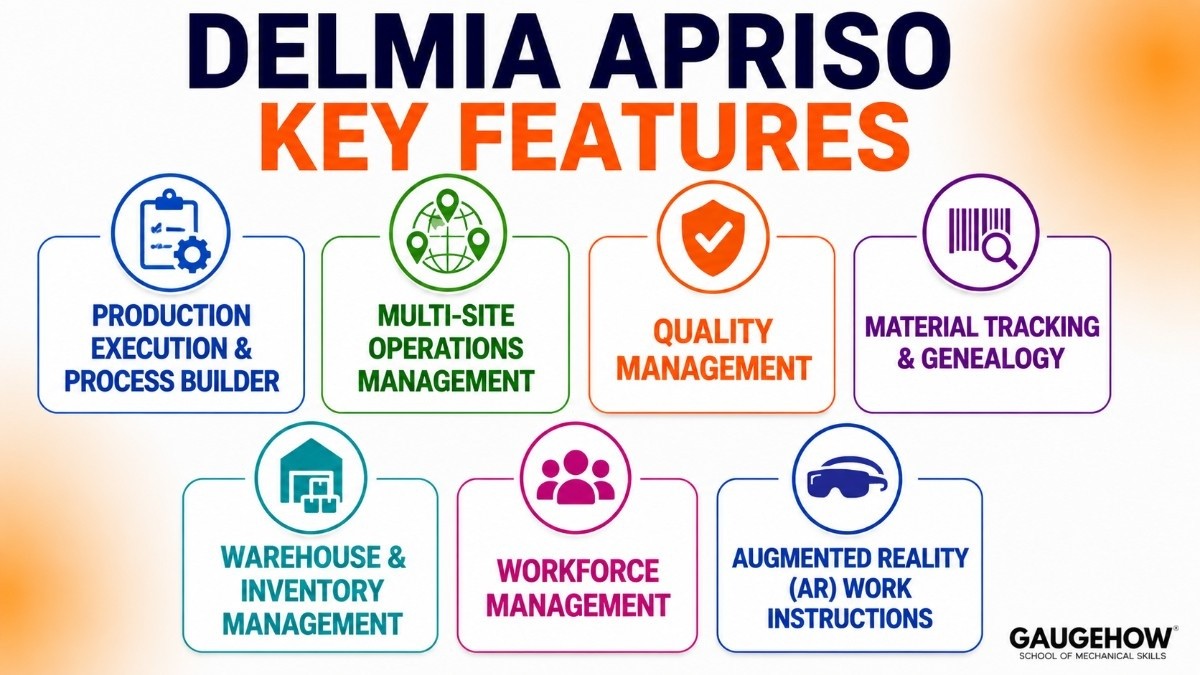
Production Execution & Process Builder
DELMIA Apriso manages production orders with digital workflows, work instructions, and automated tracking. Its Process Builder allows engineers to create and deploy production processes visually without coding.
Multi-Site Operations Management
Designed for global manufacturers, Apriso connects multiple plants into one system. Production, inventory, quality, and workforce data are visible across all facilities in real time.
Quality Management
Quality controls are built directly into production workflows. Features include SPC monitoring, non-conformance management, CAPA workflows, and electronic audit trails.
Material Tracking & Genealogy
Apriso provides complete product traceability by tracking materials, batches, machines, and operators throughout the manufacturing process.
Warehouse & Inventory Management
The platform includes built-in warehouse operations such as receiving, storage, picking, replenishment, and shipping, creating a seamless link between inventory and production.
Workforce Management
Tracks operator certifications, labor hours, and task assignments while ensuring only qualified personnel perform specific operations.
Augmented Reality (AR) Work Instructions
AR-enabled guidance delivers step-by-step assembly instructions through mobile devices or smart glasses, helping reduce errors in complex manufacturing environments.
DELMIA Apriso vs Siemens Opcenter vs SAP
This is the comparison that matters most for enterprise manufacturers. All three platforms are Gartner and IDC leaders.
All three target large, complex manufacturing environments. Choosing between them largely depends on which technology ecosystem you already live in.
Side-by-Side Comparison
Capability | DELMIA Apriso | Siemens Opcenter | SAP Digital Manufacturing |
|---|---|---|---|
Made by | Dassault Systèmes | Siemens | SAP SE |
Best ecosystem fit | CATIA / ENOVIA | Siemens Xcelerator / Teamcenter | SAP S/4HANA |
Multi-site global management | Best in class | Strong | Strong |
PLM integration | Native (Dassault) | Native (Siemens Teamcenter) | Moderate |
Pharmaceutical / GxP | Moderate | Very strong | Moderate |
Semiconductor | Weak | Very strong | Moderate |
Automotive | Very strong | Strong | Strong |
Aerospace | Very strong | Strong | Moderate |
Cloud option | 3DEXPERIENCE cloud | Opcenter X | SAP DMC |
Typical implementation | 12–24 months | 9–18 months | 9–15 months |
Best fit for SMEs | Low | Low to moderate | Low |
DELMIA Apriso vs Siemens Opcenter
Both are enterprise MOM platforms with genuine global multi-site capabilities. The decision between them usually comes down to your existing engineering stack.
Choose Apriso if your engineering team runs on CATIA or ENOVIA. The PLM-to-production integration is Apriso's single strongest differentiator — no other MES connects to Dassault's design tools with the same depth and bidirectionality.
Aerospace and automotive manufacturers in the Dassault ecosystem benefit most from this.
Choose Siemens Opcenter if your automation infrastructure uses Siemens Simatic hardware or Teamcenter for PLM, or if you are in pharmaceutical or semiconductor manufacturing where Opcenter has more mature, purpose-built compliance functionality.
DELMIA Apriso vs SAP Digital Manufacturing
This comparison is fundamentally about ERP strategy.
Choose SAP Digital Manufacturing if your organization runs SAP S/4HANA end-to-end and your primary need is tight ERP-to-shop-floor integration with minimal middleware. The tradeoff is reduced flexibility outside the SAP ecosystem.
Choose DELMIA Apriso if your main challenge is multi-plant production standardization, PLM integration, or complex discrete assembly — rather than ERP connectivity as the primary driver. Apriso integrates well with SAP but does not require it.
The Honest Bottom Line
If you are already embedded in one of these three ecosystems — Dassault, Siemens, or SAP — the practical answer is usually to stay there. Integration advantages within an ecosystem are real and significant.
If you are genuinely platform-agnostic, evaluate based on your primary operational challenge: multi-site process standardization and PLM leans toward Apriso; deep regulated industry compliance leans toward Opcenter; maximum SAP alignment leans toward SAP DMC.
Apriso MES: Pricing
How DELMIA Apriso Is Priced
Dassault Systèmes does not publish pricing for Apriso. It is sold through a direct enterprise sales team and certified implementation partners. Pricing is customized based on:
Number of plants and production lines in scope
Modules selected — execution, quality, warehousing, workforce, analytics
Number of users or concurrent sessions
Deployment model — 3DEXPERIENCE cloud or on-premises
Implementation and customization services
Free Trial or Demo
There is no self-service free trial. Dassault Systèmes offers structured product demonstrations through their sales team and certified partners.
Academic access is available through the 3DEXPERIENCE Education program for qualifying institutions. Commercial evaluation begins with a sales conversation — there is no shortcut around this.
Pros and Cons
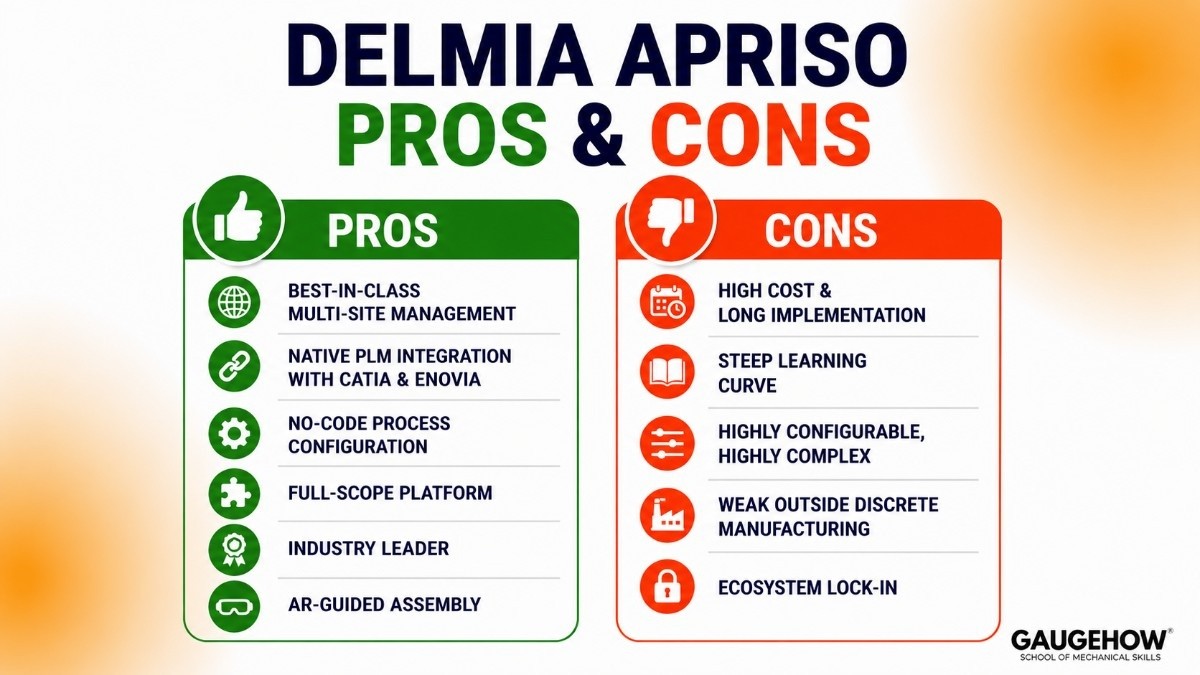
What DELMIA Apriso Does Well
Multi-site global management is genuinely best in class — few enterprise MES platforms handle globally distributed production with the same depth and real-time visibility
PLM-to-production integration with CATIA and ENOVIA is tighter than any third-party MES can match — engineering changes flow directly into production workflows without manual re-entry
Process Builder gives manufacturers real configuration flexibility without requiring custom code — a capability that most enterprise MES platforms do not offer at this level
Full scope in one platform — execution, quality, warehousing, workforce, and analytics without needing separate specialist tools stitched together
Recognized by Gartner, IDC, and ABI Research as a consistent leader in the MOM/MES category for large, complex manufacturing
AR-guided assembly is a practical, production-ready capability — not a prototype feature
Where DELMIA Apriso Falls Short
High cost and long timeline — implementations typically run 12 to 24 months and require experienced, certified consultants. This is not a platform you deploy in a quarter
Steep learning curve — user reviews consistently note that Apriso requires skilled staff to operate day-to-day, not just to implement. It is not designed for casual business users
Highly configurable means highly custom — because Process Builder lets you configure almost anything, every deployment is unique. This makes upgrades, staff changes, and long-term support more complex than with more opinionated platforms
Weak outside discrete manufacturing — pharmaceutical batch manufacturing, continuous process industries, and semiconductor fabs are better served by Siemens Opcenter or specialist platforms like Werum PAS-X
Ecosystem lock-in — the deeper you go with 3DEXPERIENCE, the harder integrations with non-Dassault tools become over time
Best For
Industries Where Apriso Performs Strongest
Automotive — multi-plant production networks, IATF 16949 quality compliance, WIP tracking, CATIA integration for vehicle component manufacturing
Aerospace and defense — part-level serialization, AS9100 traceability, complex assembly guidance, decades-long genealogy requirements
Industrial equipment — complex make-to-order and engineer-to-order production with frequent engineering changes flowing from design into production
Consumer goods — high-volume multi-SKU manufacturing across global facilities that need standardized processes at every site
Electronics manufacturing — component traceability, complex assembly, and quality-driven production workflows
Ideal Plant Size and Setup
Apriso is built for large enterprises — manufacturers with 1,000 or more employees, multiple production facilities in different countries, and dedicated engineering and IT teams to support the platform long-term.
The strongest use case is an organization already using CATIA or ENOVIA for product lifecycle management that needs the manufacturing execution side to match the sophistication of its engineering environment.
Manufacturers with fewer than 500 employees, fewer than three production sites, or limited IT resources will almost always find Apriso overbuilt and hard to justify. DELMIA Works, Plex, or Tulip are more realistic starting points for that profile.
Integrations
PLM and Engineering
CATIA and ENOVIA (Dassault Systèmes) — native, bidirectional. Engineering BOMs, drawings, and change orders flow directly from ENOVIA into Apriso production workflows without middleware
3DEXPERIENCE platform — Apriso shares data models, user management, and dashboards with all other 3DEXPERIENCE applications
SIMULIA — simulation results can inform process parameters and quality thresholds in production
ERP Systems
SAP S/4HANA and SAP ECC — production orders, materials management, and financial postings synchronized bidirectionally; one of the most common Apriso integration deployments in the field
Oracle — production order and inventory synchronization through standard APIs
Microsoft Dynamics 365 — supported through certified partner-built connectors
Shop Floor and Automation
OPC-UA — open standard for connecting PLCs, SCADA systems, and industrial equipment from any vendor without proprietary drivers
Siemens Simatic and Rockwell Allen-Bradley — connected through OPC-UA in most deployments
RFID and barcode scanning systems — native support for material tracking, component identification, and operator authentication
Vision inspection systems — integration available for automated quality data capture directly from inspection stations
Analytics and IoT
3DEXPERIENCE analytics dashboards — native KPI reporting within the Dassault platform
SAP Analytics Cloud, Microsoft Power BI, Tableau — commonly connected through standard database connectors for custom reporting outside the Dassault environment
IIoT platforms — integration with industrial IoT data collection layers for machine performance and OEE monitoring
Deployment
On-Premises
The traditional Apriso deployment model — the software runs on servers within the manufacturer's own data center or factory IT infrastructure.
This gives full control over data security, customization, and system availability. Most aerospace, defense, and government-regulated manufacturers choose this model for security clearance and data sovereignty reasons.
3DEXPERIENCE Cloud
Hosted and managed by Dassault Systèmes on their cloud infrastructure. This reduces the IT overhead of managing on-premises servers and enables automatic updates without internal upgrade projects.
Data residency options are available for manufacturers with regional data compliance requirements. New Apriso deployments increasingly favor this model.
Hybrid
A combination of cloud-based corporate visibility and local on-premises execution at individual plants.
Used by manufacturers who want enterprise-level dashboards and coordination through the cloud but need local data processing at plant level due to connectivity limitations or regulatory constraints.
Brownfield Readiness
Apriso is designed to integrate into existing factory environments without replacing current equipment. OPC-UA connectivity allows existing machines, PLCs, and sensors to be connected to the platform using open standards.
The vast majority of Apriso implementations are brownfield — the platform layers over what is already there rather than replacing it.
Alternatives to DELMIA Apriso
Siemens Opcenter
A strong alternative for large manufacturers. It is widely used in pharma and semiconductor industries and works well with Siemens factory systems.
SAP Digital Manufacturing
Best for companies already using SAP systems like SAP S/4HANA. It offers strong ERP integration and cloud-based manufacturing management.
Plex by Rockwell Automation
A cloud-based MES that is easier and faster to deploy. It is a good choice for mid-sized manufacturers and automotive suppliers.
Körber Werum PAS-X
Designed mainly for pharmaceutical manufacturing. It offers strong compliance and batch production management.
Tulip
A low-code platform for quickly digitizing shop floor operations. It is best for smaller factories and fast implementation projects.
Frequently Asked Questions
What is DELMIA Apriso used for?
DELMIA Apriso helps manufacturers manage production across multiple plants. It controls production orders, quality checks, material tracking, warehouse operations, and workforce activities in one connected system.
Is DELMIA Apriso cloud-based?
Yes, it supports cloud, on-premises, and hybrid deployment. Most new companies prefer cloud deployment, while industries with strict security needs often choose on-premises setup.
How long does DELMIA Apriso implementation take?
Implementation usually takes 12 to 24 months for large manufacturers. The timeline depends on factory size, workflow complexity, and integration requirements.
What is Process Builder in DELMIA Apriso?
Process Builder is a visual workflow tool inside Apriso. It helps manufacturers create and manage production processes without heavy coding.
Does DELMIA Apriso work with SAP?
Yes, Apriso integrates well with SAP S/4HANA and SAP ECC. It can also connect with Oracle, Microsoft Dynamics, and other ERP systems.
Is DELMIA Apriso suitable for small manufacturers?
Usually no. It is designed for large companies with multiple plants and complex manufacturing operations.
Final Thoughts
DELMIA Apriso is a strong choice for large manufacturers managing global production operations. It is especially useful for companies already using Dassault systems.
It requires time, budget, and technical expertise to implement. But for businesses with complex manufacturing needs, it offers strong process control and multi-site standardization.
DELMIA Apriso is Dassault Systèmes' MOM and MES platform for global manufacturers. Learn features, pricing, and how it compares to SAP and Siemens.