Rockwell Plex
Rockwell Plex

Rockwell Plex: The Complete Guide for Manufacturers (2026)
If you are evaluating manufacturing software and Plex keeps coming up in your research, this guide is for you. We cover what Plex actually does, how it is priced, who it works best for, and how it stacks up against other platforms — without the marketing language.
What Is a Smart Manufacturing Platform?
Before getting into Plex specifically, it helps to understand the category it sits in.
The Simple Explanation
A smart manufacturing platform is software that connects your factory floor to your business systems — and keeps both in sync in real time. It tracks what is being produced, how fast, at what quality level, and flags problems before they become costly.
Traditional factories run on a mix of paper records, spreadsheets, and disconnected tools. A smart manufacturing platform replaces all of that with a single, connected system.
Operators see live production data. Managers see OEE (Overall Equipment Effectiveness) dashboards. The ERP gets accurate inventory numbers automatically.
Where Plex Fits In
Most manufacturing software tools solve one piece of the puzzle. An MES handles shop floor execution. An ERP handles financials and supply chain. A quality system handles inspections and compliance.
Plex is different because it attempts to cover all three in one platform. That is its main selling point — and also the reason some manufacturers find it more than they bargained for.
Plex Manufacturing Software: Overview
One-line definition: Plex is a cloud-native manufacturing platform that combines production execution, quality management, supply chain, and ERP in a single system.
Plex was founded in 1995 — long before "cloud manufacturing" was a common phrase — as one of the first browser-based platforms built specifically for factory operations.
It spent two decades proving the model in automotive and food manufacturing before Rockwell Automation acquired it in 2021 for $2.22 billion.
Since the acquisition, Plex has been integrated into Rockwell's FactoryTalk software portfolio and positioned as the company's flagship cloud manufacturing platform. Rockwell now calls it an "elastic MES" — meaning it is modular and scales as manufacturers add capabilities over time.
It is used by over 700 manufacturers globally, with particularly deep penetration in automotive, food and beverage, life sciences, and consumer packaged goods.
Plex MES: Key Features
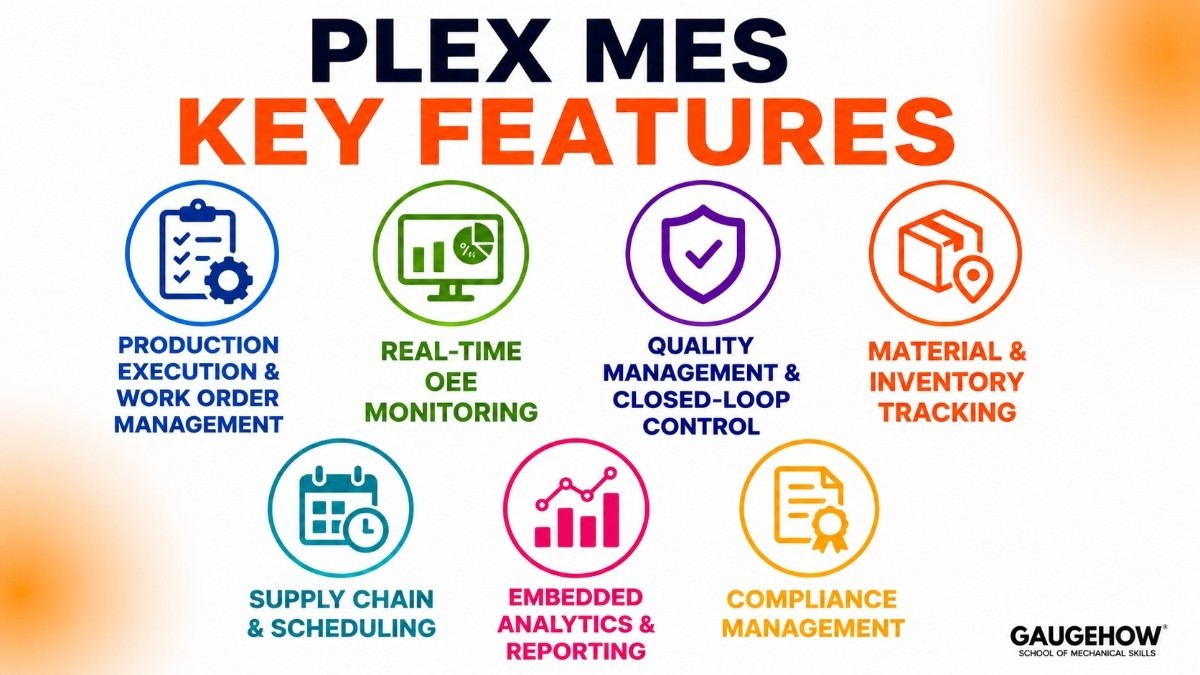
Production Execution and Work Order Management
Plex manages production orders from release to completion. Operators receive step-by-step instructions on screen, and every action — scan, entry, confirmation — is recorded with a timestamp and user ID. There are no paper travelers, no end-of-shift data entry. The system records everything as it happens.
Real-Time OEE Monitoring
Overall Equipment Effectiveness is calculated continuously from machine data and operator inputs. You see availability, performance, and quality metrics updated live — not reconstructed from reports the next morning. Downtime events are logged automatically, categorized by cause, and fed into reports that help identify patterns over time.
Quality Management and Closed-Loop Control
Quality checks are embedded directly into the production workflow. Operators cannot skip inspection steps or move a job forward without completing the required checks. When a defect is detected, Plex can automatically hold affected material, trigger a non-conformance workflow, and notify the quality team — all without manual intervention.
This closed-loop quality model is one of the reasons Plex is popular in automotive manufacturing, where customer-specific quality requirements are strict and audit trails are mandatory.
Material and Inventory Tracking
Plex tracks every raw material, work-in-progress item, and finished good in real time. Inventory levels update automatically as materials are consumed or moved. This feeds directly into production planning — if a component is low, the system flags it before the line runs out.
For food and beverage manufacturers, this same tracking system supports lot traceability and recall management. If a supplier issues a recall, you can identify every product that used that batch within minutes.
Supply Chain and Scheduling
Plex includes tools for production scheduling, purchase order management, and supplier collaboration. This is part of what separates it from a standalone MES — it extends beyond the shop floor into the supply chain that feeds it.
The scheduling engine accounts for machine capacity, labor availability, and material constraints when generating a production plan. When conditions change (a machine goes down, a supplier is late), the plan updates accordingly.
Embedded Analytics and Reporting
Plex comes with pre-built dashboards and reports covering production performance, quality metrics, inventory, and financial KPIs. For manufacturers who need custom reports, there is a built-in reporting tool that does not require IT involvement for most tasks.
Since Rockwell acquired the platform, AI-driven insights have been added — flagging anomalies, predicting downtime, and surfacing improvement opportunities across the dataset.
Compliance Management
For regulated industries, Plex supports FDA 21 CFR Part 11, SQF (food safety), IATF 16949 (automotive quality), and ISO 9001 compliance workflows. Audit trails, electronic signatures, and controlled documents are built into the platform — not added as afterthoughts.
Pricing
How Plex Is Priced
Plex does not publish pricing on its website. It is sold through Rockwell Automation's sales team and certified implementation partners, with pricing tailored to the manufacturer's size, modules required, and deployment scope.
Pricing is subscription-based (SaaS), which means you pay an annual fee rather than a large upfront license cost. This is one of the financial advantages over traditional on-premises MES platforms.
What to Budget For
Based on publicly available data and analyst reports, typical Plex pricing for a mid-sized manufacturer falls in the range of $80,000 to $300,000 per year for the core platform, depending on the number of production lines, users, and modules. Implementation services — which are significant — are billed separately, typically adding $150,000 to $500,000 for the initial deployment.
Total first-year cost for a mid-market manufacturer is commonly in the $300,000 to $700,000 range, including software and implementation.
Free Trial or Demo
There is no self-service free trial. Plex offers product demonstrations through their sales team. If you want to evaluate the platform, the process starts with a discovery call and a customized demo based on your industry and requirements. Contact Rockwell or a Plex-certified partner to request one.
Pros and Cons
Pros of Plex MES
✅ Cloud-Native Platform
Built for the cloud from the start, making updates and maintenance easier.
✅ Great for Automotive & Food Manufacturing
Comes with many industry-specific features out of the box, reducing customization work.
✅ All-in-One Solution
Combines MES, ERP, and Quality Management in one platform, reducing software complexity.
✅ Multi-Plant Support
Works well for manufacturers managing multiple facilities.
✅ Automatic Updates
New features and improvements are delivered through regular cloud updates.
✅ Strong Rockwell Integration
Excellent choice for companies already using Allen-Bradley and Rockwell Automation equipment.
Cons of Plex MES
❌ Large ERP Migration May Be Required
Adopting Plex often means replacing your existing ERP system, making projects larger and more complex.
❌ Limited Customization
Works well for standard processes, but highly unique manufacturing workflows can be difficult to adapt.
❌ Not Ideal for Highly Regulated Industries
Industries like semiconductors, aerospace, and pharmaceuticals may need more specialized MES platforms.
❌ Long Implementation Time
Even though it's cloud-based, deployment typically takes 6–12 months.
❌ Pricing Is Not Public
Costs are only available through the sales process, making budgeting harder during evaluation.
Quick Summary
Best For: Automotive, food & beverage, and mid-sized manufacturers looking for an all-in-one cloud platform.
Less Suitable For: Highly customized manufacturing processes, semiconductor fabs, aerospace programs, and pharmaceutical production environments.
Best For

Industries Where Plex Performs Best
Automotive manufacturing — deep IATF 16949 support, WIP tracking, supplier quality management, and integration with Allen-Bradley PLCs make it a natural fit for tier 1 and tier 2 suppliers
Food and beverage — lot traceability, SQF and FSMA compliance tools, and batch scheduling are purpose-built for this industry
Life sciences and medical devices — FDA 21 CFR Part 11 compliance, electronic batch records, and quality workflows
Consumer packaged goods — high-volume, repetitive manufacturing with multiple SKUs and multi-plant operations
Tires and rubber — Plex has a long history in this segment going back to its early automotive-focused days
Ideal Plant Size
Plex is best suited for small to mid-market manufacturers — typically companies with 50 to 2,000 employees, one to ten production facilities, and a need to move off spreadsheets or aging on-premises systems.
It is less suited for very large global enterprises with hundreds of sites, complex custom engineering workflows, or industries that require deep simulation and PLM integration (that is where platforms like Siemens Opcenter have the advantage).
When Plex Makes the Most Sense
The scenario where Plex genuinely shines is a mid-sized manufacturer that is running a fragmented system landscape — a legacy ERP that does not talk to the shop floor, paper-based quality records, and no real-time production visibility. Plex can replace all of that with one platform and one vendor relationship.
Integrations
ERP and Business Systems
Plex can integrate with external ERP systems if a manufacturer does not want to migrate to Plex's built-in ERP. Common integrations include:
SAP — bidirectional integration for production orders, materials, and financial data
Oracle — production order and inventory synchronization
Microsoft Dynamics 365 — supported through standard APIs and partner-built connectors
That said, Plex is designed to work best when its own ERP module is in use. External ERP integrations add complexity and require ongoing maintenance.
Shop Floor and Automation
Rockwell Allen-Bradley PLCs — native, deeply tested integration. This is a major reason Rockwell-heavy factories choose Plex — the shop floor connectivity is pre-built
OPC-UA — open standard for connecting to third-party machines and sensors from any manufacturer
Barcode and RFID scanners — supported out of the box for parts tracking, material movement, and operator identification
Vision systems — supported for automated quality inspection integration
Quality and Compliance
Statistical Process Control (SPC) — built-in, no third-party tool required
LIMS (Laboratory Information Management Systems) — integration available for life sciences manufacturers
EDI (Electronic Data Interchange) — for supplier and customer data exchange
Deployment
Cloud-Only (Primary Model)
Plex is a cloud-native SaaS platform hosted by Rockwell Automation. The application runs in your browser — no software to install on workstations, no servers to maintain on-site. This is the standard and recommended deployment model.
Cloud hosting means updates, security patches, and new features are applied automatically. Your IT team does not manage infrastructure for Plex — Rockwell does.
Hybrid Edge Deployment
For manufacturers with connectivity concerns — remote facilities, factories with strict data residency requirements, or sites with unreliable internet — Plex supports edge configurations that allow local data collection to continue even when the cloud connection is interrupted. Data syncs back to the cloud when connectivity is restored.
On-Premises
Plex does not offer a traditional on-premises deployment. If your factory environment strictly requires on-premises software for security or regulatory reasons, Plex is not the right choice — and platforms like Siemens Opcenter or Rockwell's own FactoryTalk MES would be more appropriate.
Brownfield Readiness
Plex is well-suited for brownfield installations — factories with existing machines, automation systems, and processes already in place. The OPC-UA connectivity and Allen-Bradley integration mean you do not need to replace equipment to connect to Plex. Most implementations connect existing machines to the platform without hardware changes.
Plex vs Siemens Opcenter
This is the most direct competitive comparison in the mid-to-large MES market. Here is an honest breakdown.
What They Have in Common
Both Plex and Siemens Opcenter are enterprise-grade manufacturing platforms. Both support multi-site deployments, quality management, and ERP integration. Both are positioned as end-to-end manufacturing operations solutions. Both are IDC and Gartner-recognized leaders in the MES space.
Where They Diverge
Plex is cloud-native from the ground up. Deployment is faster, IT overhead is lower, and the out-of-the-box functionality for automotive and food manufacturing is strong. It is the better choice for manufacturers who want to avoid a 12–18 month implementation and do not need deep PLM or simulation integration.
Siemens Opcenter is the stronger choice for manufacturers in regulated industries (pharmaceutical, semiconductor, aerospace) where complex traceability, electronic batch records, or engineering change management are non-negotiable. It has deeper industry-specific functionality but also a longer, more expensive implementation.
Industry Fit Side by Side
Plex | Siemens Opcenter | |
|---|---|---|
Automotive | Strong | Strong |
Food and beverage | Very strong | Moderate |
Pharmaceutical / GxP | Moderate | Very strong |
Semiconductor | Weak | Very strong |
Aerospace | Weak | Strong |
SME to mid-market | Strong | Moderate |
Large enterprise | Moderate | Very strong |
Cloud-native | Yes | Opcenter X only |
Typical implementation | 6–12 months | 9–18 months |
Which One Should You Choose?
If your factory runs Allen-Bradley equipment, you are in automotive or food manufacturing, and you want a cloud platform that your operations team can actually manage — Plex is the better starting point.
If you are in pharmaceuticals, semiconductor, or aerospace with strict regulatory requirements, multi-site PLM integration needs, or you are already embedded in the Siemens Xcelerator ecosystem — Siemens Opcenter is the stronger long-term fit.
If you are genuinely undecided, the most useful exercise is to run both through a demo with a real use case from your factory. The gap becomes obvious quickly.
Alternatives to Plex
Siemens Opcenter
The enterprise heavyweight in the MES space. Deeper regulatory compliance functionality and stronger PLM integration than Plex, but more complex to implement and significantly more expensive for large deployments.
Best for regulated industries and Siemens-ecosystem manufacturers.
SAP Digital Manufacturing Cloud
The natural choice if your organization runs SAP S/4HANA. The ERP-to-shop-floor integration is tighter than anything Plex offers within the SAP ecosystem. Less compelling if you are not already an SAP customer.
Tulip
A modern, low-code platform for manufacturers who want to digitize shop floor operations quickly without a full MES implementation.
Much faster to deploy and significantly cheaper than Plex, but without the depth for complex quality compliance or multi-site operations. Good starting point for smaller manufacturers not ready for Plex-scale investment.
DELMIAworks (formerly IQMS)
A long-standing competitor to Plex, particularly strong in plastic injection molding and repetitive discrete manufacturing.
Now offers cloud options after years as an on-premises platform. Worth evaluating if your production is primarily injection molding or highly repetitive assembly.
AVEVA MES
Strong in process manufacturing — chemicals, oil and gas, food processing, power generation. If your production is primarily continuous or batch process rather than discrete assembly, AVEVA has deeper functionality in that domain than Plex.
Frequently Asked Questions
Is Plex fully cloud-based?
Yes. Plex is a cloud-native SaaS platform — it runs entirely in the browser and is hosted by Rockwell Automation. There is no on-premises version.
For factories with connectivity concerns, a hybrid edge configuration is available that allows local data collection to continue offline.
Does Plex replace your existing ERP?
It can, and in many deployments it does. Plex includes its own ERP functionality — financials, purchasing, HR, and supply chain.
However, it can also integrate with an existing ERP like SAP or Oracle if you prefer to keep your business systems separate. The all-in-one path is more powerful but also a bigger migration project.
How long does a Plex implementation take?
A typical Plex implementation at a mid-sized manufacturer takes between 6 and 12 months from contract to go-live.
This varies significantly based on the number of modules, plants, integrations, and the complexity of existing systems being replaced. Manufacturers who try to deploy everything at once almost always underestimate the timeline.
Is Plex suitable for small manufacturers?
Plex targets the small-to-mid-market segment, but "small" in manufacturing terms still means a meaningful investment. Manufacturers with fewer than 50 employees or a single production line with basic needs may find Plex overbuilt and overpriced.
For those cases, lighter platforms like Tulip or even a modern cloud ERP with basic production tracking may be a better starting point.
How does Plex connect to existing machines?
Plex connects to shop floor equipment through OPC-UA (the open standard for industrial connectivity) and through native integration with Rockwell Allen-Bradley PLCs.
Barcode scanners, RFID readers, and vision systems are also supported. In most cases, you do not need to replace existing equipment to connect it to Plex.
What happened to Plex Systems after Rockwell acquired it?
Rockwell Automation acquired Plex Systems in 2021 for $2.22 billion. Since then, the Plex brand has been maintained, but the platform has been integrated into Rockwell's FactoryTalk portfolio.
Rockwell has invested in adding AI capabilities, expanding the integration with Allen-Bradley automation hardware, and positioning Plex as the cloud layer of its "elastic MES" strategy alongside the on-premises FactoryTalk MES product.
Final Thoughts
Plex is one of the more mature and complete cloud manufacturing platforms available today.
If you are a mid-sized manufacturer in automotive, food, or consumer goods who wants a single platform to replace a fragmented system landscape — it is genuinely worth serious evaluation.
The main things to go in clear-eyed about: it is more than an MES, the implementation is a bigger project than it appears upfront, and it works best when you commit to it as your primary system rather than layering it on top of existing tools.
The right next step is a demo built around your actual production scenario — not a generic walkthrough.
Ask Rockwell or a certified Plex partner to show you how it handles your specific industry, compliance requirements, and machine environment. That conversation will tell you far more than this guide.
Rockwell Plex helps manufacturers manage production, quality, and supply chain operations. It improves factory efficiency through smart manufacturing.