Siemens Opcenter
Siemens Opcenter

Siemens Opcenter: The Complete Guide for Manufacturers (2026)
Siemens Opcenter is one of the most widely used manufacturing platforms in the world — but it is also one of the most misunderstood. This guide breaks down exactly what it does, who it is for, how it compares to competitors like SAP, and whether it is the right fit for your factory.
What Is a Manufacturing Execution System?
Before diving into Opcenter specifically, it helps to understand the category it belongs to.
The Simple Definition
A Manufacturing Execution System (MES) is software that sits between your business systems (like ERP) and your factory floor.
It tracks, monitors, and controls every step of the production process in real time — from raw materials coming in to finished goods going out.
What an MES Actually Does Day to Day
Without an MES, factories rely on paper records, spreadsheets, or disconnected systems to manage production.
This leads to gaps: you find out about quality issues too late, you cannot trace which batch of material went into which product, and downtime goes unrecorded and unanalyzed.
An MES solves this by:
Giving operators digital work instructions at each station
Recording every production step with a timestamp and operator ID
Tracking material consumption and product genealogy in real time
Flagging quality deviations before they become large batches of scrap
Feeding production data back to ERP for accurate inventory and costing
In regulated industries like pharmaceuticals and medical devices, an MES is not optional — it is a compliance requirement.
In high-volume industries like automotive and electronics, it is the foundation of continuous improvement.
Key Features of Opcenter MES
Production Execution and Work Order Management
Opcenter manages the full lifecycle of a production order — from release to completion. Operators receive digital work instructions at each workstation, and every action is recorded automatically.
This replaces paper-based traveler documents and eliminates manual data entry errors.
Material and Genealogy Tracking
Every component, batch, and sub-assembly is tracked as it moves through production. Opcenter records what went into every finished product, creating a complete genealogy.
If a supplier issues a recall on a raw material, you can identify every affected product within minutes.
This level of traceability is required in FDA-regulated industries and is increasingly expected in aerospace and automotive supply chains.
Quality Management
Opcenter includes built-in quality control tools — statistical process control (SPC), non-conformance management, and electronic batch records.
Quality checks are embedded directly into the production workflow, so operators cannot skip them or record them after the fact.
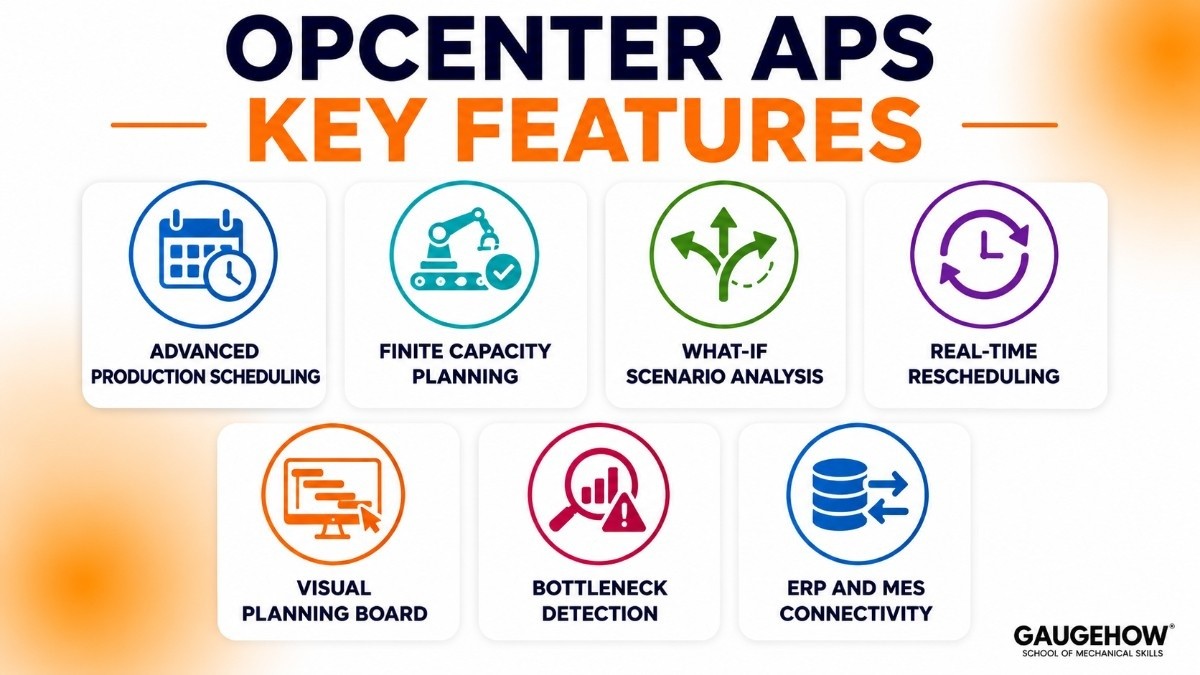
Advanced Planning and Scheduling (Opcenter APS)
Opcenter APS optimizes production schedules based on real constraints — machine capacity, material availability, labor shifts, and delivery deadlines. When something changes (a machine goes down, an urgent order comes in), it recalculates the schedule automatically.
This prevents the common problem of planning teams working from a schedule that is already out of date by the time it reaches the shop floor.
Real-Time Analytics and OEE Monitoring
Opcenter collects data from machines and operators continuously and surfaces it through dashboards and reports. Overall Equipment Effectiveness (OEE) — the standard metric for production efficiency — is calculated in real time, not reconstructed from shift reports at the end of the day.
Electronic Batch Records
For pharmaceutical and medical device manufacturers, Opcenter generates electronic batch records (EBR) that meet FDA 21 CFR Part 11 and EU Annex 11 requirements.
This replaces paper batch records and dramatically reduces the time and cost of batch release reviews.
AI-Powered Digital Copilots (Opcenter X)
The newest generation of Opcenter includes embedded AI assistants — called digital copilots — that guide operators through complex tasks, flag anomalies in real time, and suggest process improvements. This is part of the Opcenter X platform (covered in detail below).
Siemens Opcenter X: The Cloud-Native Evolution
What Is Opcenter X?
Siemens Opcenter X is the cloud-based, modular version of the Opcenter platform. It is Siemens's response to the growing demand for software that can be deployed faster, scaled more easily, and connected across multiple sites without complex on-premises infrastructure.
Where traditional Opcenter products are full-featured, industry-specific suites, Opcenter X is built around a modular architecture — meaning you start with the capabilities you need and add more over time.
How Opcenter X Differs From Classic Opcenter
Classic Opcenter | Opcenter X | |
|---|---|---|
Deployment | On-premises or private cloud | Cloud-native (Siemens cloud) |
Implementation time | 9–18 months typical | Faster, modular onboarding |
Scalability | Requires IT infrastructure | Scales on demand |
Target user | Enterprise, regulated industries | Mid-market to enterprise |
AI features | Limited | Digital copilots, autonomous agents |
Who Should Consider Opcenter X?
Opcenter X is the better starting point for manufacturers who are beginning their digital transformation journey and want to avoid a multi-year implementation project.
It is also well-suited for companies that need to connect multiple plants on a single platform without deploying identical on-premises systems at each location.
Pricing
How Siemens Opcenter Is Priced
Siemens does not publish list prices for Opcenter. It is sold through Siemens's direct sales team and a network of certified implementation partners. Pricing is based on:
The specific modules selected (Execution, Quality, APS, Intelligence, etc.)
The number of production lines and users
Deployment model (on-premises vs. cloud)
Implementation and customization scope
What to Expect
Based on market data and industry reports, total cost of ownership for a full Opcenter implementation at a mid-sized manufacturer typically ranges from $500,000 to $2.5 million over three years — including software licensing, implementation services, and ongoing support.
Larger enterprises with multiple sites can exceed this significantly.
Opcenter X is designed to have a lower entry cost than traditional Opcenter, with a modular subscription model that reduces the upfront investment.
Is There a Free Trial?
There is no self-service free trial. Siemens offers product demonstrations through their sales team, and certain academic or pilot programs may be available through Siemens partners. The starting point is always a conversation with a Siemens representative or certified partner.
Siemens Opcenter vs SAP Digital Manufacturing:
Feature | Siemens Opcenter | SAP Digital Manufacturing |
|---|---|---|
Best For | Complex manufacturing environments, regulated industries | SAP-centric enterprise manufacturing |
ERP Integration | Strong with SAP, Oracle, Microsoft Dynamics, Teamcenter | Native and seamless with SAP S/4HANA |
Ecosystem Flexibility | High – works across mixed IT environments | Limited outside SAP ecosystem |
Industry Strength | Semiconductor, pharmaceutical, automotive, aerospace | General enterprise manufacturing |
Traceability & Compliance | Advanced, highly detailed shop-floor traceability | Strong, but less specialized for strict regulatory workflows |
Automation Hardware Integration | Excellent with Siemens industrial automation | Works well but less hardware-focused |
Deployment | On-premise, hybrid, cloud | Primarily cloud-based |
Implementation Complexity | Moderate to high depending on integrations | Lower if already using SAP |
Customization | Highly configurable | More standardized SAP workflows |
Ideal Choice If... | You run mixed systems or need deep manufacturing control | Your business is fully invested in SAP |
Quick Decision Guide
Choose Siemens Opcenter if:
✔ You need deep traceability
✔ You use Siemens automation
✔ You operate in pharma or semiconductor
✔ You run a multi-vendor enterprise stack
Choose SAP Digital Manufacturing if:
✔ You already use SAP S/4HANA
✔ You want simpler SAP-native integration
✔ Your IT team is SAP-focused
✔ You prefer cloud-first deployment
Pros and Cons
What Siemens Opcenter Does Well
Deep industry-specific functionality — especially strong in pharmaceutical, semiconductor, and automotive manufacturing
Seamless integration with Siemens's broader ecosystem (Teamcenter PLM, Simatic automation, Insights Hub IoT)
Mature, battle-tested platform used in some of the world's most demanding production environments
Strong regulatory compliance support — FDA, GxP, aerospace traceability standards
Scalable from single-site to global multi-plant deployments
Recognized as a leader in Gartner's MES Market Guide
Where Siemens Opcenter Falls Short
High cost and long implementation — typical implementations take 9–18 months and require significant investment in consulting and customization
Complexity — the platform's depth is also its biggest challenge for smaller teams. Configuration requires experienced Siemens-certified implementers
Vendor lock-in — once inside the Siemens ecosystem, it becomes expensive and difficult to integrate third-party hardware or software from outside the Siemens stack
Not ideal for SMEs — smaller manufacturers (under 100 employees, 1–3 production lines) will find the cost and complexity hard to justify against lighter, cloud-native alternatives
Pricing opacity — the lack of published pricing makes it difficult to budget without going through a sales process
Best For
Ideal Industries
Siemens Opcenter is a strong fit for:
Pharmaceuticals and biotech — batch manufacturing, electronic batch records, GxP compliance, serialization
Semiconductor manufacturing — wafer-level genealogy, equipment integration, yield management
Aerospace and defense — part-by-part serialization, AS9100 traceability, complex bill of materials
Automotive (tier 1 suppliers) — high-volume production, IATF 16949 quality compliance, SAP integration
Medical devices — FDA 21 CFR Part 11, UDI traceability, design history files
Ideal Plant Size and Setup
Opcenter is best suited for mid-to-large manufacturers — typically companies with more than 500 employees, multiple production lines, or regulatory compliance requirements that demand a formal, validated MES.
It is particularly well-positioned for organizations that are already using Siemens Teamcenter for PLM, SAP for ERP, or Simatic automation hardware — because the integrations between these systems are pre-built and well-supported.
Integrations
ERP Systems
SAP — one of the strongest and most commonly deployed integrations. Opcenter connects to SAP S/4HANA and SAP ECC for production orders, materials management, and quality notifications
Oracle — supported for production order and inventory synchronization
Microsoft Dynamics 365 — available through standard connectors and partner-built integrations
PLM and Engineering
Siemens Teamcenter — native, bi-directional integration for product structure, engineering changes, and manufacturing BOMs
NX and Solid Edge — CAD data can flow directly into manufacturing process definitions
Automation and Shop Floor
Siemens Simatic (PLC/SCADA) — direct integration with Siemens's own automation hardware
OPC-UA — open standard for connecting to third-party machines and sensors from any vendor
RFID, barcode, and vision systems — supported through standard interfaces for parts tracking and quality inspection
IoT and Analytics
Siemens Insights Hub (formerly MindSphere) — Siemens's industrial IoT platform for collecting and analyzing machine data
Mendix — Siemens's low-code platform for building custom extensions and dashboards on top of Opcenter data
Deployment Options
On-Premises
The traditional deployment model for Opcenter. The software runs on servers within your own data center or factory IT infrastructure.
This gives you full control over data and customization but requires internal IT resources to manage and maintain the system.
Most large pharmaceutical and defense manufacturers prefer on-premises deployment for data sovereignty and security reasons.
Private Cloud
Opcenter can be deployed on a private cloud environment (Microsoft Azure, AWS, or a customer-managed cloud). This gives you the security of on-premises with some of the flexibility of cloud infrastructure.
Siemens Cloud (Opcenter X)
Opcenter X is hosted and managed entirely by Siemens on their cloud infrastructure. This eliminates the need for internal servers and reduces IT overhead significantly. Updates are pushed automatically, and the platform scales as your production grows.
Brownfield Readiness
Opcenter is specifically designed for brownfield deployments — factories that already have equipment, automation systems, and processes in place.
It connects to existing machines through OPC-UA and other standard protocols without requiring you to replace your existing hardware.
Most Opcenter implementations are brownfield. The software is built to work around what you already have, not replace it.
Alternatives to Siemens Opcenter
Rockwell Automation FactoryTalk (Plex)
Since Rockwell acquired Plex, FactoryTalk has become a strong cloud-native MES option. It is particularly well-suited for automotive, food and beverage, and discrete manufacturing. Stronger for organizations running Allen-Bradley automation hardware.
AVEVA MES
AVEVA (now part of Schneider Electric) has a mature MES platform with strong roots in process manufacturing — oil and gas, chemicals, power generation. If your production is primarily continuous or batch process rather than discrete assembly, AVEVA deserves a look.
SAP Digital Manufacturing Cloud
The integrated choice for SAP-heavy enterprises. Tighter ERP connectivity than Opcenter if your entire stack is SAP, but less flexible outside that ecosystem.
Tulip
A modern, low-code alternative aimed at manufacturers who want to digitize shop floor operations without a 12-month implementation. Significantly lower cost and faster to deploy than Opcenter, but less capable for complex regulatory compliance or large-scale multi-site operations.
Critical Manufacturing MES
A strong specialist choice for high-tech electronics and semiconductor manufacturers. Deep functionality for complex routing, equipment integration, and wafer-level genealogy.
Siemens Opcenter in Practice: Real-World Results
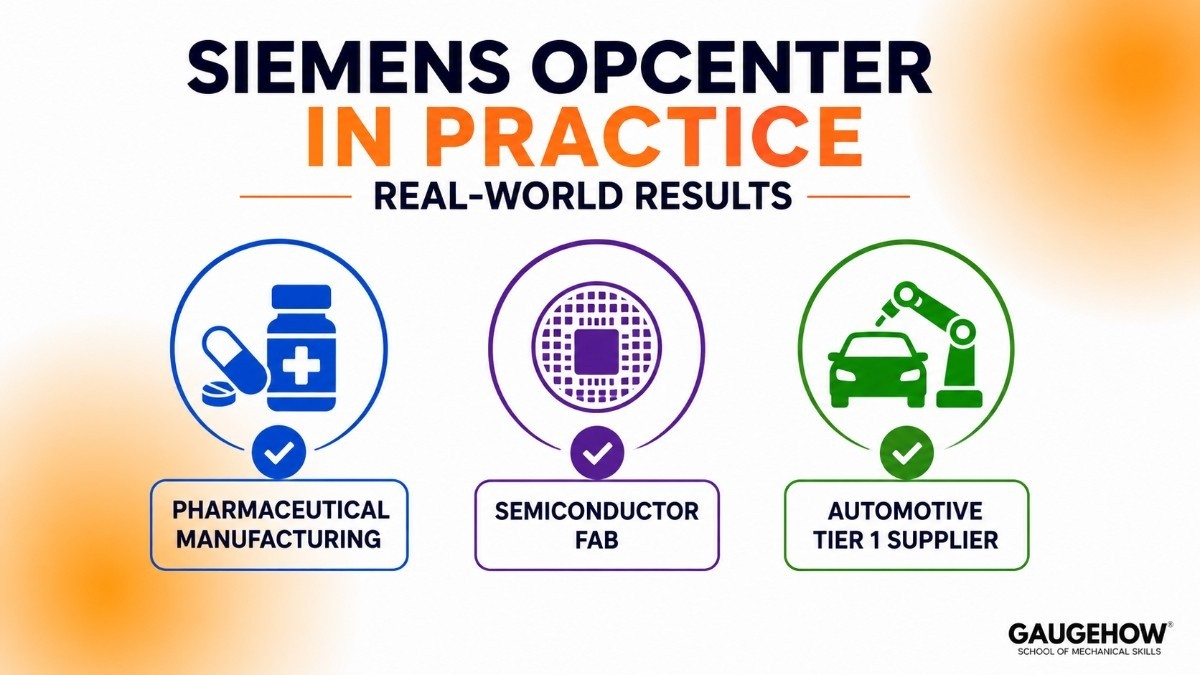
Pharmaceutical Manufacturing
A mid-sized pharmaceutical company replaced paper batch records with Opcenter's electronic batch records module.
The result was a reduction in batch review and release time from an average of 14 days to under 3 days — a direct impact on working capital and time to market.
Semiconductor Fab
A semiconductor manufacturer deployed Opcenter Execution Semiconductor across a 300mm wafer fab. The genealogy and equipment integration features enabled wafer-level tracking that identified a process drift early — preventing an estimated $4 million in scrapped product.
Automotive Tier 1 Supplier
An automotive supplier with four plants in three countries used Opcenter APS to synchronize production scheduling across all sites. Planning time dropped by 60% and on-time delivery improved from 82% to 94% within the first year.
Frequently Asked Questions
Is Siemens Opcenter cloud-based?
Yes. Siemens Opcenter can be deployed on-premises, in a private cloud, or through the cloud-based Opcenter X platform. Most new deployments are moving toward Opcenter X for greater flexibility.
How long does a Siemens Opcenter implementation take?
Most implementations take between 9 and 18 months, depending on the number of sites, integrations, and business requirements. Cloud-based deployments can often be rolled out faster.
Does Siemens Opcenter replace ERP?
No. ERP systems like SAP manage business processes, while Opcenter manages manufacturing operations on the shop floor. The two systems are designed to work together.
What industries use Siemens Opcenter most?
Opcenter is commonly used in pharmaceuticals, biotech, semiconductors, automotive, aerospace, and electronics manufacturing, where traceability and compliance are critical.
How does Siemens Opcenter compare to DELMIA Apriso?
Both Siemens Opcenter and DELMIA Apriso are manufacturing operations platforms used by large manufacturers. Opcenter is often chosen by companies already using Siemens software, while DELMIA Apriso is popular for managing production, quality, and operations across multiple factories.
How does Siemens Opcenter handle FDA compliance?
Opcenter includes support for FDA 21 CFR Part 11 requirements, including electronic records, electronic signatures, and audit trails. It is widely used in regulated industries such as pharmaceuticals and medical devices.
What is the difference between MES and MOM?
MES focuses on executing and tracking production on the shop floor. MOM is broader and includes MES, quality management, analytics, and production planning. Siemens Opcenter is considered a MOM platform.
Final Thoughts
Siemens Opcenter is a powerful manufacturing operations platform for companies that need strong shop-floor control, traceability, and compliance. It is especially popular in regulated and high-complexity industries.
While implementation can require significant time and investment, manufacturers often compare Siemens Opcenter with DELMIA Apriso when evaluating enterprise manufacturing platforms. The best choice depends on your operational requirements, existing software ecosystem, and long-term manufacturing strategy.
Siemens Opcenter is a manufacturing software that helps improve production planning, quality control, factory efficiency and support digital manufacturing.