DELMIA Quintiq
DELMIA Quintiq 2026

DELMIA Quintiq 2026: Complete Guide to Smarter Supply Chain Planning
What Is DELMIA Quintiq?
DELMIA Quintiq is an enterprise planning and scheduling platform by Dassault Systèmes that helps manufacturers, logistics companies, and transport operators plan their operations more efficiently.
When a machine breaks down or a supplier is late, most businesses scramble — updating spreadsheets, making calls, and hoping the plan still works. Quintiq software changes that.
It connects every part of the operation — production, logistics, workforce, and supply chain — into one live model. When something changes, every affected plan updates automatically.
Dassault Systèmes, the French technology company behind CATIA and SolidWorks, acquired Quintiq in 2014. Today it serves businesses across 80+ countries in industries from automotive manufacturing to rail transport and airline scheduling.
What Is Supply Chain Optimization?
Before diving into features, it helps to understand the problem Quintiq solves.
Supply chain optimization means finding the best possible plan when you have too many demands and not enough resources — and every decision affects something else.
A simple example:
You have orders for 10,000 units but capacity for only 8,000
Two machines are shared across five product lines
A key supplier is three days late
One customer has a penalty clause for late delivery
A spreadsheet planner makes guesses. An optimization engine considers all of these constraints at the same time and finds the plan that causes the least damage — automatically.
Quintiq supply chain software does this across production, logistics, and workforce simultaneously — not one department at a time.
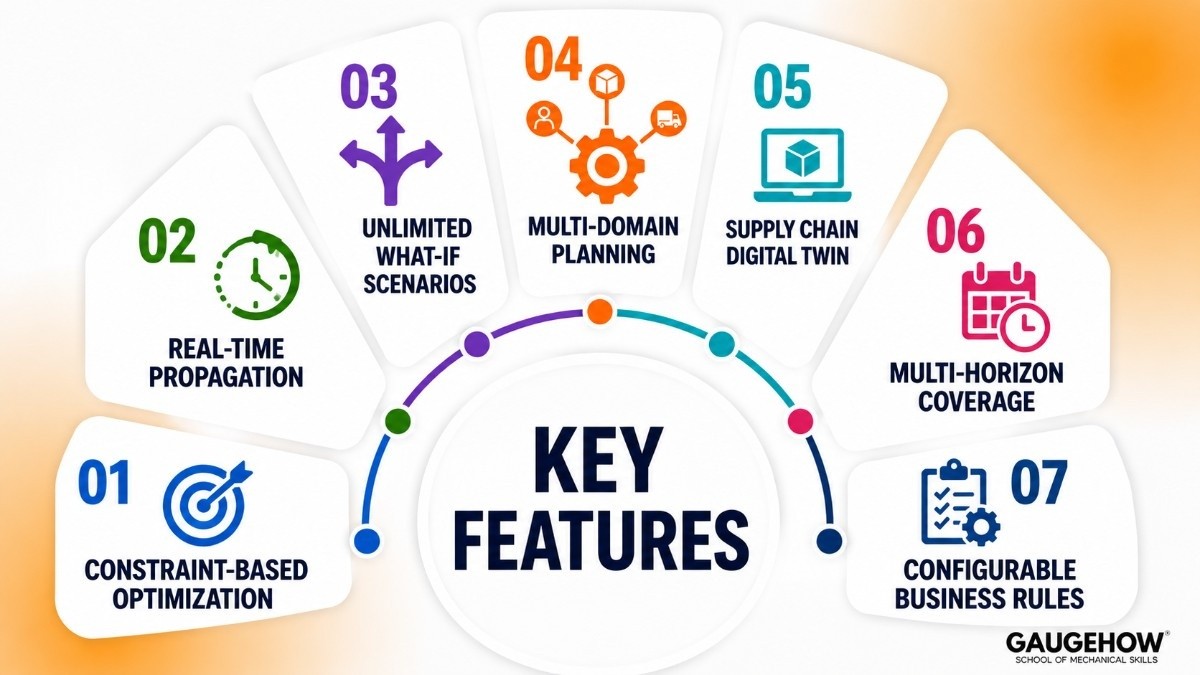
Key Features
1. Constraint-Based Optimization
Quintiq does not just apply scheduling rules one by one. It runs a mathematical optimization engine that weighs all your constraints — machine capacity, labour rules, material availability, delivery deadlines — at the same time and finds the best possible outcome.
2. Real-Time Propagation
When any plan changes, Quintiq instantly shows what else is affected. A production delay flows through to logistics, workforce needs, and customer delivery dates — all before you confirm the change. Planners see the consequences before they act, not after.
3. Unlimited What-If Scenarios
Create and compare multiple schedule options without touching the live plan. Run a night shift scenario.
Delay one order to protect another. Add a supplier. Each option calculates in minutes. You present the options with trade-offs — leadership makes an informed decision.
4. Multi-Domain Planning in One System
Most tools plan one thing: production or logistics, or workforce. Quintiq connects all three. A production delay automatically triggers a logistics re-plan and a workforce schedule update — no manual coordination needed.
5. Supply Chain Digital Twin
Quintiq builds a live virtual model of your supply chain — inventory levels, capacity status, supplier lead times, demand signals — updated in real time. Planners test decisions against this model before executing them in the real world.
6. Multi-Horizon Coverage
One platform covers long-range strategic planning (months ahead), medium-term tactical planning (weeks ahead), and detailed daily scheduling — all using the same data model and the same constraints.
7. Configurable Business Rules
Every business plans differently. Quintiq is configured to match your specific rules, KPIs, and constraints — not a generic template. This is what makes it work for industries as different as food manufacturing and rail operations on the same platform.
DELMIA Quintiq for Manufacturing
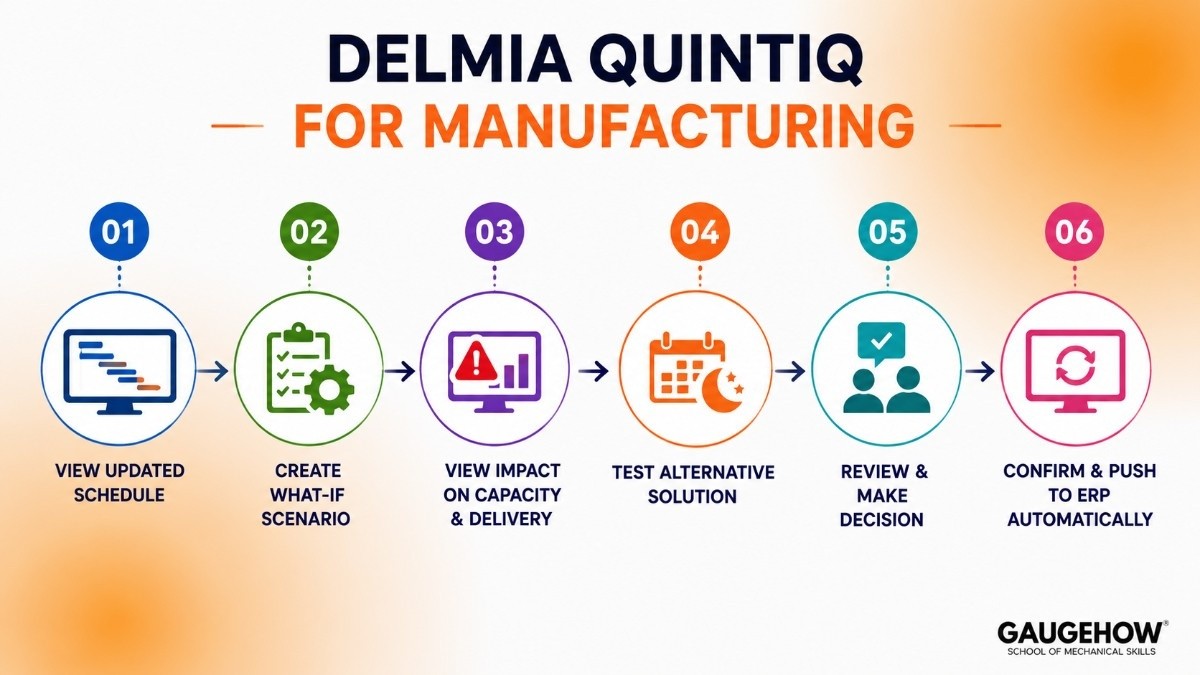
For production planners, Quintiq sits as a scheduling layer between the ERP and the shop floor.
Here is what a typical morning looks like:
The planner opens Quintiq and sees the updated Gantt chart — new orders from SAP, confirmed deliveries, and current machine status
Two urgent orders need to be moved forward. The planner creates a what-if scenario
Quintiq instantly shows: Machine 4 hits capacity, three other orders slip by one day, on-time delivery drops from 97% to 95%
The planner tries adding a partial night shift instead. The system shows: urgent orders saved, all other orders unaffected, overtime cost rises by $4,200
Both options go to the operations manager. A decision is made in 20 minutes. The confirmed schedule pushes back to the ERP automatically
What would take half a day with spreadsheets takes under an hour — and the decision is based on data, not instinct.
Pricing
Dassault Systèmes does not publish prices for DELMIA Quintiq. All contracts are negotiated based on scope, industry, and organization size.
How It Is Priced
Costs are driven by:
Which planning domains do you license (production, logistics, workforce, etc)
Number of planner users
Complexity of custom configuration required
Annual maintenance and support fees
Estimated Ranges (2025–2026 Market Data)
Deployment | Estimated Year-One Cost |
|---|---|
Single domain (e.g., production only) | $150,000 – $400,000 |
Two to three domains | $400,000 – $1,000,000 |
Full enterprise deployment | $1,000,000 – $3,000,000+ |
Implementation fees from certified partners typically add 1.5× to 3× the licence cost on top.
Free Trial?
No self-serve trial. Guided demos are available through Dassault Systèmes offices and certified partners. Some partners offer scoping workshops with limited evaluation access for serious buyers.
What Makes It More Expensive
Customising rules for non-standard planning logic
Integrating with multiple ERP systems across different sites
Multi-country workforce scheduling needs different labour law rules per region
Investing in planner training and change management (often underbudgeted)
Pros and Cons
What It Does Well
Genuinely solves multi-domain planning complexity. No other platform at this level connects production scheduling, logistics, workforce rostering, and rail planning in one configurable system. For large enterprises where these domains constantly conflict, Quintiq removes the manual coordination.
Plans update in real time. The propagation engine means teams are never working from outdated plans. A change in production immediately appears in the logistics and workforce views — before it causes a crisis.
Scenario planning changes how decisions get made. Instead of presenting one plan and defending it, planners can present three options with clear trade-offs. Leadership makes better decisions faster.
Works for very different industries: rail operators, food manufacturers, airlines, aerospace companies — the same platform configured completely differently. Few competitors match this range.
Where It Falls Short
Cost rules out most mid-market buyers. Year-one costs over $1M are common. For companies under $200M revenue, the investment is very hard to justify. Simpler tools like Siemens Opcenter or Asprova deliver better value per dollar at that scale.
Long and complex implementation. Most enterprise deployments take 9–18 months. Every deployment is custom-configured from scratch — there is no pre-built template to speed things up.
Finding certified partners with genuine Quintiq expertise is harder than finding SAP or Dynamics partners.
Planners need to trust the output. The optimization engine only works when planners use its recommendations rather than overriding them manually. Organizations that skip training consistently report getting far less value than expected.
No quick trial or self-serve access. Evaluating Quintiq requires significant engagement with sales and partners before seeing the product. Compared to competitors with free trials, this slows down the evaluation process considerably.
Best For
Quintiq is the right fit when:
You are a large enterprise (typically $200M+ revenue) with complex, multi-domain planning problems
Your operations span multiple domains — production, logistics, and workforce — and the interaction between them is where things go wrong
You are in aerospace, automotive, food and beverage, chemicals, rail transport, airlines, or complex logistics
Your planning is constrained by real operational rules — labour law, sequence-dependent changeovers, multi-tier supply networks — that generic tools cannot model
You have the budget and timeline for a major enterprise software project
Not a good fit if:
You are a mid-size manufacturer (under 500 employees) — the cost and complexity are too high
You only need shop floor scheduling — Asprova or Siemens Opcenter are deeper and cheaper for this specific need
You need to live for under 6 months
You want a cloud SaaS tool you can trial and deploy quickly
Integrations
Category | Examples |
|---|---|
ERP systems | SAP S/4HANA, SAP ECC, Oracle ERP, Infor LN and M3, Microsoft Dynamics |
MES / shop floor | DELMIA MES, third-party MES via API |
Dassault ecosystem | Teamcenter, CATIA, SolidWorks, 3DEXPERIENCE platform |
Demand planning | Kinaxis Maestro, SAP IBP (as input sources) |
Transportation management | TMS systems via API |
Analytics and BI | Power BI, Tableau, Qlik |
IoT and real-time data | Sensor feeds for live capacity and inventory |
HR and payroll | SAP SuccessFactors, Workday (for workforce scheduling rules) |
Custom | REST API and flat file exchange |
Deployment
Cloud
New deployments increasingly run on Dassault Systèmes' 3DEXPERIENCE cloud. Vendor manages updates and infrastructure. Best for organizations already on the 3DEXPERIENCE platform.
On-Premise
Still available for organizations with strict data requirements — common in aerospace, defense, and government-adjacent industries.
Hybrid
Some customers run the core optimization engine on-premise for security, with cloud-based dashboards and collaboration layers on top. Works well for multinational organizations with different data rules per region.
What to Expect During Implementation
Implementation is a consulting-heavy process. There is no out-of-the-box template:
Phase 1 — Planning model design: Map real constraints, rules, and data sources into a Quintiq configuration
Phase 2 — ERP integration: Connect to source systems; data quality issues are the most common delay
Phase 3 — Training and go-live: Planner training is the biggest factor in whether the system delivers its theoretical value
DELMIA Quintiq vs SAP IBP
SAP IBP (Integrated Business Planning) is the most searched alternative to Quintiq — especially for companies already using SAP.
Dimension | DELMIA Quintiq | SAP IBP |
|---|---|---|
Core strength | Multi-domain constraint optimization | Demand-driven S&OP and supply planning |
Shop floor scheduling | Very deep | Moderate (paired with SAP PP/DS) |
Workforce scheduling | Strong — especially aviation and rail | Not a focus |
Rail planning | Best-in-class | Not offered |
Optimization approach | Constraint programming + math optimization | Statistical models + demand-supply balance |
SAP integration | Good — supported connector | Native — built for SAP |
Implementation time | 9–18 months | 9–18 months |
Best fit | Multi-domain ops, non-SAP shops | SAP-first orgs focused on demand and S&OP |
Simple way to choose:
Choose DELMIA Quintiq if your problem is connecting multiple planning domains with complex real-world constraints — and you are not locked into SAP.
Choose SAP IBP if you are deeply invested in SAP, and your main need is demand planning and S&OP at the business level, not detailed shop floor scheduling.
Alternatives
Kinaxis Maestro
Best for supply chain risk management and concurrent planning across the full network. Stronger than Quintiq for demand-supply balancing at scale; weaker in detailed shop floor scheduling and workforce rostering.
o9 Solutions
A modern, AI-native option growing fast in enterprise S&OP and commercial planning. Often more affordable than Quintiq for planning teams focused on demand, commercial alignment, and business planning.
Blue Yonder
Strong in retail supply chain, demand planning, and warehouse management. More accessible for distribution-heavy organizations, but less configurable for manufacturing or workforce scheduling constraints.
Siemens Opcenter APS
The better option for manufacturers who primarily need production scheduling, not the full multi-domain Quintiq scope. Faster to implement, lower cost, and deeper for shop floor scheduling specifically.
Asprova
Best for mid-market manufacturers needing fast, high-accuracy finite capacity scheduling at a significantly lower cost. Does not cover logistics, workforce, or S&OP — purpose-built for production scheduling only.
Similar buyers often evaluate PlanetTogether as an alternative, especially when they need stronger ERP integration, visual production scheduling, and collaborative planning workflows.
Frequently Asked Questions
What is DELMIA Quintiq used for?
DELMIA Quintiq is used to plan and optimize complex operations across multiple domains at once — production scheduling, supply chain planning, logistics, workforce rostering, S&OP, and rail scheduling. It is most valuable when these domains interact with each other and create conflicts that simpler tools cannot resolve.
Is DELMIA Quintiq cloud-based?
Yes. New deployments default to Dassault Systèmes' 3DEXPERIENCE cloud. On-premise is still available for organizations with strict data or security requirements. Hybrid configurations also exist for multinationals with different requirements per region.
How is Quintiq different from an ERP planning module?
ERP planning modules cover most businesses adequately. Quintiq is for businesses where planning is genuinely complex. It uses mathematical optimization (not rules-based scheduling), handles constraints ERP modules cannot model, and offers scenario planning ERP tools do not. For standard operations, the ERP is usually enough. For complex operations, Quintiq delivers results that an ERP cannot match.
How long does implementation take?
Most enterprise deployments take 9–18 months. Single-domain projects are faster; multi-domain enterprise rollouts are at the longer end. The biggest delays come from ERP data quality problems, scope creep mid-project, and the time needed to properly train planners.
Who uses DELMIA Quintiq?
Large enterprises in: discrete manufacturing (automotive, aerospace, electronics), process manufacturing (food, chemicals, pharma), rail and public transit operators, airlines and airports, complex 3PL logistics providers, and defense manufacturers with multi-program supply challenges.
Final Thoughts
DELMIA Quintiq earns its place in the enterprise software market by doing something genuinely difficult connecting planning across multiple business domains with real-world constraints, in one configurable system.
It is the right choice when:
Siloed planning is creating expensive operational conflicts
The interaction between production, logistics, and workforce is where problems originate
Your industry has specific planning constraints that generic tools cannot handle
Go in with clear expectations:
Year-one costs over $1M are normal
9–18-month implementations are typical
The system only delivers its full value when planners are trained to trust and use it
For students studying supply chain and operations: understanding constraint-based optimization and digital twin planning — the core concepts behind Quintiq — is increasingly relevant for careers in advanced supply chain roles.
DELMIA Quintiq is a supply chain planning and optimization platform. It helps businesses manage planning and daily operations in one connected system.