Augury
augury meaning

Augury Meaning — Definition, Machine Health & Everything You Need to Know
You may have searched "augury meaning" expecting a dictionary entry — and you'll get that here. But "augury" is also the name of one of the most talked-about industrial AI platforms on the market today. This guide covers both, clearly and completely, so you leave with a full picture.
What is augury?
The word "augury" has been around for over 2,000 years. At its core, it means reading signs to predict what will happen next. In ancient Rome, augurs were official priests whose job was to observe birds — their flight patterns, feeding behaviour, and calls — and interpret what those signs meant for the future of the empire.
Today, we still use the word in everyday speech. When someone says "this is a good augury," they mean it's a positive sign of things to come. Writers, journalists, and historians use it frequently, which is why it appears in dictionaries, literature, and — interestingly — in the name of a cutting-edge tech company.
Augury machine health monitoring software
Overview
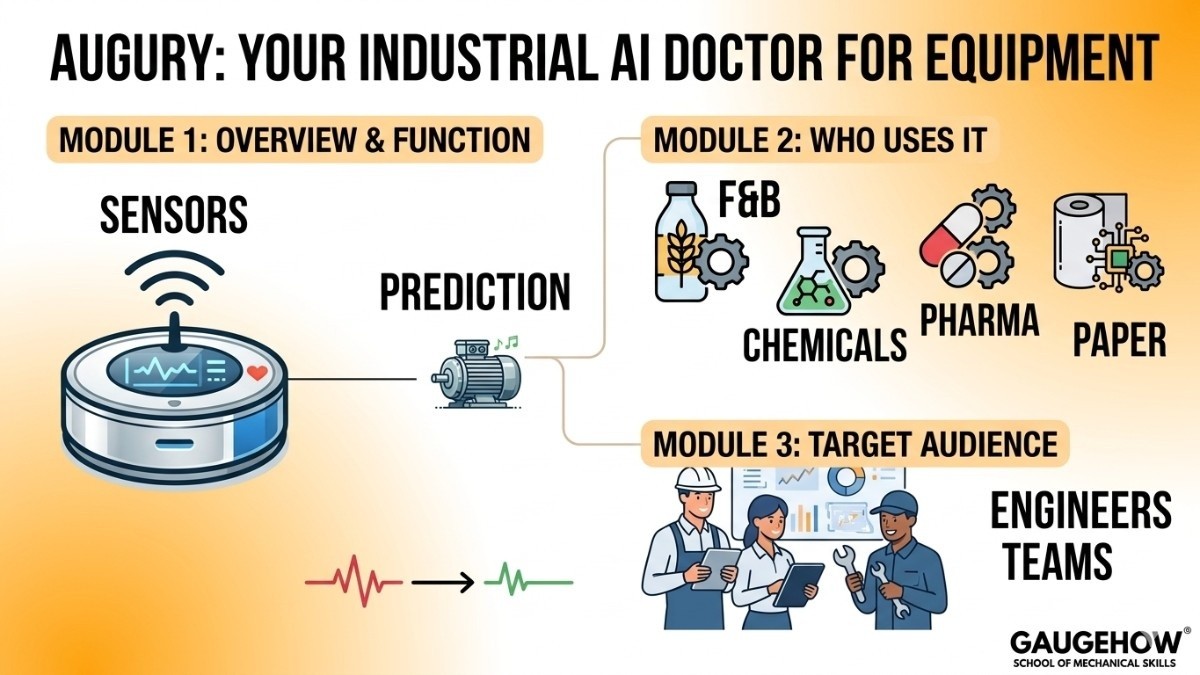
Augury is a New York-based industrial AI company founded in 2011. Its platform helps manufacturing and industrial companies predict and prevent machine failures — before those failures cause costly downtime.
Think of it as a doctor for your factory equipment. Instead of waiting for a motor, pump, or conveyor to break down (and shut your entire production line), Augury's sensors continuously listen to your machines and flag early warning signs — sometimes weeks before anything visible goes wrong.
Who uses it
Large manufacturers across food & beverage, chemicals, pharmaceuticals, paper, and consumer goods. Notable customers include DuPont, Nestlé, and Schneider Electric. The platform is designed for reliability engineers and maintenance teams who manage critical rotating equipment at scale.
Key features
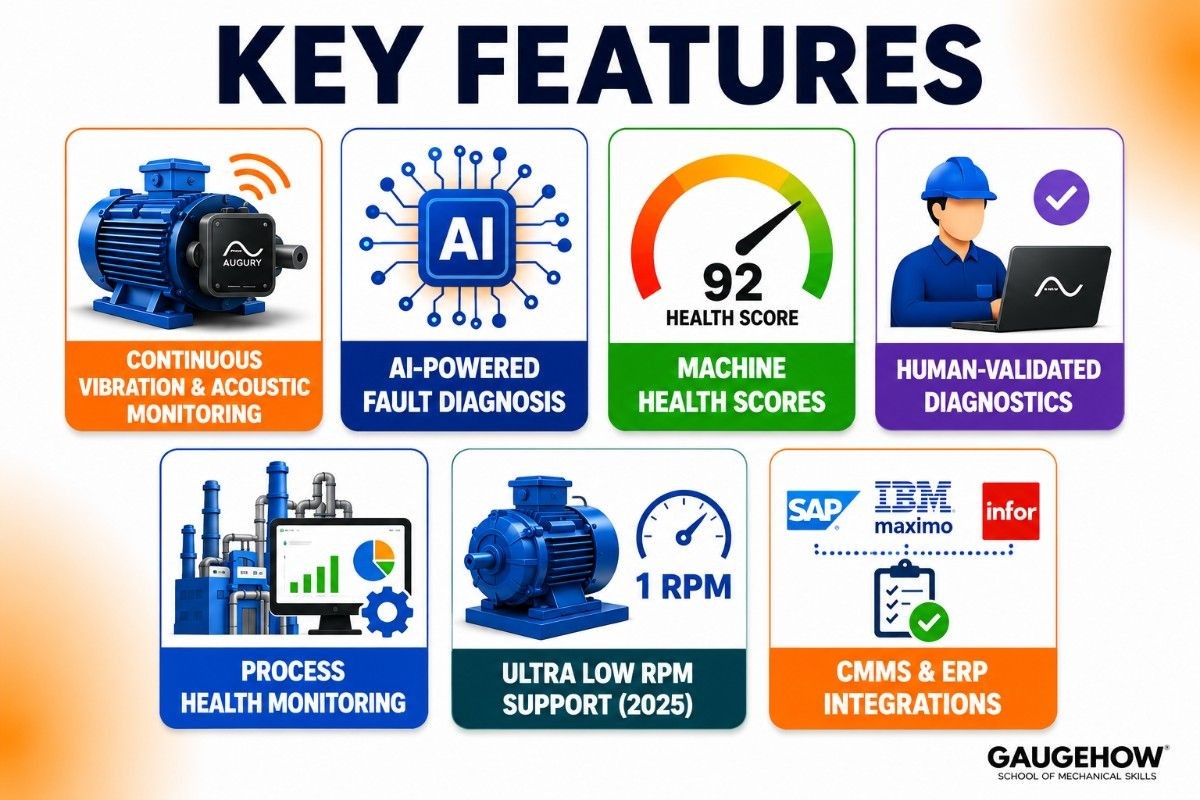
Continuous vibration and acoustic monitoring
Proprietary sensors attach to motors, pumps, fans, compressors, and gearboxes. They sample at high frequency 24/7, not just during scheduled inspections.AI-powered fault diagnosis
Augury's machine learning models are trained on data from millions of machine operating hours. They can identify specific fault types — bearing wear, misalignment, imbalance, cavitation — not just flag "something's wrong."Machine Health Scores
Every monitored asset gets a clear health score. Maintenance teams can see at a glance which machines need attention now versus which ones can wait until the next planned maintenance window.Human-validated diagnostics
Unlike pure software tools, Augury backs its AI alerts with a team of certified reliability engineers who review flagged issues. This reduces false alarms significantly.Process Health monitoring
Beyond machine condition, Augury also monitors production process quality — catching inefficiencies in yield, energy consumption, and waste before they become financial problems.Ultra Low RPM support (2025)
The Machine Health 360° suite now covers machinery rotating as slow as 1 RPM — equipment like slow-speed mixers, paper calenders, and cooling towers that most competitors can't monitor effectively.CMMS and ERP integrations
Augury connects to SAP, IBM Maximo, Infor, and other systems to auto-generate maintenance work orders when a fault is confirmed.
Pricing
Augury does not publish pricing on its website. It operates on a subscription model based on the number of monitored assets and the level of service. However, based on industry reports and user reviews, here is what buyers should expect:
Starter
~$30K–$50K
per year (est.)
Small-to-mid site deployment
Up to ~20–30 assets
Basic Machine Health
Standard support
Enterprise
$50K–$200K+
per year (est.)
Multi-site, unlimited assets
Machine + Process Health
CMMS/ERP integration
Dedicated reliability experts
Free trial
Available
Pilot programmes offered
POC deployments available
Site assessment included
Typically 60–90 day.
Pros and cons
No platform is perfect. Here is a balanced view based on customer reviews, analyst reports, and comparison studies:
Pros
Industry-leading AI accuracy (99%+ claimed on rotating assets)
Human expert validation reduces false alarms
Largest machine data library in the industry
Strong ROI track record (DuPont: 7x in under 1 year)
Easy to use — no vibration analysis expertise needed
Covers ultra-low RPM machines (1 RPM+)
Cons
Proprietary sensors required — no third-party sensor support
Short wireless range (50 ft) — needs more gateways vs competitors
Mobile app limited to installation only
Enterprise pricing — expensive for small operations
Primarily vibration-based — weaker on non-rotating assets
Requires internet connectivity; no offline mode
Best for
Plant size
Mid to large facilities with 20+ critical rotating assets
Industry
Food & beverage, chemicals, pharma, paper, consumer goods
Team type
Reliability engineers wanting expert-backed AI diagnostics
Use case
Eliminating unplanned downtime on motors, pumps, fans, compressors
Not ideal for
Small shops, non-rotating equipment focus, or tight budgets
Augury CMMS integration — SAP and IBM Maximo
One of Augury's biggest practical strengths is how it connects to existing enterprise systems.
When the AI detects a machine fault, it doesn't just send an email alert — it can automatically create a maintenance work order inside your CMMS or ERP, assign it to the right team, and attach the full diagnostic report.
Supported Integrations
Augury can easily connect with many common maintenance and asset management systems, including:
SAP PM / SAP S/4HANA – for maintenance planning and asset tracking
IBM Maximo – for enterprise asset management
Infor EAM – for managing equipment and maintenance operations
Oracle EAM – for asset lifecycle management
UpKeep – for mobile maintenance management
Fiix CMMS – for maintenance scheduling and tracking
Limble CMMS – for work order and maintenance management
ServiceMax – for field service and equipment maintenance
REST API – for custom software integrations
OPC-UA – for connecting directly with industrial machines and sensors
These integrations make it easy to bring Augury’s predictive maintenance insights into the tools maintenance teams already use every day.
How the SAP integration works
1 Augury detects a bearing fault on a pump motor and assigns a severity level.
2 The alert is validated by Augury's reliability engineers (or auto-approved for high-confidence cases).
3 A work order is automatically created in SAP PM with the fault description, recommended action, and time-to-failure estimate.
4 Maintenance planners see the work order in SAP — no need to log in to a separate system.
Deployment
Deployment model
Cloud-native SaaS (Augury-hosted). No on-prem option.
Connectivity
Requires Wi-Fi or Ethernet at sensor gateway level. No cellular option (currently).
Sensor installation
Professional installation by Augury team. Takes 1–3 days for typical mid-size site.
Brownfield readiness
Designed for existing facilities. No production shutdown required for installation.
Edge processing
Partial — gateways pre-process raw sensor data before cloud transmission.
Time to value
4–6 weeks from installation to first actionable insights (per customer reports).
Augury vs Tractian
Tractian is the most direct competitor to Augury right now and the comparison is all over manufacturing trade publications. Both platforms use vibration sensors and AI to predict rotating equipment failure — but they differ in meaningful ways.
Feature | Augury | Tractian |
|---|---|---|
Founded | 2011 (New York) | 2019 (São Paulo) |
Sensor type | Proprietary vibration + acoustic | Proprietary vibration + temperature |
Wireless range | ~50 ft (2.4 GHz) | ~330 ft indoors / 3,000 ft LOS (915 MHz) |
Mobile app | Installation only | Full monitoring, alerts, and analytics |
Human expert review | Yes — certified engineers | AI-led, limited human review |
Data library | Largest in industry | Smaller but growing fast |
Ultra-low RPM | Yes (1 RPM+) | Limited |
CMMS integration | SAP, Maximo, Infor, others | SAP, Maximo, and others |
Pricing model | Enterprise subscription ($50K+/yr) | More accessible; lower entry point |
Best for | Large, complex multi-site enterprises | Mid-market and growing manufacturers |
Which one should you pick?
If you are a large enterprise with complex assets across multiple sites and you want expert-validated diagnostics with the deepest AI training data available — Augury is likely the better choice.
If you need faster deployment, better mobile access, and a wider wireless range at a lower entry cost — Tractian is worth a serious look.
Alternatives to Augury
Best direct alternative. Stronger mobile app, longer wireless range, more accessible pricing.
Another leading predictive maintenance platform used by large manufacturers. It focuses on AI-driven machine health monitoring and enterprise-scale analytics, making it a common option for organisations evaluating industrial reliability software alongside Augury. Ideal for mid-market manufacturers.
Factory AI focuses on using artificial intelligence to improve factory operations, equipment reliability, and maintenance decision-making. Manufacturers exploring modern AI-powered maintenance platforms often evaluate Factory AI alongside Augury and other predictive maintenance solutions.
SparkCognition (SparkPredict)
Industrial AI built for high-stakes assets — wind turbines, oil rigs, power plants. Uses SCADA data, not additional sensors. Strong prescriptive analytics.
Aspentech APM
Asset performance management with deep process integration. Wider asset coverage beyond rotating equipment. Complex to implement.
Enterprise
Fiix (by Rockwell Automation)
Cloud-based CMMS with growing predictive features. Better fit if you primarily need maintenance workflow management, not deep machine diagnostics.
Mid-market
IBM Maximo Application Suite
Combines CMMS, EAM, and predictive analytics. Broad asset coverage and deep ERP integration. Significant implementation effort required.
Enterprise
FAQ
What does "augury" mean in simple terms?
Augury means reading signs or omens to predict what will happen next. It comes from ancient Rome, where special priests called augurs watched birds to forecast the outcome of battles and political events.
Today, the word also refers to a sign or indication of what's to come — for example, "a good augury for the future."
Is Augury the software cloud-based?
Yes. Augury is a fully cloud-hosted SaaS platform. Data collected by sensors is transmitted to Augury's cloud for processing and analysis. There is no on-premises deployment option. You will need Wi-Fi or Ethernet at the plant level for sensor connectivity.
How accurate is Augury's predictive maintenance?
Augury claims accuracy rates exceeding 99.9% on fault detection for rotating equipment. This figure is supported by real-world deployments — for example, DuPont reported zero missed predictions in their initial implementation.
The combination of AI trained on a massive proprietary dataset and human expert validation keeps false alarm rates low.
Augury vs Tractian — which is better?
It depends on your needs. Augury is better for large enterprises that need expert-backed diagnostics, ultra-low RPM coverage, and deep integration with SAP or Maximo.
Tractian is better for teams that want a strong mobile app, longer sensor range, faster self-serve deployment, and more accessible pricing. Both are solid platforms — the right choice depends on plant size, budget, and technical requirements.
Does Augury integrate with SAP?
Yes. Augury has a native integration with SAP Plant Maintenance (SAP PM) and SAP S/4HANA. When a machine fault is confirmed, Augury can automatically generate a maintenance work order in SAP — with fault details, recommended actions, and time-to-failure estimates pre-filled. This eliminates manual data entry and speeds up the maintenance response cycle.
What is the synonym for augury?
Common synonyms include: omen, portent, harbinger, presage, sign, auspice, and foreboding. "Auspice" is the closest in historical meaning — it also derives from Roman augury practice. In modern English, "omen" is the most commonly used everyday equivalent.
Discover how Augury uses AI-powered machine health monitoring, and real-time diagnostics to predict equipment failures,and improve industrial reliability.