Factory AI
Factory AI CMMS

Factory AI CMMS: Features, Pricing, and How It Works (2026 Guide)
Factory AI CMMS is an AI-powered computerized maintenance management system that helps manufacturers schedule maintenance, manage work orders, track assets, and reduce equipment downtime through smarter maintenance planning.
It combines traditional CMMS functions with artificial intelligence to help maintenance teams predict issues, automate workflows, and improve overall equipment performance.
Manufacturers use Factory AI CMMS to organize maintenance operations, monitor asset health, and make faster, data-driven decisions across production facilities.
What is Factory AI?
Factory AI — also known as f7i.ai — is a software company that makes an AI-powered predictive maintenance platform with a built-in CMMS. It was built specifically for mid-sized manufacturing plants, especially older "brownfield" facilities that already have existing sensors and equipment.
The core idea is simple: most factories already collect data from their machines. They just don't have a smart way to use it. Factory AI plugs into that existing data and applies machine learning to predict when something will fail — before it actually does.
Who is it for?
Factory AI is designed for maintenance engineers, reliability teams, and plant managers at mid-sized factories in industries like food and beverage, automotive, and consumer goods. You don't need to be a data scientist to use it.
How does Factory AI work?
The system works in four connected steps. Each one flows into the next automatically, with very little manual effort from your team.
1 Connect your data
Factory AI pulls data from existing PLCs, SCADA systems, historians, or third-party sensors. No new hardware required.
2 AI learns your machines
The platform builds a baseline model for each asset — what "normal" looks like for that specific machine in your environment.
3 Anomalies are flagged
When a machine deviates from its baseline, the AI identifies the fault type, estimates severity, and predicts how long before failure.
4 Work order created
The CMMS automatically generates a prioritised work order with the fault description and suggested repair steps — no manual data entry needed.
Key Features of Factory AI
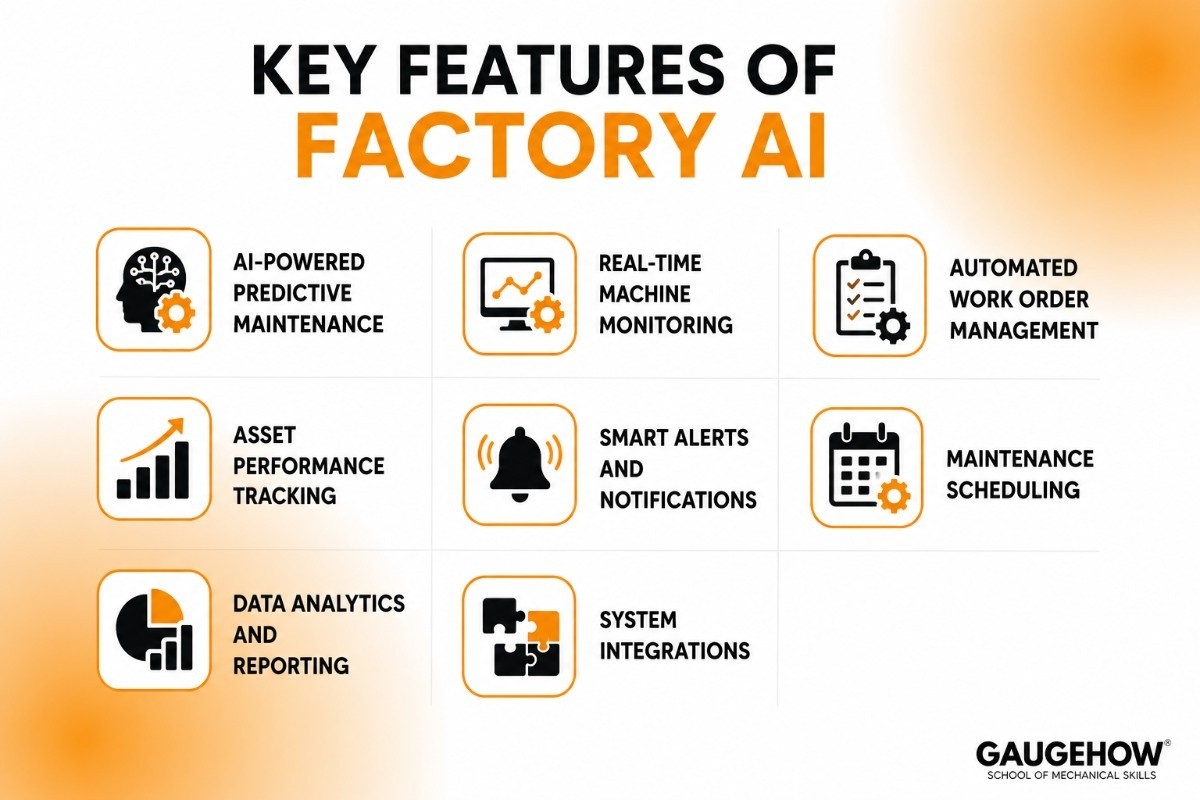
AI-Powered Predictive Maintenance
Factory AI uses artificial intelligence to detect machine issues early and predict failures before they happen.
This helps maintenance teams prevent unexpected breakdowns and reduce costly downtime.
Real-Time Machine Monitoring
The platform continuously monitors machine performance using live operational data.
It provides instant visibility into equipment health across the factory floor.
Automated Work Order Management
Factory AI helps create, assign, and track maintenance work orders automatically.
This improves maintenance scheduling and team coordination.
Asset Performance Tracking
It tracks machine history, maintenance records, and performance trends in one place.
This helps teams make smarter maintenance decisions.
Smart Alerts and Notifications
The system sends automatic alerts when unusual machine behavior is detected.
This allows faster response to potential issues.
Maintenance Scheduling
Factory AI helps teams plan preventive and predictive maintenance activities.
This reduces emergency repairs and improves operational efficiency.
Data Analytics and Reporting
It provides dashboards and reports for machine health, downtime trends, and maintenance performance.
These insights help improve long-term reliability.
System Integrations
Factory AI connects with ERP, CMMS, sensors, and industrial systems.
This makes it easier to fit into existing manufacturing workflows.
What makes it different from a standard CMMS?
A standard CMMS manages work orders and schedules. That's it. Factory AI's CMMS does all of that — but the work orders are generated by AI, not by a human typing something in after a machine already broke.
The shift is from "the machine broke, create a ticket" to "the machine is going to break in 9 days, here's the work order, parts needed, and technician assigned."
Factory AI sensor-agnostic CMMS for manufacturing
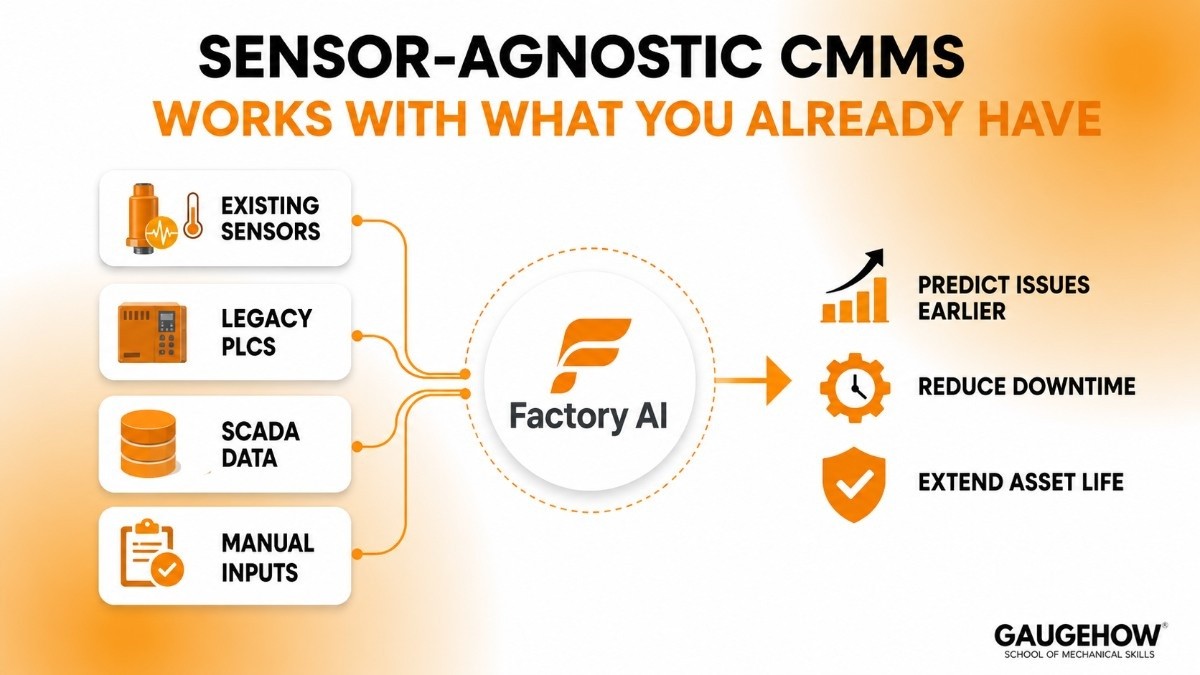
This is Factory AI's biggest technical differentiator. Most predictive maintenance platforms — Augury, Tractian, AssetWatch — require you to buy and install their own proprietary sensors. That adds hardware costs, installation time, and locks you into one vendor's ecosystem.
Factory AI is sensor-agnostic. It works with whatever you already have.
What does sensor-agnostic actually mean?
Existing vibration or temperature sensors? Factory AI reads them directly — no replacement needed.
Legacy PLCs from Allen-Bradley or Siemens? It connects via OPC-UA or Modbus — no rip-and-replace.
SCADA historian data? It ingests that too — turning data you already collect into predictive insights.
Manual inspection inputs? Technicians can log observations that feed into the AI model alongside sensor data.
Factory AI pricing
Factory AI is one of the few platforms in the predictive maintenance space that publishes its pricing publicly. This is a major advantage for buyers doing research — you don't need to sit through a sales call to get a number.
Prevent CMMS
$0
per user / month — free forever
Full work order management
Asset tracking and history
PM scheduling (calendar + meter-based)
Mobile app for technicians
Unlimited assets
Predict — AI Anomaly Detection
$500
per monitoring point (asset)
AI fault detection and forecasting
Connects to existing sensors/SCADA
Auto-generates work orders from alerts
Remaining useful life estimation
14-day free trial available
Enterprise / Multi-site
Custom
quote-based; scales with asset count
Reliability Command Center
5–50 sites in one dashboard
Hardware-as-a-service options
SAP / ERP integration
Dedicated success team
How this compares: Augury starts at ~$50,000/year. Tractian requires a hardware purchase on top of the software subscription. Factory AI's free CMMS tier and $500/monitoring-point Predict module make it the most accessible entry point in the category — especially for plants that want to try before committing.
Pros and cons
No platform is perfect. Here is an honest breakdown — including the things Factory AI's own website won't highlight.
What works well
Free CMMS tier — genuinely functional, not a stripped demo
No new hardware required — works with what you already have
Fastest deployment in the category (14 days)
Prescriptive fix instructions — technicians don't need specialist training
Regime-based monitoring solves the false alarm problem
Transparent public pricing — no "request a demo" gatekeeping
30–50% lower TCO than proprietary hardware platforms
Where it falls short
Not designed for large utility grids or oil & gas pipelines
Fewer enterprise references than Augury or IBM Maximo
No proprietary sensors — you source your own hardware
Less suited for massive Fortune 500 global rollouts
Smaller ecosystem of third-party integrations vs SAP EAM
Newer brand — fewer G2/Capterra reviews than MaintainX
Best for
Plant size
Mid-sized facilities — typically 1 to 50 sites
Industries
Food & beverage, automotive, CPG, packaging, chemicals
Infrastructure
Brownfield plants with legacy PLCs, SCADA, or mixed-brand equipment
Team type
Maintenance teams without in-house data scientists or vibration analysts
Budget
Teams that want a free CMMS entry point or a lower-cost alternative to proprietary platforms
Not ideal for
Oil & gas, large utility grids, or plants needing acoustic/ultrasonic specialist analysis
Integrations
Factory AI is built to layer on top of your existing infrastructure — not replace it. Here is what it connects to out of the box.
ERP and CMMS connections
SAP PM / S4HANAIBM MaximoOracle EAMFiix (Rockwell)MaintainXLimble CMMSUpKeep
Industrial data protocols
OPC-UAModbus TCP/RTUMQTTREST APISCADA historiansPLC data feeds (Allen-Bradley, Siemens, Mitsubishi)InfluxDB / time-series databases
Sensor compatibility
Factory AI is fully sensor-agnostic. It works with vibration, temperature, current, pressure, and acoustic sensors from any brand. It also accepts manual inspection data and can run on no new hardware at all if your existing infrastructure already streams data.
Deployment
Model
Cloud-native SaaS. All AI processing happens in Factory AI's cloud. No on-premises software installation required.
Data connection
Edge gateways or direct API pull from historians and SCADA. Works over existing factory ethernet or Wi-Fi infrastructure.
Installation time
14 days from kickoff to live. No production shutdown required. The platform connects to data flows that are already running.
Brownfield ready
Fully designed for existinFactory AI and Tractian trial
14-day free trial available on the Predict module. Prevent CMMS is free permanently with no trial expiry.
Time to first alert
The AI baseline model typically completes within 5–10 days. First anomaly alerts appear once the model has enough operating data to establish "normal."
Factory AI vs Augury
This is the comparison that comes up most often. Both platforms use AI to predict machine failures, but they take very different approaches.
Feature | Factory AI | Augury |
|---|---|---|
Sensors required | No — sensor agnostic | Yes — proprietary Augury sensors |
CMMS included | Yes — Prevent CMMS (free) | No — requires separate integration |
Deployment time | 14 days | 3–6 months |
Starting price | $0 (CMMS) / $500/point (AI) | ~$50,000/year |
Human expert review | AI-led diagnostics | AI + certified reliability engineers |
Ultra-low RPM (1 RPM+) | Limited | Yes |
Largest training dataset | Growing fast | Largest in industry |
Best for | Mid-market brownfield plants | Large enterprise, critical assets |
Which should you choose?
Choose Factory AI if you want fast deployment, no hardware investment, a free CMMS, and a lower cost of ownership. Especially strong for brownfield plants and mid-sized manufacturers.
Choose Augury if you are a large enterprise with critical rotating assets, a budget of $50K+ per year, and you want expert-validated AI diagnostics backed by the largest machine health dataset in the industry.
Alternatives to Factory AI CMMS
Factory AI is a strong fit for mid-market brownfield manufacturers. But if it's not the right match, here are four solid alternatives.
Best for large enterprises needing high-accuracy AI diagnostics backed by human experts. Requires proprietary sensors and a $50K+ annual budget. Strongest machine data library in the world.
Enterprise
Tractian
All-in-one platform with its own wireless sensors, a built-in CMMS (TracOS), and a strong mobile app. Best for teams who want plug-and-play hardware with full diagnostics in one box.
Mid-market
Enterprise-grade predictive maintenance from Siemens. Best for organisations already using Siemens MindSphere, TIA Portal, or PLCs. Technically sensor-agnostic but easiest inside the Siemens ecosystem.
Enterprise
MaintainX
Best pure CMMS for teams focused on work order management rather than predictive analytics. Excellent mobile experience, over 2,300 App Store ratings, and more accessible pricing for small teams.
SMB / Mid-market
Fiix (by Rockwell Automation)
CMMS-first platform with growing predictive capabilities. Strong choice for teams already inside the Rockwell ecosystem or needing deep inventory management and compliance features.
Mid-market
FAQ — questions students and buyers ask most
What is Factory AI, in simple terms?
Factory AI is a software platform that uses artificial intelligence to predict when industrial machines are about to fail — and then automatically creates maintenance work orders to fix them before they do.
It connects to the sensors and systems your factory already has, so you don't need to buy new hardware. The basic CMMS version is completely free.
How does Factory AI work step by step?
First, it connects to your existing data sources — PLCs, SCADA systems, historians, or third-party sensors. Then it builds a "normal" baseline for each machine.
When a machine's behaviour starts to drift from that baseline, the AI flags the anomaly, identifies the likely fault, and estimates how long before failure. Finally, it automatically generates a prioritised work order in the CMMS with step-by-step repair instructions. The whole pipeline runs without manual input from your team.
How much does Factory AI cost?
The Prevent CMMS is completely free — no time limit, no credit card required. The Predict AI module costs $500 per monitoring point (per asset). Enterprise and multi-site plans are quote-based and scale with the number of critical assets. Factory AI also offers a 14-day free trial on the Predict module before you commit.
Does Factory AI need new sensors installed?
No. Factory AI is fully sensor-agnostic, which means it works with whatever data your factory already produces.
It can pull from existing vibration or temperature sensors, connect to PLCs via OPC-UA or Modbus, read from SCADA historians, or even accept manual technician observations. You only need new sensors if your machines produce no data at all today — which is rare.
Is Factory AI cloud-based?
Yes. Factory AI is a cloud-native SaaS platform. Your machine data is transmitted to Factory AI's cloud for AI processing and storage. There is no on-premises software to install. The mobile app supports offline use for field technicians and syncs automatically when back online.
Is Factory AI better than Augury?
It depends on your situation. Factory AI is better if you want a fast 14-day deployment, no hardware investment, a free CMMS, and a lower-cost entry point — especially for brownfield plants. Augury is better if you need the highest-accuracy AI diagnostics for critical rotating equipment, are willing to invest $50K+ per year, and want human expert validation alongside the AI.
They serve different budget levels and use cases rather than being direct substitutes.
Factory AI uses technology to monitor machine health, predict equipment problems early,and help manufacturers improve planning and factory performance.